
Recent from talks
Golden jackal
Knowledge base stats:
Talk channels stats:
Members stats:
Golden jackal
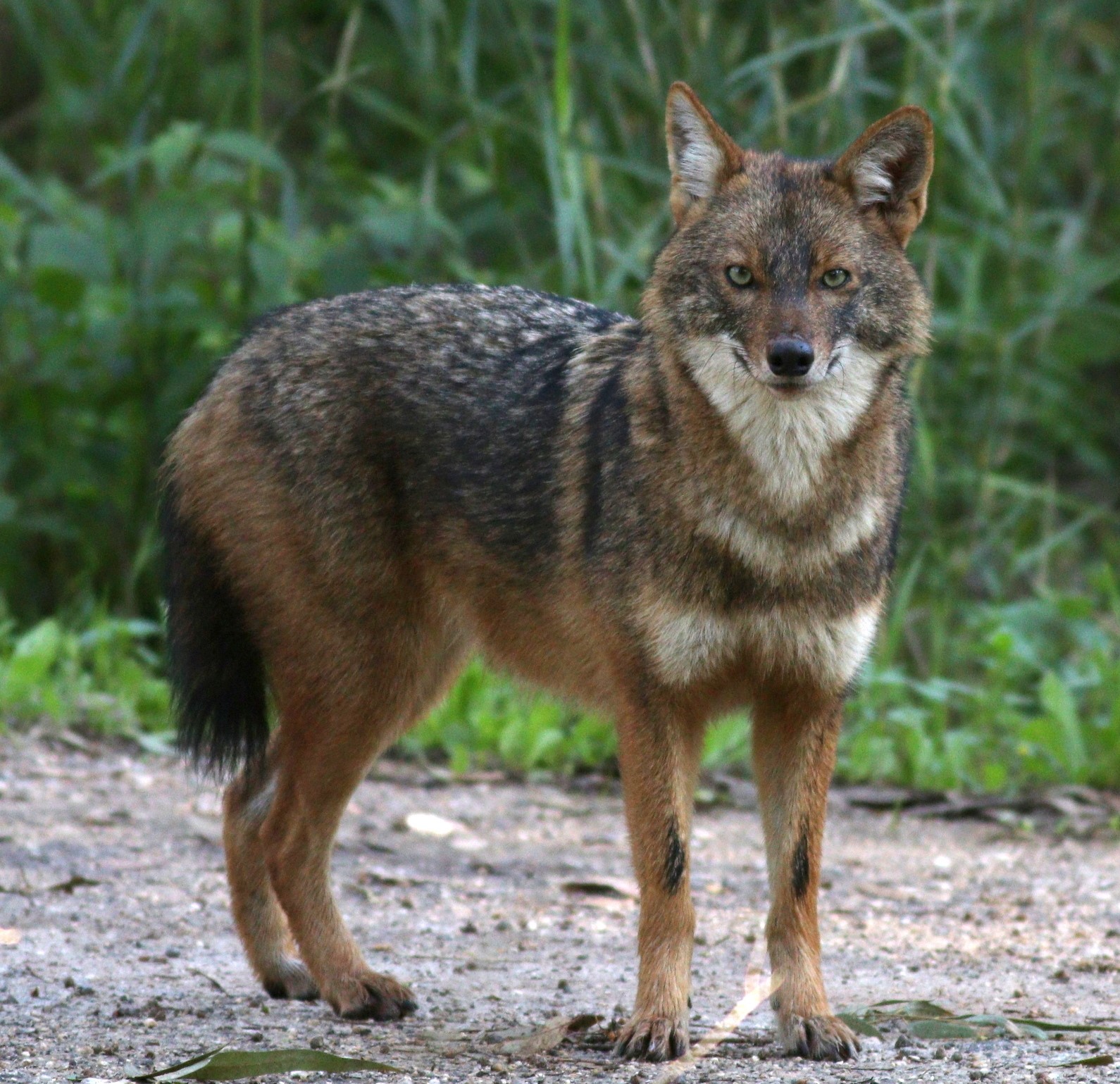
The golden jackal (Canis aureus), also called the common jackal, is a wolf-like canid that is native to Eurasia. The golden jackal's coat varies in color from a pale creamy yellow in summer to a dark tawny beige in winter. It is smaller and has shorter legs, a shorter tail, a more elongated torso, a less-prominent forehead, and a narrower and more pointed muzzle than the Arabian wolf. It is listed as Least Concern on the IUCN Red List due to its widespread distribution and high density in areas with plenty of available food and optimum shelter.
Despite its name, the golden jackal is not closely related to the African black-backed jackal or the side-striped jackal, which are part of the genus Lupulella. It is instead closer to wolves and coyotes. The ancestor of the golden jackal is believed to be the extinct Arno river dog that lived in southern Europe 1.9 million years ago. It is described as having been a small, jackal-like canine. Genetic studies indicate that the golden jackal expanded from India around 20,000 years ago, towards the end of the last Last Glacial Maximum. The oldest golden jackal fossil, found at the Ksar Akil rock shelter near Beirut, Lebanon, is 7,600 years old. The oldest golden jackal fossils in Europe were found in Greece and are 7,000 years old. There are six subspecies of the golden jackal. It is capable of producing fertile hybrids with both the gray wolf and the African wolf. Jackal–dog hybrids called Sulimov dogs are in service at the Sheremetyevo Airport near Moscow, where they are deployed by the Russian airline Aeroflot for scent-detection.
The golden jackal is abundant in valleys and beside rivers and their tributaries, canals, lakes, and seashores; however, the species is rare in foothills and low mountains. It is a social species, the basic social unit of which consists of a breeding pair and any young offspring. It is very adaptable, with the ability to exploit food ranging from fruit and insects to small ungulates. It attacks domestic fowl and domestic mammals up to the size of domestic water buffalo calves. Its competitors are the red fox, steppe wolf, jungle cat, Caucasian wildcat, the raccoon in the Caucasus and in Central Asia, and the Asiatic wildcat. It is expanding beyond its native grounds in from Southeast Europe into Central Europe as far as France, and Northeast Europe into areas where there are few or no wolves.
The word 'jackal' appeared in the English language around 1600. It derives from the Turkish word çakal, which originates from the Persian word šagāl. The golden jackal is also known as the common jackal.
The biological family Canidae is composed of the South American canids, the fox-like canids, and the wolf-like canids. All species within the wolf-like canids share a similar morphology and possess 78 chromosomes, allowing them potentially to interbreed. Within the wolf-like canids is the jackal group, which includes the three jackals: the black-backed jackal (Lupulella mesomela), the side-striped jackal (Lupulella adusta), and the golden jackal (Canis aureus). These three species are approximately the same size, possess similar dental and skeletal morphology, and are identified from each other primarily by their coat color. They were once thought to have different distributions across Africa with their ranges overlapping in East Africa (Ethiopia, Kenya, and Tanzania). Although the jackal group has traditionally been considered as homogenous, genetic studies show that jackals are not monophyletic (they do not share a common ancestor), and they are only distantly related. The accuracy of the colloquial name "jackal" to describe all jackals is therefore questionable.
Mitochondrial DNA (mDNA) passes along the maternal line and can date back thousands of years. Thus, phylogenetic analysis of mDNA sequences within a species provides a history of maternal lineages that can be represented as a phylogenetic tree. A 2005 genetic study of the canids found that the gray wolf and dog are the most closely related on this tree. The next most closely related are the coyote (Canis latrans), golden jackal, and Ethiopian wolf (Canis simensis), which have all been shown to hybridize with the dog in the wild. The next closest are the dhole (Cuon alpinus) and African wild dog (Lycaon pictus), which are not members of genus Canis. These are followed by the black-backed and side-striped jackals, members of the genus Lupulella and the most basal members of this clade.
Results from two recent studies of mDNA from golden jackals indicate that the specimens from Africa are genetically closer to the gray wolf than are the specimens from Eurasia. In 2015 a major DNA study of golden jackals concluded that the six C. aureus subspecies found in Africa should be reclassified under the new species C. anthus (African wolf), reducing the number of golden jackal subspecies to seven. The phylogenetic tree generated from this study shows the golden jackal diverging from the wolf/coyote lineage 1.9 million years ago and the African wolf diverging 1.3 million years ago. The study found that the golden jackal and the African wolf shared a very similar skull and body morphology and that this had confused taxonomists into regarding these as one species. The study proposes that the very similar skull and body morphology is due to both species having originated from a larger common ancestor.
The Arno river dog (Canis arnensis) is an extinct species of canine that was endemic to Mediterranean Europe during the Early Pleistocene around 1.9 million years ago. It is described as a small jackal-like dog and probably the ancestor of modern jackals. Its anatomy and morphology relate it more to the modern golden jackal than to the two African jackal species, the black-backed jackal and the side-striped jackal.
Hub AI
Golden jackal AI simulator
(@Golden jackal_simulator)
Golden jackal
The golden jackal (Canis aureus), also called the common jackal, is a wolf-like canid that is native to Eurasia. The golden jackal's coat varies in color from a pale creamy yellow in summer to a dark tawny beige in winter. It is smaller and has shorter legs, a shorter tail, a more elongated torso, a less-prominent forehead, and a narrower and more pointed muzzle than the Arabian wolf. It is listed as Least Concern on the IUCN Red List due to its widespread distribution and high density in areas with plenty of available food and optimum shelter.
Despite its name, the golden jackal is not closely related to the African black-backed jackal or the side-striped jackal, which are part of the genus Lupulella. It is instead closer to wolves and coyotes. The ancestor of the golden jackal is believed to be the extinct Arno river dog that lived in southern Europe 1.9 million years ago. It is described as having been a small, jackal-like canine. Genetic studies indicate that the golden jackal expanded from India around 20,000 years ago, towards the end of the last Last Glacial Maximum. The oldest golden jackal fossil, found at the Ksar Akil rock shelter near Beirut, Lebanon, is 7,600 years old. The oldest golden jackal fossils in Europe were found in Greece and are 7,000 years old. There are six subspecies of the golden jackal. It is capable of producing fertile hybrids with both the gray wolf and the African wolf. Jackal–dog hybrids called Sulimov dogs are in service at the Sheremetyevo Airport near Moscow, where they are deployed by the Russian airline Aeroflot for scent-detection.
The golden jackal is abundant in valleys and beside rivers and their tributaries, canals, lakes, and seashores; however, the species is rare in foothills and low mountains. It is a social species, the basic social unit of which consists of a breeding pair and any young offspring. It is very adaptable, with the ability to exploit food ranging from fruit and insects to small ungulates. It attacks domestic fowl and domestic mammals up to the size of domestic water buffalo calves. Its competitors are the red fox, steppe wolf, jungle cat, Caucasian wildcat, the raccoon in the Caucasus and in Central Asia, and the Asiatic wildcat. It is expanding beyond its native grounds in from Southeast Europe into Central Europe as far as France, and Northeast Europe into areas where there are few or no wolves.
The word 'jackal' appeared in the English language around 1600. It derives from the Turkish word çakal, which originates from the Persian word šagāl. The golden jackal is also known as the common jackal.
The biological family Canidae is composed of the South American canids, the fox-like canids, and the wolf-like canids. All species within the wolf-like canids share a similar morphology and possess 78 chromosomes, allowing them potentially to interbreed. Within the wolf-like canids is the jackal group, which includes the three jackals: the black-backed jackal (Lupulella mesomela), the side-striped jackal (Lupulella adusta), and the golden jackal (Canis aureus). These three species are approximately the same size, possess similar dental and skeletal morphology, and are identified from each other primarily by their coat color. They were once thought to have different distributions across Africa with their ranges overlapping in East Africa (Ethiopia, Kenya, and Tanzania). Although the jackal group has traditionally been considered as homogenous, genetic studies show that jackals are not monophyletic (they do not share a common ancestor), and they are only distantly related. The accuracy of the colloquial name "jackal" to describe all jackals is therefore questionable.
Mitochondrial DNA (mDNA) passes along the maternal line and can date back thousands of years. Thus, phylogenetic analysis of mDNA sequences within a species provides a history of maternal lineages that can be represented as a phylogenetic tree. A 2005 genetic study of the canids found that the gray wolf and dog are the most closely related on this tree. The next most closely related are the coyote (Canis latrans), golden jackal, and Ethiopian wolf (Canis simensis), which have all been shown to hybridize with the dog in the wild. The next closest are the dhole (Cuon alpinus) and African wild dog (Lycaon pictus), which are not members of genus Canis. These are followed by the black-backed and side-striped jackals, members of the genus Lupulella and the most basal members of this clade.
Results from two recent studies of mDNA from golden jackals indicate that the specimens from Africa are genetically closer to the gray wolf than are the specimens from Eurasia. In 2015 a major DNA study of golden jackals concluded that the six C. aureus subspecies found in Africa should be reclassified under the new species C. anthus (African wolf), reducing the number of golden jackal subspecies to seven. The phylogenetic tree generated from this study shows the golden jackal diverging from the wolf/coyote lineage 1.9 million years ago and the African wolf diverging 1.3 million years ago. The study found that the golden jackal and the African wolf shared a very similar skull and body morphology and that this had confused taxonomists into regarding these as one species. The study proposes that the very similar skull and body morphology is due to both species having originated from a larger common ancestor.
The Arno river dog (Canis arnensis) is an extinct species of canine that was endemic to Mediterranean Europe during the Early Pleistocene around 1.9 million years ago. It is described as a small jackal-like dog and probably the ancestor of modern jackals. Its anatomy and morphology relate it more to the modern golden jackal than to the two African jackal species, the black-backed jackal and the side-striped jackal.
Recent media