
Recent from talks
Cape Barren goose
Knowledge base stats:
Talk channels stats:
Members stats:
Cape Barren goose
The Cape Barren goose (Cereopsis novaehollandiae), sometimes also known as the pig goose, is a species of goose endemic from southern Australia. It is a distinctive large, grey bird that is mostly terrestrial and is not closely related to other extant members of the subfamily Anserinae.
The indigenous Jardwadjali people of western Victoria refer to this species as toolka. The Noongar / Nyungar people of south-western Western Australia use the name bibib.
The Cape Barren goose was first formally described by English ornithologist John Latham in 1801 as Cereopsis N. Hollandiae. The species had been earlier reported from the Bass Strait by George Bass and Matthew Flinders in 1798, who referred to it as a "Brent or Barnacle Goose".
The taxonomic placement of this species is not yet fully resolved. It is now generally recognised as being a member of the subfamily Anserinae, however, it has also been associated with Tadorninae. When placed within Anserinae it may be considered a member of the tribe Anserini (alongside Anser and Branta) or placed in its own tribe, Cereopsini.
Two subspecies of Cape Barren goose are currently recognised:
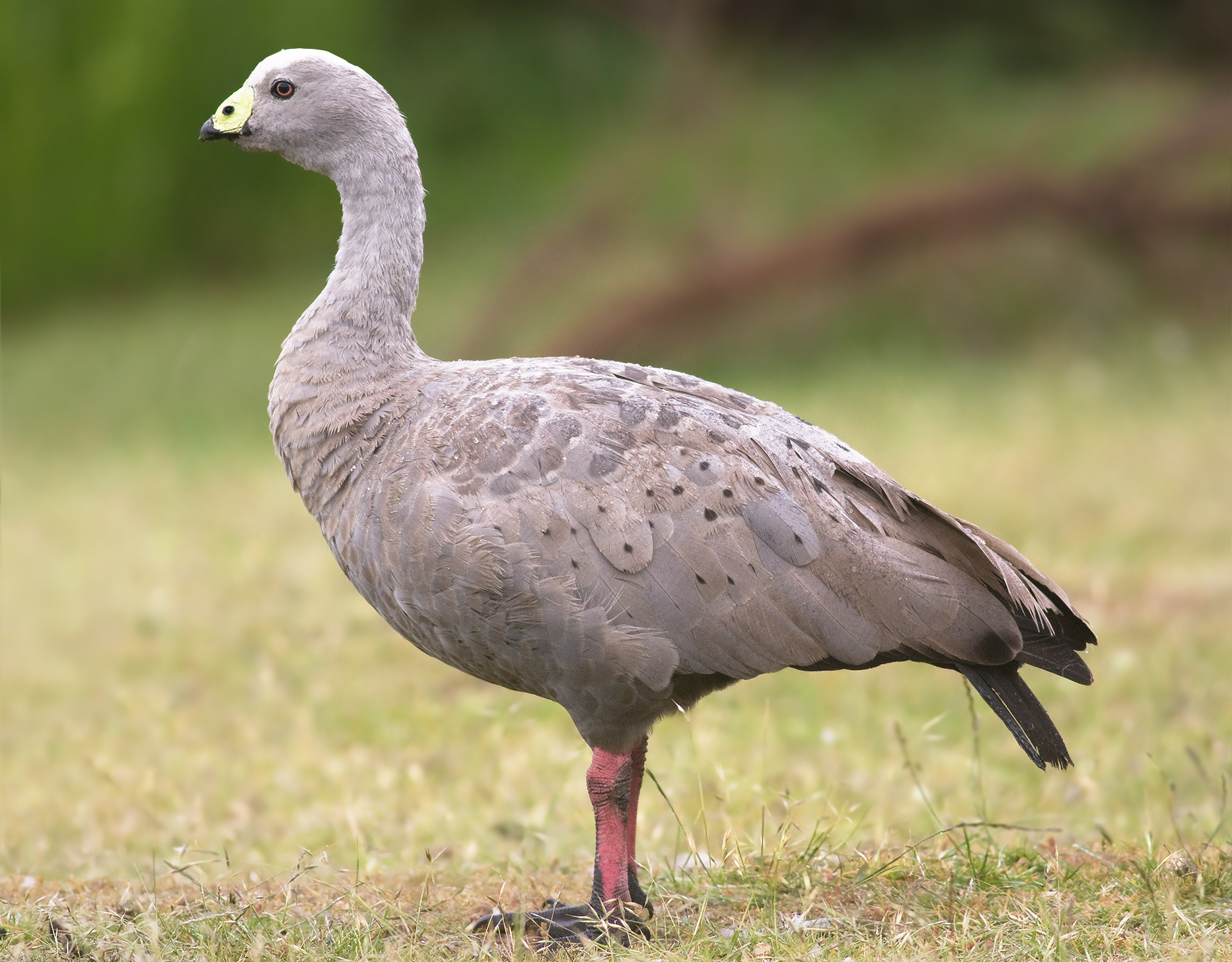
Adult Cape Barren geese are large birds, typically measuring 75–100 cm (30–39 in) long and weighing between 3.7–5.2 kg (8.2–11.5 lb), with males generally being larger than females. The plumage is mostly pale grey with a slight brown tint. The head is somewhat small in proportion to the body and mostly grey in colour, save for a pale whitish patch on the forehead and crown. The bill is short, measuring 56–63 mm (2.2–2.5 in) in length, triangular in shape and black in colour with a prominent pale yellow-green cere covering more than half the length of the bill. Feathers on the breast and back have pale margins, while the upperwing coverts and scapular feathers each have a brownish grey spot near the tip. The flight feathers are grey with black tips, with the black extending to cover the distal half of the outer primaries, giving the appearance of a dark trailing edge to the wings when in flight. The tail feathers are black, and the legs are pink with black feet.
Newly-hatched goslings are white with broad, dark stripes and a dark cere. Older juveniles are a paler grey with heavier spotting on the wings and scapular feathers than adults. The cere turns a light yellow-green colour at around 70 days old, with juveniles molting into adult plumage at around 6 months old.
Cape Barren geese are largely terrestrial, only occasionally swimming. They predominantly graze on grasses, sedges, legumes, herbs, and succulents. Their diet may include plants such as Poa poiformis, Disphyma australe, Myoporum insulare, and species of Trifolium and Juncus.
Hub AI
Cape Barren goose AI simulator
(@Cape Barren goose_simulator)
Cape Barren goose
The Cape Barren goose (Cereopsis novaehollandiae), sometimes also known as the pig goose, is a species of goose endemic from southern Australia. It is a distinctive large, grey bird that is mostly terrestrial and is not closely related to other extant members of the subfamily Anserinae.
The indigenous Jardwadjali people of western Victoria refer to this species as toolka. The Noongar / Nyungar people of south-western Western Australia use the name bibib.
The Cape Barren goose was first formally described by English ornithologist John Latham in 1801 as Cereopsis N. Hollandiae. The species had been earlier reported from the Bass Strait by George Bass and Matthew Flinders in 1798, who referred to it as a "Brent or Barnacle Goose".
The taxonomic placement of this species is not yet fully resolved. It is now generally recognised as being a member of the subfamily Anserinae, however, it has also been associated with Tadorninae. When placed within Anserinae it may be considered a member of the tribe Anserini (alongside Anser and Branta) or placed in its own tribe, Cereopsini.
Two subspecies of Cape Barren goose are currently recognised:
Adult Cape Barren geese are large birds, typically measuring 75–100 cm (30–39 in) long and weighing between 3.7–5.2 kg (8.2–11.5 lb), with males generally being larger than females. The plumage is mostly pale grey with a slight brown tint. The head is somewhat small in proportion to the body and mostly grey in colour, save for a pale whitish patch on the forehead and crown. The bill is short, measuring 56–63 mm (2.2–2.5 in) in length, triangular in shape and black in colour with a prominent pale yellow-green cere covering more than half the length of the bill. Feathers on the breast and back have pale margins, while the upperwing coverts and scapular feathers each have a brownish grey spot near the tip. The flight feathers are grey with black tips, with the black extending to cover the distal half of the outer primaries, giving the appearance of a dark trailing edge to the wings when in flight. The tail feathers are black, and the legs are pink with black feet.
Newly-hatched goslings are white with broad, dark stripes and a dark cere. Older juveniles are a paler grey with heavier spotting on the wings and scapular feathers than adults. The cere turns a light yellow-green colour at around 70 days old, with juveniles molting into adult plumage at around 6 months old.
Cape Barren geese are largely terrestrial, only occasionally swimming. They predominantly graze on grasses, sedges, legumes, herbs, and succulents. Their diet may include plants such as Poa poiformis, Disphyma australe, Myoporum insulare, and species of Trifolium and Juncus.
Recent media