Hubbry Logo
CapesizeCapesizeMain
Open search
Capesize
Community hub
Capesize
logo
8 pages, 0 posts
0 subscribers
Be the first to start a discussion here.
Capesize
Capesize
from Wikipedia
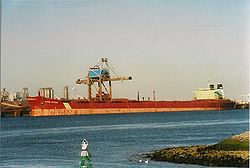
MV Berge Athene, a capesize bulk carrier of 225,200 DWT, built in 1979

Capesize ships are the largest dry cargo ships with ball mark dimension:[i] about 170,000 DWT (deadweight tonnage) capacity, 290 m (950 ft) long, 45 m (148 ft) beam (wide), 18 m (59 ft) draught (under water depth).[1] They are too large to transit the Suez Canal (Suezmax limits) or Panama Canal (Neopanamax limits),[2] and so have to pass either Cape Agulhas or Cape Horn to traverse between oceans.

When the Suez Canal was deepened in 2009, it became possible for some capesize ships to transit the canal and so change categories.

Routes

[edit]

Major capesize bulk trade routes include: Brazil to China, Australia to China, South Africa to China and South Africa to Europe.[3]

Classification

[edit]
After deepening of the Suez Canal, a formerly capesize bulk carrier approaches the Suez Canal Bridge.
Capesize bulk carrier Cape Elise of 174,124 DWT at Inchgreen quay, Greenock, Scotland, for repairs in March 2014 after being struck by a massive wave. At 289 metres long, it was the largest ship to dock at Greenock in 20 years.[4]

Ships in this class are bulk carriers, usually transporting coal, ore and other commodity raw materials. The term capesize is not applied to tankers. The average size of a capesize bulker is around 156,000 DWT, although larger ships (normally dedicated to ore transportation) have been built, up to 400,000 DWT.[5] The large dimensions and deep drafts of such vessels mean that only the largest deep-water terminals can accommodate them.[6]

Subcategories of capesize vessels include very large ore carriers (VLOC) and very large bulk carriers (VLBC) of above 200,000 DWT. These vessels are mainly designed to carry iron ore.

See also

[edit]

References

[edit]
[edit]
Revisions and contributorsEdit on WikipediaRead on Wikipedia
from Grokipedia
A Capesize is a category of very large dry bulk carrier ships, typically with a deadweight tonnage (DWT) ranging from 100,000 to over 200,000 tons, designed primarily for transporting massive quantities of unpackaged raw materials such as iron ore, coal, and bauxite across oceans. These vessels, often measuring 230 to 290 meters in length and up to 18 meters in draft, are too large to pass through the Panama Canal and typically the Suez Canal, necessitating routes around the Cape of Good Hope or Cape Horn—thus earning their name "Capesize." Capesize ships represent the largest segment of the dry bulk carrier fleet and play a critical role in global commodity trade, particularly on high-volume routes like those connecting Australia and Brazil to China for iron ore exports. Their design emphasizes efficiency in loading and unloading bulk cargoes via specialized ports with deep drafts and gearless operations, often relying on conveyor systems and grabs. Evolving from 19th-century bulk carrier innovations, the Capesize category solidified in the late 20th century as trade in heavy raw materials surged, driven by industrial demand in Asia. In the maritime market, Capesize vessels dominate the transport of iron ore and coal, accounting for a significant portion of the dry bulk sector's capacity, with the global fleet consisting of approximately 1,900 units as of 2025. Their operations are highly sensitive to commodity prices, freight rates, and geopolitical factors, such as trade tensions or canal expansions, influencing vessel utilization and newbuild orders.

Definition and Overview

Definition

Capesize refers to a category of very large dry bulk carriers with a deadweight tonnage (DWT) exceeding 80,000 tonnes, typically ranging from 120,000 to 200,000 DWT, though specialized variants like the Valemax class can reach up to 400,000 DWT. The term "Capesize" originates from the ships' inability to transit the Panama Canal due to their dimensions, necessitating longer routes around the Cape of Good Hope or Cape Horn. These vessels are distinguished from smaller classes such as Panamax (under 80,000 DWT) and Handymax (35,000–50,000 DWT), which can navigate the Panama Canal and are suited for more versatile port access. Capesize ships primarily transport major dry bulk commodities, including iron ore, coal, and grains.

Key Characteristics

Capesize ships are defined by their substantial physical dimensions, which enable them to carry large volumes of dry bulk cargoes while navigating major global ports unsuitable for smaller vessels. Typical lengths range from 225 to 365 meters, allowing for variations from standard Capesize to larger subtypes like Valemax. Beams measure 32 to 65 meters, providing the necessary stability for heavy loads, and drafts vary between 14.5 and 22 meters, optimizing access to deep-water terminals such as those in Brazil and Australia. These vessels are propelled by low-speed, two-stroke diesel engines, which deliver reliable power for long-haul voyages. Engine outputs typically fall between 20,000 and 40,000 kW, enabling service speeds of 13 to 15 knots under laden conditions. This configuration balances fuel efficiency with the demands of transporting dense cargoes over extended distances, often incorporating modern features like exhaust gas recirculation for emissions compliance. Cargo hold configurations are optimized for the efficient loading and discharge of unpackaged bulk materials, featuring 5 to 9 box-shaped holds that minimize residue and facilitate self-trimming. These holds are designed with large hatch openings and double-skin structures to enhance structural integrity and cargo segregation. A representative Capesize can accommodate 150,000 to 180,000 tonnes of iron ore, underscoring their role in high-volume trades like mineral exports. Operations require a compact but skilled crew, typically numbering 20 to 30 personnel, supported by advanced automation systems for navigation, engine monitoring, and cargo management. This reduced manning reflects industry standards for safety and efficiency on extended voyages, with roles divided among deck officers, engineers, and support staff.

History

Origins

The emergence of Capesize ships in the 1950s and 1960s was primarily driven by the post-World War II surge in global demand for iron ore to fuel expanding steel industries in Japan and Europe. Australia's iron ore exports, previously restricted by a government ban since 1938, were partially lifted in November 1960, with the first export license granted in December 1960 for 500 tons; major exports from the Pilbara region began in 1966, marking the start of large-scale bulk trade. Similarly, Brazil's Companhia Vale do Rio Doce (CVRD) signed a landmark 1962 agreement with Japanese steel producers to supply 50 million tons of iron ore over 15 years, accelerating exports from ports like Tubarão to Asian and European markets. These developments necessitated larger vessels capable of efficiently transporting high-density cargoes over long distances, as technological advances in mining and rail infrastructure made such volumes economically viable. The first Capesize vessels appeared around 1960, evolving from wartime Liberty ships that were converted post-war into early bulk carriers to handle growing commodity trades. These prototypes exceeded 100,000 deadweight tons (DWT), with initial designs around 110,000 DWT, featuring strengthened hulls and larger holds optimized for iron ore. This size increase was a direct response to the limitations imposed by the Suez and Panama Canals, whose dimensions—established in the early 20th century but rigidly enforced in the 1950s—restricted vessels to smaller capacities, such as Panamax's maximum of about 80,000 DWT and early Suezmax around 30,000–50,000 DWT. As a result, Capesize ships, too large to transit these canals when fully loaded, were forced to navigate around the Cape of Good Hope or Cape Horn, giving the class its name. Japanese shipyards played a pivotal role as early builders, leveraging their post-war industrial recovery to construct prototypes like 100,000 DWT ore carriers for domestic steelmakers and export trades. Companies affiliated with Mitsubishi Heavy Industries, such as Chiyoda Ore Transport (founded in 1959 as a joint venture), delivered their first dedicated ore carrier, the Santa Lucia Maru, in July 1960, exemplifying the shift toward specialized large-scale bulkers. These vessels were tailored for the Japan-Australia and Japan-Brazil routes, supporting the rapid growth in iron ore imports that underpinned Japan's "economic miracle" and Europe's reconstruction.

Evolution

The 1970s oil crises, particularly the 1973 embargo and subsequent 1979 events, prompted a shift toward larger bulk carriers to achieve economies of scale amid rising fuel costs and economic pressures, as operators sought to lower per-tonne transportation expenses through increased cargo capacity. This drive resulted in significant fleet expansion for Capesize vessels, with the segment's total deadweight tonnage growing from approximately 1.29 million DWT in 1970 (comprising about 12 ships) to 18.3 million DWT by 1980, reflecting average sizes reaching around 150,000 DWT as designs prioritized efficiency for iron ore and coal trades. The 1990s and 2000s saw a surge in Capesize development fueled by booming Chinese steel production, which drove unprecedented demand for iron ore imports and necessitated larger vessels to optimize long-haul routes from Australia and Brazil. This period introduced specialized subclasses, including the Newcastlemax (170,000–210,000 DWT), originating in the late 2000s to maximize loading at Australian ports like Newcastle while fitting Panama Canal dimensions, enhancing efficiency for coal and ore exports. Similarly, the Chinamax subclass (300,000–400,000 DWT) emerged in response to Chinese port infrastructure, with the first purpose-built vessels delivered in 2011 by Vale do Rio Doce for direct Brazil-to-China iron ore voyages, though conceptual designs date to the mid-2000s amid the steel demand peak. Post-2010 adaptations in Capesize designs were influenced by International Maritime Organization (IMO) regulations from the late 1990s, mandating double-side skin construction for new bulk carriers over 150 meters in length carrying dense cargoes (effective for ships built after 1 July 1999 under SOLAS amendments), which required wider beams (minimum 2 meters for side spaces) and deeper drafts to maintain stability and cargo volume. These changes, implemented progressively into the 2010s, increased overall vessel dimensions—beams expanding by up to 4 meters and drafts by 1–2 meters in some designs—to comply with safety standards while accommodating larger payloads, though they raised construction costs by 10–15%. The 2008 global financial crisis severely curtailed Capesize orders, with newbuilding contracts dropping over 70% from 2008 peaks as iron ore demand contracted and freight rates collapsed, leading to widespread vessel lay-ups and delayed fleet renewal. Recovery began in the early 2010s, supported by rebounding Chinese imports and low interest rates, resulting in robust ordering activity and fleet expansion to over 1,000 Capesize ships by 2020 (from approximately 900 in 2010), more than doubling the segment's capacity to around 170 million DWT amid sustained trade growth. By 2024, the fleet had surpassed 2,000 ships with a capacity of approximately 397 million DWT. Since 2020, the Capesize segment has continued to expand, driven by ongoing demand for iron ore and coal from Asia, alongside adaptations to environmental regulations such as the IMO 2020 low-sulfur fuel standards, which prompted retrofits and newbuilds with scrubbers or alternative fuels. As of 2025, fleet growth remains steady, with emphasis on efficiency and sustainability in response to global decarbonization efforts.

Design and Specifications

Size Classifications

Capesize vessels are primarily classified by their deadweight tonnage (DWT), which measures the maximum load of cargo, fuel, passengers, and crew they can carry, typically ranging from 80,000 to 200,000 DWT. This places them in the largest category of dry bulk carriers, distinguishing them from smaller classes such as Handymax vessels, which generally fall between 40,000 and 60,000 DWT and are suited for more versatile port access. The DWT threshold for Capesize reflects their design for transporting massive quantities of bulk commodities like iron ore and coal over long distances, often exceeding the capabilities of mid-sized carriers. A key defining feature of Capesize classification is their physical dimensions, particularly beam (width) and draft (depth below waterline), which prevent transit through the original Panama Canal locks. These locks accommodate a maximum beam of 32.3 meters and draft of 12 meters, whereas typical Capesize ships have beams around 45 meters and drafts of 17 to 18 meters, necessitating routes around the Cape of Good Hope or Cape Horn. Even with the expanded Neo-Panamax locks allowing up to 49 meters beam and 15 meters draft, most Capesize vessels exceed these limits due to their deeper drafts and overall scale, reinforcing their "Capesize" designation. Classification societies play a crucial role in verifying and certifying Capesize ships' compliance with international standards for structural integrity, stability, and safety. Organizations such as Lloyd's Register and the American Bureau of Shipping (ABS) conduct surveys, issue class notations (e.g., for hull strength and load line assignments), and ensure adherence to regulations like those from the International Maritime Organization (IMO). These notations confirm the vessel's suitability for heavy bulk loads and extreme sea conditions, with ongoing inspections throughout the ship's lifecycle to maintain classification status. Within the broader Capesize category, specialized subclasses exist for optimized operations at specific ports, such as Valemax vessels developed for Brazilian iron ore exports. These very large ore carriers boast up to 400,000 DWT, with beams of 65 meters and lengths around 360 meters, tailored for deep-water terminals like those at Ponta da Madeira in Brazil. Designed by Vale S.A. in collaboration with shipbuilders, Valemax ships maximize efficiency for direct transatlantic voyages to Asia while requiring custom infrastructure that standard Capesize ports cannot accommodate.

Structural Features

Capesize bulk carriers incorporate a double-bottom hull structure, which provides additional space for ballast water and fuel while enhancing structural integrity and safety by separating the cargo holds from the outer hull plating. This design is complemented by double-sided skin in the cargo region for many modern vessels, reducing the risk of pollution from side shell damage and improving overall transverse strength. The hull is primarily constructed from high-tensile shipbuilding steels, such as EH36 grade, offering a minimum tensile strength of 490 MPa to withstand the high bending moments and shear forces encountered during heavy bulk cargo transport. The deck arrangement features a single main deck with large hatch openings covered by robust steel panels, facilitating efficient loading and unloading of bulk commodities like iron ore and coal. Cargo holds are configured with hopper side tanks and sloping floors at angles designed to match the cargo's angle of repose, preventing shifting during voyages and aiding self-trimming. Optional self-unloading gear, including conveyor systems, can be integrated for specialized operations, allowing discharge rates up to several thousand tonnes per hour without reliance on shore equipment. Topside tanks along the deck edges further support structural rigidity and provide additional ballast capacity. Stability is ensured through precise calculations maintaining a metacentric height (GM) typically between 1 and 2 meters, which balances roll response and prevents excessive motion in heavy seas. Ballast water systems, utilizing the double-bottom and side tanks, offer capacities up to 100,000 tonnes to control trim, draft, and immersion of the propeller across varying load conditions, with dedicated holds sometimes used as ballast tanks in heavy loading scenarios. For navigation, Capesize vessels are equipped with integrated bridge systems that consolidate radar, ECDIS, and communication functions for safe deep-sea operations, while some receive ice-class notations (e.g., Ice Class 1C) for routes involving light ice, enhancing hull reinforcement against ice impacts.

Operations and Routes

Typical Routes

Capesize vessels, due to their large dimensions exceeding the capacity of the Panama and Suez canals, are primarily deployed on oceanic routes that circumnavigate the continents, such as passing the Cape of Good Hope or Cape Horn. The dominant iron ore trade route involves shipments from the Pilbara region in Western Australia, loaded at deep-water terminals like Port Hedland, to major Chinese ports including Qingdao in North China, covering approximately 3,541 nautical miles with a typical voyage duration of around 10 days at service speeds of 14-16 knots. Another critical long-haul iron ore route runs from Tubarão in Brazil to ports like Rizhao in China, spanning about 11,200 nautical miles and requiring roughly 33 days under normal conditions. These routes account for the majority of Capesize ton-miles, driven by China's demand for high-grade iron ore. Coal transportation also features prominently, with Capesize ships carrying thermal and coking coal from Newcastle in Australia to destinations in Taiwan and Japan, a relatively shorter intra-Asia route optimized for regional energy needs. From Richards Bay in South Africa, the world's largest coal export terminal, Capesize vessels deliver to markets in India and Europe, with the India leg traversing the Indian Ocean and the European route often rounding the Cape of Good Hope. Seasonal factors influence route , particularly in the winter when vessels avoid the treacherous waters around to mitigate storm risks on trans-Pacific legs, opting instead for safer northern passages where feasible. As of November 2025, ongoing Red Sea security disruptions from Houthi attacks since late 2023 have significantly increased reliance on routes for Europe-bound cargoes, including from , adding 10-20% to voyage distances and costs for affected trades. Port infrastructure plays a key role in these operations, with facilities like Port Hedland featuring deep-water berths supporting drafts of 16 meters or more to accommodate fully laden Capesize vessels up to 180,000 DWT. Voyage optimizations, including speed adjustments and route fine-tuning, are employed to enhance fuel efficiency on these extended hauls, reducing operational costs amid fluctuating bunker prices.

Cargo Handling

Capesize vessels, designed for transporting large volumes of dry bulk cargoes such as iron ore and coal, rely on specialized equipment and procedures at dedicated terminals to ensure efficient loading and unloading. Loading operations typically employ fixed shiploaders equipped with conveyor belts, which transfer cargo from stockyards to the ship's holds at high rates to minimize berth occupancy. These systems can achieve peak capacities of 16,000 to 18,000 tonnes per hour for iron ore, allowing a full load of up to 180,000 tonnes to be completed in under 24 hours at major export terminals. In some ports, grabs attached to cranes supplement or replace conveyors for iron ore loading, particularly for finer or dust-prone variants, enabling precise placement into the open holds. Unloading at import terminals utilizes harbor cranes with large-capacity grabs or continuous unloaders, such as screw or bucket chain types, to extract cargo from the deep holds. Grab unloaders, common for iron ore, operate at rates of 3,000 to 5,000 tonnes per hour per machine, while advanced continuous unloaders can reach up to 16,000 tonnes per hour for coal and similar free-flowing bulks, often with multiple units working simultaneously on a single vessel. To mitigate dust generation during these processes, especially with iron ore, terminals incorporate suppression systems like water mist sprays and enclosed chutes, ensuring compliance with environmental standards and reducing cargo loss. The stowage of cargoes in Capesize holds accounts for their specific densities to optimize stability and capacity. Iron ore, with a stowage factor of 0.4 to 0.5 m³ per tonne, fills the voluminous holds densely, requiring careful trimming to level the cargo surface and prevent shifts during transit. Coal, exhibiting a stowage factor of 0.8 to 1.0 m³ per tonne depending on type, allows for slightly more volume per tonne but similarly demands hold trimming for even weight distribution across the vessel's box-shaped compartments. These practices, leveraging the structural features of Capesize designs, maintain trim and stability throughout operations. Overall turnaround times at major ports, encompassing berthing, loading or unloading, and departure, typically range from 24 to 48 hours, heavily influenced by the vessel's draft restrictions and the terminal's infrastructure capacity. Efficient coordination between ship and shore equipment is critical to achieving these timelines, particularly for high-volume cargoes like iron ore at ports such as Port Hedland or Qingdao.

Economic Importance

Role in Global Trade

Capesize vessels are indispensable to the global movement of essential raw materials, dominating the seaborne iron ore trade that underpins the worldwide steel industry. These ships handle approximately 70% of all seaborne iron ore shipments, transporting approximately 1.7 billion metric tons annually in recent years, with 2025 expected to remain around 1.7 billion metric tons globally (based on year-to-date figures and projections). This dominance stems from their capacity to carry massive cargoes on long-haul routes from major exporters like Australia and Brazil to steel-producing hubs in Asia. In 2025, seaborne iron ore trade has remained flat compared to 2024, influenced by subdued demand in China amid economic slowdowns. In addition to iron ore, Capesize ships play a key role in the seaborne coal trade, particularly for thermal and coking coal on transoceanic voyages, and occasionally support grain shipments during peak harvest seasons. They represent a significant portion of the global dry bulk fleet capacity, facilitating the transport of these commodities to fuel industrial growth. Their contributions are especially vital for Asia's steel sector, where Capesize vessels carry the majority (around 70%) of seaborne iron ore imports to China, enabling the country to meet over 70% of its steel production needs through seaborne supplies. The Capesize fleet, numbering approximately 1,625 active vessels as of 2024 with a combined deadweight tonnage of 303 million metric tons, represents 10–15% of the world's merchant fleet by capacity. This scale underscores their economic significance, as disruptions in key export regions like Australia—responsible for over 50% of global seaborne iron ore—or Brazil can ripple through international supply chains. Events such as the 2021 Suez Canal blockage, while not directly affecting Capesize transits due to their size, exemplified broader vulnerabilities by delaying global shipping and exacerbating commodity flow imbalances.

Market Dynamics

The Capesize segment of the dry bulk shipping market is heavily influenced by the Baltic Dry Index (BDI), which incorporates a significant Capesize component weighted at 40% in its composite calculation, reflecting daily time charter rates and voyage assessments for major routes. Freight rates for Capesize vessels typically fluctuate between lows of around $10,000 per day during periods of weak demand and highs exceeding $100,000 per day during peaks, such as in 2021 when fronthaul rates approached $100,000 per day amid strong iron ore demand from China. These indices, published daily by the Baltic Exchange, serve as benchmarks for market participants to gauge overall dry bulk sentiment and negotiate contracts. Supply dynamics in the Capesize fleet are shaped by newbuilding orders, which averaged 50–100 vessels annually in recent years—for instance, 108 orders were placed in 2024—constrained by high construction costs and yard capacity limitations. Scrapping rates, influenced by a typical vessel lifespan of 25–30 years, have remained low, with only about 2–3% of the fleet recycled annually in recent cycles, contributing to a tight orderbook of under 8% of the existing fleet capacity. This balance helps stabilize supply but can amplify rate volatility when demand surges. Demand for Capesize tonnage is closely tied to global steel production, particularly in China, which accounts for over 70% of seaborne iron ore trade and drives the majority of Capesize utilization. Economic growth in China amplifies this effect; for example, a 1% increase in GDP has historically boosted Capesize demand by 2–3% through heightened steel output and raw material imports. This correlation underscores the sector's sensitivity to macroeconomic trends in key importing regions. Chartering in the Capesize market primarily occurs via time charters, typically lasting 1–3 years, where the charterer controls the vessel's commercial operations while the owner handles technical aspects, or voyage charters for single trips, which fix payment per tonne loaded. Brokers play a pivotal role through the Baltic Exchange, which provides standardized assessments and facilitates negotiations for these contracts, ensuring transparency in a market dominated by iron ore and coal trades.

Challenges and Future Developments

Environmental Impact

Capesize vessels, among the largest dry bulk carriers, have a notable environmental footprint due to their high fuel consumption and extensive operational ranges. A typical Capesize ship consumes around 50-70 tonnes of fuel per day when underway, resulting in annual CO2 emissions of approximately 50,000 to 100,000 tonnes per vessel, based on operational days and fuel type. These emissions arise primarily from heavy fuel oil combustion, with CO2 output calculated using an emission factor of about 3.2 tonnes of CO2 per tonne of fuel burned. The shipping industry's total CO2 emissions stood at about 858 million tonnes in 2022, underscoring their role in the sector's 2.9% share of anthropogenic greenhouse gases. Regulatory frameworks aim to curb these impacts through efficiency and pollution controls. The International Maritime Organization's (IMO) Energy Efficiency Design Index (EEDI), applicable to new Capesize builds, mandates a minimum 30% reduction in CO2 emissions per transport work by 2025 compared to 2008-2012 baselines, promoting designs with lower power demands and optimized hull forms. Complementing this, IMO's 2020 sulfur cap restricts fuel sulfur content to 0.5% to limit SOx emissions, prompting widespread adoption of exhaust gas cleaning systems (scrubbers) on Capesize fleets; these devices wash exhaust gases to remove over 99% of sulfur, allowing continued use of cheaper high-sulfur fuels while meeting limits that previously contributed to acid rain and respiratory issues. Ballast water discharge from Capesize ships poses risks of introducing invasive species, disrupting marine ecosystems. The IMO's Ballast Water Management Convention, adopted in 2004 and effective since 2017, requires compliance via the D-2 standard, achieved through approved treatment systems such as ultraviolet irradiation or electrolysis that kill or inactivate organisms before discharge. Over 90% of the global fleet, including Capesize vessels, must now install these systems during their first International Oil Pollution Prevention certificate renewal after September 8, 2024, to prevent biodiversity loss observed in past unmanaged discharges. Although Capesize carriers transport dry commodities, bunker fuel spills remain a concern during accidents. Structural designs mandated by IMO and classification societies incorporate double-skin sides and double bottoms, providing a protective layer that reduces spill potential from fuel tanks in collisions or groundings compared to single-hull predecessors. A notable example is the 2020 grounding of the Capesize bulk carrier MV Wakashio off Mauritius, where approximately 1,000 tonnes of very low sulfur fuel oil leaked, but the double-skin construction contained much of the remaining 3,000 tonnes onboard, mitigating a potentially larger disaster that affected sensitive coral ecosystems.

Technological Advancements

Since the early 2010s, but with notable trials accelerating from 2018 onward, liquefied natural gas (LNG) dual-fuel engines have been integrated into Capesize vessels to enhance fuel flexibility and reduce emissions. These engines allow ships to operate on either LNG or conventional heavy fuel oil, with LNG providing immediate greenhouse gas (GHG) benefits; for instance, LNG-fueled operations can achieve 25-30% lower CO2 emissions compared to heavy fuel oil on a well-to-wake basis. A prominent example is the 210,000 DWT Capesize bulker SG Twilight, delivered to NYK in February 2025 by Japan Marine United, which incorporates an LNG dual-fuel system utilizing boil-off gas to minimize waste and further slash emissions. This technology has been economically viable on key routes like Australia-China, with payback periods of 2-4 years due to fuel cost savings and regulatory compliance advantages. Looking ahead, pilots for zero-emission alternative fuels like ammonia and hydrogen are targeting deployment by 2030 to address the shipping sector's net-zero goals. Ammonia dual-fuel Capesize bulkers, capable of carrying iron ore and coal without GHG emissions when using green ammonia, are in advanced planning; Mitsui O.S.K. Lines (MOL) has ordered three such 210,000 DWT vessels for delivery by 2030, with bunkering infrastructure planned in Australia's Pilbara region. Earlier milestones include MOL and CMB.Tech's joint venture for ammonia-fueled Capesize bulk carriers, with initial deliveries slated from 2026, positioning these as scalable solutions for long-haul bulk trades. Hydrogen, often derived onboard from ammonia cracking, is being tested in complementary pilots, such as the Pherousa project involving Berge Bulk for zero-emission copper transport, though full-scale Capesize adoption remains contingent on supply chain maturation. Digitalization is transforming Capesize operations through AI-driven tools that optimize efficiency and maintenance. AI route optimization platforms analyze real-time weather, currents, and vessel performance to adjust speeds and paths, yielding 5-10% fuel savings per voyage; for bulk carriers on transoceanic routes, this equates to significant GHG reductions without compromising schedules. Complementing this, drone inspections enable non-intrusive maintenance assessments, particularly for hulls, cargo holds, and ballast tanks, reducing downtime and safety risks associated with confined spaces. In a case involving CSL's self-unloading bulk carrier (a Capesize equivalent), Lloyd's Register utilized drones for an intermediate survey in 2021, capturing high-resolution imagery while the vessel remained operational, thereby avoiding dry-docking costs and minimizing crew exposure to heights. Advancements in autonomous operations are progressing via remote monitoring systems, with full autonomy eyed for the 2040s under international frameworks. The International Maritime Organization (IMO) defines four degrees of ship autonomy, including remote control with seafarers on board (Degree 2) and full autonomy (Degree 4), supported by interim guidelines for trials since 2019. Current implementations feature shore-based control centers for real-time monitoring of Capesize fleets, enhancing situational awareness and fuel efficiency through automated collision avoidance and engine management. The IMO's MASS Code, set for mandatory entry into force in 2032, paves the way for broader adoption, with roadmaps like the EU's AUTOSHIP project projecting fully autonomous bulk operations from 2040 onward, driven by labor shortages and safety imperatives. Efforts to scale Capesize designs beyond traditional 180,000 DWT limits are exploring next-generation concepts up to 450,000 DWT for ultra-efficient bulk trades, though constrained by global port infrastructure. Valemax-class vessels, at 400,000 DWT, exemplify this trend, optimized for iron ore from Brazil to Asia with 2.3 times the capacity of standard Capesizes, but their beam and draft often exceed many terminal limits, restricting access—such as initial bans in Chinese ports until 2015 adaptations. These larger designs promise lower emissions per ton-mile but require dredging and quay expansions, highlighting infrastructure as the primary bottleneck for widespread deployment.

References

Add your contribution
Related Hubs
User Avatar
No comments yet.