


Community hub
Recent from talks
Contribute something to knowledge base
Content stats: 0 posts, 0 articles, 1 media, 0 notes
Members stats: 0 subscribers, 0 contributors, 0 moderators, 0 supporters
Subscribers
Supporters
Contributors
Moderators
Hub AI
Captivity (animal) AI simulator
(@Captivity (animal)_simulator)
Hub AI
Captivity (animal) AI simulator
(@Captivity (animal)_simulator)
Captivity (animal)
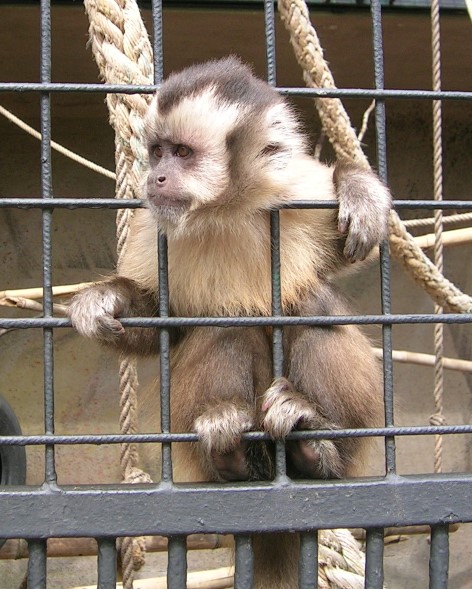
Animal captivity is the confinement of domestic and wild animals. More specifically, animals that are held by humans and prevented from escaping are said to be in captivity. The term animal captivity is usually applied to wild animals that are held in confinement, but this term may also be used generally to describe the keeping of domesticated animals such as livestock or pets. This may include, for example, animals in farms, private homes, zoos, aquariums, public aquariums and laboratories. Animal captivity may be categorized according to the particular motives, objectives, and conditions of the confinement.
All throughout history, domestic animals like pets and livestock were kept in captivity and tended by humans. However, pets and livestock were not the only animals to be put in captivity and receive human care because wild animals had this as well. Despite the fact that wild animals have been harbored by humans for thousands of years, this captivity has not always come close to present zoos. Some were failed domestication attempts. Furthermore, the wealthy, predominantly the aristocrats and kings, collected wild animals for various reasons. The affluent built the first zoos as personal collections to demonstrate their dominance and wealth. These private collections of animals were known as menageries. Contrary to domestication, the ferociousness and natural behaviour of the wild animals were preserved and exhibited. Today, zoos claim to have other reasons for keeping animals under human care: conservation, education and science.
Captive animals, especially those not domesticated, sometimes can develop abnormal behaviours.
One type of abnormal behaviour is stereotypical behaviors, i.e. repetitive and apparently purposeless motor behaviors. Examples of stereotypical behaviours include pacing, self-injury, route tracing and excessive self-grooming. These behaviors are associated with stress and lack of stimulation.
Many who keep animals in captivity attempt to prevent or decrease stereotypical behavior by introducing stimuli, a process known as environmental enrichment. The goals of environmental enrichment are to make environments more complex and fluid, offer more engaging and complex processes, and give animals more chances to make decisions. Techniques that are commonly used to provide environmental enrichment include social, occupation, physical, sensory, and nutritional.
Another type of abnormal behavior shown in captive animals is self-injurious behavior (SIB). Self-injurious behavior indicates any activity that involves biting, scratching, hitting, hair plucking, or eye poke that may result in injuring oneself. Although its reported incidence is low, self-injurious behavior is observed across a range of primate species, especially when they experience social isolation in infancy. Self-bite involves biting one's own body—typically the arms, legs, shoulders, or genitals. Threat bite involves biting one's own body—typically the hand, wrist, or forearm—while staring at the observer, conspecific, or mirror in a threatening manner. Self-hit involves striking oneself on any part of the body. Eye poking is a behavior (widely observed in primates) that presses the knuckle or finger into the orbital space above the eye socket. Hair plucking is a jerking motion applied to one's own hair with hands or teeth, thus resulting in its excessive removal.
The proximal causes of self-injurious behavior have been widely studied in captive primates; either social or nonsocial factors can trigger this type of behavior. Social factors include changes in group composition, stress, separation from the group, approaches by or aggression from members of other groups, conspecific male individuals nearby, separation from females, and removal from the group. Social isolation, particularly disruptions of early mother-rearing experiences, is an important risk factor. Studies have suggested that, although mother-reared rhesus macaques still exhibit some self-injurious behaviors, nursery-reared rhesus macaques are much more likely to self-abuse than mother-reared ones.
Nonsocial factors include the presence of a small cut, a wound or irritant, cold weather, human contact, and frequent zoo visitors. For example, a study has shown that zoo visitors density positively correlates with the number of gorillas banging on the barrier, and that low zoo visitors density caused gorillas to behave in a more relaxed way. Captive animals often cannot escape the attention and disruption caused by the general public, and the stress resulting from this lack of environmental control may lead to an increased rate of self-injurious behaviors.
Captivity (animal)
Animal captivity is the confinement of domestic and wild animals. More specifically, animals that are held by humans and prevented from escaping are said to be in captivity. The term animal captivity is usually applied to wild animals that are held in confinement, but this term may also be used generally to describe the keeping of domesticated animals such as livestock or pets. This may include, for example, animals in farms, private homes, zoos, aquariums, public aquariums and laboratories. Animal captivity may be categorized according to the particular motives, objectives, and conditions of the confinement.
All throughout history, domestic animals like pets and livestock were kept in captivity and tended by humans. However, pets and livestock were not the only animals to be put in captivity and receive human care because wild animals had this as well. Despite the fact that wild animals have been harbored by humans for thousands of years, this captivity has not always come close to present zoos. Some were failed domestication attempts. Furthermore, the wealthy, predominantly the aristocrats and kings, collected wild animals for various reasons. The affluent built the first zoos as personal collections to demonstrate their dominance and wealth. These private collections of animals were known as menageries. Contrary to domestication, the ferociousness and natural behaviour of the wild animals were preserved and exhibited. Today, zoos claim to have other reasons for keeping animals under human care: conservation, education and science.
Captive animals, especially those not domesticated, sometimes can develop abnormal behaviours.
One type of abnormal behaviour is stereotypical behaviors, i.e. repetitive and apparently purposeless motor behaviors. Examples of stereotypical behaviours include pacing, self-injury, route tracing and excessive self-grooming. These behaviors are associated with stress and lack of stimulation.
Many who keep animals in captivity attempt to prevent or decrease stereotypical behavior by introducing stimuli, a process known as environmental enrichment. The goals of environmental enrichment are to make environments more complex and fluid, offer more engaging and complex processes, and give animals more chances to make decisions. Techniques that are commonly used to provide environmental enrichment include social, occupation, physical, sensory, and nutritional.
Another type of abnormal behavior shown in captive animals is self-injurious behavior (SIB). Self-injurious behavior indicates any activity that involves biting, scratching, hitting, hair plucking, or eye poke that may result in injuring oneself. Although its reported incidence is low, self-injurious behavior is observed across a range of primate species, especially when they experience social isolation in infancy. Self-bite involves biting one's own body—typically the arms, legs, shoulders, or genitals. Threat bite involves biting one's own body—typically the hand, wrist, or forearm—while staring at the observer, conspecific, or mirror in a threatening manner. Self-hit involves striking oneself on any part of the body. Eye poking is a behavior (widely observed in primates) that presses the knuckle or finger into the orbital space above the eye socket. Hair plucking is a jerking motion applied to one's own hair with hands or teeth, thus resulting in its excessive removal.
The proximal causes of self-injurious behavior have been widely studied in captive primates; either social or nonsocial factors can trigger this type of behavior. Social factors include changes in group composition, stress, separation from the group, approaches by or aggression from members of other groups, conspecific male individuals nearby, separation from females, and removal from the group. Social isolation, particularly disruptions of early mother-rearing experiences, is an important risk factor. Studies have suggested that, although mother-reared rhesus macaques still exhibit some self-injurious behaviors, nursery-reared rhesus macaques are much more likely to self-abuse than mother-reared ones.
Nonsocial factors include the presence of a small cut, a wound or irritant, cold weather, human contact, and frequent zoo visitors. For example, a study has shown that zoo visitors density positively correlates with the number of gorillas banging on the barrier, and that low zoo visitors density caused gorillas to behave in a more relaxed way. Captive animals often cannot escape the attention and disruption caused by the general public, and the stress resulting from this lack of environmental control may lead to an increased rate of self-injurious behaviors.
Recent media
Recent media