
Recent from talks
Capture of Recife (1595)
Knowledge base stats:
Talk channels stats:
Members stats:
Capture of Recife (1595)
The Capture of Recife also known as James Lancaster's 1595 Expedition or Lancaster's Pernambucan expedition was an English military expedition during the Anglo–Spanish War in which the primary objective was the capture of the town and port of Recife in the Captaincy of Pernambuco in the Portuguese colony of Brazil (then within the Iberian Union with Spain) in April 1595. An English expedition of ships led by James Lancaster sailed via the Atlantic capturing numerous prizes before he captured Recife. He held the place for nearly a month and then proceeded to defeat a number of Portuguese counterattacks before leaving. The booty captured was substantial, Lancaster chartered Dutch and French ships that were also present there thus making the expedition a military and financial success.
By virtue of the Iberian Union, the Anglo-Portuguese Treaty of 1373 was in abeyance, and as the Anglo–Spanish War was still ongoing, attacks on Portuguese shipping and colonies were a fair target for the English. The first ever English expedition under James Lancaster was attempted to the East Indies via Penang Island in June 1592. Remaining there until September, Portuguese and Spanish ships were plundered which although highly profitable had been a near disaster in terms of lives lost to storms and disease. Lancaster newly returned in 1593, decided on an expedition to Portuguese Brazil to tap the lucrative sugar and spice market. Lancaster mustered a small fleet of a joint stock venture in late 1594 with John Watts, Simon Boreman, Paul Bayning, John More, and William Shute as the leading investors. The fleet consisted of Consent of 350 tons owned by Watts, followed by Boreman's Saloman of 170 tons and Virgin of 60 tons; these were effectively armed merchant ships some of which had been used against the Spanish Armada. Lancaster had been raised amongst the Portuguese, spoke the language, and had been a trader with them before war had broken out.
In October 1594 they sailed from Plymouth, England, and on the outward voyage the English took several Spanish and Portuguese prizes and were joined by Edward Venner captain of the Peregrine out of Portsmouth and Welcome of Plymouth who with them also had a number of Spanish prizes. The combined forces soon captured its largest prize yet, a large Spanish galley-frigate.
As they sailed further South a few of the ships headed back to cash in the prizes, and whilst raiding supplies at Tenerife Lancaster learned from prisoners of a wine ship that a rich carrack from the East Indies had been wrecked near Olinda of which her cargo was safely stowed at Recife. This was great news for Lancaster which gave him even more of an incentive to take Recife. The fleet now totaling nearly fifteen ships would accompany him there and converted the galley-frigate into a troop ship.
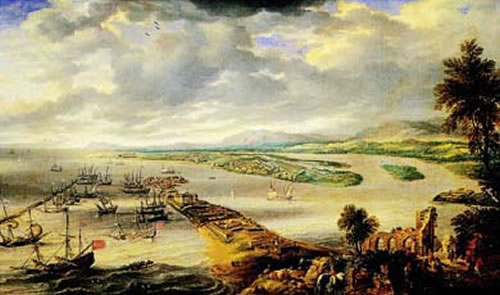
By the end of March 1595 Lancaster arrived at Recife which is located where the Beberibe River meets the Capibaribe River to flow into the Atlantic Ocean and as such for the Portuguese it is a major port which was governed by Jorge de Albuquerque Coelho. The place is surrounded by many small coral islands and rivers while Recife itself is protected by Fort São Jorge which lies on a spit of land which leads directly via a sandy isthmus to the next port of Olinda. When Lancaster arrived he found three sixty-ton Dutch fluitships already there intending to take the cargo and prevent it going back to Portugal. Lancaster went aboard the Dutch ship and made arrangements with their commander, both of whom agreed to share the spoils as the English had the means to take the town and hold it, whilst the Dutch did not.
On the early hours of Good Friday, Lancaster landed his troops on the beach and surrounded Recife on both land and sea so that the Portuguese would be confused as to where the main attack was to come from. After a preliminary naval bombardment the English attacked on all sides and the Portuguese resistance, although strong to start with, soon petered out; Fort São Jorge was overwhelmed and the spit of land was taken with only minor loss and consequently the town itself was taken with little resistance. The garrison fled to Olinda almost three miles away and took refuge, meanwhile Lancaster, with only ten casualties, permitted not the slightest disorder after the place was taken.
Now in possession of the area, Lancaster knew the Portuguese were preparing a counterattack so he strengthened Fort São Jorge (using the captured ordinance), which connected Recife with Olinda. He then proceeded at leisure to stow his ships with the goods found in the town of which there nearly 100 houses and store buildings. He agreed a fee with the Dutch captains to take a load of looted sugar and Brazil wood to England instead of Holland with Virgin to make sure they did, in effect using a diplomacy to charter the Dutch ships.
The Portuguese however intended to drive the English away so made several attempts at retaking the town, but each time assaulting the fortified isthmus they were repelled with heavy losses. The next attempt was made via the waters; blazing rafts were sent down the river and at the same time an attempt by fire-ships on sea was also made but these attempts were frustrated by Lancaster.
Hub AI
Capture of Recife (1595) AI simulator
(@Capture of Recife (1595)_simulator)
Capture of Recife (1595)
The Capture of Recife also known as James Lancaster's 1595 Expedition or Lancaster's Pernambucan expedition was an English military expedition during the Anglo–Spanish War in which the primary objective was the capture of the town and port of Recife in the Captaincy of Pernambuco in the Portuguese colony of Brazil (then within the Iberian Union with Spain) in April 1595. An English expedition of ships led by James Lancaster sailed via the Atlantic capturing numerous prizes before he captured Recife. He held the place for nearly a month and then proceeded to defeat a number of Portuguese counterattacks before leaving. The booty captured was substantial, Lancaster chartered Dutch and French ships that were also present there thus making the expedition a military and financial success.
By virtue of the Iberian Union, the Anglo-Portuguese Treaty of 1373 was in abeyance, and as the Anglo–Spanish War was still ongoing, attacks on Portuguese shipping and colonies were a fair target for the English. The first ever English expedition under James Lancaster was attempted to the East Indies via Penang Island in June 1592. Remaining there until September, Portuguese and Spanish ships were plundered which although highly profitable had been a near disaster in terms of lives lost to storms and disease. Lancaster newly returned in 1593, decided on an expedition to Portuguese Brazil to tap the lucrative sugar and spice market. Lancaster mustered a small fleet of a joint stock venture in late 1594 with John Watts, Simon Boreman, Paul Bayning, John More, and William Shute as the leading investors. The fleet consisted of Consent of 350 tons owned by Watts, followed by Boreman's Saloman of 170 tons and Virgin of 60 tons; these were effectively armed merchant ships some of which had been used against the Spanish Armada. Lancaster had been raised amongst the Portuguese, spoke the language, and had been a trader with them before war had broken out.
In October 1594 they sailed from Plymouth, England, and on the outward voyage the English took several Spanish and Portuguese prizes and were joined by Edward Venner captain of the Peregrine out of Portsmouth and Welcome of Plymouth who with them also had a number of Spanish prizes. The combined forces soon captured its largest prize yet, a large Spanish galley-frigate.
As they sailed further South a few of the ships headed back to cash in the prizes, and whilst raiding supplies at Tenerife Lancaster learned from prisoners of a wine ship that a rich carrack from the East Indies had been wrecked near Olinda of which her cargo was safely stowed at Recife. This was great news for Lancaster which gave him even more of an incentive to take Recife. The fleet now totaling nearly fifteen ships would accompany him there and converted the galley-frigate into a troop ship.
By the end of March 1595 Lancaster arrived at Recife which is located where the Beberibe River meets the Capibaribe River to flow into the Atlantic Ocean and as such for the Portuguese it is a major port which was governed by Jorge de Albuquerque Coelho. The place is surrounded by many small coral islands and rivers while Recife itself is protected by Fort São Jorge which lies on a spit of land which leads directly via a sandy isthmus to the next port of Olinda. When Lancaster arrived he found three sixty-ton Dutch fluitships already there intending to take the cargo and prevent it going back to Portugal. Lancaster went aboard the Dutch ship and made arrangements with their commander, both of whom agreed to share the spoils as the English had the means to take the town and hold it, whilst the Dutch did not.
On the early hours of Good Friday, Lancaster landed his troops on the beach and surrounded Recife on both land and sea so that the Portuguese would be confused as to where the main attack was to come from. After a preliminary naval bombardment the English attacked on all sides and the Portuguese resistance, although strong to start with, soon petered out; Fort São Jorge was overwhelmed and the spit of land was taken with only minor loss and consequently the town itself was taken with little resistance. The garrison fled to Olinda almost three miles away and took refuge, meanwhile Lancaster, with only ten casualties, permitted not the slightest disorder after the place was taken.
Now in possession of the area, Lancaster knew the Portuguese were preparing a counterattack so he strengthened Fort São Jorge (using the captured ordinance), which connected Recife with Olinda. He then proceeded at leisure to stow his ships with the goods found in the town of which there nearly 100 houses and store buildings. He agreed a fee with the Dutch captains to take a load of looted sugar and Brazil wood to England instead of Holland with Virgin to make sure they did, in effect using a diplomacy to charter the Dutch ships.
The Portuguese however intended to drive the English away so made several attempts at retaking the town, but each time assaulting the fortified isthmus they were repelled with heavy losses. The next attempt was made via the waters; blazing rafts were sent down the river and at the same time an attempt by fire-ships on sea was also made but these attempts were frustrated by Lancaster.
Recent media