



Community hub
Recent from talks
Contribute something to knowledge base
Content stats: 0 posts, 0 articles, 1 media, 0 notes
Members stats: 0 subscribers, 0 contributors, 0 moderators, 0 supporters
Subscribers
Supporters
Contributors
Moderators
Hub AI
Cardinal-nephew AI simulator
(@Cardinal-nephew_simulator)
Hub AI
Cardinal-nephew AI simulator
(@Cardinal-nephew_simulator)
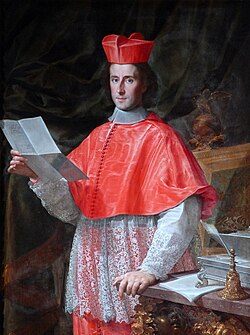
Cardinal-nephew
A cardinal-nephew (Latin: cardinalis nepos; Italian: cardinale nipote; Spanish: valido de su tío; Portuguese: cardeal-sobrinho; French: prince de fortune) was a cardinal elevated by a pope who was that cardinal's relative. The practice of creating cardinal-nephews originated in the Middle Ages, and reached its apex during the 16th and 17th centuries. The last cardinal-nephew was named in 1689 and the practice was abolished in 1692. The word nepotism originally referred specifically to this practice, when it appeared in the English language about 1669. From the middle of the Avignon Papacy (1309–1377) until Pope Innocent XII's anti-nepotism bull (a papal charter), Romanum decet pontificem (1692), a pope without a cardinal-nephew was the exception to the rule. Every Renaissance pope who created cardinals appointed a relative to the College of Cardinals, and the nephew was the most common choice, although one of Alexander VI's creations was his own son.
The institution of the cardinal-nephew evolved over seven centuries, tracking developments in the history of the papacy and the styles of individual popes. From 1566 until 1692, a cardinal-nephew held the curial office of the Superintendent of the Ecclesiastical State, known as the Cardinal Nephew, and thus the terms are sometimes used interchangeably. The curial office of the Cardinal Nephew as well as the institution of the cardinal-nephew declined as the power of the Cardinal Secretary of State increased and the temporal power of popes decreased in the 17th and 18th centuries.
The list of cardinal-nephews includes at least fifteen, and possibly as many as nineteen popes (Gregory IX, Alexander IV, Adrian V, Gregory XI, Boniface IX, Innocent VII, Eugene IV, Paul II, Alexander VI, Pius III, Julius II, Leo X, Clement VII, Benedict XIII, and Pius VII; perhaps also John XIX and Benedict IX, if they were really promoted cardinals; as well as Innocent III and Benedict XII, if in fact they were related to their elevators); one antipope (John XXIII); and two or three saints (Charles Borromeo, Guarinus of Palestrina, and perhaps Anselm of Lucca, if he was really a cardinal).
The creation of cardinal-nephews predates the hierarchical preeminence of cardinals within the Roman Catholic Church, which grew out of the 1059 decree of Pope Nicholas II, In nomine Domini, which established cardinal bishops as the sole electors of the Pope, with the consent of cardinal deacons and cardinal priests. The first known cardinal-nephew is Lottario (Latin: Loctarius), seniore, cousin of Pope Benedict VIII (1012–1024), elected circa 1015. Benedict VIII also elevated his brother Giovanni (the future Pope John XIX) and his cousin Teofilatto (the future Pope Benedict IX) as cardinal-deacons. The first known cardinal-nephew after 1059 is Anselm of Lucca, the nephew or brother of Pope Alexander II (1061–1073), although until the end of the 12th century the majority of the alleged cases of such appointments are dubious, either because the relationship between the Pope and cardinal is not proven, or because the cardinalate of the papal kinsman is uncertain. However, it is beyond doubt that the promotions of papal relatives to the College of Cardinals were common in the 13th century.
According to historian John Bargrave, "by the Council of Bazill, Session 21, the number of cardinals was not to be above 24, and not any nephew of the Pope or of any cardinal was to be of that number. (Session 23.)"
Pope Clement VI (1342–1352) created more cardinal-nephews than any other pontiff, including six on September 20, 1342, the greatest number of cardinal-nephews elevated at one time. The capitulation of the 1464 papal conclave limited the Pope it elected (Pope Paul II) to appointing one cardinal-nephew, along with other conditions designed to increase the power of the College of Cardinals and reduce the Pope's ability to dilute that power.
The Fifth Council of the Lateran declared in 1514 that the care of relatives was to be commended, and the creation of cardinal-nephews was often recommended or justified based on the need to care for indigent family members. A cardinal-nephew could usually expect profitable appointments; for example, Alessandro Farnese, cardinal-nephew of Pope Paul III (1534–1549) held 64 benefices simultaneously in addition to the vice-chancellorship.
Pope Paul IV (1555–1559), in his old age, was said to have "fallen almost completely under the cardinal-nephew's influence"; Paul IV's cardinal-nephew, Carlo Carafa, was accused in August 1558 by a Theatine of seducing a Roman noble woman, Plautila de' Massimi, who had come into possession of an inordinate amount of money and jewelry, but the accusations were dismissed by the pontiff. Saint Charles Borromeo, cardinal-nephew of Pope Pius IV (1559–1565), had ensured the subordination of the secretarius intimus to the Cardinal Nephew, which came to be sometimes known as the secretarius maior. Pius IV was notorious for nepotism: between 1561 and 1565 he transferred more than 350,000 scudi to his relatives.
Cardinal-nephew
A cardinal-nephew (Latin: cardinalis nepos; Italian: cardinale nipote; Spanish: valido de su tío; Portuguese: cardeal-sobrinho; French: prince de fortune) was a cardinal elevated by a pope who was that cardinal's relative. The practice of creating cardinal-nephews originated in the Middle Ages, and reached its apex during the 16th and 17th centuries. The last cardinal-nephew was named in 1689 and the practice was abolished in 1692. The word nepotism originally referred specifically to this practice, when it appeared in the English language about 1669. From the middle of the Avignon Papacy (1309–1377) until Pope Innocent XII's anti-nepotism bull (a papal charter), Romanum decet pontificem (1692), a pope without a cardinal-nephew was the exception to the rule. Every Renaissance pope who created cardinals appointed a relative to the College of Cardinals, and the nephew was the most common choice, although one of Alexander VI's creations was his own son.
The institution of the cardinal-nephew evolved over seven centuries, tracking developments in the history of the papacy and the styles of individual popes. From 1566 until 1692, a cardinal-nephew held the curial office of the Superintendent of the Ecclesiastical State, known as the Cardinal Nephew, and thus the terms are sometimes used interchangeably. The curial office of the Cardinal Nephew as well as the institution of the cardinal-nephew declined as the power of the Cardinal Secretary of State increased and the temporal power of popes decreased in the 17th and 18th centuries.
The list of cardinal-nephews includes at least fifteen, and possibly as many as nineteen popes (Gregory IX, Alexander IV, Adrian V, Gregory XI, Boniface IX, Innocent VII, Eugene IV, Paul II, Alexander VI, Pius III, Julius II, Leo X, Clement VII, Benedict XIII, and Pius VII; perhaps also John XIX and Benedict IX, if they were really promoted cardinals; as well as Innocent III and Benedict XII, if in fact they were related to their elevators); one antipope (John XXIII); and two or three saints (Charles Borromeo, Guarinus of Palestrina, and perhaps Anselm of Lucca, if he was really a cardinal).
The creation of cardinal-nephews predates the hierarchical preeminence of cardinals within the Roman Catholic Church, which grew out of the 1059 decree of Pope Nicholas II, In nomine Domini, which established cardinal bishops as the sole electors of the Pope, with the consent of cardinal deacons and cardinal priests. The first known cardinal-nephew is Lottario (Latin: Loctarius), seniore, cousin of Pope Benedict VIII (1012–1024), elected circa 1015. Benedict VIII also elevated his brother Giovanni (the future Pope John XIX) and his cousin Teofilatto (the future Pope Benedict IX) as cardinal-deacons. The first known cardinal-nephew after 1059 is Anselm of Lucca, the nephew or brother of Pope Alexander II (1061–1073), although until the end of the 12th century the majority of the alleged cases of such appointments are dubious, either because the relationship between the Pope and cardinal is not proven, or because the cardinalate of the papal kinsman is uncertain. However, it is beyond doubt that the promotions of papal relatives to the College of Cardinals were common in the 13th century.
According to historian John Bargrave, "by the Council of Bazill, Session 21, the number of cardinals was not to be above 24, and not any nephew of the Pope or of any cardinal was to be of that number. (Session 23.)"
Pope Clement VI (1342–1352) created more cardinal-nephews than any other pontiff, including six on September 20, 1342, the greatest number of cardinal-nephews elevated at one time. The capitulation of the 1464 papal conclave limited the Pope it elected (Pope Paul II) to appointing one cardinal-nephew, along with other conditions designed to increase the power of the College of Cardinals and reduce the Pope's ability to dilute that power.
The Fifth Council of the Lateran declared in 1514 that the care of relatives was to be commended, and the creation of cardinal-nephews was often recommended or justified based on the need to care for indigent family members. A cardinal-nephew could usually expect profitable appointments; for example, Alessandro Farnese, cardinal-nephew of Pope Paul III (1534–1549) held 64 benefices simultaneously in addition to the vice-chancellorship.
Pope Paul IV (1555–1559), in his old age, was said to have "fallen almost completely under the cardinal-nephew's influence"; Paul IV's cardinal-nephew, Carlo Carafa, was accused in August 1558 by a Theatine of seducing a Roman noble woman, Plautila de' Massimi, who had come into possession of an inordinate amount of money and jewelry, but the accusations were dismissed by the pontiff. Saint Charles Borromeo, cardinal-nephew of Pope Pius IV (1559–1565), had ensured the subordination of the secretarius intimus to the Cardinal Nephew, which came to be sometimes known as the secretarius maior. Pius IV was notorious for nepotism: between 1561 and 1565 he transferred more than 350,000 scudi to his relatives.
Recent media
Recent media