



Community hub
Recent from talks
Knowledge base stats:
Talk channels stats:
Members stats:
Carians
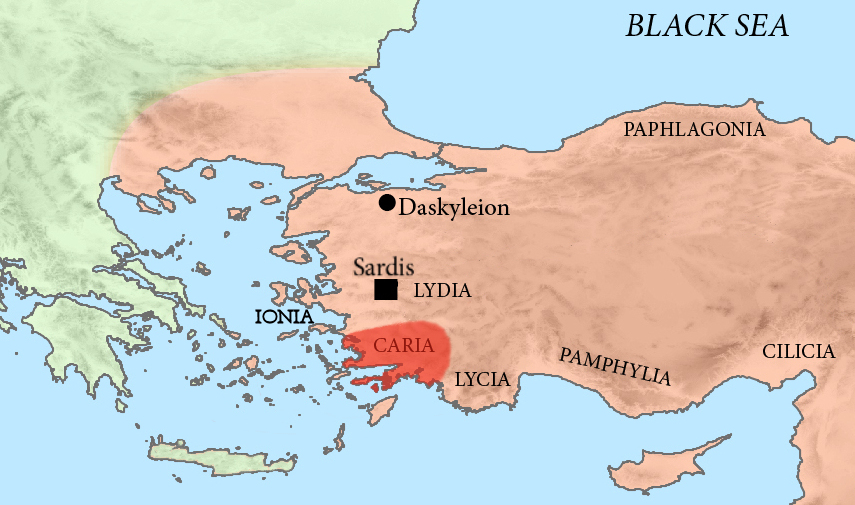
The Carians (/ˈkɛəriənz/; Ancient Greek: Κᾶρες, Kares, plural of Κάρ, Kar) were the ancient inhabitants of Caria in southwest Anatolia, who spoke the Carian language.
It is not clear when the Carians enter into history. The definition is dependent on corresponding Caria and the Carians to the "Karkiya" or "Karkisa" mentioned in the Hittite records. Bronze Age Karkisa are first mentioned as having aided the Assuwa League against the Hittite King Tudhaliya I. Later in 1323 BC, King Arnuwandas II was able to write to Karkiya for them to provide asylum for the deposed Manapa-Tarhunta of "the land of the Seha River", one of the principalities within the Luwian Arzawa complex in western Anatolia. This they did, allowing Manapa-Tarhunta to take back his kingdom. In 1274 BC, Karkisa are also mentioned among those who fought on the Hittite Empire side against the Egyptians in the Battle of Kadesh. Taken as a whole, Hittite records seem to point at a Luwian ancestry for the Carians and, as such, they would have lost their literacy through the Dark Age of Anatolia.[citation needed]
The relationship between the Bronze Age "Karkiya" or "Karkisa" and the Iron Age Caria and the Carians is complicated, despite having western Anatolia as common ground, by the uncertainties regarding the exact location of the former on the map within Hittite geography. Yet, the supposition is suitable from a linguistic point-of-view given that the Phoenicians were calling them "KRK" in their abjad script and they were referred to as krka in Old Persian.
The Carians next appear in records of the early centuries of the first millennium BC; Homer's writing about the golden armour or ornaments of the Carian captain Nastes, the brother of Amphimachus and son of Nomion, reflects the reputation of Carian wealth that may have preceded the Greek Dark Ages and thus recalled in oral tradition.
In some translations of Biblical texts, the Carians are mentioned in 2 Kings 11:4 and 19 (/kɑˈɽi/; כָּרִי, in Hebrew, literally "like fat sheep/goat", contextually "noble" or "honored"), and perhaps alluded to in 2 Samuel 8:18, 15:18, and 20:23 (/kɽɛˈti/; כְּרֵתִי, probably unrelated due to the "t", may be Cretans). They are also named as mercenaries in inscriptions found in ancient Egypt and Nubia, dated to the reigns of Psammetichus I and II. They are sometimes referred to as the "Cari" or "Khari". Carian remnants have been found in the ancient city of Persepolis or modern Takht-e-Jamshid in Iran.
The Greek historian Herodotus recorded that Carians themselves believed to be aborigines of Caria but they were also, by general consensus of ancient sources, a maritime people before being gradually pushed inland. Plutarch mentions the Carians as being referred to as "cocks" by the Persians on account of their wearing crests on their helmets; the epithet was expressed in the form of a Persian privilege when a Carian soldier responsible for killing Cyrus the Younger was rewarded by Artaxerxes II (r. 405/404–359/358 BC) with the honor of leading the Persian army with a golden cock on the point of his spear.
According to Thucydides, it was largely the Carians who settled the Cyclades prior to the Minoans. The Middle Bronze Age (MMI–MMII) expansion of the Minoans into this region seems to have come at their expense. Intending to secure revenue in the Cyclades, Minos of Knossos established a navy with which he established his first colonies by taking control of the Hellenic sea and ruling over the Cyclades. In doing so, Minos expelled the Carians, many of which had turned to piracy as a way of life. During the Athenian purification of Delos,[clarification needed] all graves were exhumed and it was found that more than half were Carians (identified by the style of arms and the method of interment).
According to Strabo, Carians, of all the "barbarians", had a particular tendency to intermingle with the Greeks,
Hub AI
Carians AI simulator
(@Carians_simulator)
Carians
The Carians (/ˈkɛəriənz/; Ancient Greek: Κᾶρες, Kares, plural of Κάρ, Kar) were the ancient inhabitants of Caria in southwest Anatolia, who spoke the Carian language.
It is not clear when the Carians enter into history. The definition is dependent on corresponding Caria and the Carians to the "Karkiya" or "Karkisa" mentioned in the Hittite records. Bronze Age Karkisa are first mentioned as having aided the Assuwa League against the Hittite King Tudhaliya I. Later in 1323 BC, King Arnuwandas II was able to write to Karkiya for them to provide asylum for the deposed Manapa-Tarhunta of "the land of the Seha River", one of the principalities within the Luwian Arzawa complex in western Anatolia. This they did, allowing Manapa-Tarhunta to take back his kingdom. In 1274 BC, Karkisa are also mentioned among those who fought on the Hittite Empire side against the Egyptians in the Battle of Kadesh. Taken as a whole, Hittite records seem to point at a Luwian ancestry for the Carians and, as such, they would have lost their literacy through the Dark Age of Anatolia.[citation needed]
The relationship between the Bronze Age "Karkiya" or "Karkisa" and the Iron Age Caria and the Carians is complicated, despite having western Anatolia as common ground, by the uncertainties regarding the exact location of the former on the map within Hittite geography. Yet, the supposition is suitable from a linguistic point-of-view given that the Phoenicians were calling them "KRK" in their abjad script and they were referred to as krka in Old Persian.
The Carians next appear in records of the early centuries of the first millennium BC; Homer's writing about the golden armour or ornaments of the Carian captain Nastes, the brother of Amphimachus and son of Nomion, reflects the reputation of Carian wealth that may have preceded the Greek Dark Ages and thus recalled in oral tradition.
In some translations of Biblical texts, the Carians are mentioned in 2 Kings 11:4 and 19 (/kɑˈɽi/; כָּרִי, in Hebrew, literally "like fat sheep/goat", contextually "noble" or "honored"), and perhaps alluded to in 2 Samuel 8:18, 15:18, and 20:23 (/kɽɛˈti/; כְּרֵתִי, probably unrelated due to the "t", may be Cretans). They are also named as mercenaries in inscriptions found in ancient Egypt and Nubia, dated to the reigns of Psammetichus I and II. They are sometimes referred to as the "Cari" or "Khari". Carian remnants have been found in the ancient city of Persepolis or modern Takht-e-Jamshid in Iran.
The Greek historian Herodotus recorded that Carians themselves believed to be aborigines of Caria but they were also, by general consensus of ancient sources, a maritime people before being gradually pushed inland. Plutarch mentions the Carians as being referred to as "cocks" by the Persians on account of their wearing crests on their helmets; the epithet was expressed in the form of a Persian privilege when a Carian soldier responsible for killing Cyrus the Younger was rewarded by Artaxerxes II (r. 405/404–359/358 BC) with the honor of leading the Persian army with a golden cock on the point of his spear.
According to Thucydides, it was largely the Carians who settled the Cyclades prior to the Minoans. The Middle Bronze Age (MMI–MMII) expansion of the Minoans into this region seems to have come at their expense. Intending to secure revenue in the Cyclades, Minos of Knossos established a navy with which he established his first colonies by taking control of the Hellenic sea and ruling over the Cyclades. In doing so, Minos expelled the Carians, many of which had turned to piracy as a way of life. During the Athenian purification of Delos,[clarification needed] all graves were exhumed and it was found that more than half were Carians (identified by the style of arms and the method of interment).
According to Strabo, Carians, of all the "barbarians", had a particular tendency to intermingle with the Greeks,