Hubbry Logo
ThucydidesThucydidesMain
Open search
Thucydides
Community hub
Thucydides
logo
8 pages, 0 posts
0 subscribers
Be the first to start a discussion here.
Contribute something
Thucydides
Thucydides
from Wikipedia

Thucydides (/θjˈsɪdɪˌdz/ thew-SID-ih-deez; Ancient Greek: Θουκυδίδης, romanizedThoukudídēs [tʰuːkydǐdɛːs]; c. 460 – c. 400 BC) was an Athenian historian and general. His History of the Peloponnesian War recounts the fifth-century BC war between Sparta and Athens until the year 411 BC. Thucydides has been dubbed the father of "scientific history" by those who accept his claims to have applied strict standards of impartiality and evidence-gathering and analysis of cause and effect, without reference to intervention by the gods, as outlined in his introduction to his work.[3][4][5]

Key Information

Thucydides has been called the father of the school of political realism, which views the political behavior of individuals and the subsequent outcomes of relations between states as ultimately mediated by, and constructed upon, fear and self-interest.[6] His text is still studied at universities and military colleges worldwide.[7] The Melian dialogue is regarded as a seminal text of international relations theory, while his version of Pericles's Funeral Oration is widely studied by political theorists, historians, and students of the classics. More generally, Thucydides developed an understanding of human nature to explain behavior in such crises as plagues, massacres, and wars.[8]

Life

[edit]

In spite of his stature as a historian, modern historians know relatively little about Thucydides's life. The most reliable information comes from his own History of the Peloponnesian War, in which he mentions his nationality, paternity, and birthplace. Thucydides says that he fought in the war, contracted the plague, and was exiled by the democracy. He may have also been involved in quelling the Samian Revolt.[9]

Evidence from the classical period

[edit]

Thucydides identifies himself as an Athenian, telling us that his father's name was Olorus and that he was from the Athenian deme of Halimous.[10] A disputed anecdote from his early life says that when Thucydides was 10–12 years old, he and his father were supposed to have gone to the agora of Athens where the young Thucydides heard a lecture by the historian Herodotus. According to some accounts, the young Thucydides wept with joy after hearing the lecture, deciding that writing history would be his life's calling. The same account also claims that after the lecture, Herodotus spoke with the youth and his father, stating: "Oloros your son yearns for knowledge." In all essence, the episode is most likely from a later Greek or Roman account of his life.[11] He survived the Plague of Athens,[12] which killed Pericles and many other Athenians. There is a first observation of acquired immunity.[13] He also records that he owned gold mines at Scapte Hyle (literally "Dug Woodland"), a coastal area in Thrace, opposite the island of Thasos.[14]

The ruins of Amphipolis as envisaged by E. Cousinéry in 1831: the bridge over the Strymon, the city fortifications, and the acropolis

Because of his influence in the Thracian region, Thucydides wrote, he was sent as a strategos (general) to Thasos in 424 BC. During the winter of 424–423 BC, the Spartan general Brasidas attacked Amphipolis, a half-day's sail west from Thasos on the Thracian coast, sparking the Battle of Amphipolis. Eucles, the Athenian commander at Amphipolis, sent to Thucydides for help.[15] Brasidas, aware of the presence of Thucydides on Thasos and his influence with the people of Amphipolis, and afraid of help arriving by sea, acted quickly to offer moderate terms to the Amphipolitans for their surrender, which they accepted. Thus, when Thucydides arrived, Amphipolis was already under Spartan control.[16]

Amphipolis was of considerable strategic importance, and news of its fall caused great consternation in Athens.[17] It was blamed on Thucydides, although he claimed that it was not his fault and that he had simply been unable to reach it in time. Because of his failure to save Amphipolis, he was exiled:[18]

I lived through the whole of it, being of an age to comprehend events, and giving my attention to them in order to know the exact truth about them. It was also my fate to be an exile from my country for twenty years after my command at Amphipolis; and being present with both parties, and more especially with the Peloponnesians by reason of my exile, I had leisure to observe affairs somewhat particularly.

Using his status as an exile from Athens to travel freely among the Peloponnesian allies, he was able to view the war from the perspective of both sides. Thucydides claimed that he began writing his history as soon as the war broke out, because he thought it would be one of the greatest wars waged among the Greeks in terms of scale:

Thucydides, an Athenian, wrote the history of the war between the Peloponnesians and the Athenians, beginning at the moment that it broke out, and believing that it would be a great war, and more worthy of relation than any that had preceded it.[19]

This is all that Thucydides wrote about his own life, but a few other facts are available from reliable contemporary sources. Herodotus wrote that the name Olorus, Thucydides's father's name, was connected with Thrace and Thracian royalty.[20] Thucydides was probably connected through family to the Athenian statesman and general Miltiades and his son Cimon, leaders of the old aristocracy supplanted by the Radical Democrats. Cimon's maternal grandfather's name also was Olorus, making the connection quite likely. Another Thucydides lived before the historian and was also linked with Thrace, making a family connection between them very likely as well.

Thucydides Mosaic from Jerash, Jordan, Roman, 3rd century AD at the Pergamon Museum in Berlin

Combining all the fragmentary evidence available, it seems that his family had owned a large estate in Thrace, one that even contained gold mines, and which allowed the family considerable and lasting affluence. The security and continued prosperity of the wealthy estate must have necessitated formal ties with local kings or chieftains, which explains the adoption of the distinctly Thracian royal name Óloros into the family. Once exiled, Thucydides is commonly said to have taken up permanent residence in the estate and, given his ample income from the gold mines, he was able to dedicate himself to full-time history writing and research. In essence, he was a well-connected gentleman of considerable resources who, after involuntarily retiring from the political and military spheres, decided to fund his own historical investigations.

Later sources

[edit]

The remaining evidence for Thucydides's life comes from later and rather less reliable ancient sources; Marcellinus wrote Thucydides's biography about a thousand years after his death. According to Pausanias, someone named Oenobius had a law passed allowing Thucydides to return to Athens, presumably shortly after the city's surrender and the end of the war in 404 BC. Pausanias goes on to say that Thucydides was murdered on his way back to Athens, placing his tomb near the Melite gate.[21] Many doubt this account, seeing evidence to suggest he lived as late as 397 BC, or perhaps slightly later. Plutarch preserves a tradition that he was murdered in Skaptē Hulē and that his remains were returned to Athens, where a monument to him was erected in Cimon's family plot.[22] There are problems with this, since this was outside Thucydides's deme and the tradition goes back to Polemon, who asserted he had discovered just such a memorial.[23] Didymus mentions another tomb in Thrace.[24]

Thucydides's narrative breaks off in the middle of the year 411 BC, and this abrupt end has traditionally been explained as due to his death while writing the book, although other explanations have been put forward.

Bust of Pericles

During his description of the Athenian plague, he remarks that old Athenians seemed to remember a verse predicting a Dorian War that would bring about a "plague" (loimos) λοιμός.[25] A dispute later arose, when some claimed that the saying referred to the advent in such a war of "famine" or "starvation" (limos) λιμός. Thucydides draws the conclusion that people adapt their recollections to their present state of suffering. Were the same situation to recur, but with people experiencing famine rather than a pestilence, the verse would be remembered differently, in terms of starvation (limos), thereby cancelling the received adage about a plague (loimos).[26][27]

Thucydides admired Pericles, approving of his power over the people and showing a marked distaste for the demagogues who followed him. He did not approve of the democratic commoners nor of the radical democracy that Pericles ushered in, but considered democracy acceptable when guided by a good leader.[28] Thucydides's presentation of events is generally even-handed; for example, he does not minimize the negative effect of his own failure at Amphipolis. Occasionally, however, strong passions break through, as in his scathing appraisals of the democratic leaders Cleon[29][30] and Hyperbolus.[31] Sometimes, Cleon has been connected with Thucydides's exile.[32]

It has been argued that Thucydides was moved by the suffering inherent in war and concerned about the excesses to which human nature is prone in such circumstances, as in his analysis of the atrocities committed during the civil conflict on Corcyra,[33] which includes the phrase "war is a violent teacher" (πόλεμος βίαιος διδάσκαλος).

The History of the Peloponnesian War

[edit]
10th-century minuscule manuscript of Thucydides's History of the Peloponnesian War

Thucydides believed that the Peloponnesian War represented an event of unmatched importance.[34] As such, he began to write the History at the onset of the war in 431 BC.[35][36] He declared his intention was to write an account which would serve as "a possession for all time".[37] The History breaks off near the end of the twenty-first year of the war (411 BC), in the wake of the Athenian defeat at Syracuse, and so does not elaborate on the final seven years of the conflict.

The History of the Peloponnesian War continued to be modified well beyond the end of the war in 404 BC, as exemplified by a reference at Book I.1.13[38] to the conclusion of the war.[39] After his death, Thucydides's History was subdivided into eight books: its modern title is the History of the Peloponnesian War. This subdivision was most likely made by librarians and archivists, themselves being historians and scholars, most likely working in the Library of Alexandria.[citation needed]

Thucydides is generally regarded as one of the first true historians. Like his predecessor Herodotus, known as "the father of history", Thucydides places a high value on eyewitness testimony and writes about events in which he probably took part. He also assiduously consulted written documents and interviewed participants about the events that he recorded. Unlike Herodotus, whose stories often teach that a hubris invites the wrath of the deities, Thucydides does not acknowledge divine intervention in human affairs.[40]

Thucydides exerted wide historiographical influence on subsequent Hellenistic and Roman historians, although the exact description of his style in relation to many successive historians remains unclear.[41] Readers in antiquity often placed the continuation of the stylistic legacy of the History in the writings of Thucydides's putative intellectual successor Xenophon. Such readings often described Xenophon's treatises as attempts to "finish" Thucydides's History. Many of these interpretations, however, have garnered significant scepticism among modern scholars, such as Dillery, who spurn the view of interpreting Xenophon qua Thucydides, arguing that the latter's "modern" history (defined as constructed based on literary and historical themes) is antithetical to the former's account in the Hellenica, which diverges from the Hellenic historiographical tradition in its absence of a preface or introduction to the text and the associated lack of an "overarching concept" unifying the history.[42]

Pericles's Funeral Oration (Perikles hält die Leichenrede) by Philipp Foltz (1852)[43]

A noteworthy difference between Thucydides's method of writing history and that of modern historians is Thucydides's inclusion of lengthy formal speeches that, as he states, were literary reconstructions rather than quotations of what was said—or, perhaps, what he believed ought to have been said. Arguably, had he not done this, the gist of what was said would not otherwise be known at all—whereas today there is a plethora of documentation—written records, archives, and recording technology for historians to consult. Therefore, Thucydides's method served to rescue his mostly oral sources from oblivion. We do not know how these historical figures spoke. Thucydides's recreation uses a heroic stylistic register. A celebrated example is Pericles' funeral oration, which heaps honour on the dead and includes a defence of democracy:

The whole earth is the sepulchre of famous men; they are honoured not only by columns and inscriptions in their own land, but in foreign nations on memorials graven not on stone but in the hearts and minds of men. (2:43)

Stylistically, the placement of this passage also serves to heighten the contrast with the description of the plague in Athens immediately following it, which graphically emphasizes the horror of human mortality, thereby conveying a powerful sense of verisimilitude:

Though many lay unburied, birds and beasts would not touch them, or died after tasting them [...]. The bodies of dying men lay one upon another, and half-dead creatures reeled about the streets and gathered round all the fountains in their longing for water. The sacred places also in which they had quartered themselves were full of corpses of persons who had died there, just as they were; for, as the disaster passed all bounds, men, not knowing what was to become of them, became equally contemptuous of the property of and the dues to the deities. All the burial rites before in use were entirely upset, and they buried the bodies as best they could. Many from want of the proper appliances, through so many of their friends having died already, had recourse to the most shameless sepultures: sometimes getting the start of those who had raised a pile, they threw their own dead body upon the stranger's pyre and ignited it; sometimes they tossed the corpse which they were carrying on the top of another that was burning, and so went off. (2:52)

Thucydides omits discussion of the arts, literature, or the social milieu in which the events in his book take place and in which he grew up. He saw himself as recording an event, not a period, and went to considerable lengths to exclude what he deemed frivolous or extraneous.

Philosophical outlook and influences

[edit]

Paul Shorey calls Thucydides "a cynic devoid of moral sensibility".[44] In addition, he notes that Thucydides conceived of human nature as strictly determined by one's physical and social environments, alongside basic desires.[45] Francis Cornford was more nuanced: Thucydides's political vision was informed by a tragic ethical vision, in which:

Man, isolated from, and opposed to, Nature, moves along a narrow path, unrelated to what lies beyond and lighted only by a few dim rays of human 'foresight'(γνώμη/gnome), or by the false, wandering fires of Hope. He bears within him, self-contained, his destiny in his own character: and this, with the purposes which arise out of it, shapes his course. That is all, in Thucydides' view, that we can say: except that, now and again, out of the surrounding darkness comes the blinding strokes of Fortune, unaccountable and unforeseen.'[46]

Thucydides's work indicates an influence from the teachings of the Sophists that contributes substantially to the thinking and character of his History.[47] Possible evidence includes his skeptical ideas concerning justice and morality.[48] There are also elements within the History—such as his views on nature revolving around the factual, empirical, and the non-anthropomorphic—which suggest that he was at least aware of the views of philosophers such as Anaxagoras and Democritus. There is also evidence of his knowledge concerning some of the corpus of Hippocratic medical writings.[49]

Thucydides was especially interested in the relationship between human intelligence and judgment,[50] fortune and necessity,[51] and the idea that history is too irrational and incalculable to predict.[52]

Critical interpretation

[edit]
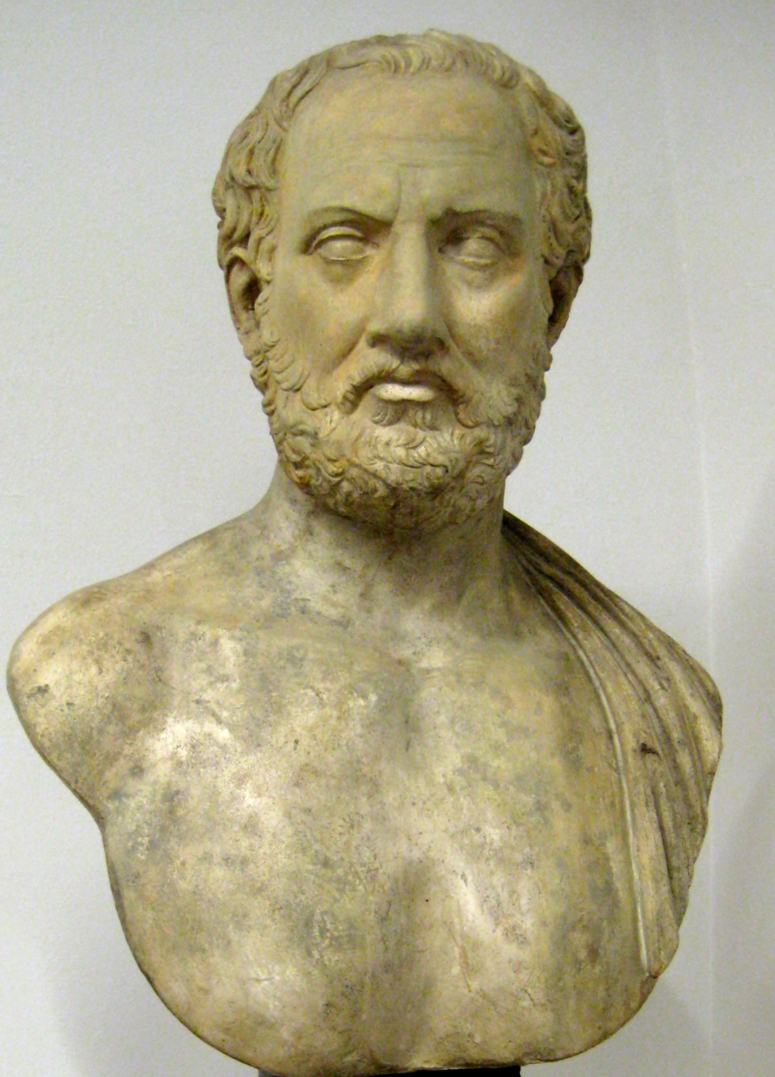
Bust of Thucydides residing in the Royal Ontario Museum, Toronto

Scholars traditionally viewed Thucydides as recognizing and teaching the lesson that democracies need leadership but that leadership can be dangerous to democracy. Leo Strauss (in The City and Man) locates the problem in the nature of Athenian democracy, about which, he argued, Thucydides was ambivalent. Thucydides's "wisdom was made possible" by the Periclean democracy, which had the effect of liberating individual daring, enterprise and questioning spirit; this liberation, by permitting the growth of limitless political ambition, led to imperialism and eventually, to civic strife.[53]

For Canadian historian Charles Norris Cochrane (1889–1945), Thucydides's fastidious devotion to observable phenomena, focus on cause and effect and strict exclusion of other factors anticipates twentieth-century scientific positivism. Cochrane, the son of a physician, speculated that Thucydides generally (and especially in describing the plague in Athens) was influenced by the methods and thinking of early medical writers such as Hippocrates of Kos.[3]

After World War II, classical scholar Jacqueline de Romilly pointed out that the problem of Athenian imperialism was one of Thucydides's preoccupations and situated his history in the context of Greek thinking about international politics. Since the appearance of her study, other scholars further examined Thucydides's treatment of realpolitik.[citation needed]

Other scholars have brought to the fore the literary qualities of the History, which they see in the narrative tradition of Homer and Hesiod and as concerned with the concepts of justice and suffering found in Plato and Aristotle and questioned in Aeschylus and Sophocles.[54] Richard Ned Lebow terms Thucydides "the last of the tragedians", stating that "Thucydides drew heavily on epic poetry and tragedy to construct his history, which not surprisingly is also constructed as a narrative".[55] In this view, the blind and immoderate behaviour of the Athenians (and indeed of all the other actors)—although perhaps intrinsic to human nature—leads to their downfall. Thus his History could serve as a warning to leaders to be more prudent, by putting them on notice that someone would be scrutinizing their actions with a historian's objectivity rather than a chronicler's flattery.[56]

The historian J. B. Bury writes that the work of Thucydides "marks the longest and most decisive step that has ever been taken by a single man towards making history what it is today".[57]

Historian H. D. Kitto feels that Thucydides wrote about the Peloponnesian War, not because it was the most significant war in antiquity but because it caused the most suffering. Several passages of Thucydides's book are written "with an intensity of feeling hardly exceeded by Sappho herself".[58]

In his book The Open Society and Its Enemies, Karl Popper writes that Thucydides was the "greatest historian, perhaps, who ever lived". Thucydides's work, Popper goes on to say, represents "an interpretation, a point of view; and in this we need not agree with him". In the war between Athenian democracy and the "arrested oligarchic tribalism of Sparta", we must never forget Thucydides's "involuntary bias", and that "his heart was not with Athens, his native city."

Although he apparently did not belong to the extreme wing of the Athenian oligarchic clubs who conspired throughout the war with the enemy, he was certainly a member of the oligarchic party, and a friend neither of the Athenian people, the demos, who had exiled him, nor of its imperialist policy.[59]

Comparison with Herodotus

[edit]
Double herm showing Herodotus and Thucydides. Farnese Collection, Naples

Thucydides and his immediate predecessor, Herodotus, both exerted a significant influence on Western historiography. Thucydides does not mention his counterpart by name, but his famous introductory statement is thought to refer to him:[60][61]

To hear this history rehearsed, for that there be inserted in it no fables, shall be perhaps not delightful. But he that desires to look into the truth of things done, and which (according to the condition of humanity) may be done again, or at least their like, shall find enough herein to make him think it profitable. And it is compiled rather for an everlasting possession than to be rehearsed for a prize. (1:22)

Herodotus records in his Histories not only the events of the Persian Wars, but also geographical and ethnographical information, as well as the fables related to him during his extensive travels. Typically, he passes no definitive judgment on what he has heard. In the case of conflicting or unlikely accounts, he presents both sides, says what he believes and then invites readers to decide for themselves.[62] Of course, modern historians would generally leave out their personal beliefs, which is a form of passing judgment upon the events and people about which the historian is reporting. The work of Herodotus is reported to have been recited at festivals, where prizes were awarded, as for example, during the games at Olympia.[63]

Herodotus views history as a source of moral lessons, with conflicts and wars as misfortunes flowing from initial acts of injustice perpetuated through cycles of revenge.[64] In contrast, Thucydides claims to confine himself to factual reports of contemporary political and military events, based on unambiguous, first-hand, eye-witness accounts,[65] although, unlike Herodotus, he does not reveal his sources. Thucydides views life exclusively as political life, and history in terms of political history. Conventional moral considerations play no role in his analysis of political events while geographic and ethnographic aspects are omitted or, at best, of secondary importance. Subsequent Greek historians—such as Ctesias, Diodorus, Strabo, Polybius and Plutarch—held up Thucydides's writings as a model of truthful history. Lucian[66] refers to Thucydides as having given Greek historians their law, requiring them to say what had been done (ὡς ἐπράχθη). Greek historians of the fourth century BC accepted that history was political and that contemporary history was the proper domain of a historian.[67] Cicero calls Herodotus the "father of history";[68] yet the Greek writer Plutarch, in his Moralia (Ethics) denigrated Herodotus, notably calling him a philobarbaros, a "barbarian lover", to the detriment of the Greeks.[69] Unlike Thucydides, however, these authors all continued to view history as a source of moral lessons, thereby infusing their works with personal biases generally missing from Thucydides's clear-eyed, non-judgmental writings focused on reporting events in a non-biased manner.[citation needed]

Due to the loss of the ability to read Greek, Thucydides and Herodotus were largely forgotten during the Middle Ages in Western Europe, although their influence continued in the Byzantine world. In Europe, Herodotus become known and highly respected only in the late-sixteenth and early-seventeenth century as an ethnographer, in part due to the discovery of America, where customs and animals were encountered that were even more surprising than what he had related. During the Reformation, moreover, information about Middle Eastern countries in the Histories provided a basis for establishing Biblical chronology as advocated by Isaac Newton.

The first European translation of Thucydides (into Latin) was made by the humanist Lorenzo Valla between 1448 and 1452, and the first Greek edition was published by Aldo Manuzio in 1502. During the Renaissance, however, Thucydides attracted less interest among Western European historians as a political philosopher than his successor, Polybius,[70] although Poggio Bracciolini claimed to have been influenced by him. There is not much evidence of Thucydides's influence in Niccolò Machiavelli's The Prince (1513), which held that the chief aim of a new prince must be to "maintain his state" [i.e., his power] and that in so doing he is often compelled to act against faith, humanity, and religion. Later historians, such as J. B. Bury, however, have noted parallels between them:

If, instead of a history, Thucydides had written an analytical treatise on politics, with particular reference to the Athenian empire, it is probable that ... he could have forestalled Machiavelli ... [since] the whole innuendo of the Thucydidean treatment of history agrees with the fundamental postulate of Machiavelli, the supremacy of reason of state. To maintain a state, said the Florentine thinker, "a statesman is often compelled to act against faith, humanity and religion". ... But ... the true Machiavelli, not the Machiavelli of fable ... entertained an ideal: Italy for the Italians, Italy freed from the stranger: and in the service of this ideal he desired to see his speculative science of politics applied. Thucydides has no political aim in view: he was purely a historian. But it was part of the method of both alike to eliminate conventional sentiment and morality.[71]

Thomas Hobbes translated Thucydides directly from Greek into English

In the seventeenth century, the English political philosopher Thomas Hobbes, whose Leviathan advocated absolute monarchy, admired Thucydides and in 1628 was the first to translate his writings into English directly from Greek. Thucydides, Hobbes, and Machiavelli are together considered the founding fathers of western political realism, according to which, state policy must primarily or solely focus on the need to maintain military and economic power rather than on ideals or ethics.

Nineteenth-century positivist historians stressed what they saw as Thucydides's seriousness, his scientific objectivity and his advanced handling of evidence. A virtual cult following developed among such German philosophers as Friedrich Schelling, Friedrich Schlegel, and Friedrich Nietzsche, who claimed that, "[in Thucydides], the portrayer of Man, that culture of the most impartial knowledge of the world finds its last glorious flower." The late-eighteenth-century Swiss historian Johannes von Müller described Thucydides as "the favourite author of the greatest and noblest men, and one of the best teachers of the wisdom of human life".[72] For Eduard Meyer, Thomas Babington Macaulay and Leopold von Ranke, who initiated modern source-based history writing,[73] Thucydides was again the model historian.[74][75]

Generals and statesmen loved him: the world he drew was theirs, an exclusive power-brokers' club. It is no accident that even today Thucydides turns up as a guiding spirit in military academies, neocon think tanks and the writings of men like Henry Kissinger; whereas Herodotus has been the choice of imaginative novelists (Michael Ondaatje's novel The English Patient and the film based on it boosted the sale of the Histories to a wholly unforeseen degree) and—as food for a starved soul—of an equally imaginative foreign correspondent from Iron Curtain Poland, Ryszard Kapuscinski.[76]

These historians also admired Herodotus, however, as social and ethnographic history increasingly came to be recognized as complementary to political history.[77] In the twentieth century, this trend gave rise to the works of Johan Huizinga, Marc Bloch, and Fernand Braudel, who pioneered the study of long-term cultural and economic developments and the patterns of everyday life. The Annales School, which exemplifies this direction, has been viewed as extending the tradition of Herodotus.[78]

At the same time, Thucydides's influence was increasingly important in the area of international relations during the Cold War, through the work of Hans Morgenthau, Leo Strauss,[79] and Edward Carr.[80]

The tension between the Thucydidean and Herodotean traditions extends beyond historical research. According to Irving Kristol, self-described founder of American neoconservatism, Thucydides wrote "the favorite neoconservative text on foreign affairs";[81] and Thucydides is a required text at the Naval War College, an American institution located in Rhode Island. On the other hand, Daniel Mendelsohn, in a review of a recent edition of Herodotus, suggests that, at least in his graduate school days during the Cold War, professing admiration of Thucydides served as a form of self-presentation:

To be an admirer of Thucydides' History, with its deep cynicism about political, rhetorical and ideological hypocrisy, with its all too recognizable protagonists—a liberal yet imperialistic democracy and an authoritarian oligarchy, engaged in a war of attrition fought by proxy at the remote fringes of empire—was to advertise yourself as a hardheaded connoisseur of global Realpolitik.[82]

Another contemporary historian believes that, while it is true that critical history "began with Thucydides, one may also argue that Herodotus' looking at the past as a reason why the present is the way it is, and to search for causality for events beyond the realms of Tyche and the Gods, was a much larger step."[83]

See also

[edit]

Notes

[edit]

References and further reading

[edit]
[edit]
Revisions and contributorsEdit on WikipediaRead on Wikipedia
from Grokipedia
Thucydides (Θουκυδίδης, c. 460 – c. 400 BC) was an Athenian general and historian whose offers a detailed, analytical chronicle of the protracted conflict between and that erupted in 431 BC and ended in Athenian defeat in 404 BC. Born into a prosperous with Thracian connections, Thucydides contracted the plague during the early in Athens but survived, an experience that informed his vivid descriptions of its societal impacts. Appointed strategos in 424 BC, he was tasked with securing northern Aegean interests but faced condemnation and 20-year exile after Spartan forces under Brasidas captured Amphipolis, a key Athenian outpost, while Thucydides was stationed too distant to intervene effectively. This banishment enabled Thucydides to travel extensively, interviewing participants from opposing sides and accessing restricted sites, which enriched his narrative's impartiality and depth compared to prior accounts reliant on hearsay or myth. His unfinished history, terminating abruptly in 411 BC amid the Sicilian Expedition's aftermath, eschews explanations in favor of human motivations—ambition, fear, and honor—rooted in empirical observation and . Regarded as a foundational text in historiography for prioritizing evidence over legend and reconstructing speeches to reflect probable intent rather than verbatim records, Thucydides' emphasis on and inevitable clashes between dominant and ascendant states continues to shape understandings of interstate rivalry and strategic decision-making.

Biography

Early Life and Origins

Thucydides was an Athenian of the Halimous, born circa 460–455 BCE, an estimate derived from his eligibility to serve as in 424 BCE, which typically required candidates to be at least thirty years old under Athenian norms. His father, Olorus, bore a name associated with Thracian , indicating possible non-Athenian ancestry on that side. The family held significant wealth from ownership of gold mines in the Thracian region of Scaptē Hylē, near the island of , which afforded Thucydides property interests and influence beyond . These connections likely stemmed from prior Athenian-Thracian intermarriages or commercial ventures, though direct evidence for royal Thracian ties remains speculative and unverified beyond onomastic inference. Little else is documented about his upbringing, which occurred amid the cultural and political ascendancy of Athens under , but no specific personal anecdotes or education details survive in contemporary records.

Athenian Political and Military Role

Thucydides served as an Athenian strategos (general) during the Peloponnesian War, a position that encompassed both military command and political authority, elected annually by the assembly. His family's substantial property interests, including gold mines in Scaptē Hylē in Thrace opposite Thasos, granted him regional influence that prompted his assignment to northern Aegean operations in 424 BC, where he commanded a squadron of ships based at Thasos. In the winter of 424–423 BC, Spartan general advanced into , capturing several Athenian allies before besieging , a critical established by in 437 BC under ' leadership to secure grain routes and timber resources. Thucydides, tasked with relieving the city, sailed from but arrived too late; adverse conditions or cautious maneuvering delayed his fleet, allowing to seize after a brief resistance, while Thucydides reached only the nearby port of Eion on the same day. The assembly blamed Thucydides for the loss, voting his in 423 BC for failing to prevent the of this strategic asset, which bolstered Spartan morale and eroded Athenian control in the Chalcidice peninsula. He describes the banishment as lasting twenty years, ending after the war's conclusion in 404 BC, though some evidence suggests possible earlier recall amid political shifts. This incident terminated his , redirecting his efforts toward composing his historical account from an external vantage.

Exile, Composition Period, and Death

In 424 BC, Thucydides, serving as an Athenian general, was charged with relieving the besieged colony of in but arrived too late to prevent its surrender to the Spartan commander . The Athenian assembly, amid public outrage over the loss of this strategically vital mining region, held him accountable and sentenced him to exile for twenty years. Thucydides himself noted that the failure stemmed from delays in his orders and the distance involved, yet the political climate, influenced by demagogues like , led to his rather than a tactical assessment. During his , Thucydides resided primarily in the Thracian Chalcidice, where he owned property in the gold-mining district of Scaptē Hylē, affording him resources and proximity to both Athenian and Spartan operations. This period enabled him to gather evidence impartially, as he "was present with both parties" and could interview participants without Athenian bias constraining access to Peloponnesian sources. He advanced the composition of his , which he had begun at the conflict's outbreak in 431 BC, structuring it chronologically while incorporating analytical digressions; scholars infer multiple stages of revision, with Books 1–5 likely refined early in exile and later books reflecting ongoing events up to 411 BC. The exile's isolation from Athenian politics preserved his critical distance, allowing emphasis on verifiable inquiry over partisan narrative. Thucydides' banishment effectively ended with Athens' defeat in 404 BC, permitting his recall to the city, though he had already composed much of his work by then. His death occurred sometime between approximately 400 and 395 BC, with the precise date, location, and cause unknown; the History remained unfinished, breaking off mid-sentence in 411 BC despite evident awareness of subsequent developments. Later ancient biographies, such as Marcellinus' Life of Thucydides, attribute a violent end in to a local dispute, but these accounts, composed centuries later, lack contemporary corroboration and blend with .

Historical Methodology

Sources and Evidence Gathering

Thucydides conducted his historical inquiry through systematic personal investigation, prioritizing direct access to participants and survivors of the events he chronicled. As an Athenian general exiled in 424 BC, he gained proximity to both belligerents, enabling interviews with combatants and eyewitnesses across factions, which he cross-examined to verify consistency and discard unreliable . For earlier phases like the war's prelude, he applied analogous scrutiny to available informants, assessing reports against probabilities derived from observed patterns in and . While Thucydides rarely enumerated his sources explicitly—unlike modern historiographical —scholarly analysis infers his consultation of documentary materials, including treaties, public decrees, and inscriptions, to corroborate timelines and diplomatic exchanges; for instance, his detailed reckoning of Athenian naval strength at the war's outset aligns with epigraphic of fleet compositions around 431 BC. He eschewed unverified oral traditions or mythological interpolations, favoring empirical traces like siege engineering descriptions that match archaeological findings at sites such as . This method underscored his commitment to a possession , predicated on verifiable human causation rather than divine agency or anecdotal flourish. Critics note potential biases in his Athenian insider perspective, yet his methodological rigor—evident in reconciling conflicting Spartan and Athenian narratives on key battles like Mantinea in 418 BC—enhances reliability, as corroborated by later Hellenistic historians and modern cross-referencing with Xenophon's continuations. Thucydides' approach thus prefigured scientific by emphasizing and evidential hierarchy, though limited by antiquity's scarcity of written records, compelling reliance on elite informants over mass testimony.

Rejection of Mythology and Divine Explanations

Thucydides articulated a methodological commitment to exclude mythological narratives and divine interventions from his historical account, prioritizing verifiable evidence over traditional tales. In the introduction to his , he emphasized composing a work "" rather than for immediate entertainment, criticizing earlier writers for including unexamined stories that mixed human events with mythical elements to appeal to audiences. This stance is evident in his declaration at 1.21.1-2, where he notes the "absence of romance" in his narrative due to reliance on and , eschewing fables that lacked substantiation. His rejection extended to divine explanations, as Thucydides attributed causation to human factors such as fear, honor, and interest, without invoking gods, oracles, or omens as causal agents. Unlike , who integrated supernatural elements into explanations of historical events, Thucydides omitted references to divine agency, viewing them as incompatible with rigorous historical analysis. For instance, in describing the Athenian plague of 430 BCE, he provided a detailed, naturalistic account based on and medical symptoms, avoiding any attribution to divine wrath despite contemporary religious interpretations. This approach reflected his broader toward unchecked mythological sources, which he deemed unverifiable and thus unsuitable for scholarly history. Thucydides' innovation lay in establishing as a rational discipline grounded in , influencing subsequent by demanding critical evaluation of sources and rejection of the . While he acknowledged religious motivations in —such as oaths or prophecies influencing decisions—he analyzed them psychologically rather than accepting divine intervention as explanatory. His method thus privileged causal realism, focusing on political and dynamics over traditional mythic frameworks, though some scholars note residual cultural references to the divine that do not imply causal .

Composition of Speeches and Narrative Style

Thucydides detailed his compositional approach to speeches in Book 1, Chapter 22 of his History of the Peloponnesian War, stating that while some speeches he heard personally and others he obtained from reports, verbatim recollection proved challenging; thus, he attributed to speakers the sentiments fitting the circumstances, phrased as he judged most appropriate, while adhering closely to the general import of actual utterances. This methodology prioritized conveying essential arguments and motivations over literal transcription, enabling deeper illumination of strategic deliberations and human drives amid conflict. Scholars interpret this as a balanced exercise in reconstruction, where Thucydides supplemented available evidence with reasoned invention to capture probable rhetoric, rather than fabricating detached inventions, thereby advancing the narrative's analytical depth on power and decision-making. Prominent examples include ' Funeral Oration (2.34–46), which extols Athenian democratic virtues and imperial resolve in idealized terms to rally morale after early war losses, and the Melian Dialogue (5.84–116), a stark exchange revealing Athenian in demanding subjugation from neutral Melos, underscoring themes of might over right. These compositions, though not stenographic, reflect Thucydides' eyewitness proximity to many events and his intent to model speeches on authentic oratorical forms, such as assembly debates or diplomatic envoys, to dissect causal factors like and ambition. Critics have debated the , with some viewing the speeches as vehicles for Thucydides' own intellectual projections, yet the adherence to contextual distinguishes them from pure artistry, aligning with his broader rejection of mythological embellishment in favor of empirical scrutiny. Thucydides' narrative style employs a precise annalistic framework, organizing events into annual cycles of summer military campaigns and winter diplomatic or domestic interludes, which imposed chronological rigor on the sprawling Peloponnesian conflict from 431 to 411 BCE. This structure, comprising discrete action units sequenced within seasons, facilitated by juxtaposing operations across theaters, such as Athenian Sicilian ventures against Spartan invasions, without succumbing to episodic fragmentation. Interwoven are objective digressions—e.g., on the Athenian plague (2.47–54) or victory (4.1–41)—that dissect psychological and logistical drivers, rendered in terse, unadorned prose emphasizing human agency over divine intervention. Such technique yields a realist , where narrative retardation in key episodes heightens focus on rational choices and their consequences, distinguishing Thucydides from predecessors like by prioritizing verifiable sequences and power dynamics.

The History of the Peloponnesian War

Scope and Structure of the Work

The narrates the conflict between and its allies against and the , commencing in 431 BCE with the Theban attack on and Spartan invasions of . Thucydides frames the war's scope as the greatest disturbance in Greek history up to his time, surpassing prior conflicts in scale and upheaval, with the intent to provide an enduring analytical account rather than mere entertainment or moralizing. He traces the deepest cause (aitia alēthestatē) to Athens' rapid imperial expansion post-Persian Wars and Sparta's resultant fear, rather than superficial disputes. To contextualize this, the opening includes an "" (1.1–23) evaluating prehistoric Greek military capacities and migrations, followed by the Pentecontaetia (1.89–118), a selective of the circa 479–431 BCE interval from the Persian defeat at to the war's eve, highlighting Athenian consolidation of naval power, subjugation of allies like (c. 470 BCE) and (465–463 BCE), and interventions such as the failed Egyptian campaign (460–454 BCE). The narrative advances chronologically through annual summers (campaign seasons) and winters, interweaving operations, diplomatic exchanges, and extended speeches attributed to key figures, which Thucydides composes as embodying the sense (xnēmē) of what was said, though not verbatim. Coverage spans the war's initial phases up to 411 BCE, terminating mid-sentence during oligarchic revolts in ' eastern allies amid the Ionian theater, omitting the war's conclusion in 404 BCE with Sparta's victory. This truncation reflects Thucydides' death, likely around 399 BCE, leaving the text as a partial draft, particularly Book 8, which lacks the polished speeches of earlier sections. Later editors subdivided the undivided into eight books for , a convention not originating with Thucydides. Book 1 encompasses preliminaries: the , Pentecontaetia, Corcyraean alliance debate (433 BCE), revolt (432 BCE), and Spartan congress deliberations, including ' advocacy for war. Books 2–4 detail the Archidamian War (431–421 BCE), from plague-ravaged to Spartan setbacks at (425 BCE) and Sphacteria. Book 5 succinctly treats the fragile (421 BCE) and battles like Mantinea (418 BCE). Books 6–7 center the Sicilian Expedition (415–413 BCE), from ' and ' assembly speeches to total Athenian annihilation at Syracuse. Book 8 opens the Decelean phase with Spartan fortification of (413 BCE) and Persian funding, chronicling Ionian defections and Athenian internal strife up to the Battle of Cynossema (411 BCE).

Coverage of Key Events and Phases

Thucydides structures his narrative chronologically, commencing with the war's outbreak in 431 BC following Sparta's declaration after disputes over Corcyra, , and Megara's decree. The opening phase, termed the Archidamian War after Spartan King , spanned 431–421 BC and involved annual Peloponnesian invasions of aimed at drawing Athenians into open battle, while Athens relied on its [Long Walls](/page/Long Walls) for protection, naval superiority for raids, and ' strategy of avoiding land engagements. A devastating plague struck Athens in 430 BC, killing approximately one-third of its population including in 429 BC, exacerbating internal discontent and weakening morale without decisively altering the military stalemate. Athenian victories at in 425 BC, where they fortified a Spartan and captured over 120 Spartiates at Sphacteria—a rare humiliation for Spartan hoplites—shifted momentum temporarily, prompting Sparta to seek terms. Subsequent clashes included the Athenian defeat at Delium in 424 BC and the death of key commanders and at in 422 BC, events that facilitated the in 421 BC, a fifty-year truce nominally ending hostilities but undermined by mutual suspicions and alliance realignments, such as Sparta's pact with and Athens' entanglements with Argos and Mantinea. Thucydides details the battle of Mantinea in 418 BC as a rare pitched engagement where Sparta's victory restored its in the , yet failed to deter Athenian . These years highlighted the war's attritional nature, with neither side achieving dominance: Sparta ravaged annually, destroying crops and forcing reliance on imports, while Athens conducted amphibious operations, capturing territories like Cythera and conducting plundering expeditions. The narrative intensifies with the Sicilian Expedition of 415–413 BC, an overambitious Athenian campaign to conquer Syracuse, motivated by imperial ambition and Alcibiades' advocacy despite Nicias' warnings of overextension. Athens dispatched a force of 134 triremes, over 5,000 hoplites, and numerous auxiliaries, but internal scandals—including the herms mutilation and Alcibiades' recall for trial—disrupted leadership. Syracuse, bolstered by Spartan general Gylippus and local fortifications, repelled the siege through innovative counter-tactics like cross-wall defenses and harbor barriers; Athenian attempts to block the Great Harbor failed catastrophically in 413 BC, leading to the annihilation of the fleet and the capture or death of nearly all 40,000 expeditionary personnel. Thucydides portrays this as a pivotal disaster, draining Athens' reserves and exposing strategic hubris, with survivors' harrowing retreat overland underscoring the expedition's totality of failure. Thucydides concludes his account in 411 BC amid the war's final phase, marked by Athenian naval resurgence attempts clashing with Spartan-Persian alliances. Following , Athens faced revolts in its empire and Spartan fortification of in from 413 BC, intensifying economic strain through slave defections and mining disruptions. Internal oligarchic coups—the Four Hundred in 411 BC, briefly supplanted by the Five Thousand—reflected desperation, yet Thucydides notes democratic restoration amid naval victories like , though Persian funding tilted the balance toward . His coverage ends abruptly with the Ionian phase's onset, emphasizing persistent Athenian resilience despite mounting losses exceeding 100 triremes and vast manpower post-.

Unfinished Nature and Continuations

Thucydides' History of the Peloponnesian War terminates abruptly in Book 8, chapter 109, amid the account of the Athenian oligarchic coup and the installation of the Four Hundred in 411 BC, without resolving the described events or advancing to the war's conclusion. The narrative covers the conflict from its origins in 431 BC through the disastrous Sicilian Expedition of 415–413 BC and subsequent Ionian campaigns, but omits the final phase, including Sparta's decisive victory at Aegospotami in 405 BC and Athens' capitulation in 404 BC. This truncation leaves unaddressed the full arc of the war that Thucydides explicitly intended to document as a comprehensive possession for all time, based on his stated purpose in Book 1. The unfinished state is widely attributed to Thucydides' death prior to completion, with estimates placing his demise around , after the war's end but before he could integrate later developments into a unified account. Ancient tradition, preserved in later sources, suggests his daughter or associates preserved the drafts, explaining the work's survival in an incomplete form rather than deliberate abandonment. While some analyses propose structural —arguing the ending aligns with thematic closure on Athenian internal strife—the absence of post-411 BC material and mid-sentence halt support the view of interruption by mortality over authorial design. Xenophon's serves as the primary ancient continuation, commencing precisely where Thucydides concludes in 411 BC and extending the chronicle through Greek affairs to the Battle of Mantinea in 362 BC. Composed in the early fourth century BC, Xenophon's work adopts a year-by-year annalistic style contrasting Thucydides' thematic depth, though it explicitly resumes the Peloponnesian narrative to fill the historical gap. Fragmentary efforts by contemporaries like Cratippus of Athens reportedly covered the war's close, but only excerpts survive via citations in later historians such as , rendering Xenophon's account the most substantial and accessible extension.

Core Themes and Insights

Human Nature, Power, and Realism

Thucydides portrayed as unchanging and prone to recurring patterns of behavior, rooted in , ambition, and the pursuit of security through power. In his analysis of the Peloponnesian War's origins, he identified phobos (), timē (honor), and ōpheleia ( or benefit) as the primary motives compelling states to action, with fear of Athenian expansion serving as Sparta's chief impetus for war in 431 BCE. These drives, he argued, operate universally across polities, overriding ethical norms or appeals to when power imbalances arise. Central to Thucydides' realism is the view that international politics is governed by the distribution of power rather than moral laws or divine intervention. In the Melian Dialogue (circa 416 BCE), Athenian delegates reject the neutral islanders' pleas for fairness, declaring that "the strong do what they can and the weak suffer what they must," a stark formulation underscoring how superior force dictates outcomes irrespective of right or wrong. This episode exemplifies Thucydides' causal realism: states expand empires not from inherent aggression but from the necessities of survival—initially fear, later reinforced by honor and profit—as Athens justified its dominance over subject allies. He critiqued idealistic hopes for restraint, showing how and miscalculation, amplified by unchecked power, lead to self-destructive overreach, as in the Sicilian Expedition of 415–413 BCE. Thucydides' emphasis on power dynamics anticipates modern realist theory, positing that alliances and conflicts stem from rational calculations of relative strength amid , where trust in others' goodwill proves illusory. He observed that democratic assemblies, swayed by demagogues and mass passions, often prioritize short-term gains over prudent realism, as seen in ' aggressive voting patterns post-' death in 429 BCE. Yet, his work resists simplistic ; human agency introduces contingency, with leaders like embodying cautious power-balancing before yielding to irrational fears and honor-bound escalations. This framework reveals war's inevitability not as fate but as emergent from immutable human incentives interacting with material capabilities.

Imperialism, Democracy, and Decision-Making

Thucydides portrays Athenian imperialism as an outgrowth of democratic dynamism, where the assembly's collective will drove expansion but also invited strategic miscalculations. Initially formed as the in 478–477 BC to counter Persian threats, the alliance evolved into a coercive empire under Athenian dominance, justified by speakers like as essential for security and prosperity. Pericles argued that empire necessitated aggressive defense, framing tribute collection and subjugation of allies as pragmatic responses to Sparta's rivalry, thereby linking democratic freedoms at home to imperial burdens abroad. In democratic decision-making, Thucydides highlights the tension between mass deliberation and elite counsel, praising ' ability to guide toward restrained imperialism during the Archidamian War (431–421 BC). ' leadership exemplified how a statesman could harness democratic debate for coherent policy, resisting calls for risky offensives while maintaining imperial cohesion through naval supremacy and fiscal prudence. Yet, following ' death in 429 BC from plague, Thucydides depicts democracy's vulnerability to demagogic influence, where orators like exploited popular emotions—fear, ambition, and resentment—overriding cautious advisors. The Sicilian Expedition of 415–413 BC serves as Thucydides' prime illustration of democratic flaws in imperial overreach, with the assembly's vote for invasion reflecting and inadequate risk assessment. Despite ' warnings of logistical impossibilities and potential Spartan resurgence, ' appeals to glory and potential gains swayed the demos, mobilizing 134 triremes and 5,100 hoplites in a campaign that ended in near-total annihilation, costing over 40,000 lives and weakening Athens' core empire. This episode underscores Thucydides' view that unchecked democratic impulses prioritize short-term enthusiasm over long-term strategy, exacerbating imperialism's inherent strains. Complementing this, the Melian Dialogue of 416 BC reveals the amoral logic of Athenian , where envoys dismissed Melian pleas for neutrality and Spartan , asserting that "the strong do what they can and the weak suffer what they must." Thucydides presents this exchange not as democratic deliberation but as imperial , detached from or equity, culminating in Melos' subjugation and execution of male inhabitants, which alienated allies and fueled resentment. Overall, Thucydides implies that while enabled Athens' rise, its decision-making processes amplified imperialism's perils, fostering decisions driven by passion rather than foresight.

Fear, Honor, and Interest as Causal Drivers

Thucydides identifies , honor, and —rendered in Greek as phobos, timē, and ōpheleia (or benefit)—as the principal motives propelling states toward expansion, , and , reflecting an underlying realism in interstate relations grounded in human nature's imperatives for , status, and gain. In the Athenian envoys' speech to the Spartan assembly in winter 432–431 BC, just before the Peloponnesian War's outbreak, they defend the retention of ' maritime post-Persian Wars, arguing it arose not from unprovoked aggression but from necessity: "we did accept an empire that was offered to us, and refused to give it up under the pressure of three of the strongest motives, , honor, and ." This triad explains the progression: initial of betrayal by former Persian subjects compelled defensive consolidation; subsequent honor from repelling Persia demanded upholding prestige against rivals; and enduring in tribute revenues (reaching 600 talents annually by 431 BC) and naval dominance secured material advantages. Thucydides presents these not as Athenian but as universal drivers, evident in Sparta's own , formed amid of Messenian helot revolts (c. 464 BC) and honor-bound alliances. Fear operates as a preemptive force, often the deepest cause of conflict, as Thucydides explicitly states for the war's origins: , alarmed by ' rapid ascent from a minor power contributing 8,000 hoplites at (479 BC) to an empire controlling Aegean trade routes, feared encirclement and eventual subjugation, overriding diplomatic pretexts like the Corcyra dispute (433 BC). This mirrors defensive expansions elsewhere, such as ' fortification of (425 BC) to deter Spartan incursions, where mutual s escalated into prolonged attrition. Honor, by contrast, binds actors to reputational commitments, fueling escalations beyond rational calculation; the Spartan ephors' refusal to rescind the Decree (c. 432 BC) stemmed partly from timē owed to allies decrying Athenian overreach, while Athenian persistence in the Sicilian Expedition (415–413 BC) reflected ' successors' compulsion to maintain doxa (public esteem) amid domestic criticism, leading to the dispatch of 134 triremes and 5,100 hoplites despite evident risks. Interest manifests in tangible self-advancement, as in the (428 BC), where ' initial order to execute all adult males (over 1,000) prioritized the deterrent value of empire's economic sinews—Lesbos contributed 33 talents yearly—over mercy, though Cleon's speech invoked and honor to justify severity before assembly reversal. These motives interlock causally, often amplifying one another in decision-making pathologies Thucydides dissects without moral overlay: fear begets honor-bound alliances that entangle interests, as seen in the (445 BC) fracturing under cumulative pressures, with Sparta's xenia (guest-friendship) ties to compelling intervention despite Archidamus II's warnings of 15-year war costs. Thucydides' narrative eschews divine or ideological explanations, attributing outcomes to these prosaic forces—evident in the Melian Dialogue (416 BC), where Athenians reduce to power asymmetries, declaring "the strong do what they can and the weak suffer what they must," an extension of interest unchecked by honor's restraints. Scholarly analyses affirm this framework's enduring validity, with Thucydides implying states ignore it at peril, as Athens' overextension ignored Spartan fear, culminating in defeat at Aegospotami (405 BC) after 600,000 estimated deaths across phases. Yet, Thucydides tempers pure materialism by showing honor's irrational pull, such as Brasidas' liberation campaigns (424–422 BC) in , motivated by Spartan prestige restoration post-Sphacteria humiliation (425 BC, 120 survivors from 400 captured), which briefly shifted interests but ultimately reinforced fear-driven stalemates. This causal realism underscores Thucydides' insight: wars arise not from caprice but from inexorable human incentives, verifiable in the Peloponnesian record of shifting alliances and betrayals.

Critical Evaluations

Strengths in Objectivity and Foresight

Thucydides demonstrated a pioneering commitment to objectivity by explicitly rejecting mythological narratives and explanations in favor of empirical and human causation. In his methodological preface, he outlined a rigorous approach to historical investigation, emphasizing of sources and reliance on where possible, while acknowledging the limitations of oral traditions and admitting that he formed conclusions based on the most probable reconstructions rather than unverified details. This marked a departure from predecessors like , who incorporated legendary elements, positioning Thucydides as an early proponent of critical that prioritized verifiable facts over entertaining myths. His objectivity extended to balanced portrayals of conflicting parties, avoiding overt partisanship despite his Athenian background and personal involvement in the , such as his following the failed Thracian campaign in 424 BCE. Thucydides critiqued Athenian decisions, like the Sicilian Expedition of 415–413 BCE, through detailed analysis of strategic errors and internal debates, presenting Spartan perspectives without idealization and highlighting mutual miscalculations driven by fear and ambition. Scholarly assessments affirm this impartiality, noting his focus on structural causes over personal blame, which allowed for a detached examination of power dynamics akin to modern . In terms of foresight, Thucydides employed prolepses—anticipatory statements foreshadowing future developments—to underscore recurring patterns in human behavior and interstate relations, enabling readers to discern principles applicable beyond the (431–404 BCE). For instance, his analysis of the war's origins in Sparta's of Athens' rising power anticipated broader geopolitical tensions, a dynamic later formalized as the "" in , though rooted in his causal emphasis on structural shifts rather than inevitability. He predicted the fragility of alliances and the perils of overextension, as seen in his depiction of ' imperial overreach, providing timeless insights into how honor, interest, and propel conflicts. This foresight stemmed from his generalization of events into enduring lessons on and , such as Pericles' prudent containment policies versus demagogic risks post-429 BCE, which illuminated potential outcomes for future leaders facing similar dilemmas. Modern strategic analyses credit Thucydides with revolutionizing thought on war termination and policy, attributing his enduring relevance to this analytical depth rather than mere chronicling. By framing history as a "possession ," Thucydides equipped posterity with tools for causal foresight, grounded in realistic assessments of human nature's constants.

Alleged Biases and Athenian-Centric Views

Thucydides, despite professing in 1.22 to pursue an impartial inquiry free from or , has faced scholarly scrutiny for an Athenian-centric lens shaped by his citizenship, military service, and primary access to Athenian archives and eyewitnesses. His narrative foregrounds Athenian strategic deliberations, such as the debates before the Sicilian Expedition in 415 BC, while Spartan internal politics receive sparse treatment, often inferred rather than detailed from direct sources. This asymmetry stems from his position: as a general exiled in 424 BC for failing to prevent the Spartan capture of , Thucydides relied on Athenian networks during his 20-year banishment and composed the work amid Athenian elite circles upon recall. Critics argue this fosters partiality, portraying Athens as the war's dynamic innovator—driven by ambition and naval power—against a more conservative reacting to Athenian growth, as in the "" framing of Spartan fear precipitating conflict around 431 BC. For instance, Thucydides' sympathetic depiction of (d. 429 BC) as a restrained statesman contrasts sharply with his condemnation of post-Periclean demagogues like , whom he blames for escalating irrational decisions, such as the Mytilene debate in 427 BC or the execution of Spartan envoys in 421 BC. Some historians, like Hans van Wees, contend this reflects an Athenian imperial self-image, overemphasizing Athens' agency in power projection while underplaying Spartan agency or non-Athenian perspectives on events like the Corinthian complaints in 433 BC. Yet allegations of overt pro-Athenian bias are tempered by Thucydides' unflinching critiques of Athenian , as in the Melian Dialogue (416 BC), where Athenian envoys invoke unvarnished realism—"the strong do what they can and the weak suffer what they must"—only for to suffer catastrophic reversal in , losing 40,000 men. His analysis attributes ' defeat not to Spartan superiority but to internal democratic pathologies, such as unchecked ambition under , suggesting a detached, if elite Athenian, realism rather than nationalism. Modern reassessments, including those questioning his overreliance on Athenian speeches as proxies for his own views, highlight how this centricity limits holistic objectivity but underscores his intent to dissect power dynamics universally, beyond partisan loyalty.

Reliability Challenges and Modern Scrutiny

Thucydides' methodological statement in Book 1, chapter 22, acknowledges that his reported speeches represent the general sense of what speakers likely said, rather than verbatim transcripts, a practice that invites scrutiny over their historical fidelity. Scholars have argued that this reconstruction serves rhetorical and thematic purposes, such as illustrating debates on power and decision-making, potentially prioritizing analytical insight over precise reportage. For instance, the Debate (Book 3) and Melian Dialogue (Book 5) are seen by some as dramatized constructs that advance Thucydides' views on realism and inevitability, with limited corroboration from other contemporary sources. His reliance on eyewitness accounts and personal observation, while innovative for antiquity, introduces selectivity and potential distortion, as Thucydides was an Athenian who accessed information unevenly, favoring Athenian perspectives on events like the campaign. Modern analyses highlight apparent biases, including disproportionate admiration for —portrayed as a statesman of foresight and restraint—and vilification of as a whose boasts Thucydides may have amplified to underscore democratic follies. This Athenian-centric lens is evident in the emphasis on internal assembly dynamics and strategic miscalculations, with less granular detail on Spartan operations, raising questions about impartiality despite his claims of objectivity. The unfinished state of the History, abruptly terminating mid-sentence in 411 BCE during the Ionian War phase, compounds reliability concerns for the war's later years (down to 404 BCE), where narrative density decreases and analytical asides suggest incomplete revision. Thucydides notes foreknowledge of the war's outcome but provides no systematic account of the final Spartan victory or Athenian surrender, leaving gaps filled by successors like , whose differing emphases underscore interpretive variances. Archaeological and epigraphic evidence largely corroborates Thucydides' factual core for verifiable events, such as fortification details and battle sites, with few outright contradictions; inscriptions often align with his diplomatic summaries, affirming utility over predecessors like . However, chronological discrepancies with and interpretive liberties in causation—favoring structural factors like fear and honor—prompt modern critiques that Thucydides functions more as a realist theorist than a neutral chronicler. Contemporary scholarship, while acknowledging these limitations, generally upholds his evidentiary rigor against ancient norms, though postmodern readings in academia sometimes overemphasize constructed narrative to align with broader skepticism of authorial intent, potentially understating empirical alignments.

Influence and Legacy

Reception in Antiquity and the Middle Ages

In antiquity, Thucydides' History of the Peloponnesian War received acclaim for its analytical depth and stylistic innovation, influencing subsequent historians and orators. Xenophon emulated and continued his narrative in the Hellenica, adopting a similar objective tone while covering events from 411 BCE onward. Aristotle referenced Thucydidean events and speeches in his Politics and Rhetoric, treating the work as a source of empirical examples for political theory, such as the Mytilenean Debate. Polybius, in the 2nd century BCE, praised Thucydides' causal explanations and commitment to factual accuracy over myth, positioning him as a model for pragmatic historiography. Roman reception built on Greek foundations, with lauding Thucydides as superior to in precision and moral insight, though noting his dense style. , in the 1st century BCE, commended the History's vigor and purity but critiqued its occasional obscurity and emotional restraint as deviations from ideal prose. recommended Thucydides for advanced rhetorical training in the late 1st century CE, valuing his speeches as exemplars of persuasive argumentation despite their complexity. Hellenistic scholars, including Ephorus, drew on Thucydides as a for universal histories, while Alexandrian critics analyzed his text for textual variants. During the Middle Ages, Thucydides' influence waned significantly, particularly in Western Europe where the full History remained inaccessible, known only through scattered Roman citations until the 15th century. In the Byzantine Empire, his work became esoteric from the 8th to 13th centuries, sidelined in rhetorical education as curricula shifted toward Christian and later Byzantine models like Procopius, leading to devaluation as a stylistic or historical authority. Rare engagements included Arethas of Caesarea's defense of Thucydides' prose around 900 CE and 12th-century attestations of scholarly familiarity, such as Demetrios Tornikes memorizing passages; nonetheless, readership was limited to a narrow elite. Approximately 10 manuscripts survive from the 9th–13th centuries, preserving the text amid this decline and enabling later revival. Early and late Byzantine historians occasionally imitated Thucydidean techniques, such as impartial narration, but without widespread emulation.

Renaissance Revival and Enlightenment Impact

Thucydides' History of the Peloponnesian War experienced a revival during the as Italian humanists sought ancient Greek texts to inform contemporary political and historical writing. Manuscripts of the work, preserved primarily in Byzantine libraries, reached Italy in the early through scholarly exchanges, enabling figures like to model their histories on Thucydides' analytical style, though Bruni did not complete a full . The first complete Latin was produced by in 1452, commissioned by , which made the text accessible to a broader European audience beyond Greek readers and highlighted its prudential lessons on statecraft and warfare. The advent of printing amplified this revival; the first Greek edition appeared in in 1502 from the under Aldo Manuzio, facilitating wider dissemination and study among humanists who prized Thucydides for his empirical method and focus on power dynamics over mythological elements. thinkers, including , drew on Thucydides' depiction of Athenian imperialism and decision-making to underscore realist principles of state policy driven by necessity and rather than abstract , though direct citations in Machiavelli's works remain sparse. This momentum carried into the Enlightenment through English philosopher , whose 1629 translation of Thucydides into English, titled Eight Bookes of the Peloponnesian Warre, served as his first major publication and illustrated the perils of factionalism in democracies to advocate for strong sovereign authority. Hobbes interpreted Thucydides' account of fear, honor, and interest as causal forces in international conflict as evidence of enduring in a , influencing subsequent Enlightenment political realism by prioritizing causal analysis of power over idealistic moral frameworks. Thucydides' emphasis on verifiable evidence and psychological motivations thus contributed to the era's shift toward secular, pragmatic and , as seen in later applications by thinkers examining balance-of-power politics.

Modern Applications in Political Science and Geopolitics

Thucydides' History of the Peloponnesian War serves as a foundational text for realism in , emphasizing state behavior driven by power dynamics, self-interest, and structural constraints rather than moral or ideological factors. Modern realists, including neorealists like , draw on Thucydides' depiction of anarchy in interstate relations, where fear and security dilemmas compel states to prioritize survival and relative gains over cooperation. His analysis of the war's causes—particularly the rise of alarming —illustrates how power transitions generate inevitable tensions, influencing contemporary theories that view great-power competition as recurrent and structurally determined. A prominent modern application is the "Thucydides Trap," coined by Harvard political scientist Graham Allison in a 2015 Atlantic article and expanded in his 2017 book Destined for War. Allison examined 16 historical cases of a rising power challenging a ruling one over the past 500 years, finding that war ensued in 12 instances (75%), attributing this to the ruling power's fear of displacement rather than aggression by the challenger. Applied to U.S.-China relations, the framework posits China's rapid economic and military ascent—GDP growth from 2% of U.S. levels in 1990 to over 70% by 2020—as evoking American apprehension, heightening risks of conflict absent deliberate restraint. Critics, including some IR scholars, argue the trap oversimplifies by underweighting agency and domestic factors, noting exceptions like the U.S. supplanting Britain peacefully in the early 20th century due to aligned interests. The Melian Dialogue, where Athenians assert that "the strong do what they can and the weak suffer what they must," exemplifies Thucydidean realism's rejection of justice in favor of power realities, informing analyses of asymmetric conflicts and in . In contemporary terms, it has been invoked to critique interventions where dominant powers impose terms on weaker entities, such as U.S. policies toward smaller states in the or Russia's actions in , underscoring how appeals to neutrality or morality fail against existential security imperatives. Thucydides' emphasis on honor, fear, and interest as war's proximate causes also guides assessments of dynamics, as in NATO's expansion amid Russian fears, paralleling Spartan apprehensions over Athenian . These applications persist in policy circles, with Allison's trap cited in U.S. strategic documents to advocate deterrence and economic decoupling from as means to avert escalation.

Comparisons with Contemporaries

Differences from Herodotus

Thucydides distinguished his historiographical method from that of by emphasizing empirical verification and personal observation over broad inquiry reliant on oral traditions. Whereas conducted extensive travels and compiled accounts from diverse informants, including ethnographic details and marvels, often presenting multiple versions of events without definitive judgment, Thucydides restricted his narrative to the (431–404 BCE), prioritizing and of sources to establish factual accuracy. He explicitly critiqued earlier historians for incorporating unverified tales and genealogies that lacked utility, implicitly targeting ' inclusion of mythical elements and divine interventions as less rigorous. In terms of causation, Thucydides focused on rational, human-driven factors such as , honor, and interest, analyzing power dynamics and strategic decisions without recourse to explanations, in contrast to ' integration of oracles, gods, and moral retribution as influences on historical outcomes. ' broader scope encompassed the Persian Wars and cultural customs across empires, aiming to preserve human achievements for moral edification, while Thucydides sought a timeless "possession for all time" through analytical insight into recurring political patterns, rendering his work more austere and less digressive. Stylistically, employed a lively, prose interspersed with anecdotes and speeches drawn from , fostering entertainment alongside instruction, whereas Thucydides adopted a concise, objective tone, composing speeches to capture their essential arguments as he deemed them likely rather than verbatim records, to illuminate motivations and decisions. This shift marked Thucydides' response to Herodotus' programmatic approach, refining techniques like vivid description and authoritative narration while rejecting pleasurable storytelling in favor of unadorned precision. Scholars note that Thucydides absorbed certain Herodotean elements, such as patterned , but elevated political and , establishing a model for scientific despite his narrower focus on Athenian-centric events.

Contrasts with Xenophon and Other Successors

, an Athenian exile and associate of , directly continued Thucydides' unfinished in his , commencing precisely at the point where Thucydides' narrative ends in 411 BCE and extending coverage through the Corinthian War and until approximately 362 BCE. Unlike Thucydides' tightly focused analysis of the war's causes and progression, Xenophon's work adopts a more annalistic structure after an initial Thucydidean-style section, emphasizing chronological events with less emphasis on underlying causal mechanisms or diplomatic intricacies. In historiographical method, Thucydides prioritized rigorous inquiry, relying on eyewitness accounts and critical to achieve factual precision, explicitly rejecting mythological embellishments in favor of a "possession for all time" grounded in verifiable motivations and power dynamics. , by contrast, employed a paradigmatic approach, selecting events to illustrate behavioral models and moral lessons rather than exhaustive reconstruction, often prioritizing exemplarity over comprehensive reliability; for instance, his omission of certain Athenian initiatives, such as the Second Athenian Confederacy, reflects selective framing. Stylistically, Thucydides' prose is dense and analytical, featuring extended, reconstructed speeches that capture the essence of debates and long, complex sentences to dissect strategic decisions. Xenophon's style is simpler and more straightforward, with taut narratives akin to memoir—evident in Anabasis, his firsthand account of the Ten Thousand's retreat—and fewer rhetorical speeches, shifting toward moralistic commentary that overtly judges leaders like Agesilaus favorably. This pro-Spartan tilt, stemming from Xenophon's exile from Athens around 399 BCE and his alliances with Spartan figures, contrasts with Thucydides' more balanced, though Athenian-influenced, scrutiny of imperial overreach on both sides. Among other successors, figures like Cratippus of reportedly extended Thucydides' account immediately after his death around 400 BCE, focusing on the war's conclusion, though fragments survive only in citations by later authors. Later historians such as Ephorus and in the fourth century BCE built on Xenophon's framework but diverged further into broader universal histories, often incorporating rhetorical flourishes that Thucydides had eschewed; , in the second century BCE, explicitly critiqued Xenophon's superficiality while reaffirming Thucydidean standards of pragmatic causation and political insight. These continuators generally lacked Thucydides' methodological austerity, tending toward episodic or moralizing narratives influenced by Xenophon's precedent.

References

Add your contribution
Related Hubs
Contribute something
User Avatar
No comments yet.