Hubbry Logo
search
logo
Carians
Carians
current hub
2222072

Carians

logo
Community Hub0 Subscribers
Read side by side
from Wikipedia
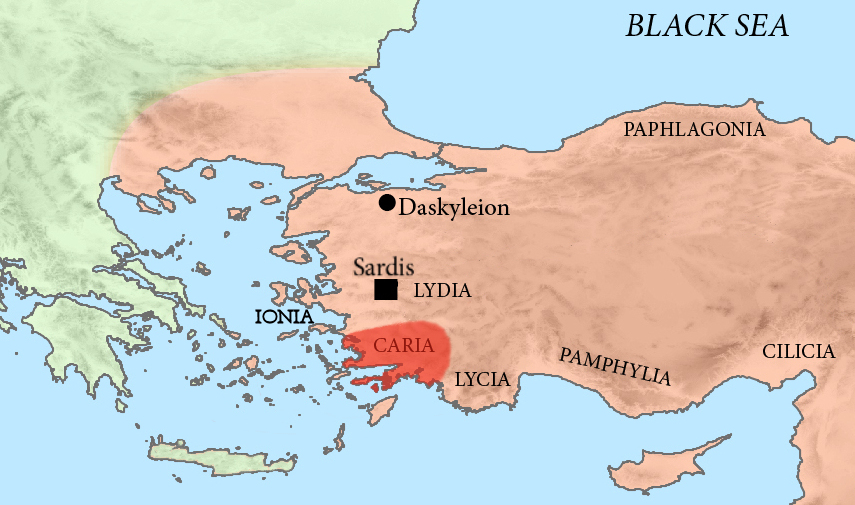
Location of Caria within the classical regions of Asia Minor
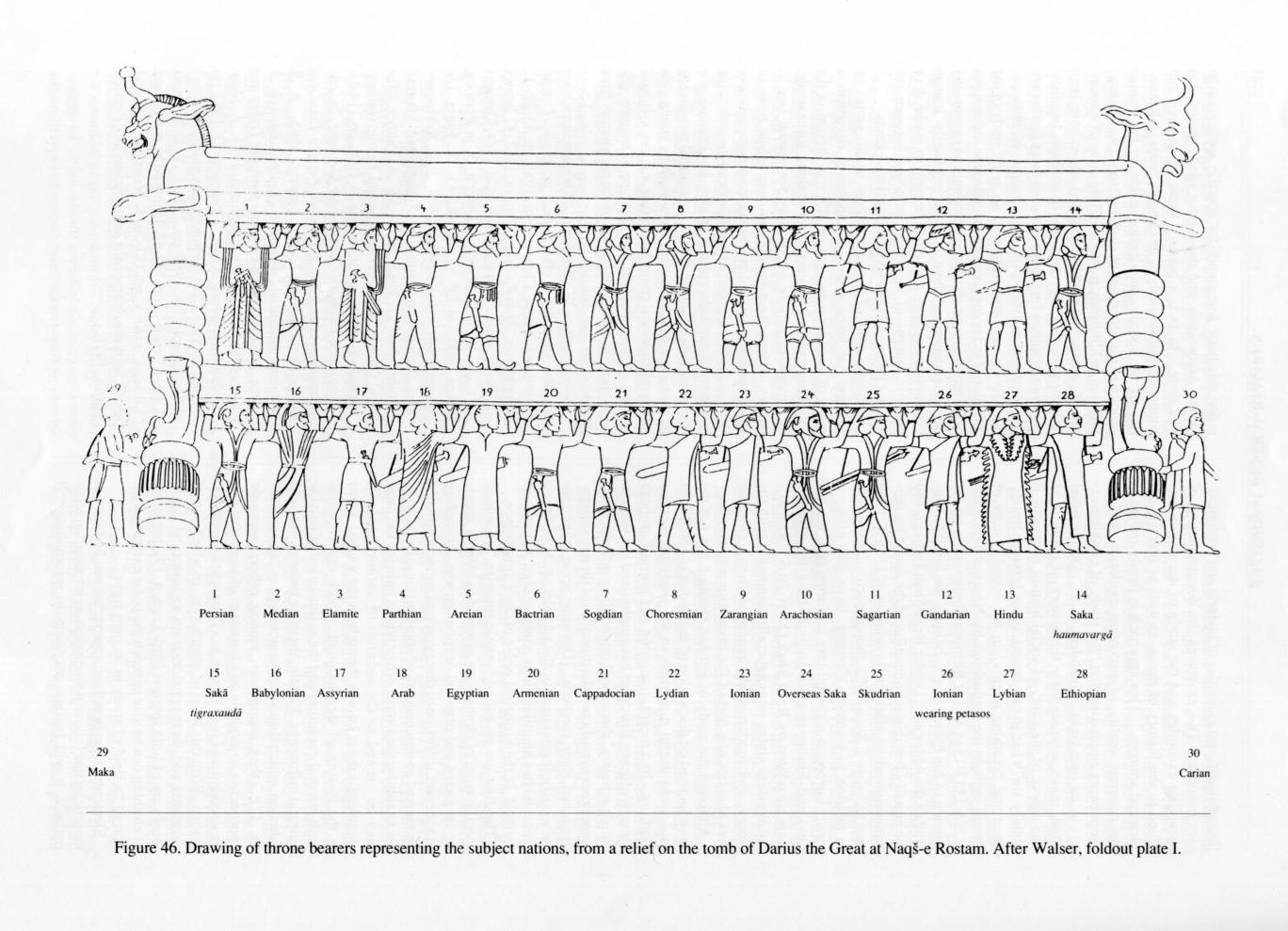
Carian soldier of the Achaemenid army c. 480 BC. Tomb of Xerxes I.[1]
Ancient copy of the cult image of a local Hellenistic goddess as Aphrodite at Aphrodisias

The Carians (/ˈkɛəriənz/; Ancient Greek: Κᾶρες, Kares, plural of Κάρ, Kar[2]) were the ancient inhabitants of Caria in southwest Anatolia, who spoke the Carian language.

Historical accounts

[edit]

Karkisa

[edit]

It is not clear when the Carians enter into history. The definition is dependent on the corresponding Caria and the Carians to the "Karkiya" or "Karkisa" mentioned in the Hittite records. Bronze Age Karkisa are first mentioned as having aided the Assuwa League against the Hittite King Tudhaliya I. Later in 1323 BC, King Arnuwandas II was able to write to Karkiya for them to provide asylum for the deposed Manapa-Tarhunta of "the land of the Seha River", one of the principalities within the Luwian Arzawa complex in western Anatolia. This they did, allowing Manapa-Tarhunta to take back his kingdom. In 1274 BC, Karkisa is also mentioned among those who fought on the Hittite Empire side against the Egyptians in the Battle of Kadesh. Taken as a whole, Hittite records seem to point to a Luwian ancestry for the Carians and, as such, they would have lost their literacy through the Dark Age of Anatolia.[citation needed]

The relationship between the Bronze Age "Karkiya" or "Karkisa" and the Iron Age Caria and the Carians is complicated, despite having western Anatolia as common ground, by the uncertainties regarding the exact location of the former on the map within Hittite geography.[3] Yet, the supposition is suitable from a linguistic point of view, given that the Phoenicians were calling them "KRK" in their abjad script, and they were referred to as krka in Old Persian.

Homer

[edit]

The Carians next appear in records of the early centuries of the first millennium BC; Homer's writing about the golden armour or ornaments of the Carian captain Nastes, the brother of Amphimachus and son of Nomion,[4] reflects the reputation of Carian wealth that may have preceded the Greek Dark Ages and thus recalled in oral tradition.

Old Testament

[edit]

In some translations of Biblical texts, the Carians are mentioned in 2 Kings 11:4 and 19 (/kɑˈɽi/; כָּרִי, in Hebrew, literally "like fat sheep/goat", contextually "noble" or "honored"),[a] and perhaps alluded to in 2 Samuel 8:18, 15:18, and 20:23 (/kɽɛˈti/; כְּרֵתִי, probably unrelated due to the "t", may be Cretans). They are also named as mercenaries in inscriptions found in ancient Egypt and Nubia, dated to the reigns of Psammetichus I and II. They are sometimes referred to as the "Cari" or "Khari". Carian remnants have been found in the ancient city of Persepolis or modern Takht-e-Jamshid in Iran.

Greek and Roman Antiquity

[edit]

The Greek historian Herodotus recorded that Carians believed themselves to be the aborigines of Caria, but they were also, by general consensus of ancient sources, a maritime people before being gradually pushed inland.[6] Plutarch mentions the Carians as being referred to as "cocks" by the Persians on account of their wearing crests on their helmets; the epithet was expressed in the form of a Persian privilege when a Carian soldier responsible for killing Cyrus the Younger was rewarded by Artaxerxes II (r. 405/404–359/358 BC) with the honor of leading the Persian army with a golden cock on the point of his spear.[7]

According to Thucydides, it was largely the Carians who settled the Cyclades before the Minoans. The Middle Bronze Age (MMI–MMII) expansion of the Minoans into this region seems to have come at their expense. Intending to secure revenue in the Cyclades, Minos of Knossos established a navy with which he established his first colonies by taking control of the Hellenic sea and ruling over the Cyclades. In doing so, Minos expelled the Carians, many of whom had turned to piracy as a way of life. During the Athenian purification of Delos,[clarification needed] all graves were exhumed, and it was found that more than half were Carians (identified by the style of arms and the method of interment).[8]

According to Strabo, Carians, of all the "barbarians", had a particular tendency to intermingle with the Greeks,

"This was particularly the case with the Carians, for, although the other peoples were not yet having very much intercourse with the Greeks nor even trying to live in Hellenic fashion or to learn our language ... yet the Carians roamed throughout the whole of Greece serving on expeditions for pay. ... and when they were driven thence [from the islands] into Asia, even here they were unable to live apart from the Greeks, I mean when the Ionians and Dorians later crossed over to Asia." (Strabo 14.2.28)

Indeed, the term barbarian was coined by Homer in reference to the Carians speaking an unintelligible language.[9]

Greek mythology

[edit]

According to Herodotus, the Carians were named after an eponymous Car, a legendary early king and a brother of Lydus and Mysus, also eponymous founders respectively of Lydians and Mysians, and all sons of Atys.[10]

Homer records that Miletus (later an Ionian city), together with the mountain of Phthries, the river Maeander and the crests of Mount Mycale were held by the Carians at the time of the Trojan War and that the Carians, qualified by the poet as being of incomprehensible speech, joined the Trojans against the Achaeans under the leadership of Nastes, brother of Amphimachos ("he who fights both ways") and son of Nomion. These figures appear only in the Iliad and in a list in Dares of Phrygia's epitome of the Trojan War.

Classical Greeks would often claim that part of Caria to the north was originally colonized by Ionian Greeks before the Dorians.

The Greek goddess Hecate possibly originated among the Carians.[11] Indeed, most theophoric names invoking Hecate, such as Hecataeus or Hecatomnus, the father of Mausolus, are attested in Caria.[12]

Carians and Leleges

[edit]

The Carians were often linked by Greek writers to the Leleges, but the exact nature of the relationship between Carians and Leleges remains mysterious. The two groups seem to have been distinct, but later intermingled with each other. Strabo wrote that they were so intermingled that they were often confounded with each other.[13] However, Athenaeus stated that the Leleges stood in relation to the Carians as the Helots stood to the Lacedaemonians.[14] This confusion of the two peoples is found also in Herodotus, who wrote that the Carians, when they were allegedly living amid the Cyclades, were known as Leleges.[10]

Archaeologists studying a Carian tomb in Milas, Beçin.

Language

[edit]

The Carian language belongs to the Luwic group of the Anatolian family of languages. Other Luwic languages besides Luwian proper are Lycian and Milyan (Lycian B). Although the ancestors of Carian and Lycian must have been very close to Luwian, it is probably incorrect to claim that they are linear descendants of Luwian.[15] It is possible that the speakers of Proto-Carian, or the common ancestor of Carian and Lycian, supplied the elites of the Bronze Age kingdom of Arzawa, the population of which partly consisted of Lydians.[16]

An important evidence of the Carians' own belief in their blood ties and cultural affinity with the Lydians and Mysians is the admittance, apart from theirs, exclusively of Lydians and Mysians to the temple of the "Carian Zeus" in their first capital that was Mylasa.

Religion

[edit]

One of the Carian ritual centers was Mylasa, where they worshipped their supreme god, called "the Carian Zeus" by Herodotus. Unlike Zeus, this was a warrior god.

It is possible that the goddess Hecate, the patron of pathways and crossroads, originated among the Carians.[17] Herodotus calls her Athena and says that her priestess would grow a beard when disaster pended.[18]

On Mount Latmos near Miletus, the Carians worshipped Endymion, who was the lover of the Moon and fathered fifty children. Endymion slept eternally in the sanctuary devoted to him, which lasted into Roman times.

There is at least one named priestess known to us from this region, Carminia Ammia who was priestess of Thea Maeter Adrastos and of Aphrodite.

Archaeology

[edit]

Throughout the 1950s, J.M. Cook and G.E. Bean conducted exhaustive archaeological surveys in Caria.[19] Cook ultimately concluded that Caria was virtually devoid of any prehistoric remains. According to his reports, third millennium finds were mostly confined to a few areas on or near the Aegean coast. No finds from the second millennium were known aside from the Submycenean remains at Asarlik and the Mycenaean remains at Miletus and near Mylasa. Archaeologically, there was nothing distinguishing about the Carians since the material evidence so far only indicated that their culture was merely a reflection of Greek culture.[20]

During the 1970s, further archaeological excavations in Caria revealed Mycenean buildings at Iasus (with two "Minoan" levels underneath them),[21] as well as Protogeometric and Geometric material remains (i.e. cemeteries and pottery).[22] Archaeologists also confirmed the presence of Carians in Sardis, Rhodes, and in Egypt where they served as mercenaries of the Pharaoh. In Rhodes, specifically, a type of Carian chamber-tomb known as a Ptolemaion may be attributed to a period of Carian hegemony on the island.[23] Despite this period of increased archaeological activity, the Carians still appear not to have been an autochthonous group of Anatolia since both the coastal and interior regions of Caria were virtually unoccupied throughout prehistoric times.[24]

As for the assumption that the Carians descended from Neolithic settlers, this is contradicted by the fact that Neolithic Caria was essentially desolate.[25][failed verification] Though a very small Neolithic population may have existed in Caria,[26] the people known as "Carians" may in fact have been of Aegean origin that settled in southwestern Anatolia during the second millennium BC.[27]

See also

[edit]

Notes

[edit]

References

[edit]

Further reading

[edit]
[edit]
Revisions and contributorsEdit on WikipediaRead on Wikipedia
from Grokipedia
The Carians were an ancient indigenous people of southwestern Anatolia, primarily inhabiting the rugged region of Caria (modern-day southwestern Turkey) from at least the early 2nd millennium BCE, as evidenced by references to "Karkissa" in Hittite and Assyrian texts.[1] Renowned as skilled warriors and sailors, they served as mercenaries for foreign powers, including the Egyptian pharaoh Psammetichus I in the 7th century BCE and the Persian Empire after its conquest of the region around 545 BCE.[2][1] Their language, Carian, belonged to the Anatolian branch of the Indo-European family and was related to Luwian, Lycian, and Lydian; it was written in a distinctive script derived from Phoenician influences, with numerous inscriptions surviving from Egypt where Carian mercenaries settled in communities like Memphis during the Late Period (ca. 664–332 BCE).[1][2] Culturally, the Carians blended indigenous traditions with influences from neighboring Ionians and later Persians, developing a polytheistic religion that venerated deities such as Zeus Carius (a war god) and Hecate, with major sanctuaries at Mylasa.[1] Politically, Caria achieved prominence under the Hecatomnid dynasty (ca. 391–326 BCE), a Persian satrapal family that fostered architectural and cultural achievements, including the Mausoleum at Halicarnassus—built for Mausolus (r. 377–353 BCE) and considered one of the Seven Wonders of the Ancient World.[1] Notable figures included Artemisia I of Caria, who commanded Persian forces during the Battle of Salamis in 480 BCE, and Artemisia II, who co-ruled after her brother-husband Mausolus and funded the mausoleum's construction.[1] The Carians participated in key events like the Ionian Revolt against Persia (499–493 BCE) and later integrated into the Hellenistic world following Alexander the Great's conquest in 334 BCE, gradually Hellenizing while preserving elements of their distinct identity.[1]

Geography and Territory

Location and Extent

Caria was an ancient region situated in southwestern Anatolia, encompassing parts of modern-day provinces such as Aydın, Muğla, and western Denizli in Turkey.[3] It was bordered by Lydia to the north along the Meander River (modern Büyük Menderes), Phrygia to the northeast, Lycia to the southeast, and the Aegean Sea to the west and south.[3][4] The topography of Caria was characterized by rugged mountainous terrain, including ranges such as the Latmus (modern Beşparmak Mountains) and Messogis, which created tectonic blocks, high plateaus, and narrow alluvial valleys.[3] Fertile coastal plains, notably the expansive Maiandros plain, contrasted with the fragmented western coastline featuring high cliffs, gulfs, and natural bays that facilitated maritime access.[3] Offshore, the region included numerous Aegean islands formed by geological faulting, with larger ones like Rhodes and Kos occasionally falling under Carian political influence during periods of expansion.[3][4] Caria's Mediterranean climate, marked by mild, wet winters and hot, dry summers, supported diverse vegetation and agriculture in its valleys and plains.[3] Key resources included fertile soils yielding crops such as olives, figs, grains, and vines, alongside maritime fisheries, timber from forested highlands, marble quarries, and honey production, all of which underpinned local economies and enabled trade through its natural ports and river systems.[3]

Major Settlements and Sites

The major settlements of the Carians were distributed across the rugged terrain of southwestern Anatolia, with coastal cities serving as vital hubs for maritime trade and defense, while inland sites focused on agriculture, administration, and religious activities. Halicarnassus, located on a prominent peninsula along the Aegean coast, emerged as the political capital under the Hecatomnid dynasty in the 4th century BCE, functioning as a key port that facilitated commerce and naval operations due to its natural harbor sheltered by the surrounding hills.[5] Mylasa, situated in the interior highlands near the Maeander River valley, served as an early administrative and religious center for the native Carian dynasties, organized around hilltop sanctuaries that integrated local rock formations for defensive and ceremonial purposes.[5] Cnidus, positioned on a double peninsula projecting into the Aegean, was a prominent maritime center renowned for its temple of Aphrodite, which drew pilgrims and enhanced its role in regional trade networks, leveraging its strategic coastal location for shipbuilding and commerce.[5] Miletus, though primarily a Greek colony, exhibited strong Carian influences in its early population and speech patterns, acting as a major trade hub with access to fertile plains and a deep-water harbor that supported extensive commercial exchanges across the Aegean.[6] Iasus, built on an island connected to the mainland by a causeway in the Gulf of Iasos, relied on its enclosed harbor for fishing, marble quarrying, and defense, with cliffs providing natural fortifications against invasions. Inland settlements like Stratonicea, located on a plain near the sources of the Marsyas River and overlooked by fortified hills, functioned as an agricultural and administrative outpost, with its integration of local topography supporting grain production and serving as a gathering point for Carian communities.[7] These sites exemplified how Carian settlements adapted to the mountainous and coastal geography, with coastal ones emphasizing trade and naval power, and interior ones prioritizing sustenance and governance.[5]

Origins and Early History

Prehistoric Roots and Migration Theories

The origins of the Carians remain a subject of scholarly debate, contrasting ancient literary accounts with archaeological findings that suggest deep roots in Anatolian prehistory. The Greek historian Herodotus (c. 484–425 BCE) claimed that the Carians migrated from the Aegean islands, specifically from Crete, where they were originally known as Leleges and served as subjects of King Minos before settling in southwest Anatolia.[6] However, this migratory narrative from Minoan Crete has been challenged by modern archaeology, which indicates continuity of indigenous Anatolian populations in the region from the Bronze Age, with no clear evidence of large-scale island-to-mainland migration during the 2nd millennium BCE.[8] Excavations at sites like Iasos in coastal Caria reveal human occupation dating back to at least the early 3rd millennium BCE, supporting the view that the Carians developed as an indigenous group rather than recent arrivals.[8] Archaeological evidence points to strong connections between the Carians and other Bronze Age Anatolian groups, particularly the Luwians, an Indo-European people who inhabited western and southwestern Anatolia during the 2nd millennium BCE. The Carian language, classified as part of the Anatolian branch of Indo-European, shares typological features with Luwian, suggesting cultural and possibly ethnic continuity from Luwian-speaking communities in the Late Bronze Age.[9] Some scholars propose tentative links to the Sea Peoples, a confederation of maritime raiders active around 1200 BCE, with elements like the Karkisa potentially including proto-Carian groups from the Aegean-Anatolian interface, though direct evidence remains circumstantial and debated.[10] These ties align with broader patterns of interaction between Anatolian highlands and pre-Greek Aegean populations, evidenced by shared material culture across the region.[11] Pottery and burial practices provide key indicators of Carian presence in the 2nd millennium BCE, predating Greek colonization by centuries. In Early Bronze Age II (c. 2700–2200 BCE) contexts across Caria, ceramics exhibit new forms such as wheel-turned vessels with incised decorations and horizontal handles, reflecting intensified trade and cultural exchanges with neighboring Anatolian and Aegean groups.[12] Cemeteries from this period, including those at sites like Asartepe and Çine-Tepecik, feature pithos burials—large storage jars used as coffins for multiple interments—alongside simple pit graves containing pottery offerings, a practice consistent with broader western Anatolian traditions and indicative of settled communities by the mid-2nd millennium BCE.[13] This material record underscores an ethnogenesis rooted in local Bronze Age developments, rather than abrupt migration.[12]

Earliest Historical Mentions

The earliest historical mentions of the Carians emerge in cuneiform records from the ancient Near East, where the region is referred to as Karkiya or Karkisa, denoting a western Anatolian entity. These references appear in Hittite texts from the 14th–13th centuries BCE, but persist into the Neo-Assyrian period of the 8th–7th centuries BCE, during which Karkiya is noted as part of the broader Anatolian territories under Assyrian influence, with local rulers paying tribute to kings such as Sargon II (r. 722–705 BCE). This identification links Karkiya linguistically and geographically to the later Greek Caria, highlighting the Carians as a distinct group in southwestern Anatolia engaged in interactions with Mesopotamian powers.[1] In Greek literary sources, the Carians receive their first explicit mention in Homer's Iliad, composed around the 8th century BCE, where they are portrayed as non-Greek-speaking allies (barbarophōnoi) of the Trojans during the Trojan War. Led by the brothers Nastes and Amphimachus, the Carians hail from Miletus and the branches of the Maeander (a river in western Anatolia), emphasizing their Anatolian origins and martial role in the conflict.[14] This depiction underscores their position as indigenous inhabitants of the region, distinct from the Greek forces, and bridges earlier Near Eastern records to classical Greek awareness of the group. Biblical texts from the 7th–6th centuries BCE also allude to the Carians, particularly in the Book of Jeremiah, where they are referenced among foreign mercenaries serving in the Egyptian army. In prophecies against Egypt, these warriors—likely including Carian auxiliaries known for their expertise in combat—are described as fleeing like "fattened calves" in the face of disaster, reflecting their role as hired fighters in regional conflicts during the late Neo-Assyrian and early Neo-Babylonian eras. Such mentions portray the Carians as renowned soldiers for hire, extending their historical footprint into Judean prophetic literature.

Historical Development

Classical Greek and Persian Periods

The Carians came under Achaemenid Persian control following Cyrus the Great's conquest of Lydia in 546 BCE, after which the region submitted to Persian authority without significant resistance, becoming part of the empire's western satrapies.[15] Initially administered as a dependency within the Lydian satrapy, Caria gradually achieved greater autonomy under local dynasts who served as Persian satraps, balancing loyalty to the Great King with regional influence.[16] This period marked a shift from relative independence to integration into the Persian administrative system, where Carian rulers contributed military forces and tribute while maintaining cultural distinctiveness.[17] During the Ionian Revolt of 499–493 BCE, the Carians actively participated on the side of the rebelling Greek cities in Asia Minor, driven by resentment toward Persian overlordship and hopes for greater autonomy.[18] They achieved a notable victory at the Battle of Pedasus in 496 BCE, where Carian forces ambushed and annihilated a Persian army led by Daurises, temporarily stalling Persian reconquest efforts in the region.[19] Despite this success, the revolt ultimately failed, leading to harsh Persian reprisals, including the destruction of Miletus; the Carians were subdued and compelled to provide ships and troops for subsequent Persian campaigns.[18] In the ensuing Persian Wars, Carian contingents fought under Persian command, most famously exemplified by Artemisia I, the dynast of Halicarnassus, who served as a naval commander during Xerxes I's invasion of Greece in 480 BCE.[20] Artemisia led five ships at the Battle of Salamis, where her tactical acumen—advising against the naval engagement and later ramming a Greek ship to evade pursuit—earned high praise from Xerxes, highlighting the valued role of Carian leaders in Persian military strategy.[20] The Hecatomnid dynasty, founded by Hecatomnus around 395–391 BCE, epitomized Carian semi-independence within the Achaemenid framework, with satraps exercising considerable authority over Caria, Lycia, and parts of Ionia while nominally loyal to Persia.[17] Under Mausolus (r. 377–353 BCE), the dynasty reached its zenith; he expanded Carian territory by annexing Greek cities like Rhodes and Chios, concluded independent treaties with entities such as Phaselis, and promoted cultural Hellenization through urban refoundings (e.g., Cnidus and Priene) and the construction of the Mausoleum at Halicarnassus, a grand tomb that symbolized dynastic power and blended Carian, Greek, and Persian architectural elements.[21] Mausolus participated in the Revolt of the Satraps (366–360 BCE), allying briefly with other western satraps against Artaxerxes II before submitting and regaining favor, which underscored the fragile balance of autonomy amid Persian oversight.[17] His sister-wife Artemisia II (r. 353–351 BCE) continued this policy, enhancing the Mausoleum with renowned Greek sculptors like Scopas and Pliny the Elder.[21] Later Hecatomnid rulers faced increasing internal strife, culminating in the usurpation by Pixodarus (r. 340–334 BCE), who overthrew his sister Ada with possible Persian backing, consolidating control over Caria and Lycia but sparking resistance from Ada's supporters in rural strongholds like Alinda.[22] This internal satrap revolt highlighted dynastic vulnerabilities and the Persian court's willingness to intervene in Carian affairs to maintain stability.[22] Pixodarus sought alliances beyond Persia, notably proposing a marriage between his daughter and Philip II's son Arrhidaeus in 337 BCE to counter rising Macedonian influence, though the plan was thwarted by Alexander the Great's opposition.[22] These events reflected the Hecatomnids' ongoing navigation of Persian subjugation and regional ambitions until the eve of Alexander's conquest in 334 BCE.

Hellenistic and Roman Eras

The conquest of Caria by Alexander the Great in 334 BCE marked the region's integration into the expanding Macedonian empire, facilitated by the local dynast Ada, who had been ousted by Persian authorities but allied with Alexander and formally adopted him as her son, allowing her to resume rule over much of Caria until her death in 326 BCE.[1] During this initial phase, Alexander's forces faced resistance at Halicarnassus, the former Hecatomnid capital, but the city's fall enabled rapid Macedonian control over the Carian hinterland and coast.[23] Following Alexander's death in 323 BCE, Caria became a contested territory among his successors (Diadochi), initially falling under Antigonus I Monophthalmus after the Battle of Ipsus in 301 BCE, before passing to Lysimachus of Thrace around 285 BCE.[1] By the mid-third century BCE, Caria experienced divided Hellenistic overlordship, with Ptolemaic Egypt exerting influence over coastal areas and islands through naval power and alliances, as seen in Ptolemy II Philadelphus's control of key sites like Stratonicea during the First Syrian War (274–271 BCE).[24] Inland regions, however, aligned more closely with the Seleucid Empire under Antiochus I and II, who established administrative foundations and garrisons to consolidate power, though local dynasts maintained semi-autonomous rule in cities like Aphrodisias, founded as a Hellenistic city-state in the early second century BCE amid regional urbanization.[24][25] This period saw cultural Hellenization intensify, with Koine Greek supplanting the Carian language in inscriptions and administration, while local elites adopted Greek civic institutions without fully erasing indigenous traditions.[26] Roman expansion into Caria accelerated after the defeat of the Seleucids at the Battle of Magnesia in 190 BCE, leading to the Treaty of Apamea in 188 BCE, which ceded southwestern Anatolia to Pergamon and Rhodes; the Pergamene portion, including much of Caria, was bequeathed to Rome upon Attalus III's death in 133 BCE, formally incorporating it into the province of Asia by 129 BCE under consul Marcus Perperna.[1][27] Cities like Halicarnassus retained privileged status as a "free city" (civitas libera), exempt from direct taxation and governed by local councils, allowing it to preserve Hellenistic urban structures while integrating Roman imperial cults and infrastructure, such as aqueducts and theaters.[23] Gradual Romanization manifested in elite adoption of Latin nomenclature, villa estates in the countryside, and economic ties to Rome via marble exports from sites like Aphrodisias, which flourished as a sculptural center under imperial patronage.[28] In late antiquity, Caria transitioned under the Byzantine Empire as part of the Thema Kibyrrhaioton, a maritime administrative district formed in the seventh century CE to counter Arab threats, with cities like Myra serving as key ecclesiastical centers.[26] Christianization progressed slowly from the fourth century, driven by imperial edicts under Constantine and Theodosius, transforming pagan sanctuaries—such as the Temple of Aphrodite at Aphrodisias—into churches, though elite resistance persisted in rural areas until the sixth century.[26][29] By the seventh century, Arab invasions under the Rashidun and Umayyad caliphates raided Carian coasts, disrupting trade and accelerating the shift to a more fortified, medieval Byzantine character, though the region remained under imperial control until later Seljuk incursions.[26]

Language and Writing

Linguistic Classification and Features

The Carian language is classified as a member of the Luwic subgroup within the Anatolian branch of the Indo-European language family.[30] It shares close affinities with other Luwic languages such as Luwian and Lycian, as well as the more distantly related Lydian, all of which diverged early from Proto-Anatolian around the 2nd millennium BCE. This classification was firmly established through comparative analysis of inscriptions and proper names, particularly following the discovery of the Greek-Carian bilingual from Kaunos in 1996, which confirmed Carian's Indo-European status and its specific ties to the Anatolian group.[31] Carian exhibits several grammatical features characteristic of Anatolian languages, though knowledge remains partial due to the limited corpus of approximately 200 inscriptions, mostly short and formulaic. Nouns are inflected for at least nominative, accusative, genitive, and dative cases, with evidence for plural forms in accusative and dative. For instance, the nominative singular of animate nouns typically shows a zero ending, as in kbos ("of Keramos"), reflecting a prehistoric -s inherited from Proto-Indo-European and paralleled in Lycian and Sidetic.[32] The accusative singular animate ends in -n, seen in otonosn ("Athenian"), while the accusative plural uses , as in kbdùnš ("Kaunians"), akin to Hieroglyphic Luwian -nzi. Genitive singular markers include , exemplified by terwezś upe ("stele of T."), and dative singular forms appear as -s or zero, such as šarnaís ("for Šarnai"). These case endings demonstrate Carian's retention of Anatolian morphological patterns, including sibilant markers and pre-head genitive positioning similar to Lycian.[32] Verbal morphology is less well-attested, with no undisputed verbal forms securely identified, though relics suggest conjugation patterns akin to other Anatolian languages, including a past singular marker -un.[33] The vocabulary remains largely undeciphered, with many words lacking clear cognates in other Indo-European languages, pointing to possible influences from non-Indo-European substrates in prehistoric Anatolia, such as Hattic or other pre-Anatolian tongues that may have shaped Carian lexicon and phonology. Partial grammatical insights derive primarily from bilingual inscriptions and onomastic comparisons, revealing a language distinct from its Luwic relatives yet sharing core Anatolian traits like simplified case systems compared to Hittite.[31] Carian fell out of use by the 1st century CE, supplanted by Greek amid Hellenistic and Roman hellenization in the region. Surviving traces appear in loanwords and toponyms that influenced local Greek dialects in Caria, particularly in administrative and religious contexts where bilingualism persisted.[34]

Script, Inscriptions, and Decipherment

The Carian script is an alphabetic writing system employed from the 7th century BCE onward to record the Carian language, featuring approximately 30 signs that show clear derivation from the Greek alphabet while incorporating unique letters not attested in Greek. These additional signs likely represent phonemes specific to Carian, resulting in significant deviations from Greek sound values, with only a minority of letters retaining phonetic correspondences to their Greek counterparts.[35] The script was typically written from right to left, though examples of boustrophedon (alternating direction) also occur, reflecting regional variations in scribal practice. The corpus of Carian inscriptions comprises around 200 texts, predominantly short and formulaic, with the majority being funerary stelae, dedicatory offerings, or graffiti rather than extended narratives.[36] Major concentrations of inscriptions have been found in Caria itself, such as at sites including the base of the Mausoleum at Halicarnassus and the city of Kaunos, as well as abroad, particularly in Egypt where Carian mercenaries left numerous records at Naucratis and Memphis during the 7th to 5th centuries BCE.[37] These Egyptian texts, often bilingual with hieroglyphic or demotic Egyptian, form the largest subset of the corpus, totaling about 170 examples, while only around 30 inscriptions originate from Caria proper.[38] Efforts to decipher the Carian script began in the 19th century with initial attempts to match signs to Greek equivalents based on onomastic evidence, but substantial progress occurred in the late 20th century through the work of scholars like John Ray, who utilized Egyptian-Carian bilingual tomb inscriptions from the 1980s to propose sound values for many letters.[38] The discovery of a key Carian-Greek bilingual at Kaunos in 1996 provided critical confirmation for these assignments, enabling the reading of formulaic phrases and proper names, though interpretive challenges persist due to the language's isolation and the brevity of texts.[37] As of 2025, the script's alphabet is considered fully deciphered in terms of sign values, yet the full grammatical and lexical understanding of Carian remains partial, with many words and syntactic structures undeciphered.[39]

Society and Culture

Social Structure and Daily Life

Carian society was organized hierarchically, with dynastic rulers at the apex, exemplified by the Hecatomnid dynasty, which governed as semi-autonomous satraps under Achaemenid Persian oversight from the late 5th to 4th century BCE.[17] These rulers, such as Hecatomnus and his successors Mausolus, Artemisia II, Idrieus, and Pixodarus, maintained familial succession, often through sibling marriages, and exercised control over local towns while allowing significant autonomy to urban centers.[17] Below the ruling elite stood a nobility of landowners and administrators who supported the dynasty's administration and military endeavors. Free farmers formed the bulk of the population, engaged in small-scale cultivation, while slaves, likely captured in wars or born into servitude, provided labor for estates and households.[40] A prominent mercenary class, drawn from various social strata including commoners, enhanced Carian military prominence, serving in foreign armies across Egypt, Babylon, and Persia from the Archaic period onward.[41] Daily life in Caria revolved around an agrarian economy supplemented by herding, fishing, and coastal trade, shaped by the region's mountainous terrain and Mediterranean climate. In rural areas, free farmers and herders raised sheep and goats on scrub-covered highlands, producing wool for weaving, while coastal communities focused on fishing and olive, fig, and vine cultivation in fertile valleys like the Maeander.[3] Urban centers such as Halicarnassus and Mylasa served as hubs for maritime commerce, exporting marble, honey, and agricultural goods to regions including Egypt, contrasting with the more isolated, conservative inland villages.[17] [3] Gender roles generally confined women to domestic spheres, but exceptions arose among the elite, as seen with queens like Artemisia I, who commanded naval forces during the Persian Wars (480 BCE) and advised King Xerxes, demonstrating strategic autonomy rare for her era.[42] Family structures emphasized kinship ties, evident in dynastic intermarriages and communal burial practices, with tumuli serving as prominent markers from the 6th to 4th centuries BCE, often incorporating Lydian-influenced chambers and dromoi to signify status and territorial claims.[43] These earthen mounds, concentrated in valleys like the Harpasos and Marsyas, housed elite burials and reflected a blend of local and external customs, underscoring the importance of ancestral commemoration in Carian social cohesion.[43] Rural families likely centered on extended households managing land and livestock, while urban dwellers participated in markets fostering social exchange, akin to contemporary Greek poleis.[3]

Art, Architecture, and Economy

Carian art displayed a distinctive hybrid style, merging Anatolian indigenous traditions with Greek and Ionian influences, as seen in pottery and metalwork. Pottery, such as skyphoi from sites like Iasos, featured cream slips with black glaze interiors and exterior decorations in brown-black paint, including horizontal bands and handle-zone panels with figurative motifs that echoed Ionian Greek vase painting techniques.[44] Gold jewelry from Carian tombs incorporated intricate Anatolian designs alongside Egyptian-inspired elements, reflecting cultural exchanges through trade and mercenary activities in the eastern Mediterranean.[45] Sculpture, particularly from elite contexts, blended Greco-Anatolian iconography, with motifs like lions and warriors appearing in reliefs and freestanding figures that combined local vigor with Ionian proportions.[46] Carian architecture achieved prominence through monumental tombs and civic structures that fused Greek orders with Anatolian forms, exemplified by temples, fortifications, and the Mausoleum at Halicarnassus. The Mausoleum, commissioned by Queen Artemisia II for her husband Mausolus around 353 BCE, was designed by the Greek architects Satyros and Pythius as a towering structure with a rectangular base, Ionic colonnade, stepped pyramidal roof surmounted by aquadriga, and extensive sculptural programs depicting battles and hunts.[47] This innovative design, rising to approximately 45 meters, integrated podium tombs common in Anatolia with Greek peripteral elements, earning it recognition as one of the Seven Wonders of the Ancient World.[48] Fortifications and temples, such as those at Mylasa, employed local stone masonry with Greek triglyph-frieze systems, supporting dynastic patronage by the Hecatomnids.[49] The Carian economy centered on maritime trade and resource exploitation, leveraging the region's coastal position and forested hinterlands for exports of timber and textiles to Greek and Persian markets. Cities like Iasos contributed to this through local production of timber and charcoal for shipbuilding and fuel, integral to regional commerce.[50] Dynasts introduced coinage in the late 5th century BCE, issuing silver staters from mints like Mylasa featuring local symbols such as roaring lions, which facilitated trade and asserted regional identity under Persian suzerainty.[51] The Hecatomnids expanded this system in the 4th century BCE, minting dynastic silver coinage that supported maritime exchanges, including slaves acquired through warfare and piracy, enhancing Caria's role in Aegean networks.[52]

Religion and Mythology

Deities, Practices, and Sanctuaries

The Carian pantheon featured a syncretic array of deities that blended indigenous Anatolian elements with Greek influences, prominently including Zeus Labraundos, a warrior god depicted wielding a double-headed axe symbolizing power and protection.[53] This deity, central to Carian identity, was worshipped alongside local mother goddesses often equated with figures like Artemis or Demeter, reflecting fertility and protective roles in agrarian society.[54] Hecate, revered as a chthonic and lunar goddess with deep Anatolian roots, held particular prominence in certain regions, while lesser-known local gods such as Sinuri represented communal and ancestral ties.[55] Religious practices among the Carians emphasized communal rituals, including elaborate processions, animal sacrifices, and votive offerings at altars, which reinforced social bonds and territorial claims.[56] Festivals spanning several days incorporated competitive games, ritual banquets in dedicated andrones (dining halls), and libations poured into offering pits, as evidenced by archaeological finds of tableware and inscribed decrees regulating sacred lands.[53] Hero cults honored ancestral figures through dedications, while Anatolian-influenced oracles and secret ceremonies, particularly at Hecate's sites, involved young participants carrying symbolic keys to invoke divine favor.[56] Syncretism was evident in the assimilation of Greek gods, such as Artemis at fortified cult sites, where votive terracottas and altars attest to blended worship practices.[57] Key sanctuaries served as focal points for rural and civic worship, with Labraunda standing as a monumental complex dedicated to Zeus Labraundos, featuring a peripteral temple, stoas, and sacred roads that hosted large-scale gatherings for the Mylasan community.[53] The sanctuary at Lagina, centered on Hecate, included a grand temple with a bothros for chthonic offerings and a propylon gate marking the sacred way for processions from nearby Stratonikeia. Recent excavations in 2024 uncovered a torch and a figurative head of Hecate, enhancing understanding of the site's artifacts. As of 2024, restoration projects are underway to rebuild parts of the temple.[56][58][59] Amyzon, a fortified hilltop site north of Mylasa, housed cults to Zeus Kretagenetas and the mother goddess Diktynna, supported by inscriptions and altars that highlight its role in regional devotion.[57] Sinuri, near Mylasa, functioned as a communal shrine to the god Sinuri, where over 80 inscriptions record land leases and decrees managed by local syngeneiai, underscoring economic and ritual integration.[55] Open-air sanctuaries like Çarıklar in northern Caria, with rock-cut niches and water sources, facilitated Mother Goddess worship through libations and step-altars.[54]

Connections to Greek and Anatolian Myths

In Greek mythology, the Carians were often portrayed as an ancient, indigenous people of southwestern Anatolia, with Herodotus recording their self-identification as autochthonous inhabitants who had always dwelled in the region and bore the same name from antiquity. This claim contrasted with other traditions that traced their origins to eponymous ancestors, such as Car, a legendary figure linked to early kingship in the area and sometimes associated with broader Peloponnesian lineages like the descendants of Phoroneus, reflecting efforts to integrate Carian identity into Hellenic genealogies. In epic narratives, the Carians appeared as non-Greek allies of the Trojans during the Trojan War, led by chieftains Nastes and Amphimachus, whom Homer described as speakers of a barbarous tongue, emphasizing their otherness within the conflict's catalog of forces. Their portrayal in the Argonautica of Apollonius Rhodius is more incidental, situating the voyage's early stages amid Carian-controlled territories like Miletus, which underscored the region's role as a liminal space between Greek heroic exploits and Anatolian domains during the mythic Bronze Age. Mythological traditions also intertwined the Carians with the Leleges, an enigmatic pre-Hellenic group, through legends that merged their identities; Herodotus noted that the Carians were formerly known as Leleges while serving as subjects of the Cretan king Minos in the Aegean islands before migrating to the mainland, a narrative that blurred distinctions and positioned them as part of a shared autochthonous Anatolian heritage. This fusion in legend highlighted the Carians' liminal status between island and continental worlds, often invoked to explain their cultural persistence amid Greek colonization. Anatolian mythological connections for the Carians stem primarily from their language's affiliation with the Luwian branch of Anatolian Indo-European, suggesting potential overlaps in deity concepts with neighboring Hittite and Luwian traditions, such as storm gods like Tarhunt, whose attributes of weather control and kingship protection parallel broader regional motifs that may have influenced Carian lore.[60] Linguistic evidence, including shared phonetic elements like Carian q deriving from Luwian , supports cultural exchanges that could extend to mythic frameworks, though direct Carian attestations of such deities remain sparse in surviving texts. Roman adaptations of these myths occasionally reframed Anatolian migrations to link with Italian foundations, though Virgil's Aeneid focuses more on Trojan exiles than Carians specifically; indirect ties appear through the epic's emphasis on eastern Mediterranean wanderers settling in Italy, echoing legendary dispersals of Trojan allies like the Carians into broader migration narratives that Romans used to legitimize their origins.

Interactions and Relations

With Greeks and Leleges

The Carians maintained complex interactions with Greek settlers, particularly in the Ionian region, where Greek colonization from the late Bronze Age onward exerted pressure on Carian territories in southwestern Anatolia. Greek foundations such as Miletus, Ephesus, and Priene encroached upon traditional Carian lands, leading to both conflict and coexistence as the Ionians established city-states along the Aegean coast.[2] These pressures are evident in ancient accounts, such as Herodotus' description of the Ionians and other Greek groups intermarrying with Carian women during the establishment of their settlements in Asia Minor, which fostered early cultural exchanges but also highlighted ethnic tensions.[61] Hellenization among the Carians progressed through extensive trade networks and intermarriage, introducing Greek artistic motifs, pottery styles, and religious practices into Carian society, especially in coastal cities like Halicarnassus. The historian Herodotus, born in the Carian city of Halicarnassus to a family blending Carian and Greek heritage—his father's name Lyxes being a Hellenized form of a Carian name—exemplifies these ties, as his works reflect intimate knowledge of both cultures.[6] Despite such influences, the Carians preserved a distinct identity, continuing to use their native language in inscriptions and maintaining unique architectural traditions, such as rock-cut tombs, even as Greek elements appeared in urban centers.[62] The relationship between the Carians and the Leleges remains debated, with ancient sources often conflating the two groups as indigenous inhabitants of Caria and adjacent Lycia, while others distinguish them as pre-Carian or allied populations. Homer's Iliad portrays the Leleges as Trojan allies under Altes from Pedasus on the Satnioeis in the Troad, suggesting an early association with the region, whereas Herodotus records that the Greeks termed the Carians "Leleges" during their service as subjects of the Cretan king Minos, though the Carians themselves claimed autochthonous origins as mainlanders. Strabo, drawing on Homeric geography, describes Lelegian settlements in western Caria and Lycia, sometimes equating them with Carians but noting distinctions in legendary migrations from the Troad, where Leleges appear as a separate ethnic group.[63] Archaeological evidence reveals significant overlaps in material culture between purported Carian and Lelegian sites, particularly in Early Iron Age pottery, fortifications, and burial practices across Caria and Lycia, with little indication of sharp ethnic boundaries in the archaeological record.[64] Linguistic analysis further supports connections, as the Carian language belongs to the Anatolian branch of Indo-European, showing affinities with Luwian dialects spoken in nearby regions, potentially linking Leleges to proto-Luwian speakers as a related or antecedent group, though inscriptions do not clearly differentiate the two. These overlaps suggest the Lelegian identity may have been a retrospective construct by later Carians to emphasize indigenous roots amid Greek and Persian influences.[65]

Military Role and Foreign Contacts

The Carians played a significant role as mercenaries in ancient Egyptian armies during the 7th and 6th centuries BCE, particularly under the 26th Dynasty pharaohs Psammetichus I and II, where they served alongside Ionians to help secure Egyptian independence from Assyrian influence.[2] Inscriptions in Carian script from sites in Egypt and Nubia, such as those at Tell Defenneh and Saqqara, attest to their presence and loyalty as elite troops, often referred to as "bronze men" for their armored prowess.[6] These mercenaries contributed to key campaigns, including the reconquest of the Nile Delta, and their service extended to garrison duties that facilitated cultural exchanges between Caria and Egypt.[66] In the Persian Empire, Carians were integrated into the imperial military structure, providing substantial naval support during the Second Persian Invasion of Greece in 480 BCE, with the region supplying 70 triremes to Xerxes' fleet as recorded by Herodotus.[67] A prominent example is Artemisia I, queen of Halicarnassus, who commanded five ships at the Battle of Salamis and demonstrated exceptional tactical acumen by maneuvering her vessel to ram a Greek ship, thereby escaping pursuit and earning Xerxes' admiration for her strategic insight.[20] Carian contingents also participated in land forces, adopting Greek-style equipment like hoplite armor while retaining distinctive weapons such as scimitars and daggers, which enhanced their versatility in Persian armies.[68] The Carians are credited with several military innovations that influenced Greek warfare, including the invention of shield handles (porpax) for better grip, the addition of crests to helmets, and the use of painted devices on shields, as described by Herodotus in his Histories.[69] These advancements, originating from their light infantry traditions, allowed for greater mobility and identification in battle, and Strabo later echoed this attribution, noting Carian origins for shield-holders and emblems. Their naval expertise, honed through coastal operations, further exemplified this prowess, as seen in Artemisia's evasive tactics at Salamis that prioritized cunning over direct confrontation.[20] Carian foreign contacts extended beyond military service to include diplomatic and economic ties, notably through the Hecatomnid dynasty, which ruled as Persian satraps from the late 5th to mid-4th century BCE and forged alliances via marriages, such as that of Ada II to the Persian noble Orontobates.[67] Trade networks linked Caria with Phoenicia and Egypt, where Carian merchants exchanged goods like metals and textiles, evidenced by archaeological finds of Carian pottery in Levantine ports and Egyptian sites.[2] A diaspora of Carians abroad is highlighted by over 170 inscriptions in Carian script discovered in Egypt—far outnumbering the roughly 30 from Caria itself—indicating settled communities of traders and veterans that sustained these international connections.[6]

Archaeology and Legacy

Key Excavations and Discoveries

One of the most significant early excavations in Carian territory occurred at Halicarnassus (modern Bodrum), where British archaeologist Charles Thomas Newton led systematic digs between 1857 and 1859 on behalf of the British Museum, uncovering substantial remains of the Mausoleum, the monumental tomb of Mausolus, satrap of Caria.[70] These efforts revealed a massive podium, sculptural fragments including statues by renowned Greek artists like Scopas, and architectural elements blending Anatolian and Greek styles, providing key evidence of 4th-century BCE royal patronage.[71] In the 20th century, Swedish archaeologists from Uppsala University initiated excavations at the sanctuary of Labraunda in 1948, continuing intermittently into the present day, which exposed a series of terraced temples dedicated to Zeus Labraundos, a deity central to Carian identity.[72] The digs uncovered andron structures for ritual banquets, inscribed bases with dedications by Hecatomnid rulers, and architectural features like the Temple of Zeus rebuilt under Mausolus, illustrating the site's role as a political and religious hub from the 5th century BCE onward.[73] Recent Turkish-led surveys have expanded exploration of Carian coastal sites, including a Turkish-German interdisciplinary project along the coasts of the Karian Chersonesos since 2018, which combines underwater and terrestrial methods to map harbors and settlements. This work has documented submerged structures and artifacts near ancient ports, enhancing understanding of maritime networks in the region during the Hellenistic period. Key discoveries include Carian inscriptions from Egypt, such as the bilingual stelae from Saqqara dating to the 6th-5th centuries BCE, which record funerary texts in Carian script alongside Egyptian hieroglyphs, evidencing mercenary communities abroad.[74] Tombs with frescoes, like those at Kaunos in eastern Caria, feature painted interiors depicting mythological scenes and daily life from the 4th century BCE, highlighting artistic influences from both local Anatolian and Greek traditions.[75] Urban remains at sites such as Halicarnassus reveal Greco-Anatolian fusion through hybrid city planning, with orthogonal grids integrated into natural topography and temples incorporating Ionian columns with Carian relief motifs.[76] In the 21st century, methodological advances have included GIS mapping in surveys of Keramos (modern Ören) on the Ceramic Gulf, where digital modeling of terrain and settlement patterns has identified previously unrecorded fortifications and agricultural terraces from the Classical period.[77] Bioarchaeological analysis at Carian necropoleis, such as those near Milas, has applied osteological techniques to skeletal remains, revealing dietary patterns and migration indicators through isotopic studies of 5th-4th century BCE burials.[78]

Modern Interpretations and Debates

Modern scholarship continues to debate the ethnic origins of the Carians, challenging ancient accounts such as Herodotus' assertion that they migrated from Crete during the Minoan era. Genetic analyses of Iron Age Anatolian populations, including those from southwestern regions proximate to Caria, indicate a mixed ancestry comprising primarily local Bronze Age Anatolian components with admixtures from Aegean and steppe sources, suggesting continuity with indigenous groups rather than a wholesale Minoan migration.[79] This evidence undermines Herodotus' theory by highlighting gradual cultural and genetic blending in Anatolia over millennia, rather than discrete population displacements. The Carian language remains partially undeciphered, with ongoing scholarly consensus classifying it as an isolate within the Luwian branch of Anatolian Indo-European languages, distinct from Greek or Minoan tongues. Recent philological efforts, building on the 2007 decipherment of the Carian script, have refined readings of inscriptions but yielded no major breakthroughs in the 2020s, including limited applications of computational methods that have not yet produced verifiable new interpretations.[80] This linguistic isolation reinforces views of the Carians as an indigenous Anatolian people, separate from Aegean migrants, though debates persist over potential substrate influences from pre-Indo-European elements.[81] Carian legacy in the Roman era exhibits understudied cultural continuity, with epigraphic evidence showing persistent local naming practices and temple reutilization into late antiquity, yet systematic research on this transition remains sparse compared to Hellenistic studies. In modern Turkey, Carian heritage informs regional identities in areas like Bodrum and Milas, where cosmopolitan narratives blend ancient legacies with contemporary tourism and nationalism, often invoking Carian symbols to assert multicultural roots.[82] Critiques highlight biases in colonial-era archaeology, particularly British and German excavations in Caria during the late 19th and early 20th centuries, which prioritized Greco-Roman monuments over indigenous Anatolian contexts, skewing interpretations toward Hellenic dominance and marginalizing Carian agency in geopolitical heritage discourses.[82]

References

User Avatar
No comments yet.