Hubbry Logo
Carl DavisCarl DavisMain
Open search
Carl Davis
Community hub
Carl Davis
logo
8 pages, 0 posts
0 subscribers
Be the first to start a discussion here.
Carl Davis
Carl Davis
from Wikipedia

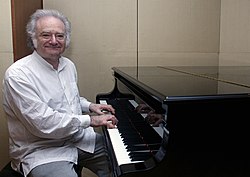
Carl Davis (October 28, 1936 – August 3, 2023) was an American-born British conductor and composer. He wrote music for more than 100 television programmes, notably the landmark ITV series The World at War (1973) and BBC's Pride and Prejudice (1995), and he created new scores for concert and cinema performances of vintage silent movies and composed many film, ballet and concert scores that were performed worldwide, including the Liverpool Oratorio in 1991, in collaboration with Paul McCartney.[1] Davis's publisher was Faber Music.[2]

Key Information

Early life and career

[edit]

Carl Davis was born in Brooklyn, New York, on October 28, 1936,[3][4] to Jewish parents,[5] Sara (née Perlmutter) and Isadore Davis.[6] He studied composition with Paul Nordoff and Hugo Kauder, and subsequently with Per Nørgard in Copenhagen. He attended Bard College, in Annandale-on-Hudson, New York.[7] His early work in the US provided valuable conducting experience with organisations such as the New York City Opera and the Robert Shaw Chorale. In 1959, the revue Diversions, of which he was co-author, won an off-Broadway award and subsequently travelled to the Edinburgh Festival in 1961. As a direct result of its success there, Davis was commissioned by Ned Sherrin to compose music for the original British version of That Was the Week That Was. Other radio and TV commissions followed and Davis's UK career was launched.[3]

Television

[edit]

Davis achieved early prominence with the title music for the BBC's anthology play series The Wednesday Play and later for Play for Today.[8] For the critically acclaimed and popular success Pride and Prejudice (1995) Davis used period classical music as his inspiration, in particular Beethoven's Septet E flat major, Op. 20 and a theme strongly reminiscent of the finale of his Emperor Concerto.[9]

Davis' television scores included The Naked Civil Servant (1975), Shades of Greene (1975), The Kiss of Death (1977), Langrishe, Go Down (1978),[10] Prince Regent (1979),[11] Private Schulz (1980),[12] Oppenheimer (1980), Winston Churchill: The Wilderness Years (1981),[13] The Hound of the Baskervilles (1982), The Far Pavilions (1984), The Day the Universe Changed (1985),[14] The Pickwick Papers (1985), Hotel du Lac (1986), Ashenden (1991), Anne Frank Remembered (1995), Seesaw (1998), Coming Home (1998), Upstairs Downstairs (2010),[8][15] and Brexicuted (2018).[16]

Davis also worked for television producer Jeremy Isaacs in providing the original music for the documentary history series The World at War (1973) for Thames Television,[17] and later Cold War (1998) for the BBC.[10] He conducted the BBC's theme song for its coverage of the 2006 FIFA World Cup, adapted from George Frideric Handel's "See the Conquering Hero Comes".[18]

Silent film music

[edit]

In the late 1970s, Davis was commissioned by documentarians Kevin Brownlow and David Gill to create music for Thames Television's Hollywood: A Celebration of the American Silent Film (1980). His association with them continued the same year with the restoration of Abel Gance's 1927 epic silent film Napoléon, for which Davis' music – drawing once again on Beethoven as a source – was used in its cinematic re-release and television screenings.[19][20] There was a similar treatment for D. W. Griffith's Intolerance: Love's Struggle Through The Ages (1916). This had orchestral music originally, but Davis's new score was used instead in 1989. In March 2012 Davis conducted the Oakland East Bay Symphony, performing his score live during a presentation of Napoleon in the complete Brownlow restoration at the San Francisco Silent Film Festival in Oakland.[21]

The Hollywood documentary series was followed by the documentaries Unknown Chaplin (1983),[22] Buster Keaton: A Hard Act to Follow (1987)[23] and Harold Lloyd: The Third Genius (1989).[24] In the 1980s and 1990s, Davis wrote and conducted the scores for numerous Thames Silents releases and television screenings.[25]

By 1993, his reputation made him the number one choice for new scores to silent films. Many DVD releases, including Ben-Hur (1925), The Phantom of the Opera (1925),[8][26] Safety Last (1923), DeMille's The Godless Girl (1928), Chaplin's City Lights (1931, re-orchestrated by Davis based on Chaplin's and José Padilla's original written score),[27] and Erich von Stroheim's Greed (1924), use Davis's music. Davis also entirely re-scored Clarence Brown's Flesh and the Devil (1927).[28] On several occasions he conducted these scores live in the cinema or concert hall as the film was being screened.[citation needed]

Film music

[edit]

Davis also composed for contemporary films, including the BAFTA and Ivor Novello award winning score for The French Lieutenant's Woman in 1981.[17] His other films included The Bofors Gun (1968),[29] The Only Way (1970), I, Monster (1971),[30] Up Pompeii (1971), Up the Chastity Belt (1971), Rentadick (1972), What Became of Jack and Jill? (1972), Catholics (1973), Man Friday (1975), The Sailor's Return (1978), Champions (1983), King David (1985), The Girl in a Swing (1988),[31] Scandal (1989), The Rainbow (1989), Frankenstein Unbound (1990),[32] The Trial (1993), Widows' Peak (1994), The Great Gatsby (2000), Mothers & Daughters (2004)[33] and The Understudy (2008).[10]

Stage and concert works

[edit]

Although Carl Davis wrote several substantial orchestral and concertante pieces – including the symphonic A Circle of Stones for full orchestra in 1997 – the core of his work outside of film and television was drama and dance, particularly musicals and ballet. He continued to actively compose over the last decade of his life,[17] during which he produced four large scale dance works: Nijinsky (2016) and Chaplin, the Tramp (2019), both for the Slovak National Ballet in Bratislava; The Great Gatsby for the Pittsburgh Ballet Theatre (2019); and most recently the two-act Le Fantôme et Christine, from Gaston Leroux's 1911 novel, which develops themes he first composed for the 1925 silent movie Phantom of the Opera. This received its premiere by the Shanghai Ballet on May 11, 2023.[34] Other works include:

Personal life and death

[edit]

Davis married the British actress Jean Boht on December 28, 1970.[47] They had two daughters, filmmakers Hannah Louise (born 1972) and Jessie Jo (born 1974).[47] Davis also composed music for his daughter Hannah's films Mothers & Daughters (2004) and The Understudy (2008). Davis and his wife were executive producers on the latter, and they appeared in the film as a married couple, the Davidovitches.[48][49]

Davis died from a brain haemorrhage in Oxford on August 3, 2023, aged 86.[2] His wife Jean Boht died a month later on September 12, 2023, aged 91, having suffered from vascular dementia and Alzheimer's disease.[50]

References

[edit]
[edit]
Revisions and contributorsEdit on WikipediaRead on Wikipedia
from Grokipedia
Carl Davis (October 28, 1936 – August 3, 2023) was an American-born British composer, conductor, and renowned for his extensive contributions to , television, and silent cinema scores, as well as his work in , , and . Born in Brooklyn, New York, to Jewish parents of Polish and Russian ancestry, Davis initially pursued in the United States before relocating to in 1961, where he established himself as a versatile all-round over a career spanning more than six decades. Davis's breakthrough in the UK came through collaborations with prestigious institutions, including the National Theatre and Royal Shakespeare Company, where he composed incidental music for stage productions. He gained widespread acclaim for his television scores, most notably the iconic theme for the landmark ITV documentary series The World at War (1973–1974), as well as music for Hollywood (1980), the BBC's Pride and Prejudice (1995), and Goodnight Mister Tom (1998). In film, his score for The French Lieutenant's Woman (1981), directed by Karel Reisz, earned him a BAFTA Award for Best Film Music and an Ivor Novello Award, with six additional BAFTA nominations across his career. A pioneer in reviving silent films through newly composed orchestral scores, Davis created music for over 50 classic pictures, including restorations of Abel Gance's Napoléon (1927), Buster Keaton's The General (1926), and Charlie Chaplin's City Lights (1931), often conducting live performances with major orchestras. His concert repertoire encompassed ballets such as A Simple Man (1987) for Northern Ballet Theatre, collaborations like Paul McCartney's Liverpool Oratorio (1991), and original works including Last Train to Tomorrow (2012) premiered by the Hallé Orchestra. Davis also conducted prominent ensembles, such as the New York City Opera and the London Philharmonic Orchestra, and received an Off-Broadway Obie Award for his early revue Diversions (1959). In recognition of his cultural impact, he was appointed Commander of the Order of the British Empire (CBE) in 2005.

Early life

Childhood and family

Carl Davis was born on October 28, 1936, in Brooklyn, New York, to Jewish immigrant parents of Eastern European origin. His mother, Sara (née Perlmutter), was a teacher, and his father, Isadore Davis, worked for the post office; the family's roots traced back to Poland and Russia. Raised as an only child in a modest Jewish neighborhood in Brooklyn that Davis later recalled as a "ghetto," he grew up in a household where music held a central place, with both parents possessing musical talents themselves. The family actively encouraged his artistic inclinations, providing support that nurtured his burgeoning passion despite their non-professional backgrounds in the field. Davis displayed prodigious musical aptitude from an exceptionally young age, beginning to play the piano at two years old and studying works by Johann Sebastian Bach by the time he was four. His early immersion in classical music stemmed from listening to Metropolitan Opera radio broadcasts and obsessively examining scores borrowed from the Brooklyn Public Library, experiences that fueled his self-directed development and marked the beginnings of a lifelong obsession with composition.

Education and initial training

Davis's formal musical education began in New York, where he studied at Queens College and privately took composition lessons with Paul Nordoff and Hugo Kauder during the late 1940s and 1950s. He furthered his training at the New England Conservatory of Music in Boston, where he worked under conductor Boris Goldovsky, gaining practical experience in making music accessible to audiences. In 1958, Davis graduated from Bard College in Annandale-on-Hudson, New York, with a degree in composition, during which time he began experimenting with scores for theatrical productions. That same year, he co-authored his first notable work, the revue Diversions, which premiered off-Broadway and earned an Obie Award, marking his initial foray into composing for stage and dance. In 1959, Davis studied composition with Per Nørgård at the Royal Danish Conservatory in Copenhagen, an experience that introduced him to European modernism and prompted his first explorations in serialism. This period solidified his technical foundation, blending American practical training with avant-garde influences before transitioning to professional opportunities.

Career beginnings

Early professional work

Davis's entry into professional music began shortly after completing his formal studies in composition at institutions including the New England Conservatory of Music and Bard College. Building on this foundation, he gained initial conducting experience in the late 1950s with prominent American ensembles, serving as an assistant conductor at the New York City Opera in 1958 and working with the Robert Shaw Chorale, which honed his skills in orchestral direction and arrangement. His first significant compositional credit came in 1959 with the off-Broadway revue Diversions, for which he served as co-author and co-composer alongside Stephen Vinaver. The production, a satirical sketch show blending music and theater, earned an Obie Award for its innovative approach, marking Davis's breakthrough in New York’s vibrant theater scene. This work showcased his emerging talent for integrating diverse musical styles, from jazz influences to classical elements, into theatrical contexts. Throughout the early 1960s, Davis contributed incidental music to various American television productions, where he focused on underscoring dramatic segments and building his orchestration expertise through short-form commissions. These assignments, though modest in scale, provided practical experience in adapting scores to visual media and collaborating with production teams, laying groundwork for his later television successes.

Move to the United Kingdom

In 1961, at the age of 25, Carl Davis emigrated from New York to London, drawn by the vibrant European arts scene and opportunities beyond his early career in American theater. His move followed the success of his revue Diversions at the Edinburgh Festival, which transferred to London and opened doors in the British cultural landscape. Davis settled permanently in the United Kingdom, making it his home for the remainder of his life until his death in 2023. Upon arrival, he faced initial challenges adapting to the British theater and television industry, including modest living conditions in decrepit lodgings in Notting Hill. To establish himself, he took on roles as a conductor for BBC productions, leveraging his prior experience as a musical director in the U.S. A pivotal moment came with his first major UK commission in 1962: composing music for the satirical BBC television program That Was the Week That Was, produced by Ned Sherrin, who had seen Davis's work in Edinburgh. This opportunity marked a significant cultural shift, transitioning Davis from American off-Broadway shows to the heart of Britain's burgeoning TV and theater scene. By the mid-1960s, his integration deepened through commissions for prestigious institutions like the Royal Shakespeare Company, solidifying his international career trajectory.

Television compositions

Major series themes

Carl Davis composed music for over 100 television productions throughout his career, establishing himself as a prolific scorer for British broadcasting. One of his most renowned contributions is the theme for the 26-part World War II documentary series The World at War (1973–1974), produced by Thames Television, where his orchestral score blended dramatic intensity with a sense of historical gravitas to underscore the narrative's epic scope. The main title theme, performed by the City of Prague Philharmonic Orchestra under Davis's direction, has become synonymous with the series' authoritative portrayal of the conflict, influencing subsequent documentary soundtracks through its emotive and symphonic approach. For the BBC's Hollywood: A Celebration of the American Silent Film (1980), a 13-part series chronicling early cinema history, Davis crafted a score that incorporated thematic motifs to evoke distinct eras, from the Keystone comedies to the epics of the late silent period, enhancing the visual archival footage with period-inspired orchestration. This work marked a pivotal collaboration with filmmakers Kevin Brownlow and David Gill, highlighting Davis's ability to tailor music to historical contexts and contributing to the series' enduring appeal as an educational landmark. Davis's scores for period dramas further demonstrated his versatility in evoking Regency and early 20th-century atmospheres through appropriate orchestration. For the BBC's Pride and Prejudice (1995), his theme and incidental music featured elegant strings and chamber-like ensembles that complemented Jane Austen's wit and social commentary, becoming one of the most recognizable television motifs of the decade. Similarly, in The Naked Civil Servant (1975), a biographical drama about Quentin Crisp starring John Hurt, Davis employed a mix of cabaret-inflected jazz and subtle orchestral layers to reflect the interwar bohemian setting and the protagonist's defiant persona. Among his extensive television oeuvre, notable examples include the poignant score for The Snow Goose (1971), an adaptation of Paul Gallico's novella that utilized lyrical orchestral writing to convey themes of loss and redemption, and the music for Silas Marner (1985), a BBC version of George Eliot's novel where Davis's arrangements captured the rural 19th-century English milieu with folk-tinged instrumentation. These compositions exemplify Davis's skill in integrating music narratively to amplify emotional and cultural resonance in television storytelling.

Awards and impact in TV

Carl Davis received significant recognition for his television compositions, particularly his score for the landmark 1973–1974 documentary series The World at War. His score for the series was widely acclaimed, praised for its evocative use of deep bass notes and orchestral tension that underscored the human cost of World War II. Throughout his career, Davis earned multiple nominations from the Ivor Novello Awards for his television scores, highlighting his versatility in dramatic and historical programming. Notable among these was a 1996 nomination in the Best Television Music category for his score to the BBC's 1995 adaptation of Pride and Prejudice, where his neoclassical arrangements, drawing on period-appropriate styles, enhanced the Regency-era narrative without overpowering the dialogue. He received another nomination in 2013 for Best Television Soundtrack for the second series of the Upstairs, Downstairs revival, where he adapted the original theme into a jazzy foxtrot to reflect the interwar period's social shifts. Davis's television music had a profound and lasting impact, with themes like that of The World at War becoming iconic markers for historical documentaries, evoking solemnity and gravitas in a way that shaped the genre's sonic identity. His ability to blend orchestral depth with narrative precision influenced subsequent composers in creating atmospheric scores for factual programming, establishing a benchmark for emotional resonance in British television history. Following his death in 2023, tributes from figures like Paul McCartney emphasized this legacy, noting Davis's role in elevating TV dramas such as Pride and Prejudice and the Upstairs, Downstairs revival through scores that captured cultural epochs with authenticity and emotional depth.

Film and silent film scores

Feature film music

Carl Davis composed original scores for several narrative feature films, often emphasizing emotional resonance through lush orchestral arrangements that blended romantic lyricism with dramatic intensity. His work in this medium drew on his expertise in silent film restorations, where he honed a sensitivity to visual storytelling that informed his approach to underscoring modern narratives. One of his most acclaimed contributions was the score for Karel Reisz's The French Lieutenant's Woman (1981), a romantic period drama starring Meryl Streep and Jeremy Irons. Davis's music, featuring sweeping strings and poignant themes, evocatively captured the film's themes of forbidden love and Victorian restraint, earning him the BAFTA Award for Best Film Music and a Grammy nomination for Best Album of Original Score Written for a Motion Picture or Television Special. Davis collaborated with director Karel Reisz on this project, marking a key partnership in his feature film career that highlighted his ability to tailor scores to introspective character-driven stories. In Champions (1983), directed by John Irvin and based on the true story of jockey Bob Champion, Davis crafted a score centered on uplifting brass and strings to convey themes of perseverance and triumph amid illness and competition. The main theme, performed by the Bournemouth Symphony Orchestra, became an iconic motif, blending optimism with emotional depth through piano and orchestral swells that underscored the film's inspirational narrative. For The Girl in a Swing (1988), a supernatural thriller directed by Gordon Hessler and adapted from Richard Adams's novel, Davis's composition utilized delicate piano and string ensembles to heighten the mood of doomed romanticism and psychological tension. The score's soaring melodies amplified the film's eerie eroticism, providing a subtle yet immersive backdrop to the story's exploration of obsession and fate. Davis continued composing for features into the late 20th and early 21st centuries, incorporating contemporary elements with classical influences in films that demanded nuanced emotional layering, though his later works often revisited themes of human resilience seen in his earlier scores.

Silent film restorations

Carl Davis played a pivotal role in the revival of silent cinema through his compositions for restored films, particularly as the primary composer for the Thames Silents series launched by Channel 4 in 1980 in collaboration with film historian Kevin Brownlow. This initiative aimed to accompany classic silent films with newly composed orchestral scores performed live, breathing new life into the era's visuals and narratives. Davis's breakthrough came with his score for Abel Gance's epic Napoléon (1927), completed in 1980, which drew on Beethoven's compositions, French Revolutionary songs, and period folk music to authentically capture the film's historical scope. The score premiered in November 1980 at the Empire Leicester Square in London, conducted by Davis to a sold-out audience of about 1,000, marking a landmark event that reignited global interest in silent film screenings with live music. Building on this success, Davis composed scores for other landmark silent films, emphasizing period-appropriate orchestration to evoke the stylistic essence of 1920s cinema, including instrumentation reminiscent of contemporary theater orchestras like Paul Whiteman's ensemble. For King Vidor's The Crowd (1928), his 1981 score highlighted the film's urban drama with dynamic, jazz-inflected cues that underscored the protagonist's emotional turmoil amid New York City's bustle. Similarly, for D.W. Griffith's Intolerance (1916), Davis's 1989 composition spanned multiple historical epochs with a sweeping orchestral palette, incorporating leitmotifs that unified the film's interwoven stories of prejudice and redemption, performed live at festivals such as Le Giornate del Cinema Muto. Over the course of five decades, Davis created more than 50 original scores for silent film restorations, transforming screenings into immersive concert experiences at venues worldwide, from the Royal Festival Hall in London to the San Francisco Silent Film Festival. Notable examples include his 1989 score for Fred C. Newmeyer and Sam Taylor's Safety Last! (1923), which infused Harold Lloyd's comedic stunts with buoyant, syncopated rhythms to heighten the film's thrilling energy, and his accompaniment for Victor Sjöström's The Wind (1928), where haunting wind effects and Native American-inspired percussion amplified Lillian Gish's portrayal of isolation in the desert. These works, often conducted by Davis himself, were featured at international events, including performances in Lyon, France, and Pordenone, Italy, well into the 2020s, sustaining the Thames Silents legacy and inspiring a new generation of filmmakers and musicians. His scores continue to be performed posthumously, such as The Phantom of the Opera in October 2025 at U.S. venues.

Other works

Stage and theater

Carl Davis's early theater work in New York provided foundational experience, including conducting for the New York City Opera and co-authoring the 1959 revue Diversions, which marked his initial foray into stage composition. Upon moving to the United Kingdom in 1961, Davis quickly established himself in British theater, composing incidental music for major institutions. He collaborated extensively with the Royal Shakespeare Company (RSC), introduced through director Ronald Eyre, providing scores that enhanced productions of Shakespearean and classical works with his versatile orchestral style blending contemporary and period elements. Similarly, his partnership with the National Theatre, facilitated by Jonathan Miller, yielded music for innovative stagings, contributing to the institution's reputation for integrated multimedia presentations during the 1960s and 1970s. A notable highlight was Davis's adaptation of Aristophanes's ancient Greek comedy Peace, for which he composed music. This score premiered in a stage production at the Mermaid Theatre, emphasizing themes of anti-war sentiment through lively, rhythmic ensembles that complemented the play's comedic structure. Expanding on this, Davis developed Peace into a full-length opera with librettist John Wells, first composed in 1978 and revised in 1989. The work transforms Aristophanes's narrative of a farmer's fantastical journey to achieve peace amid the Peloponnesian War into a lyrical piece featuring arias, choruses, and orchestral interludes that highlight the absurdity and urgency of diplomacy. The opera premiered at the University Concert Hall, University of Limerick, showcasing Davis's ability to fuse classical opera forms with accessible, humorous storytelling. Davis's theater output also included other musicals in collaboration with Wells, such as Alice in Wonderland (1978), a whimsical adaptation of Lewis Carroll's novel with surreal soundscapes evoking the story's dreamlike quality, and The Projector (1980), created for Joan Littlewood's Theatre Workshop, which explored experimental theatrical forms through eclectic scoring. These pieces underscored his versatility in bridging literary classics with innovative stage music, often performed in prominent London venues.

Concert and orchestral pieces

Carl Davis composed a range of concert and orchestral works throughout his career, distinct from his film and television scores, often blending his American roots with British influences to create pieces suitable for symphonic performance. These compositions, commissioned for festivals and orchestras, demonstrate his versatility in writing for soloists, ensembles, and full orchestras, frequently exploring thematic and programmatic elements inspired by literature, nature, and personal narratives. One of his notable early concert works is the Overture on Australian Themes (1981), a concise orchestral piece lasting about six minutes, which incorporates folk motifs from Australian music traditions into a lively symphonic structure. Commissioned and premiered by the Sydney Symphony Orchestra, it reflects Davis's interest in cultural synthesis during his international collaborations. The Clarinet Concerto (1984) stands as a significant contribution to the concerto repertoire, written for clarinet soloist with orchestra and lasting approximately 25 minutes. Commissioned by the Greenwich Festival with support from the Arts Council of Great Britain, it was first performed by clarinettist Thea King with the English Chamber Orchestra conducted by Davis himself. The work features lyrical dialogues between the solo clarinet and orchestra, showcasing technical virtuosity and melodic warmth. In 1985, Davis premiered the Fantasy for Flute, Harpsichord and Strings at the Chichester Music Festival, a 17-minute piece that pairs a solo flute with harpsichord and string orchestra in a baroque-inspired yet modern dialogue. This chamber orchestral work highlights Davis's affinity for historical forms while incorporating contemporary harmonic language, and it has been performed by ensembles including the Academy of St Martin in the Fields. Davis's Ballade for Cello and Orchestra (2010), a 19-minute programmatic piece in five linked sections, draws inspiration from the medieval legend of Tristan and Isolde, evoking themes of search, restlessness, love, betrayal, and resolution. Commissioned by the Royal Liverpool Philharmonic Orchestra, it received its world premiere in 2010 with cellist Jonathan Aasgaard as soloist, under Davis's direction, and was later recorded by the same forces. The cello line dominates with expressive, narrative-driven melodies supported by a colorful orchestral palette. Among his larger symphonic efforts, A Circle of Stones (1997) is a four-movement work for full orchestra, comprising symphonic pictures that explore prehistoric and mystical themes through evocative orchestration. Commissioned by Mike Mansfield Publications for broadcast on S4C in 1997, it represents Davis's mature style in abstract orchestral writing, with movements depicting ancient rituals and landscapes. This piece has been praised for its atmospheric depth and has seen performances by major British orchestras. Davis also ventured into choral-orchestral music with works like On the Beach at Night Alone (1998), setting Walt Whitman's poetry for baritone solo, SATB chorus, and orchestra in a reflective, expansive full version lasting around 20 minutes. Commissioned and premiered at the Leeds Open Air Concerts in the summer of 1999, it captures themes of solitude and universality through lush choral textures and orchestral swells. Similarly, his Three Spirituals (1998), arranged for baritone or mezzo-soprano with piano (and adaptable for orchestra), draws from African American spiritual traditions, offering intimate, song-like expressions of faith and resilience performed in recitals and concerts. These pieces subtly echo Davis's experience in orchestrating for silent films, where rhythmic vitality and emotional layering were key.

Later years and legacy

Personal life

Davis married actress Jean Boht on December 28, 1970. The couple had two daughters: Hannah, born in 1972, and Jessie, born in 1974, as well as three grandchildren. Both daughters pursued careers in the arts, with Hannah working as a filmmaker, producer, writer, and director, and Jessie as an actress. Davis collaborated closely with his family on creative projects, including composing original scores for Hannah's films Mothers and Daughters (2004) and The Understudy (2008), the latter of which also featured cameo appearances by Davis and Boht. He described these endeavors as the beginning of a "family business" with Hannah and her husband, David Connolly, who co-directed The Understudy. He maintained a deep appreciation for visual arts, cinema, and classical music in his personal life, citing influences such as Pablo Picasso's paintings, Charlie Chaplin's films, and Igor Stravinsky's compositions as sources of inspiration and solace. Boht died on September 12, 2023.

Death and tributes

Carl Davis died on 3 August 2023 in Oxford from a brain haemorrhage, aged 86. His family announced the news, stating they were heartbroken and proud of his lasting impact on music. In recognition of his contributions to music, Davis was appointed Commander of the Order of the British Empire (CBE) in 2005. Following his death, tributes poured in from the music and film communities. Obituaries in The Guardian described him as a "formidably gifted composer and conductor" whose scores defined eras of British screen music, while praising his innovative approach to blending period authenticity with dramatic flair. The British Film Institute (BFI) highlighted his pioneering work in silent film scoring, noting how his compositions brought new life to classics by Chaplin and Keaton, and lauded his versatility across TV, film, and concert halls. Davis's legacy endures through his revival of silent cinema on a global scale; he composed and conducted scores for over 50 silent films, performing them live with orchestras worldwide and inspiring a generation of composers to explore historical and period-appropriate scoring techniques. His works continue to be featured in performances as of 2025, including a tribute concert by the Luxembourg Philharmonic in April 2024 and the BBC Concert Orchestra's performance of the Pride and Prejudice theme on March 28, 2025, ensuring his influence on film music persists.

References

Add your contribution
Related Hubs
User Avatar
No comments yet.