Recent from talks
Nothing was collected or created yet.
Carly Patterson
View on Wikipedia
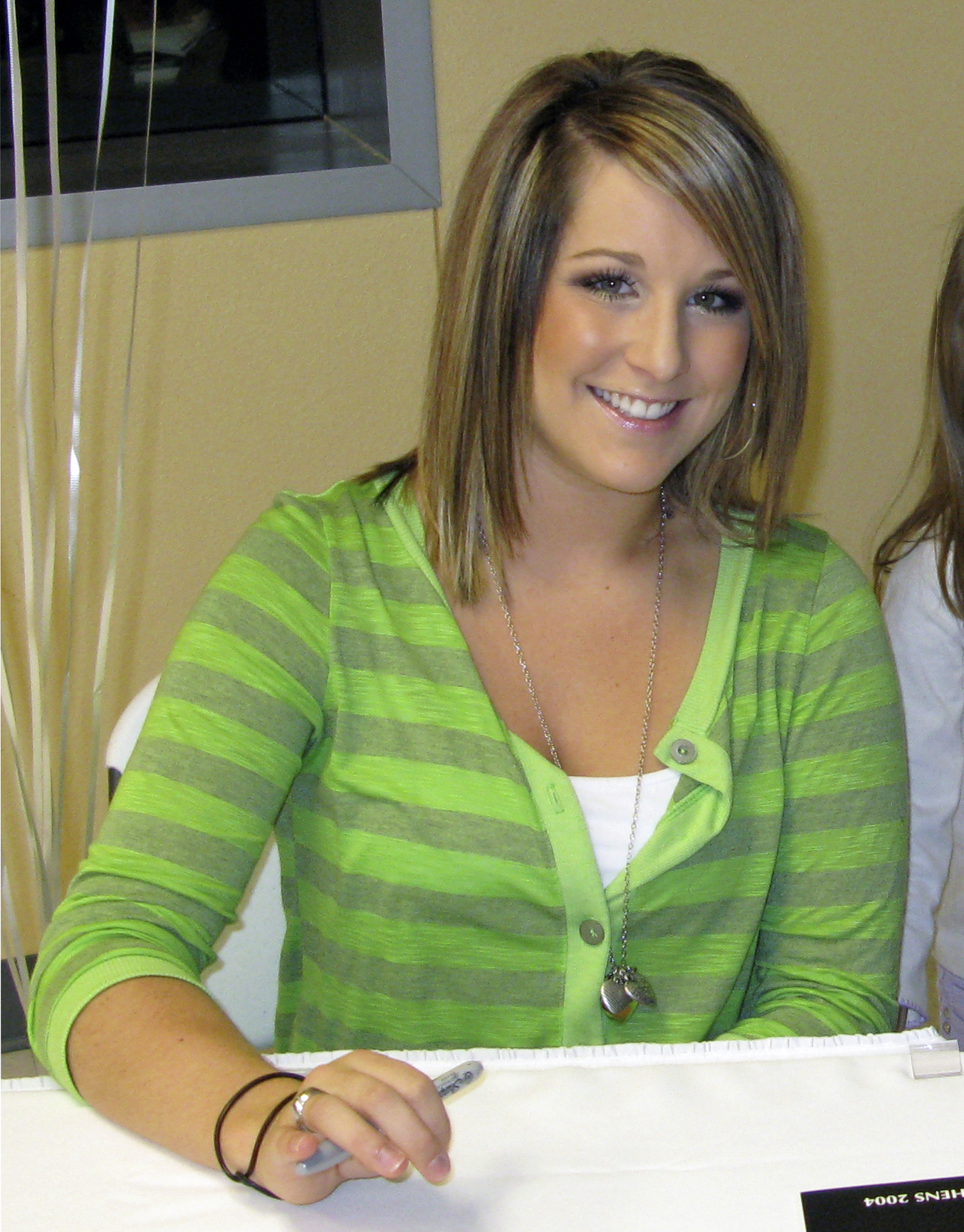
Carly Rae Patterson (born February 4, 1988)[2] is an American singer, songwriter and former artistic gymnast.[2] She was the all-around champion at the 2004 Olympics, the first all-around champion for the United States at a non-boycotted Olympics, and is a member of the USA Gymnastics Hall of Fame. Patterson frequently joins radio segments on 1310 AM and 96.7 FM The Ticket in Dallas Fort-Worth.
Key Information
Gymnastics
[edit]Patterson began gymnastics after attending a cousin's birthday party at a Baton Rouge gymnastics club (Elite Gymnastics) in 1994.[3] She was coached there by former Israeli Olympian Yohanan Moyal.[4] She started competing internationally in 2000, when she was 12 years old.
2000–2003
[edit]In 2000, Patterson participated in the Top Gym Tournament in Belgium and won the silver medal in the all-around and the bronze on balance beam. The next year, at the 2001 Goodwill Games in Brisbane, Australia, she was ranked second in the all-around before the final rotation but missed three landings on the floor exercise and finished seventh.
Patterson became the U.S. junior national all-around champion in 2002. She then began her senior career by winning the 2003 American Cup, where she was the youngest competitor, having just turned 15. However, she was forced to sit out the 2003 U.S. National Championships, which would have been her first Nationals as a senior, because of a broken elbow.
Although she could not compete in Nationals, Patterson successfully petitioned to the 2003 World Gymnastics Championships in Anaheim, California. There, she earned the all-around silver medal, becoming the first American woman to medal in a World Championships all-around since Shannon Miller in 1994. She also helped the United States earn the team gold medal, a first for the American women.
2004
[edit]Patterson again won the all-around at the American Cup in 2004, a performance she dedicated to her coach Evgeny Marchenko's mother, who had died just days before the competition. Later that year, she became co-national champion with Courtney Kupets. She also won the floor exercise at the National Championships and placed second on balance beam.
At the Olympic Trials, Patterson fell off the balance beam on both days of competition, dropping her to third place. However, her performances at a subsequent national training camp were strong enough for her to make the Olympic team.
Olympic Games
[edit]At the 2004 Olympic Games in Athens, Patterson finished first overall in the preliminary round and qualified for the all-around and balance beam finals. The United States, including Patterson, struggled in the team final: She under-rotated her vault, stubbed the low bar with her foot on the uneven bars, and had several wobbles on balance beam and a lunge forward on her dismount. She later admitted to being distracted after a rushed start on vault, with her coach saying, "The beginning of the competition was stressful. It set the tone."[5] The U.S. women, the reigning world champions, settled for silver.[5]
In the individual all-around, Patterson narrowly defeated three-time world all-around champion Svetlana Khorkina of Russia. After scoring lower than usual on the vault (9.375), Patterson was stronger on her last three events, scoring 9.575 on the uneven bars, 9.725 on the balance beam, and 9.712 on the floor exercise. She became only the second American woman to win an Olympic all-around gold medal, and the first to do so in a non-boycotted Olympic Games. (Mary Lou Retton won the title at the 1984 Summer Olympics in Los Angeles. But because those Games were boycotted by the Soviet Union, Retton did not face the Soviet gymnasts who consistently dominated the sport during that period, accounting for five of the eight Olympic all-around champions before 1984 and nine of the ten previous world all-around champions.)[6][7]
On August 23, Patterson competed in the balance beam event final, where she received a score of 9.775 and won the silver medal behind Cătălina Ponor of Romania.
Post-Olympics
[edit]Soon after the Olympics, Patterson was diagnosed with several bulging discs in her lower back that had gone unnoticed. She announced her intention to take time off from the sport to rehabilitate her back, but she officially retired in 2006 without ever participating in another major competition. She recalled the decision in a 2009 interview, saying, "I started having some back issues, and honestly, my doctor was like, 'Carly, you really need to stop if you want to be able to walk when you get older.' ... So I retired and moved on to singing."[8]
She continues to stay occupied with event appearances, gymnastics-related and otherwise. She also has a number of high-profile corporate sponsorships; she appeared in a Mobile ESPN commercial aired during Super Bowl XL in 2006. She also finished her authorized biography, which was released in April 2006.
In December 2011, she was featured on the TV show Hollywood at Home.[9]
Eponymous skill
[edit]Patterson has one eponymous skill listed in the Code of Points.[10][11]
| Apparatus | Name | Description | Difficulty[a] |
|---|---|---|---|
| Balance beam | Patterson | Arabian double salto forward tucked | G (0.7) |
- ^ Valid for the 2025–2028 Code of Points
Competitive history
[edit]| Year | Event | Team | AA | VT | UB | BB | FX |
|---|---|---|---|---|---|---|---|
| Junior | |||||||
| 2000 | American Classic | 13 | 6 | ||||
| U.S. Classic | 6 | ||||||
| U.S. National Championships | 4 | 4 | |||||
| 2001 | Goodwill Games | 7 | 5 | ||||
| Pule Int'l Junior Cup | |||||||
| U.S. Classic | 5 | ||||||
| U.S. National Championships | |||||||
| 2002 | Gymnix Int'l | ||||||
| Jurassic Classic | |||||||
| Pacific Alliance Championships | |||||||
| TJ Maxx Int'l Challenge | |||||||
| USA-Mexico Dual Meet | |||||||
| USA-UKR-BRA Friendly | |||||||
| American Classic | 5 | ||||||
| National Elite Podium Meet | |||||||
| U.S. Classic | 4 | 7 | |||||
| U.S. National Championships | |||||||
| Senior | |||||||
| 2003 | American Cup | ||||||
| Pacific Challenge | 5 | 5 | |||||
| Anaheim World Championships | |||||||
| 2004 | American Cup | ||||||
| Pacific Alliance Championships | |||||||
| U.S. National Championships | 5 | ||||||
| Olympic Trials | |||||||
| Athens Olympic Games | |||||||
Music
[edit]Patterson first expressed interest in becoming a professional singer in a March 2005 interview. On August 21, 2005, she gave an interview on Fox Sports Net's Sports Sunday in which she gave more details on her future career. She sang a small segment of "Damaged" and said that she went to New York City to record the demo. On December 18, 2005, she announced that she signed a demo contract for four songs with Papa Joe's Records, owned by Joe Simpson, father of Jessica and Ashlee Simpson.[12] She worked with singer and writer Chris Megert. They wrote and produced songs titled "Time to Wake Up" and "Lost in Me".
Celebrity Duets
[edit]On August 29, 2006, she started her appearance on the show Celebrity Duets. The program was a reality competition show executive produced by Simon Cowell. Celebrities not known for singing were teamed up with professional singers; one of the eight celebrities was voted off each week. The show aired every Thursday on Fox with a results show each Friday, from September 7, 2006, to October 13, 2006.
On September 15, 2006, during the results show, Patterson was eliminated from the competition (singing with Jesse McCartney). Patterson said that she would continue to sing. She also encouraged the audience to continue voting for the remaining celebrities because each vote raised money for charity.
Recording
[edit]On February 4, 2008, Patterson signed a recording contract with MusicMind Records, a Chicago-based label. Her single "Temporary Life (Ordinary Girl)" was released on iTunes on March 25, 2008. Her debut album Back to the Beginning was scheduled for release August 5, 2008. However, the CD was not released until more than a year later, on August 25, 2009, and in the interim, Patterson released another single, "Time to Wake Up", on iTunes on February 19, 2009.
On September 10, 2008, a remixed version of Patterson's "Temporary Life (Ordinary Girl)" was played on the Bobby Bones Show. The mixed version featured the new artist Captain Caucasian, a pseudonym for Bobby Bones.
Patterson's song "Here I Am" was featured on the second season of the ABC Family series Make It or Break It, which focused on the lives of teen gymnasts striving to make it to the Olympic Games.
Personal life
[edit]On January 21, 2012, Patterson became engaged to strategy consultant Mark Caldwell.[13] They married on November 3, 2012, in Dallas, Texas. They have three children.[14]
Honors and awards
[edit]Patterson was chosen for the USA Gymnastics Hall of Fame in 2009.[15] She was inducted to the International Gymnastics Hall of Fame as a member of the Class of 2024.[16]
See also
[edit]References
[edit]- ^ "Carly Patterson" (PDF). USA Gymnastics. June 17, 2014. Archived from the original (PDF) on November 20, 2011. Retrieved August 23, 2015.
- ^ a b "Fact Sheet: Carly Patterson" (PDF). USA Gymnastics. Archived from the original (PDF) on November 20, 2011. Retrieved July 18, 2016.
- ^ "Gold Medalist Carly Patterson to Headline Gymnastics Championship". Big 12 Sports. March 11, 2016. Retrieved July 19, 2016.
- ^ "Carly Patterson". tmz.com.
- ^ a b Boeck, Greg (August 17, 2004). "Romania wins gold in women's gymnastics, U.S. All-Round silver". USAToday.com. Retrieved July 19, 2016.
- ^ "Gymn Forum: World Championships Results". gymn-forum.net. Retrieved October 22, 2018.
- ^ "Gymn Forum: Olympic Games Results". gymn-forum.net. Retrieved October 22, 2018.
- ^ Carly Patterson Interview — 2009 Visa Championships. usagymnastics.org, YouTube.com, August 18, 2009.
- ^ "Hollywood at Home - TV Guide". TVGuide.com. Retrieved October 22, 2018.
- ^ "2022-2024 Code of Points Women's Artistic Gymnastics" (PDF). International Gymnastics Federation. pp. 143, 210. Archived from the original (PDF) on May 12, 2021. Retrieved January 22, 2022.
- ^ "Women's Artistic Gymnastics – 2025-2028 Code of Points" (PDF). International Gymnastics Federation. April 22, 2024. Retrieved February 2, 2025.
- ^ Armour, Nancy (January 14, 2008). "Olympic gold medalist singing a new tune with music career". mrt.com. Retrieved February 26, 2025.
- ^ "Carly Patterson gets engaged". USA Gymnastics. January 30, 2012. Archived from the original on August 10, 2022. Retrieved July 31, 2012.
- ^ VanHoose, Benjamin (February 16, 2021). "It's a Boy! Olympic Gymnast Carly Patterson Caldwell Welcomes Son Pearson Philip". PEOPLE.com. Retrieved June 29, 2021.
- ^ Carly Patterson Chosen for Gymnastics Hall of Fame Archived February 7, 2009, at the Wayback Machine SI.com, February 3, 2009
- ^ Ivanov, Christian (May 19, 2024). "Four gymnastics legends inducted into the International Gymnastics Hall of Fame". intlgymnast.com. Retrieved May 20, 2024.
External links
[edit]- Carly Patterson at World Gymnastics
- Carly Patterson at USA Gymnastics
- Carly Patterson at Olympics.com
- Carly Patterson at Olympic.org (archived)
- Carly Patterson at Olympedia
- Official website at the Wayback Machine (archived August 28, 2008)
Carly Patterson
View on GrokipediaEarly Life
Family and Upbringing
Carly Rae Patterson was born on February 4, 1988, in Baton Rouge, Louisiana.[10] She is the first-born child of Ricky Patterson, a district sales manager, and Natalie Patterson, a registered nurse and former gymnast.[11][3] Patterson has one younger sister, Jordan, born on May 19, 1990.[12] Raised in Baton Rouge during her early years, Patterson grew up in a middle-class family environment shaped by Southern Louisiana's community-oriented culture, where family support played a central role in daily life.[13] Her parents' divorce occurred around 1999–2000, but during her childhood in Baton Rouge, the family resided together. The family relocated to Houston, Texas, in 1999 when she was 11 due to her father's job transfer. They later moved to the Allen area in 2000.[3] She attended local schools in Baton Rouge before the move, balancing academics with extracurricular activities.[14] Patterson's childhood hobbies included swimming, bike riding, and using computers, reflecting an active and curious lifestyle.[1] Her early exposure to sports was influenced by her mother's background as a gymnast, which introduced her to athletic pursuits from a young age.[3] This Southern upbringing, with its emphasis on perseverance and family encouragement, laid the foundation for her developing interests in physical activities that later extended to creative endeavors like music.[4]Introduction to Gymnastics
Carly Patterson began her gymnastics journey at the age of six in 1994, when she attended a cousin's birthday party at Elite Gymnastics, a local gym in her hometown of Baton Rouge, Louisiana.[1] There, her natural talent caught the eye of coaches, leading her to enroll in classes and quickly develop a passion for the sport. Her early motivations were nurtured by her family, including attempts by her mother to connect her activities to the 1996 Olympic Games, though Patterson initially preferred outdoor play over watching the events on television.[15] With strong family support as a key enabler, she progressed through initial achievements in local and regional meets, such as earning her first state titles around age 10, which highlighted her potential in events like the balance beam.[1] Under the guidance of her first coaches at Elite Gymnastics, Patterson honed her fundamental skills during her early years in Baton Rouge. After the family's 1999 move to Houston, she trained at Brown's Gymnastics, marking her first year as an elite gymnast.[16] Recognizing the need for more advanced instruction, her family relocated to Allen, Texas, in 2000 when she was 12, allowing her to train at the renowned World Olympic Gymnastics Academy (WOGA).[17] There, she worked with experienced coaches including Evgeny Marchenko and Natasha Boyarskaya, who helped elevate her technique and competitive readiness in preparation for higher levels of the sport.[1] Throughout her pre-teen years, Patterson balanced rigorous daily training sessions with her school responsibilities, often managing homeschooling to accommodate her schedule while maintaining academic progress.[1] This period of focused development laid the groundwork for her transition to junior elite status, supported by her parents and sister who emphasized the importance of education alongside athletic pursuits.[1]Gymnastics Career
Early Competitions (1996–2003)
Patterson began competing at the elite level in her early teens, making her national debut at the 1998 U.S. Classic at age 10, marking her entry into higher-level gymnastics events.[18] By 2000, she had joined the junior national team and showed promise in international and domestic meets, placing second in the all-around and third on balance beam at the Top Gym Junior International Invitational in Belgium. That year, she earned third in the all-around, first on balance beam, and sixth on floor exercise at the U.S. Classic, followed by fourth in the all-around, second on balance beam, and fourth on floor at the U.S. Championships.[1] In 2001, Patterson's junior career gained momentum with her international debut at the Pule Junior International Cup in China, where she won the all-around, uneven bars, and placed third on balance beam. Domestically, she dominated the U.S. Classic with first-place finishes in the all-around, balance beam, and floor exercise, while securing third in the all-around and second on balance beam at the U.S. Championships. She continued her ascent in 2002 as the U.S. junior national all-around champion, also claiming multiple golds at events like the Jurassic Classic and silver in the all-around at the Pacific Alliance Championships, where she additionally won team gold, balance beam gold, and floor gold. These results, including first in the all-around at the American Classic, solidified her as a top junior contender.[1][18] Transitioning to the senior level in 2003, Patterson won the all-around at the American Cup with a score of 38.662, leading a U.S. sweep in the women's competition and placing first on balance beam. However, an elbow injury forced her to withdraw from the U.S. Championships that year. Despite the setback, she contributed to the U.S. team's gold medal at the World Championships in Anaheim, California, and earned individual silver in the all-around with a score of 37.936, just behind Russia's Svetlana Khorkina. This performance highlighted her rapid rise amid challenges, including the physical demands of the senior elite level.[1][19][2]2004 Olympic Games
Patterson earned her spot on the 2004 U.S. Olympic women's artistic gymnastics team following the Olympic Trials in Anaheim, California, where she placed third in the all-around, and a subsequent selection camp at Béla and Márta Károlyi's ranch in New Waverly, Texas. The final team consisted of Patterson, Courtney Kupets, Courtney McCool, Terin Humphrey, Mohini Bhardwaj, and Annia Hatch, with Chellsie Memmel, Tasha Schwikert, and Allyse Ishino named as alternates. As the silver medalist in the all-around at the 2003 World Championships, Patterson entered the selection process as one of the top contenders, though the camp involved intense evaluations to balance all-around strengths with event specialists, particularly in vaulting.[20][21] Upon arriving in Athens, the U.S. team conducted a pre-competition training camp to acclimate to the Olympic environment and refine routines under head coach Kelli Hill. In the team competition on August 17, the American squad secured the silver medal with a total score of 113.584 points, finishing just 0.699 behind gold medalist Romania (114.283) and ahead of bronze medalist Russia (113.235); Patterson contributed scores of 9.787 on vault, 9.550 on uneven bars, 9.562 on balance beam, and 9.987 on floor exercise. Patterson, viewed as a leading favorite for individual honors after her strong international showings, faced significant pressure during the event, with the team overcoming minor errors to maintain podium position.[22] In the all-around final on August 18, Patterson delivered a composed performance to claim the gold medal, the first for an American woman since Mary Lou Retton's victory in 1984, with a total score of 38.387 points. She started with a 9.375 on vault, followed by 9.575 on uneven bars, a meet-high 9.725 on balance beam that propelled her into the lead, and a 9.712 on floor exercise to seal the win over silver medalist Svetlana Khorkina of Russia (38.211). Patterson had topped the qualification round with 38.337 points, advancing as the top seed. In the balance beam event final on August 23, she earned silver with a score of 9.775, narrowly behind Romania's Cătălina Ponor (9.875), while her qualification score of 9.500 on floor placed her 10th, missing the event final.[23][24][25][23] Throughout the Games, Patterson navigated intense expectations as the pre-event favorite, drawing on mental preparation techniques emphasized in the U.S. training camp to stay focused amid media scrutiny and the weight of national hopes. Post-competition, she expressed overwhelming joy and relief in interviews, describing the all-around win as a dream realized after years of dedication, while crediting her coaches and teammates for support during high-stakes moments like her beam routine in the final. Her immediate reactions, including tearful celebrations with family, highlighted the emotional culmination of the pressure, marking her as a trailblazer in American gymnastics.[26][27][28]Post-Olympics and Retirement (2004–2006)
Following her Olympic success in Athens, Patterson was diagnosed with multiple bulging discs in her lower back, an injury that had gone undetected during the Games but became apparent shortly after her return home. This condition, compounded by the physical toll of elite competition, forced her to withdraw from training and competition for an extended period.[29] The back injury persisted into 2005, manifesting as a stress fracture that sidelined her from key events, including the U.S. National Championships in August and the World Championships in September. Patterson had hoped to defend her national titles and contribute to the U.S. team at Worlds, but medical advice emphasized rehabilitation over risking further damage. Her absence highlighted the challenges of transitioning from the high of Olympic achievement to managing chronic pain at just 17 years old.[30][31] Entering 2006, Patterson attempted a comeback by resuming light training at her gym in Plano, Texas, aiming to prepare for future competitions despite ongoing discomfort. However, the unrelenting nature of her back issues made a return to elite-level gymnastics untenable, leading her to officially retire from the sport in March at age 18. In reflecting on the decision, she described it as bittersweet, grateful for her accomplishments but saddened by the abrupt end to a career defined by dedication since childhood. With retirement, Patterson began exploring new opportunities, including a shift toward music as a way to channel her energy and maintain public engagement beyond the mat.[32][33]Eponymous Skill
The eponymous skill named after Carly Patterson is the Patterson dismount on balance beam, officially described in the FIG Code of Points as an Arabian double salto forward tucked (also known as a double front somersault tucked with a half twist).[34] This dismount begins with a round-off entry followed by a back handspring, incorporating a half twist inward before executing two forward-tucked somersaults to land on the mat.[35] The skill demands exceptional precision, aerial awareness, and control to maintain the tucked position throughout the flight phase while managing the half twist to avoid under-rotation.[34] Patterson first debuted the skill internationally at the 2003 Visa American Cup, where she won the balance beam gold, and it was officially named in her honor following her performance at the 2004 Athens Olympic Games, where she secured the all-around gold medal.[1] It entered the FIG Code of Points in the 2006–2008 cycle as a high-difficulty element valued at E (0.5 at the time), with subsequent updates reflecting adjustments in the scoring system; by the 2017–2020 cycle, it was valued at G (0.7), and in the current 2025–2028 cycle, it holds a G value (0.7), recognizing its technical demands as one of only three beam dismounts rated G or higher.[36] Since its naming, the Patterson has been performed by a select few elite gymnasts, underscoring its rarity and difficulty, as it requires the athlete to generate sufficient height and rotation from the beam's narrow surface while landing safely. Notable performers include Yulia Lozhechko of Russia, who competed it to win the 2007 European Championships on beam, and Alexandra Raisman of the United States, who regularly included it in her routines en route to the 2012 Olympic team bronze on beam.[34] The skill remains relevant in contemporary routines for gymnasts seeking to maximize difficulty values without compromising connection bonuses, though its tucked body position and forward-facing execution continue to challenge performers on amplitude and form.[37]Competitive History
Carly Patterson's major competitive results are summarized below, covering her international debut in 2001 through her retirement in 2006. All competitions prior to 2006 utilized the perfect 10.0 scoring system, where the maximum score per apparatus was 10.0 points. She withdrew from the 2003 U.S. National Championships due to an elbow injury but otherwise had no disqualifications. Post-2004 Olympics, she attempted a limited comeback but did not participate in further major events before retiring in 2006 due to chronic back issues.[1][18]| Year | Event | Location | Results |
|---|---|---|---|
| 2001 | Goodwill Games | Brisbane, Australia | 7th AA, 5th BB[1] |
| 2001 | Pule International Junior Cup | Heilongjiang, China | 1st AA, 1st UB, 3rd BB[18] |
| 2001 | U.S. Classic (Junior Division) | Pomona, CA, USA | 1st AA, 5th UB, 1st BB, 1st FX[1] |
| 2001 | U.S. National Championships (Junior Division) | Philadelphia, PA, USA | 3rd AA, 2nd BB[1] |
| 2002 | Pacific Alliance Championships | Honolulu, HI, USA | 1st Team, 2nd AA, 1st VT, 2nd UB, 1st BB, 1st FX[18] |
| 2002 | U.S. National Championships (Junior Division) | Cleveland, OH, USA | 1st AA, 2nd BB, 3rd FX[1] |
| 2003 | American Cup | Fairfax, VA, USA | 1st AA, 2nd VT, 2nd UB, 1st BB, 3rd FX[1] |
| 2003 | World Championships | Anaheim, CA, USA | 1st Team, 2nd AA (QF: 37.649; AA: 37.936)[38][1] |
| 2004 | American Cup | New York, NY, USA | 1st AA, 1st VT, 1st UB, 1st BB, 1st FX[1] |
| 2004 | Pacific Alliance Championships | Honolulu, HI, USA | 1st Team, 2nd AA, 1st BB, 1st FX[18] |
| 2004 | U.S. National Championships | Nashville, TN, USA | 1st AA (tie), 5th UB, 2nd BB, 1st FX[1] |
| 2004 | Olympic Trials | Anaheim, CA, USA | 3rd AA, 1st FX[18] |
| 2004 | Olympic Games | Athens, Greece | 2nd Team, 1st AA (QF: 38.337; AA: 38.387), 2nd BB (EF: 9.775)[39][1] |

