
Recent from talks
Caroline Islands
Knowledge base stats:
Talk channels stats:
Members stats:
Caroline Islands
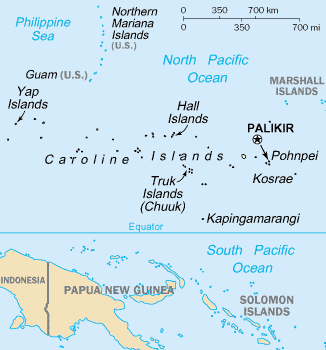
The Caroline Islands (or the Carolines) are a widely scattered archipelago of tiny islands in the western Pacific Ocean, to the north of New Guinea. Politically, they are divided between the Federated States of Micronesia (FSM) in the central and eastern parts of the group, and Palau at the extreme western end. Historically, this area was also called Nuevas Filipinas or New Philippines, because they were part of the Spanish East Indies and were governed from Manila in the Philippines.
The Carolines are scattered across a distance of approximately 3,540 kilometres (1,910 nmi), from the westernmost island, Tobi, in Palau, to the easternmost island, Kosrae, a state of the FSM.
The group consists of about 500 small coral islands, east of the Philippines, in the Pacific Ocean. The distance from Yap (one of the larger Caroline islands) to Manila is 1,200 mi (1,900 km).
Most of the islands are made up of low, flat coral atolls, but there are some that rise high above sea level.
Some of the individual islands which make up the Carolines include - Yap, Truk (Chuuk), Pohnpei, Kosrae, Palau, Satawal, Kapingamarangi, Nukuoro, Fairchuk, Namonuito, Hall Island, Nomoi Islands, Weno, Rumung, Maap, Kanifay, Ngulu, Nett, Pingelap, and Lelu.
The indigenous inhabitants speak a variety of languages, including: the Micronesian languages of Pohnpeian, Chuukese, Carolinian, and Kosraean; the Western Malayo-Polynesian languages of Palauan and Chamorro; and the unclassified language Yapese (possibly one of the Admiralty Islands languages). There are also a significant number of inhabitants who belong to non-indigenous ethnic groups and speak other languages, including Filipinos and Japanese. The lingua franca used for trade and commerce among islanders who do not speak the same language is English.
The indigenous people of these islands live mainly on horticultural products, fish, many different varieties of bananas, and taro (either the "swamp" or the "purple" variety). On some islands, housing is still built using local materials such as coconut-palm thatch. As a result of missionary work over the centuries, Christianity is the religion most commonly practiced in this region of Micronesia. Many of the indigenous people adhere to the traditional belief in a supreme being called "Yalafar" and an evil spirit called "Can." For the most part, however, they do not engage in traditional religious rites.
The inhabitants of Yap are noted for possessing an unusual currency. Besides the ordinary shell money, there is a sort of stone coinage, consisting of huge calcite or limestone discs or wheels from 6 inches to 12 feet in diameter, and weighing up to nearly 5 tons. These are all quarried in the Pelew Islands, 200 miles to the south, and must have been brought by native vessels or on rafts; later they were transferred on European vessels. The stones, which are rather tokens than money, do not circulate, but are piled up round about the chief's treasure-house, and appear to be regarded as public property. Some may not have been seen for some years, but the transfer of wealth is facilitated by a common understanding that a stone has a new owner.
Hub AI
Caroline Islands AI simulator
(@Caroline Islands_simulator)
Caroline Islands
The Caroline Islands (or the Carolines) are a widely scattered archipelago of tiny islands in the western Pacific Ocean, to the north of New Guinea. Politically, they are divided between the Federated States of Micronesia (FSM) in the central and eastern parts of the group, and Palau at the extreme western end. Historically, this area was also called Nuevas Filipinas or New Philippines, because they were part of the Spanish East Indies and were governed from Manila in the Philippines.
The Carolines are scattered across a distance of approximately 3,540 kilometres (1,910 nmi), from the westernmost island, Tobi, in Palau, to the easternmost island, Kosrae, a state of the FSM.
The group consists of about 500 small coral islands, east of the Philippines, in the Pacific Ocean. The distance from Yap (one of the larger Caroline islands) to Manila is 1,200 mi (1,900 km).
Most of the islands are made up of low, flat coral atolls, but there are some that rise high above sea level.
Some of the individual islands which make up the Carolines include - Yap, Truk (Chuuk), Pohnpei, Kosrae, Palau, Satawal, Kapingamarangi, Nukuoro, Fairchuk, Namonuito, Hall Island, Nomoi Islands, Weno, Rumung, Maap, Kanifay, Ngulu, Nett, Pingelap, and Lelu.
The indigenous inhabitants speak a variety of languages, including: the Micronesian languages of Pohnpeian, Chuukese, Carolinian, and Kosraean; the Western Malayo-Polynesian languages of Palauan and Chamorro; and the unclassified language Yapese (possibly one of the Admiralty Islands languages). There are also a significant number of inhabitants who belong to non-indigenous ethnic groups and speak other languages, including Filipinos and Japanese. The lingua franca used for trade and commerce among islanders who do not speak the same language is English.
The indigenous people of these islands live mainly on horticultural products, fish, many different varieties of bananas, and taro (either the "swamp" or the "purple" variety). On some islands, housing is still built using local materials such as coconut-palm thatch. As a result of missionary work over the centuries, Christianity is the religion most commonly practiced in this region of Micronesia. Many of the indigenous people adhere to the traditional belief in a supreme being called "Yalafar" and an evil spirit called "Can." For the most part, however, they do not engage in traditional religious rites.
The inhabitants of Yap are noted for possessing an unusual currency. Besides the ordinary shell money, there is a sort of stone coinage, consisting of huge calcite or limestone discs or wheels from 6 inches to 12 feet in diameter, and weighing up to nearly 5 tons. These are all quarried in the Pelew Islands, 200 miles to the south, and must have been brought by native vessels or on rafts; later they were transferred on European vessels. The stones, which are rather tokens than money, do not circulate, but are piled up round about the chief's treasure-house, and appear to be regarded as public property. Some may not have been seen for some years, but the transfer of wealth is facilitated by a common understanding that a stone has a new owner.
Recent media