


Community hub
Recent from talks
Contribute something
Nothing was collected or created yet.
 | This article should specify the language of its non-English content using {{lang}} or {{langx}}, {{transliteration}} for transliterated languages, and {{IPA}} for phonetic transcriptions, with an appropriate ISO 639 code. Wikipedia's multilingual support templates may also be used. (November 2021) |
| Taro | |
|---|---|

| |
Scientific classification 
| |
| Kingdom: | Plantae |
| Clade: | Tracheophytes |
| Clade: | Angiosperms |
| Clade: | Monocots |
| Order: | Alismatales |
| Family: | Araceae |
| Genus: | Colocasia |
| Species: | C. esculenta
|
| Binomial name | |
| Colocasia esculenta | |
| Synonyms[1][2][3] | |
| |
Taro (/ˈtɑːroʊ, ˈtær-/; Colocasia esculenta) is a root vegetable. It is the most widely cultivated species of several plants in the family Araceae that are used as vegetables for their corms, leaves, stems and petioles. Taro corms are a food staple in African, Oceanic, East Asian, Southeast Asian and South Asian cultures (similar to yams).
Description
[edit]Colocasia esculenta is a perennial, tropical plant primarily grown as a root vegetable for its edible, starchy corm. The plant has rhizomes of different shapes and sizes. Leaves are up to 40 by 25 centimetres (15+1⁄2 by 10 inches) and sprout from the rhizome. They are dark green above and light green beneath. They are triangular-ovate, sub-rounded and mucronate at the apex, with the tip of the basal lobes rounded or sub-rounded. The petiole is .8–1.2 metres (2+1⁄2–4 feet) high. The path can be up to 25 cm (10 in) long. The spadix is about three fifths as long as the spathe, with flowering parts up to 8 millimetres (3⁄8 in) in diameter. The female portion is at the fertile ovaries intermixed with sterile white ones. Neuters grow above the females, and are rhomboid or irregular orium lobed, with six or eight cells. The appendage is shorter than the male portion.
-
 Flower
 -
 Leaves
 -
 Corms
Corms -
 Corm (cross section)
 -
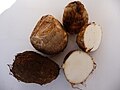 Corm with soil, may be sold (left bottom), washed (2 pcs) cross-section (2 pcs), Japan


.JPG)
Similar species
[edit]Taro is among the most widely grown species in the group of tropical perennial plants that are colloquially referred to as "elephant ears", when grown as ornamental plants.[4] Other plants with the same nickname include certain species of related aroids possessing large, heart-shaped leaves, usually within such genera as Alocasia, Caladium, Monstera, Philodendron, Syngonium, Thaumatophyllum, and Xanthosoma.
Taro is related to Xanthosoma and Caladium, plants commonly grown ornamentally, and like them, it is sometimes loosely called elephant ear. Similar taro varieties include giant taro (Alocasia macrorrhizos), swamp taro (Cyrtosperma merkusii), and arrowleaf elephant's ear (Xanthosoma sagittifolium).
Taxonomy
[edit] | This section needs additional citations for verification. (July 2021) |
The 18th-century Swedish biologist Carl Linnaeus originally described two species, Colocasia esculenta and Colocasia antiquorum, but many later botanists consider them both to be members of a single, very variable species, the correct name for which is Colocasia esculenta.[5][6]
Etymology
[edit]The Ancient Greek word κολοκάσιον (kolokasion, lit. 'lotus root') is the origin of the Modern Greek word kolokasi (κολοκάσι); the word for the plant is kolokas in Greek, gölevez in Turkish, and qulqas (قلقاس) in Arabic. These were borrowed by Latin as colocasia, thus becoming the genus name Colocasia.[7][8] The specific epithet, esculenta, means "edible" in Latin.[9]
The English name taro was borrowed from the Māori language when Captain Cook first observed Colocasia plantations in New Zealand in 1769. The form taro or talo is widespread among Polynesian languages:[10] taro in Tahitian; talo in Samoan and Tongan; kalo in Hawaiian; taʻo in Marquesan. All these forms originate from Proto-Polynesian *talo,[10] which itself descended from Proto-Oceanic *talos (cf. dalo in Fijian) and Proto-Austronesian *tales (cf. taleus in Sundanese & tales in Javanese).[11] However, irregularity in sound correspondences among the cognate forms in Austronesian suggests that the term may have been borrowed and spread from an Austroasiatic language perhaps in Borneo (cf. proto-Mon-Khmer *t2rawʔ, Khasi shriew, Khmu sroʔ, Mlabri kwaaj,...).[12]
Distribution and habitat
[edit]Colocasia esculenta is thought to be native to Southern India and Southeast Asia, but is widely naturalised.[13][14] Colocasia is thought to have originated in the Indomalayan realm, perhaps in East India, Nepal, and Bangladesh. It spread by cultivation eastward into Southeast Asia, East Asia and the Pacific Islands; westward to Egypt and the eastern Mediterranean Basin; and then southward and westward from there into East Africa and West Africa, where it spread to the Caribbean and Americas.
Taro was probably first native to the lowland wetlands of Malaysia, where it is called talas. In modern times it is also called keladi Cina (literally Chinese yam).
In Australia, C. esculenta var. aquatilis is thought to be native to the Kimberley region of Western Australia; the common variety esculenta is now naturalised and considered an invasive weed in Western Australia, the Northern Territory, Queensland and New South Wales.
In Europe, C. esculenta is cultivated in Cyprus and it's called Colocasi, (Κολοκάσι in Greek) and it is certified as a PDO product. It is also found in the Greek island of Ikaria and cited as a vital source of food for the island during World War II.[15]
In Turkey, C. esculenta is locally known as gölevez and mainly grown on the Mediterranean coast, such as the Alanya district of Antalya Province and the Anamur district of Mersin Province.
In Macaronesia this plant has become naturalized, probably as a result of the Portuguese discoveries and is frequently used in the Macaronesian diet as an important carbohydrate source.
In the southeastern United States, this plant is recognized as an invasive species.[16][17][18][19][20] Many populations can be commonly found growing near drain ditches and bayous in Houston, Texas.
Cultivation
[edit]History
[edit]Taro is one of the most ancient cultivated crops.[21][22] Taro is found widely in tropical and subtropical regions of South Asia, East Asia, Southeast Asia, and Papua New Guinea, and northern Australia and in Maldives. Taro is highly polymorphic, making taxonomy and distinction between wild and cultivated types difficult. It is believed that they were domesticated independently multiple times, with authors giving possible locations as New Guinea, Mainland Southeast Asia, and northeastern India, based largely on the assumed native range of the wild plants.[23][24][25] However, more recent studies have pointed out that wild taro may have a much larger native distribution than previously assumed, and wild breeding types may also likely be indigenous to other parts of Island Southeast Asia.[26][27]
Archaeological traces of taro exploitation have been recovered from numerous sites, though whether these were cultivated or wild types can not be ascertained. They include the Niah Caves of Borneo around 10,000 years ago,[28] Ille Cave of Palawan, dated to at least 11,000 year ago;[28][29] Kuk Swamp of New Guinea, dated to between 8250 BC and 7960 BC;[30][31] and Kilu Cave in the Solomon Islands dated to around 28,000 to 20,000 years ago.[32] In the case of Kuk Swamp, there is evidence of formalized agriculture emerging by about 10,000 years ago, with evidence of cultivated plots, though which plant was cultivated remains unknown.[33]
Taro were carried into the Pacific Islands by Austronesian peoples from around 1300 BC, where they became a staple crop of Polynesians, along with other types of "taros", like Alocasia macrorrhizos, Amorphophallus paeoniifolius, and Cyrtosperma merkusii. They are the most important and the most preferred among the four, because they were less likely to contain the irritating raphides present in the other plants.[34][35] Taro is also identified as one of the staples of Micronesia, from archaeological evidence dating back to the pre-colonial Latte Period (c. 900 – 1521 AD), indicating that it was also carried by Micronesians when they colonized the islands.[36][37] Taro pollen and starch residue have also been identified in Lapita sites, dated to between 1100 BC and 550 BC.[38] Taro was later spread to Madagascar as early as the 1st century AD.[39]

Modern production
[edit]In 2022, world production of taro was 18 million tonnes, led by Nigeria with 46% of the total (table).
Taro has the fifth largest production among root and tuber crops worldwide.[40] The average yield of taro is around 7 tons per hectare.[40]
Taro can be grown in paddy fields where water is abundant or in upland situations where water is supplied by rainfall or supplemental irrigation. Taro is one of the few crops (along with rice and lotus) that can be grown under flooded conditions.[citation needed] Flooded cultivation has some advantages over dry-land cultivation: higher yields (about double), out-of-season production (which may result in higher prices), and weed control (which flooding facilitates).[citation needed] Manmade floodplains particular to taro cultivation are commonly found throughout tropical Polynesian societies called repo.[41][42]
| Taro production – 2022 | |
|---|---|
| Country | (Millions of tonnes) |
 Nigeria Nigeria |
8.2 |
 China China |
1.9 |
 Cameroon Cameroon |
1.9 |
 Ghana Ghana |
1.7 |
 Ethiopia Ethiopia |
1.7 |
| World | 17.7 |
| Source: FAOSTAT of the United Nations[43] | |
Like most root crops, taro and eddoes do well in deep, moist or even swampy soils where the annual rainfall exceeds 2,500 mm (100 in). Eddoes are more resistant to drought and cold. The crop attains maturity within six to twelve months after planting in dry-land cultivation and after twelve to fifteen months in wetland cultivation. The crop is harvested when the plant height decreases and the leaves turn yellow.[citation needed]
Quality control
[edit]Taro generally commands a higher market price in comparison to other root crops, so the quality control measures throughout the production process are rather essential. The sizes found in most markets are 1–2 kg and 2–3 kg. The best size for packaging and for consumers is 1–2 kg. To guarantee the product meets the expected high standards upon reaching the consumer, there are some common grading standards for fresh corms:[44]
- No excess soil, softness or decay
- No bruises or deep cuts
- Spherical to round shape
- No major abnormal deformities
- No roots
- Approximately 5 cm (under 2") of petiole left attached to the corm
- No double-tops
Due to the high moisture content of the corms, and the plant's natural love of humidity, mold and disease can easily develop, causing root rot or decay. To prolong their shelf lives, the corms are usually stored at cooler temperatures, ranging from 10 to 15 degrees Celsius and maintained at a relative humidity of 80% to 90%. For packaging, the corms are commonly placed in polypropylene bags or ventilated wooden crates to minimize condensation and 'sweating.' During export, a weight allowance of approximately 5% above the net weight is included to account for potential shrinkage during transit. For commercial shipping and export purposes, refrigeration is used; for instance, corms with 5 to 10 centimeters of petiole remaining are exported from Fiji to New Zealand in wooden boxes. They are then transported via refrigerated container, chilled to around 5° Celsius.[45] The corms can be maintained for up to six weeks in good condition; most good-quality corms may even be replanted and grown by the consumer, thanks to the species' prolific nature and hardiness.
Breeding
[edit]In the early 1970s, one of the earliest taro breeding programs was initiated in the Solomon Islands to create cultivars that were resistant to taro leaf blight. After taro leaf blight was introduced to Samoa in 1993, another breeding program was initiated. In this program Asian varieties that were resistant to TLB were used. The breeding program helped restore the taro export industry in Samoa.[46]
Corm yield and corm quality appear to be negatively correlated. In order to produce the uniform fresh healthy corms that the market desires, early maturing cultivars with a growth period of 5 to 7 months can be used.[46]
Selection methods and programs
[edit]Cultivars grown in the Pacific regions produce good quality corms, as a result of selecting for corm quality and yield. However, the genetic bases of these cultivars is very narrow. Asian cultivars have agriculturally undesirable traits (such as suckers and stolon), but appear to be more genetically diverse. There needs to be an international exchange of taro germplasm with reliable quarantine procedures.[46]
There are thought to be 15,000 varieties of C. esculenta. Currently there are 6,000 accession from various institutes from across the world. The INEA (International Network for Edible Aroids) already has a core sample of 170 cultivars that have been distributed. These cultivars are maintained in vitro in a germplasm centre in Fiji,[47] which is considered safer and cheaper than field conservation.[46]
Polyploidy breeding
[edit]Taro exists as a diploid (2n=28) and a triploid (3n=42).[citation needed] Naturally occurring triploids in India were found to have significantly better yields. There have been attempts to artificially make triploids by crossing diploids with artificial tetraploids[46]
| Nutritional value per 100 g (3.5 oz) | |||||||||||||||||||||||||||||||||||||||||||
|---|---|---|---|---|---|---|---|---|---|---|---|---|---|---|---|---|---|---|---|---|---|---|---|---|---|---|---|---|---|---|---|---|---|---|---|---|---|---|---|---|---|---|---|
| Energy | 594 kJ (142 kcal) | ||||||||||||||||||||||||||||||||||||||||||
34.6 g | |||||||||||||||||||||||||||||||||||||||||||
| Sugars | 0.49 | ||||||||||||||||||||||||||||||||||||||||||
| Dietary fiber | 5.1 g | ||||||||||||||||||||||||||||||||||||||||||
0.11 g | |||||||||||||||||||||||||||||||||||||||||||
0.52 g | |||||||||||||||||||||||||||||||||||||||||||
| |||||||||||||||||||||||||||||||||||||||||||
| Other constituents | Quantity | ||||||||||||||||||||||||||||||||||||||||||
| Water | 64 g | ||||||||||||||||||||||||||||||||||||||||||
| †Percentages estimated using US recommendations for adults,[48] except for potassium, which is estimated based on expert recommendation from the National Academies.[49] | |||||||||||||||||||||||||||||||||||||||||||
| Nutritional value per 100 g (3.5 oz) | |||||||||||||||||||||||||||||||||||||||||||||
|---|---|---|---|---|---|---|---|---|---|---|---|---|---|---|---|---|---|---|---|---|---|---|---|---|---|---|---|---|---|---|---|---|---|---|---|---|---|---|---|---|---|---|---|---|---|
| Energy | 177 kJ (42 kcal) | ||||||||||||||||||||||||||||||||||||||||||||
6.7 g | |||||||||||||||||||||||||||||||||||||||||||||
| Sugars | 3 g | ||||||||||||||||||||||||||||||||||||||||||||
| Dietary fiber | 3.7 g | ||||||||||||||||||||||||||||||||||||||||||||
0.74 g | |||||||||||||||||||||||||||||||||||||||||||||
5 g | |||||||||||||||||||||||||||||||||||||||||||||
| |||||||||||||||||||||||||||||||||||||||||||||
| Other constituents | Quantity | ||||||||||||||||||||||||||||||||||||||||||||
| Water | 86 g | ||||||||||||||||||||||||||||||||||||||||||||
| †Percentages estimated using US recommendations for adults,[48] except for potassium, which is estimated based on expert recommendation from the National Academies.[49] | |||||||||||||||||||||||||||||||||||||||||||||
Nutrition
[edit]Cooked taro is 64% water, 35% carbohydrates, and contains negligible protein and fat (table). In a reference amount of 100 grams (3.5 oz), taro supplies 142 calories of food energy, and is a rich source (20% or more of the Daily Value, DV) of vitamin B6 (25% DV), vitamin E (20% DV), and manganese (21% DV), while phosphorus and potassium are in moderate amounts (10–11% DV).
Raw taro leaves are 86% water, 7% carbohydrates, 5% protein, and 1% fat. The leaves are nutrient-rich, containing substantial amounts of vitamins and minerals, especially vitamin K at 103% of the DV.
Uses
[edit] | This section needs additional citations for verification. (July 2021) |
Culinary
[edit]
Taro is a food staple in African, Oceanic and South Asian cultures.[22] People usually consume its edible corm and leaves. The corms, which have a light purple color due to phenolic pigments,[50] are roasted, baked or boiled. The natural sugars give a sweet, nutty flavor. The starch is easily digestible, and since the grains are fine and small it is often used for baby food. [citation needed]
In its raw form, the plant is toxic due to the presence of calcium oxalate,[51][52] and the presence of needle-shaped raphides in the plant cells. However, the toxin can be minimized and the tuber rendered palatable by cooking,[53] or by steeping in cold water overnight.
Corms of the small, round variety are peeled and boiled, then sold either frozen, bagged in their own liquids, or canned.
Oceania
[edit]Cook Islands
[edit]Taro is the pre-eminent crop of the Cook Islands and surpasses all other crops in terms of land area devoted to production. The prominence of the crop there has led it to be a staple of the population's diet. Taro is grown across the country, but the method of cultivation depends on the nature of the island it is grown on. Taro also plays an important role in the country's export trade.[54] The root is eaten boiled, as is standard across Polynesia. Taro leaves are also eaten, cooked with coconut milk, onion, and meat or fish.[55]
Fiji
[edit]
Taro (dalo in Fijian) has been a staple of the Fijian diet for centuries, and its cultural importance is celebrated on Taro Day. Its growth as an export crop began in 1993 when taro leaf blight[56] devastated the taro industry in neighboring Samoa. Fiji filled the void and was soon supplying taro internationally. Almost 80% of Fiji's exported taro comes from the island of Taveuni where the taro beetle species Papuana uninodis is absent. The Fijian taro industry on the main islands of Viti Levu and Vanua Levu faces constant damage from the beetles. The Fiji Ministry of Agriculture and the Land Resources Division of the Secretariat of the Pacific Community (SPC) are researching pest control and instigating quarantine restrictions to prevent the spread of the pest. Taveuni now exports pest-damage-free crops.
Hawaii
[edit]Kalo is taro's Hawaiian name. The local crop plays an important role in Hawaiian culture and Indigenous religion. Taro is a traditional staple of the native cuisine of Hawaii. Some of the uses for taro include poi, table taro (steamed and served like a potato), taro chips, and lūʻau leaf (to make laulau). In Hawaii, kalo is farmed under either dryland or wetland conditions. Taro farming there is challenging because of the difficulties of accessing fresh water. Kalo is usually grown in "pond fields" known as loʻi. Typical dryland or "upland" varieties (varieties grown in watered but not flooded fields) are lehua maoli and bun long, the latter widely known as "Chinese taro". Bun long is used for making taro chips. Dasheen (also called "eddo") is another dryland variety cultivated for its corms or as an ornamental plant. A contemporary Hawaiian diet consists of many tuberous plants, particularly sweet potato and kalo.
The Hawaii Agricultural Statistics Service determined the 10-year median production of kalo to be about 6.1 million pounds (2,800 t).[57] However, 2003 taro production was only 5 million pounds (2,300 t), the lowest since record-keeping began in 1946. The previous low (1997) was 5.5 million pounds (2,500 t). Despite generally growing demand, production was even lower in 2005—only 4 million pounds, with kalo for processing into poi accounting for 97.5%.[58] Urbanization is one cause driving down harvests from the 1948 high of 14.1 million pounds (6,400 t), but more recently, the decline has resulted from pests and diseases. A non-native apple snail (Pomacea canaliculata) is a major culprit along with a plant rot disease traced to a species of fungus in the genus Phytophthora that now damages kalo crops throughout Hawaii. Although pesticides could control both problems to some extent, pesticide use in the loʻi is banned because of the opportunity for chemicals to migrate quickly into streams, and then eventually the sea.[57][58]
Social roles
[edit]
Important aspects of Hawaiian culture revolve around kalo. For example, the newer name for a traditional Hawaiian feast, the lūʻau, comes from kalo. Young kalo tops baked with coconut milk and chicken meat or octopus arms are frequently served at luaus.[59]
By ancient Hawaiian custom, fighting is not allowed when a bowl of poi is "open". It is also disrespectful to fight in front of an elder and one should not raise their voice, speak angrily, or make rude comments or gestures.[60]
Loʻi
[edit]
A loʻi is a patch of wetland dedicated to growing kalo. Hawaiians have traditionally used irrigation to produce kalo. Wetland fields often produce more kalo per acre than dry fields.[61] Wetland-grown kalo need a constant flow of water.
About 300 varieties of kalo were originally brought to Hawaiʻi (about 100 remain). The kalo plant takes seven months to grow until harvest, so lo`i fields are used in rotation and the soil can be replenished while the loʻi in use has sufficient water. Stems are typically replanted in the lo`i for future harvests.
History
[edit]One mythological version of Hawaiian ancestry cites the taro plant as an ancestor to Hawaiians. Legend joins two siblings of high and divine rank: Papahānaumoku ("Papa from whom lands are born", or Earth mother) and Wākea (Sky father). Together they create the islands of Hawaii and a beautiful woman, Hoʻohokukalani (The Heavenly one who made the stars).[62]
The story of kalo begins when Wakea and Papa conceived their daughter, Hoʻohokukalani. Daughter and father then conceived a child together named Hāloanakalaukapalili (Long stalk trembling), but it was stillborn. After the father and daughter buried the child near their house, a kalo plant grew over the grave:[63]
The stems were slender and when the wind blew they swayed and bent as though paying homage, their heart-shaped leaves shivering gracefully as in hula. And in the center of each leaf water gathered, like a mother's teardrop.[64]
The second child born of Wākea and Hoʻohokukalani was named Hāloa after his older brother. The kalo of the earth was the sustenance for the young brother and became the principal food for successive generations.[65] The Hawaiian word for family, ʻohana, is derived from ʻohā, the shoot that grows from the kalo corm. As young shoots grow from the corm of the kalo plant, so people, too, grow from their family.[60]
Niue
[edit]The taro is one of the staple crop in Niue, and also exported to New Zealand,[66] including a pink variety.[67]
Papua New Guinea
[edit]The taro corm is a traditional staple crop for large parts of Papua New Guinea, with a domestic trade extending its consumption to areas where it is not traditionally grown. Taro from some regions has developed particularly good reputations with (for instance) Lae taro being highly prized.
Among the Urapmin people of Papua New Guinea, taro (known in Urap as ima) is the main source of sustenance along with the sweet potato (Urap: wan). In fact, the word for "food" in Urap is a compound of these two words.[68]
Polynesia
[edit]Considered the staple starch of traditional Polynesian cuisine, taro is both a common and prestigious food item that was first introduced to the Polynesian islands by prehistoric seafarers of Southeast Asian derivation. The tuber itself is prepared in various ways, including baking, steaming in earth ovens (umu or imu), boiling, and frying. The famous Hawaiian staple poi is made by mashing steamed taro roots with water. Taro also features in traditional desserts such as Samoan fa'ausi, which consists of grated, cooked taro mixed with coconut milk and brown sugar. The leaves of the taro plant also feature prominently in Polynesian cooking, especially as edible wrappings for dishes such as Hawaiian laulau, Fijian and Samoan palusami (wrapped around onions and coconut milk), and Tongan lupulu (wrapped corned beef). Ceremonial presentations on occasion of chiefly rites or communal events (weddings, funerals, etc.) traditionally included the ritual presentation of raw and cooked taro roots/plants.
The Hawaiian laulau traditionally contains pork, fish, and lu'au (cooked taro leaf). The wrapping is inedible ti leaves (Hawaiian: lau ki). Cooked taro leaf has the consistency of cooked spinach and is therefore unsuitable for use as a wrapping.
Samoa
[edit]In Samoa, the baby talo leaves and coconut milk are wrapped into parcels and cooked, along with other food, in an earth oven . The parcels are called palusami or lu'au. The resulting taste is smoky, sweet, savory and has a unique creamy texture. The root is also baked (talo tao) in the umu or boiled with coconut cream (faálifu talo). It has a slightly bland and starchy flavor. It is sometimes called the Polynesian potato.
Tonga
[edit]Lū is the Tongan word for the edible leaves of the taro plant (called talo in Tonga), as well as the traditional dish made using them. This meal is still prepared for special occasions and especially on Sunday. The dish consists of chopped meat, onions, and coconut milk wrapped in a number of taro leaves (lū talo). This is then wrapped traditionally in a banana leaf (nowadays, aluminum foil is often used) and put in the ʻumu to cook. It has a number of named varieties, dependent on the filling:
- Lū pulu – lū with beef, commonly using imported corned beef (kapapulu)
- Lū sipi – lū with lamb
- Lū moa – lū with chicken
- Lū hoosi – lū with horse meat
Oceanian atolls
[edit]The islands situated along the border of the three main parts of Oceania (Polynesia, Micronesia and Melanesia) are more prone to being atolls rather than volcanic islands (most prominently Tuvalu, Tokelau, and Kiribati). As a result of this, taro was not a part of the traditional diet due to the infertile soil and has only become a staple today through importation from other islands (taro and cassava cultivars are usually imported from Fiji or Samoa). The traditional staple, however, is the swamp taro known as pulaka or babai, a distant relative of the taro but with a very long growing phase (3–5 years), larger and denser corms and coarser leaves. It is grown in a patch of land dug out to give rise to the freshwater lense beneath the soil. The lengthy growing time of this crop usually confines it as a food during festivities, much like pork, although it can be preserved by drying out in the sun and storing it somewhere cool and dry to be enjoyed out of harvesting season.
East Asia
[edit]China
[edit]Taro (simplified Chinese: 芋头; traditional Chinese: 芋頭; pinyin: yùtou; Cantonese Yale: wuhtáu) is commonly used as a main course as steamed taro with or without sugar, as a substitute for other cereals, in Chinese cuisine in a variety of styles and provinces steamed, boiled or stir-fried as a main dish and as a flavor-enhancing ingredient. In Northern China, it is often boiled or steamed then peeled and eaten with or without sugar much like a potato. It is commonly braised with pork or beef. It is used in the Cantonese dim sum to make a small plated dish called taro dumpling as well as a pan-fried dish called taro cake. It can also be shredded into long strips which are woven together to form a seafood birdsnest. In Fujian cuisine, it is steamed or boiled and mixed with starch to form a dough for dumplings.
Taro cake is traditionally eaten during Chinese New Year celebrations. As a dessert, it can be mashed into a purée or used as a flavoring in tong sui, ice cream, and other desserts such as sweet taro pie. McDonald's sells taro-flavored pies in China.
Taro is mashed in the dessert known as taro purée.

Taro paste, a traditional Cantonese cuisine, which originated from the Chaoshan region in the eastern part of China's Guangdong Province is a dessert made primarily from taro. The taro is steamed and then mashed into a thick paste, which forms the base of the dessert. Lard or fried onion oil is then added for fragrance. The dessert is traditionally sweetened with water chestnut syrup, and served with ginkgo nuts. Modern versions of the dessert include the addition of coconut cream and sweet corn. The dessert is commonly served at traditional Teochew wedding banquet dinners as the last course, marking the end of the banquet.
Japan
[edit]-(5).jpg)
_Schott,_1804.jpg)
A similar plant in Japan is called satoimo (里芋、サトイモ; literally "village potato"). The "child" and "grandchild" corms (cormels, cormlets) which bud from the parent satoimo, are called koimo (子芋) and magoimo (孫芋), respectively, or more generally imonoko (芋の子). Satoimo has been propagated in Southeast Asia since the late Jōmon period. It was a regional staple before rice became predominant. The tuber, satoimo, is often prepared through simmering in fish stock (dashi) and soy sauce. The stalk, zuiki, can also be prepared a number of ways, depending on the variety.[69]
Korea
[edit]
In Korea, taro is called toran (Korean: 토란: "earth egg"), and the corm is stewed and the leaf stem is stir-fried. Taro roots can be used for medicinal purposes, particularly for treating insect bites. It is made into the Korean traditional soup toranguk (토란국). Taro stems are often used as an ingredient in yukgaejang (육개장).
Taiwan
[edit]
In Taiwan, taro—yùtóu (芋頭) in Mandarin, and ō͘-á (芋仔) in Taiwanese—is well-adapted to Taiwanese climate and can grow almost anywhere in the country with minimal maintenance. Before the Taiwan Miracle made rice affordable to everyone, taro was one of the main staples in Taiwan. Nowadays taro is used more often in desserts. Supermarket varieties range from about the size and shape of a brussels sprout to longer, larger varieties the size of a football. Taro chips are often used as a potato-chip-like snack. Compared to potato chips, taro chips are harder and have a nuttier flavor. Another popular traditional Taiwanese snack is taro ball, served on ice or deep-fried. It is common to see taro as a flavor in desserts and drinks, such as bubble tea. The Taiwan Technical Mission launched a Taro ice cream making workshop for Micronesians in Nekken, Aimeliik.[70]
Southeast Asia
[edit]Indonesia
[edit]

In Indonesia, taro is widely used for snacks, cakes, crackers, and even macarons, thus it can be easily found everywhere. Some varieties are specially cultivated in accordance with social or geographical traditions. Taro is usually known as "keladi", although other varieties are also known as "talas", among others. The vegetable soup, sayur asem and sayur lodeh may use taro and its leaves also lompong (taro stem) in Java. Chinese descendants in Indonesia often eat taro with stewed rice and dried shrimp. The taro is diced and cooked along with the rice, the shrimp, and sesame oil. In New Guinea, there are some traditional dishes made of taro as well its leaves such as keripik keladi (sweet spicy taro chips), keladi tumbuk, pounded taro with vegetables, and aunu senebre, anchovies mixed with slices of taro leaf. Mentawai people has a traditional food called lotlot, taro leaves cooked with tinimbok (smoked fish).
Philippines
[edit]
In the Philippines taro is usually called gabi, abi, or avi and is widely available throughout the archipelago. Its adaptability to marshland and swamps make it one of the most common vegetables in the Philippines. The leaves, stems, and corms are all consumed and form part of the local cuisine. A popular recipe for taro is laing from the Bicol Region; the dish's main ingredients are taro leaves (at times including stems) cooked in coconut milk, and salted with fermented shrimp or fish bagoong.[71] It is sometimes heavily spiced with red hot chilies called siling labuyo. Another dish in which taro is commonly used is the Philippine national stew, sinigang, although radish can be used if taro is not available. This stew is made with pork and beef, shrimp, or fish, a souring agent (tamarind fruit, kamias, etc.) with the addition of peeled and diced corms as thickener. The corm is also prepared as a basic ingredient for ginataan, a coconut milk and taro dessert.
Thailand
[edit]In Thai cuisine, taro Thai: เผือก (pheuak) is used in a variety of ways depending on the region. Boiled taro is readily available in the market packaged in small cellophane bags, already peeled and diced, and eaten as a snack. Pieces of boiled taro with coconut milk are a traditional Thai dessert.[72] Raw taro is also often sliced and deep fried and sold in bags as chips (เผือกทอด). As in other Asian countries, taro is a popular flavor for ice cream in Thailand.[73]
Vietnam
[edit]
In Vietnam, there is a large variety of taro plants. One is called khoai môn, which is used as a filling in spring rolls, cakes, puddings and sweet soup desserts, smoothies and other desserts. Taro is used in the Tết dessert chè khoai môn, which is sticky rice pudding with taro roots. The stems are also used in soups such as canh chua. One is called khoai sọ, which is smaller in size than khoai môn. Another common taro plant grows roots in shallow waters and grows stems and leaves above the surface of the water. This taro plant has saponin-like substances that cause a hot, itchy feeling in the mouth and throat. Northern farmers used to plant them to cook the stems and leaves to feed their hogs. They re-grew quickly from their roots. After cooking, the saponin in the soup of taro stems and leaves is reduced to a level the hogs can eat. Today this practice is no longer popular in Vietnam agriculture. These taro plants are commonly called khoai ngứa, which literally means "itchy potato".
South Asia
[edit]Taro roots are commonly known as Arbi or Arvi in Urdu and Hindi language. It is a common dish in Northern India and Pakistan. Arbi Gosht (meat) Masala Recipe is a tangy mutton curry recipe with taro vegetable. Mutton and Arbi is cooked in whole spices and tomatoes which lends a wonderful taste to the dish.[74]

Bangladesh
[edit]
In Bangladesh taro is a very popular vegetable known as kochu (কচু) or mukhi (মুখি). Within the Sylheti language, it is called mukhi. It is usually cooked with small prawns or the ilish fish into a curry, but some dishes are cooked with dried fish. Its green leaves, kochu pata (কচু পাতা), and stem, kochu (কচু), are also eaten as a favorite dish and usually ground to a paste or finely chopped to make shak — but it must be boiled well beforehand. Taro stolons or stems, kochur loti (কচুর লতি), are also favored by Bangladeshis and cooked with shrimp, dried fish or the head of the ilish fish.[75] Taro is available, either fresh or frozen, in the UK and US in most Asian stores and supermarkets specialising in Sylheti, Bangladeshi or South Asian food. Also, another variety called maan kochu is consumed and is a rich source of vitamins and nutrients. Maan Kochu is made into a paste and fried to prepare a food known as Kochu Bata.

India
[edit]
.jpg)
In India, taro or eddoe is a common dish served in many ways.
In Mizoram, in north-eastern India, it is called bäl; the leaves, stalks and corms are eaten as dawl bai. The leaves and stalks are often traditionally preserved to be eaten in dry season as dawl rëp bai.[76][77]
In Assam, a north-eastern state, taro is known as kosu (কচু). Various parts of the plant are eaten by making different dishes. The leaf buds called kosu loti (কচু লতি) are cooked with sour dried fruits and called thekera (থেকেৰা) or sometimes eaten alongside tamarind, elephant apple, a small amount of pulses, or fish. Similar dishes are prepared from the long root-like structures called kosu thuri. A sour fried dish is made from its flower (kosu kala). Porridges are made from the corms themselves, which may also be boiled, seasoned with salt and eaten as snacks.
In Manipur, another north-eastern state, taro is known as pan. The Kukis calls it bal. Boiled bal is a snack at lunch along with chutney or hot chili-flakes besides being cooked as a main dish along with smoked or dried meat, beans, and mustard leaves. Sun-dried taro leaves are later used in broth and stews. It is widely available and is eaten in many forms, either baked, boiled, or cooked into a curry with hilsa or with fermented soybeans called hawai-zaar. The leaves are also used in a special traditional dish called utti, cooked with peas.
It is called arbi in Urdu/Hindi and arvi in Punjabi in north India. It is called kəchu (कचु) in Sanskrit.[78]
In Himachal Pradesh, in northern India, taro corms are known as ghandyali, and the plant is known as kachalu in the Kangra and Mandi districts. The dish called patrodu is made using taro leaves rolled with corn or gram flour and boiled in water. Another dish, pujji is made with mashed leaves and the trunk of the plant and ghandyali or taro corms are prepared as a separate dish. In Shimla, a pancake-style dish, called patra or patid, is made using gram flour.
In Uttarakhand and neighboring Nepal, taro is considered a healthy food and is cooked in a variety of ways. The delicate gaderi (taro variety) of Kumaon, especially from Lobanj, Bageshwar district, is much sought after. Most commonly it is boiled in tamarind water until tender, then diced into cubes which are stir-fried in mustard oil with fenugreek leaves. Another technique for preparation is boiling it in salt water till it is reduced to a porridge. The young leaves called gaaba, are steamed, sun-dried, and stored for later use. Taro leaves and stems are pickled. Crushed leaves and stems are mixed with de-husked urad daal (black lentils) and then dried as small balls called badi. These stems may also be sun-dried and stored for later use. On auspicious days, women worship saptarshi ("seven sages") and only eat rice with taro leaves.
In Maharashtra, in western India, the leaves, called alu che paana, are de-veined and rolled with a paste of gram flour. Then seasoned with tamarind paste, red chili powder, turmeric, coriander, asafoetida and salt, and finally steamed. These can be eaten whole, cut into pieces, or shallow fried and eaten as a snack known as alu chi wadi. Alu chya panan chi patal bhaji a lentil and colocasia leaves curry, is also popular. In Goan as well as Konkani cuisine taro leaves are very popular. A tall-growing variety of taro is extensively used on the western coast of India to make patrode, patrade, or patrada (lit. 'leaf-pancake') a dish with gram flour, tamarind and other spices.
In Gujarat, it is called patar vel or saryia na paan. Gram flour, salt, turmeric, and red chili powder are made into paste and stuffed inside a roll of green taro leaves. Then the mixture is steamed, divided into small portions, and fried.[79]
Sindhis call it kachaloo; they fry it, compress it, and re-fry it to make a dish called tuk which complements Sindhi curry.
In Kerala, a state in southern India, taro corms are known as chembu kizhangu (ചേമ്പ് കിഴങ്ങ്) and are a staple food, a side dish, and an ingredient in various side dishes like sambar. As a staple food, it is steamed and eaten with a spicy chutney of green chilies, tamarind, and shallots. The leaves and stems of certain varieties of taro are also used as a vegetable in Kerala. In Dakshin Kannada in Karnataka, it is used as a breakfast dish, either made like fritters or steamed.
In Tamil Nadu and Andhra Pradesh, taro corms are known as sivapan-kizhangu (seppankilangu or cheppankilangu), chamagadda, or in coastal Andhra districts as chaama dumpa. They can be prepared in a variety of ways, such as by deep-frying the steamed and sliced corms in oil known as chamadumpa chips to be eaten on the side with rice, or cooking in a tangy tamarind sauce with spices, onion, and tomato.
In the east Indian state of West Bengal, taro corms are thinly sliced and fried to make chips called kochu bhaja(কচু ভাজা). The stem is used to cook kochur saag (কচুর শাগ) with fried hilsha (ilish) head or boiled chhola (chickpea), often eaten as a starter with hot rice. The corms are also made into a paste with spices and eaten with rice. The most popular dish is a spicy curry made with prawn and taro corms. Gathi kochu (গাঠি কচু) (taro variety) are very popular and used to make a thick curry called gathi kochur dal (গাঠি কচুর ডাল). Here kochur loti (কচুর লতি) (taro stolon) dry curry[80] is a popular dish which is usually prepared with poppy seeds and mustard paste. Leaves and corms of shola kochu (শলা কচু) and maan kochu (মান কচু) are also used to make some popular traditional dishes.
In Mithila, Bihar, taro corms are known as ədua (अडुआ) and its leaves are called ədikunch ke paat (अड़िकंच के पात). A curry of taro leaves is made with mustard paste and sour sun-dried mango pulp (आमिल; aamil).
In Odisha, taro corms are known as saru. Dishes made of taro include saru besara (taro in mustard and garlic paste). It is also an indispensable ingredient in preparing dalma, an Odia cuisine staple (vegetables cooked with dal). Sliced taro corms, deep fried in oil and mixed with red chili powder and salt, are known as saru chips.
Maldives
[edit]Ala was widely grown in the southern atolls of Addu Atoll, Fuvahmulah, Huvadhu Atoll, and Laamu Atoll and is considered a staple even after rice was introduced. Ala and olhu ala are still widely eaten all over the Maldives, cooked or steamed with salt to taste, and eaten with grated coconut along with chili paste and fish soup. It is also prepared as a curry. The corms are sliced and fried to make chips and are also used to prepare varieties of sweets.[81]
Nepal
[edit]
Taro is grown in the Terai and the hilly regions of Nepal. The root (corm) of taro is known as pindalu (पिँडालु) and petioles with leaves are known as karkalo (कर्कलो), Gava (गाभा) and also Kaichu (केेेैचु) in Maithili. Almost all parts are eaten in different dishes. Boiled corm of Taro is commonly served with salt, spices, and chilies. Taro is a popular dish in the hilly region. Chopped leaves and petioles are mixed with Urad bean flour to make dried balls called maseura (मस्यौरा). Large taro leaves are used as an alternative to an umbrella when unexpected rain occurs. Popular attachment to taro since ancient times is reflected in popular culture, such as in songs and textbooks. Jivan hamro karkala ko pani jastai ho (जीवन हाम्रो कर्कलाको पानी जस्तै हो) means, "Our life is as vulnerable as water stuck in the leaf of taro".
Taro is cultivated and eaten by the Tharu people in the Inner Terai as well. Roots are mixed with dried fish and turmeric, then dried in cakes called sidhara which are curried with radish, chili, garlic and other spices to accompany rice. The Tharu prepare the leaves in a fried vegetable side-dish that also shows up in Maithili cuisine.[82]
Pakistan
[edit]
In Pakistan, taro or eddoe or arvi is a very common dish served with or without gravy; a popular dish is arvi gosht, which includes beef, lamb or mutton. The leaves are rolled along with gram flour batter and then fried or steamed to make a dish called Pakora, which is finished by tempering with red chilies and carrom (ajwain) seeds. Taro or arvi is also cooked with chopped spinach. The dish called Arvi Palak is the second most renowned dish made of Taro.
Sri Lanka
[edit]Many varieties are recorded in Sri Lanka, several being edible, most being toxic to humans and, therefore, are not grown. Edible varieties (such as kiri ala, kolakana ala, gahala, and sevel ala) are grown for their corms and leaves. Sri Lankans eat corms after boiling them or making them into a curry with coconut milk. Some varieties of the leaves of , kolakana ala and kalu alakola are eaten.
Middle East and Europe
[edit]Taro was consumed by the early Romans in much the same way the potato is today. They called this root vegetable colocasia. The Roman cookbook Apicius mentions several methods for preparing taro, including boiling, preparing with sauces, and cooking with meat or fowl. After the fall of the Roman Empire, the use of taro dwindled in Europe. This was largely due to the decline of trade and commerce with Egypt, previously controlled by Rome. When the Spanish and Portuguese sailed to the new world, they brought taro along with them. Recently[when?] there has been renewed interest in exotic foods and consumption is increasing.
Cyprus
[edit]In Cyprus, taro has been in use since the time of the Roman Empire.[83][84] Today it is known as kolokas in Turkish or kolokasi (κολοκάσι) in Greek, which comes from the Ancient Greek name κολοκάσιον (kolokasion) for lotus root. It is usually sauteed with celery and onion with pork, chicken or lamb, in a tomato sauce – a vegetarian version is also available. The cormlets are called poulles (sing. poulla), and they are prepared by first being sauteed, followed by decaramelising the vessel with dry red wine and coriander seeds, and finally served with freshly squeezed lemon.[85]
Greece
[edit]In Greece, taro grows on Icaria. Icarians credit taro for saving them from famine during World War II. They boil it until tender and serve it as a salad.
Lebanon
[edit]In Lebanon, taro is known as kilkass and is grown mainly along the Mediterranean coast. The leaves and stems are not consumed in Lebanon and the variety grown produces round to slightly oblong tubers that vary in size from a tennis ball to a small cantaloupe. Kilkass is a very popular winter dish in Lebanon and is prepared in two ways: kilkass with lentils is a stew flavored with crushed garlic and lemon juice and 'il'as (Lebanese pronunciation of قلقاس) bi-tahini. Another common method of preparing taro is to boil, peel then slice it into 1 cm (1⁄2 in) thick slices, before frying and marinating in edible "red" sumac. In northern Lebanon, it is known as a potato with the name borshoushi (el-orse borshushi). It is also prepared as part of a lentil soup with crushed garlic and lemon juice. Also in the north, it is known by the name bouzmet, mainly around Menieh, where it is first peeled, and left to dry in the sun for a couple of days. After that, it is stir-fried in lots of vegetable oil in a casserole until golden brown, then a large amount of wedged, melted onions are added, in addition to water, chickpeas and some seasoning. These are all left to simmer for a few hours, and the result is a stew-like dish. It is considered a hard-to-make delicacy, not only because of the tedious preparation but the consistency and flavour that the taro must reach. The smaller variety of taro is more popular in the north due to its tenderness.
Portugal
[edit]In the Azores taro is known as inhame or inhame-coco and is commonly steamed with potatoes, vegetables and meats or fish. The leaves are sometimes cooked into soups and stews. It is also consumed as a dessert after first being steamed and peeled, then fried in vegetable oil or lard, and finally sprinkled with sugar, cinnamon and nutmeg. Taro grows abundantly in the fertile land of the Azores, as well as in creeks that are fed by mineral springs. Through migration to other countries, the inhame is found in the Azorean diaspora.
Turkey
[edit]Taro (Turkish: gölevez) is grown in the south coast of Turkey, especially in Mersin, Bozyazı, Anamur and Antalya. It is boiled in a tomato sauce or cooked with meat, beans and chickpeas. It is often used as a substitute for potato.
Africa
[edit]Egypt
[edit]In Egypt, taro is known as qolqas (Egyptian Arabic: قلقاس, IPA: [ʔolˈʔæːs]). The corms are larger than what would be found in North American supermarkets. After being peeled completely, it is cooked in one of two ways: cut into small cubes and cooked in broth with fresh coriander and chard and served as an accompaniment to meat stew, or sliced and cooked with minced meat and tomato sauce.[86]
Canarias
[edit]Taro has remained popular in the Canary Islands where it is known as ñame and is often used in thick vegetable stews, like potaje de berros (cress potage)[87] or simply boiled and seasoned with mojo or honey. In Canarian Spanish the word Ñame refers to Taro, while in other variants of Castilian is normally used to designate yams.
East Africa
[edit]
In Kenya, Uganda and Tanzania, taro is commonly known as arrow root, yam, amayuni (plural) or ejjuni (singular), ggobe, or nduma and madhumbe in some local Bantu languages. There are several varieties and each variety has its own local name. It is usually boiled and eaten with tea or other beverages, or as the main starch of a meal. It is also cultivated in Madagascar, Malawi, Mozambique, and Zimbabwe.
South Africa
[edit]It is known as amadumbe (plural) or idumbe (singular) in the Zulu language of Southern Africa.
West Africa
[edit]
Taro is consumed as a staple crop in West Africa, particularly in Ghana, Nigeria and Cameroon. It is called cocoyam in Nigeria, Ghana also Twi language (brobe) and Anglophone Cameroon, macabo in Francophone Cameroon, in Democratic Republic of Congo or Republic of Congo mbálá ya makoko, mankani in Hausa language, koko and lambo in Yoruba, and ede in Igbo language. Cocoyam is often boiled, fried, or roasted and eaten with a sauce. In Ghana, it substitutes for plantain in making fufu when plantains are out of season. It is also cut into small pieces to make a soupy baby food and appetizer called mpotompoto. It is also common in Ghana to find cocoyam chips (deep-fried slices, about 1 mm (1⁄32 in) thick). Cocoyam leaves, locally called kontomire in Ghana, are a popular vegetable for local sauces such as palaver sauce and egusi/agushi stew.[88] It is also commonly consumed in Guinea and parts of Senegal, as a leaf sauce or as a vegetable side, and is referred to as jaabere in the local Pulaar dialect.
Americas
[edit]Brazil
[edit]In Lusophone countries, inhame (pronounced Portuguese pronunciation: [ĩ ˈɲɐ̃mi], Portuguese pronunciation: [ˈɲɐ̃mi] or Portuguese pronunciation: [ĩ ˈɲɐ̃mi], literally "yam") and cará are the common names for various plants with edible parts of the genera Alocasia, Colocasia (family Araceae) and Dioscorea (family Dioscoreaceae), and its respective starchy edible parts, generally tubers, with the exception of Dioscorea bulbifera, called cará-moela (pronounced Portuguese pronunciation: [kɐˈɾa muˈɛlɐ], literally, "gizzard yam"), in Brazil and never deemed to be an inhame. Definitions of what constitutes an inhame and a cará vary regionally, but the common understanding in Brazil is that carás are potato-like in shape, while inhames are more oblong.
In the Brazilian Portuguese of the hotter and drier Northeastern region, both inhames and carás are called batata (literally, "potato"). For differentiation, potatoes are called batata-inglesa (literally, "English potato"), a name used in other regions and sociolects to differentiate it from the batata-doce, "sweet potato", ironic names since both were first cultivated by the indigenous peoples of South America, their native continent, and only later introduced in Europe by the colonizers.
Taros are often prepared like potatoes, eaten boiled, stewed or mashed, generally with salt and sometimes garlic as a condiment, as part of a meal (most often lunch or dinner).
Central America
[edit]In Belize, Costa Rica, Nicaragua and Panama, taro is eaten in soups, as a replacement for potatoes, and as chips. It is known locally as malanga (also malanga coco), a word of Bantu origin, and dasheen in Belize and Costa Rica, quiquizque in Nicaragua, and as otoe in Panama.
Haiti
[edit]In Haiti, it is usually called malanga, or taro. The corm is grated into a paste and deep-fried to make a fritter called Acra. Acra is a very popular street food in Haiti.
Jamaica
[edit]In Jamaica, taro is known as coco, cocoyam and dasheen. Corms with flesh which is white throughout are referred to as minty-coco. The leaves are also used to make Pepper Pot Soup which may include callaloo.
Suriname
[edit]In Suriname it is called tayer, taya, pomtayer or pongtaya. The taro root is called aroei by the indigenous Surinamese and is commonly known as "Chinese tayer". The variety known as eddoe is also called Chinese tayer. It is a popular cultivar among the Maroon population in the interior, also because it is not adversely affected by high water levels. The dasheen variety, commonly planted in swamps, is rare, although appreciated for its taste. The closely related Xanthosoma species is the base for the popular Surinamese dish pom. The cooked taro leaf (taya-wiri, or tayerblad) is also a well-known green leafy vegetable.
Trinidad and Tobago
[edit]In Trinidad and Tobago, it is called dasheen. The leaves of the taro plant are used to make the Trinidadian variant of the Caribbean dish known as callaloo (which is made with okra, dasheen/taro leaves, coconut milk or creme and aromatic herbs) and it is also prepared similarly to steamed spinach. The root of the taro plant is often served boiled, accompanied by stewed fish or meat, curried, often with peas and eaten with roti, or in soups. The leaves are also sauteed with onions, hot pepper and garlic til they are melted to make a dish called "bhaji". This dish is popular with Indo-Trinidadian people. The leaves are also fried in a split pea batter to make "saheena", a fritter of Indian origin.
United States
[edit]
Taro has been grown for centuries in the United States. William Bartram observed South Carolina Sea Islands residents[clarification needed] eating roasted roots of the plant, which they called tanya, in 1791, and by the 19th century it was common as a food crop from Charleston to Louisiana.[89] In the 1920s, dasheen[nb 1], as it was known, was highly touted by the Secretary of the Florida Department of Agriculture as a valuable crop for growth in muck fields.[91] Fellsmere, Florida, near the east coast, was a farming area deemed perfect for growing dasheen. It was used in place of potatoes and dried to make flour. Dasheen flour was said to make excellent pancakes when mixed with wheat flour.
Poi is a Hawaiian cuisine staple food made from taro. Traditional poi is produced by mashing cooked starch on a wooden pounding board (papa kuʻi ʻai), with a carved pestle (pōhaku kuʻi ʻai) made from basalt, calcite, coral, or wood.[92][93] Modern methods use an industrial food processor to produce large quantities for retail distribution. This initial paste is called paʻi ʻai.[94] Water is added to the paste during mashing, and again just before eating, to achieve the desired consistency, which can range from highly viscous to liquid. In Hawaii, this is informally classified as either "one-finger", "two-finger", or "three-finger", alluding to how many fingers are required to scoop it up (the thicker the poi, the fewer fingers required to scoop a sufficient mouthful).[95]
Since the late 20th century, taro chips have been available in many supermarkets and natural food stores, and taro is often used in American Chinatowns, in Chinese cuisine.
Venezuela
[edit]
In Venezuela, taro is called ocumo chino or chino and used in soups and sancochos. Soups contain large chunks of several kinds of tubers, including ocumo chino, especially in the eastern part of the country, where West Indian influence is present. It is also used to accompany meats in parrillas (barbecue) or fried cured fish where yuca is not available. Ocumo is an indigenous name; chino means "Chinese", an adjective for produce that is considered exotic. Ocumo without the Chinese denomination is a tuber from the same family, but without taro's inside purplish color. Ocumo is the Venezuelan name for malanga, so ocumo chino means "Chinese malanga". Taro is always prepared boiled. No porridge form is known in the local cuisine.
West Indies
[edit]Taro is called dasheen,[90] in contrast to the smaller variety of corms called eddo, or tanya in the English speaking countries of the West Indies, and is cultivated and consumed as a staple crop in the region. There are differences among the roots mentioned above: taro or dasheen is mostly blue when cooked, tanya is white and very dry, and eddoes are small and very slimy.
In the Spanish-speaking countries of the Spanish West Indies taro is called ñame, the Portuguese variant of which (inhame) is used in former Portuguese colonies where taro is still cultivated, including the Azores and Brazil. In Puerto Rico[96] and Cuba, and the Dominican Republic it is sometimes called malanga or yautia. In some countries, such as Trinidad and Tobago, Saint Vincent and the Grenadines, and Dominica, the leaves and stem of the dasheen, or taro, are most often cooked and pureed into a thick liquid called callaloo, which is served as a side dish similar to creamed spinach. Callaloo is sometimes prepared with crab legs, coconut milk, pumpkin, and okra. It is usually served alongside rice or made into a soup along with various other roots.
Ornamental
[edit]It is also sold as an ornamental plant, often by the name of elephant ears. It can be grown indoors or outdoors with high humidity. In the UK, it has gained the Royal Horticultural Society's Award of Garden Merit.[97]

Laboratory
[edit]It is also used for anthocyanin study experiments, especially with reference to abaxial and adaxial anthocyanic concentration.[98] A recent study has revealed honeycomb-like microstructures on the taro leaf that make the leaves superhydrophobic. The measured contact angle on the leaf in this study is around 148°.[99]
In Melissa K. Nelson's article Protecting the Sanctity of Native Foods, scientists at the University of Hawaii attempted to patent and genetically alter taro before being dissuaded by activists and farmers, "In 2006, the University of Hawaii withdrew its patents on the three varieties and agreed to stop genetically modifying Hawaii forms of taro. Researchers continue to experiment with modifying a Chinese form of taro, however."[100]
Smoking
[edit]Taro leaves have been used in some Pacific Island communities for smoking wraps, although this was not necessarily for a tobacco-free experience. Instead, these leaves were likely used to wrap other smokable herbs with potential medicinal or psychoactive properties. However, there is a lack of scientific research on the safety of inhaling combusted taro leaves, and they might release harmful toxins when burned.
Coming closer to recent times Taro leaves have been used as a tobacco replacement as a "healthier" alternative, but the science is still to be proven if it is safer.
In culture
[edit]In Meitei mythology and Meitei folklore of Manipur, Taro (Meitei: ꯄꯥꯟ, romanized: paan) plants are mentioned. One significant instance is the Meitei folktale of the Hanuba Hanubi Paan Thaaba (Meitei for 'Old Man and Old Woman planting Taro').[101][102] In this story, an old man and an old woman were deceived by some monkeys regarding the planting of the Taro plants in a very different way.[103][104][105] The old man and woman followed the monkeys' advice, peeling off the best tubers of the plants, then boiling them in a pot until softened and after cooling them off, wrapping them in banana leaves and burying them.[106][107] In the middle of the night, the monkeys secretly came into the farm and ate all the well-cooked plants. After their eating, the monkeys planted some inedible giant wild plants in the place where the old couple had placed the cooked plant tubers. In the morning, the old couple were amazed to see the plants getting fully grown up just after one day of planting the tubers. They were unaware of the tricks of the monkeys. So, the old couple cooked and ate the inedible wild taro plants. As a reaction of eating the wild plants, they suffered from the unbearable tingling sensation in their throats.[108][109][110]
Native Hawaiians believe that the taro plant (kalo) grew out of the still-born body of one of the first two humans conceived by gods Hoʻohokukalani and Wākea;[111] thus is connected to humans more than just providing sustenance. Thus, it is often a part of sacred offerings given in ceremonies.
In Cyprus a taro festival (Greek: Γιορτή Κολοκασ̌ιού) takes place every year in the village of Sotira.
Regional names
[edit]In Cyprus, Colocasia has been in use since the Roman Empire. Today it is known as kolokasi (Kολοκάσι). It is usually fried or cooked with corn, pork, or chicken, in a tomato sauce in casserole. "Baby" kolokasi is called poulles: after being fried dry, red wine and coriander seed are added, and then it is served with freshly squeezed lemon. Lately, some restaurants have begun serving thin slices of kolokasi deep fried, calling them "kolokasi chips".
In the Caribbean and West Indies, taro is known as dasheen in Trinidad and Tobago, Saint Lucia, Saint Vincent and the Grenadines[112] and Jamaica.[113]: 23 The leaves are known as aruiya ke bhaji by Indo-Trinidadian and Tobagonians.[114]
In Portuguese, it is known simply as taro, as well as inhame, inhame-coco, taioba, taiova, taioba-de-são-tomé or matabala;[115][116] in Spanish, it is called malanga.[117][118]
In the Philippines, the whole plant is usually referred to as gabi, while the corm is called taro. Taro is a very popular flavor for milk tea in the country, and just as popular ingredient in several Filipino savory dishes such as sinigang.[citation needed]
Other names include idumbe in the KwaZulu-Natal region,[119] and boina in the Wolaita language of Ethiopia. In Tanzania, it is called magimbi in the Swahili language. It is also called eddo in Liberia.[citation needed]
| Name | Language |
|---|---|
| gabi | Tagalog |
| natong/apay | Bikolano[120] |
| ede | Igbo |
| jimbi | Swahili |
| kókò/lámbó | Yoruba |
| kosu (কচু) | Assamese |
| kocu (কচু) | Bengali[121] |
| kacu (কচু) | Kamtapuri/Rajbongshi/Rangpuri |
| kolokasi (Kολοκάσι) | Cypriot Greek |
| kēsave (ಕೇಸವೆ) | Kannada |
| qulqas (قلقاس) | Arabic |
| kontomire | Akan |
| kiri aḷa (කිරි අළ) | Sinhala |
| arbī (अरबी) | Hindi |
| arvi (ਅਰਵੀ) | Punjabi |
| aruī (अरुई) | Bhojpuri |
| arikanchan (अरिकञ्चन) | Maithili[122] |
| aḷavī (અળવી) | Gujarati |
| āḷū (आळू) | Marathi |
| ala (އަލަ) | Dhivehi |
| aba | Ilocano |
| sāru (ସାରୁ) | Odia[123] |
| piḍālu (पिडालु) | Nepali |
| cēppankizhangu (சேப்பந்கிழங்கு) | Tamil |
| cēmpŭ (ചേമ്പ്) | Malayalam |
| cāmadumpa/cāmagaḍḍa (చామదుంప/చామగడ్డ) | Telugu |
| khoai môn | Vietnamese |
| vēnṭī (वेंटी) | Konkani |
| yendem (ꯌꯦꯟꯗꯦꯝ) | Meitei/Manipuri |
| 芋 (yù)/芋頭 (yùtou) | Chinese |
| 里芋 (satoimo) | Japanese |
| 芋 (ō͘/ū) or 芋仔 (ō͘-á) | Taiwanese Hokkien[124] |
| vasa | Paiwan[125] |
| tali | Amis[126][127] |
| Chinese tayer | Surinamese Dutch |
| saonjo | Malagasy |
| toran (토란) | Korean |
| tolotolo | Bukusu |
| pheuak, puak (เผือก) | Thai |
| pheuak, puak (ເຜືອກ) | Lao |
| trao (ត្រាវ) | Khmer |
| kheu (ခုၣ်) | S'gaw Karen |
| nabbiag | Ahamb |
| pweta | Wusi |
| amadumbe | Zulu[128] |
| amateke | Kirundi and Kinyarwanda[129] |
| *b(u,i)aqa, *bweta | Proto North-Central-Vanuatu (reconstructed)[130] |
| *talo(s), *mʷapo(q), *piRaq, *bulaka, *kamʷa, *(b,p)oso | Proto Oceanic (reconstructed)[131] |
See also
[edit]Notes
[edit]References
[edit]- ^ T. K. Lim (3 December 2014). Edible Medicinal and Non Medicinal Plants: Volume 9, Modified Stems, Roots, Bulbs. Springer. pp. 454–460. ISBN 978-94-017-9511-1.
- ^ "Colocasia esculenta (L.) Schott". Retrieved 15 February 2015.
- ^ Umberto Quattrocchi (19 April 2016). CRC World Dictionary of Medicinal and Poisonous Plants: Common Names, Scientific Names, Eponyms, Synonyms, and Etymology. CRC Press. pp. 1060–1061. ISBN 978-1-4822-5064-0.
- ^ "Elephant Ears (Colocasia, Alocasia, and Xanthosoma)". Master Gardener Program. Archived from the original on 2020-11-11.
- ^ Albert F. Hill (1939), "The Nomenclature of the Taro and its Varieties", Botanical Museum Leaflets, Harvard University, 7 (7): 113–118, doi:10.5962/p.295132
- ^ "Colocasia esculenta". Germplasm Resources Information Network. Agricultural Research Service, United States Department of Agriculture. Retrieved 24 April 2015.
- ^ Lewis, Charlton T.; Short, Charles (1879). A Latin Dictionary. Oxford: Clarendon Press.
- ^ Keimer, Ludwig (1984). Die Gartenpflanzen im alten Ägypten. Vol. 2. Hamburg: Hoffmann und Campe. p. 62.
- ^ "Colocasia esculenta 'Black Magic' - Plant Finder". www.missouribotanicalgarden.org. Retrieved 2025-06-27.
- ^ a b *talo: taro (Colocasia esculenta) Archived 2020-07-23 at the Wayback Machine – entry in the Polynesian Lexicon Project Online (Pollex).
- ^ Blust, Robert; Trussel, Stephen (2010). "*tales: taro: Colocasia esculenta". Austronesian Comparative Dictionary. Max Planck Institute for Evolutionary Anthropology. Retrieved January 30, 2023.
- ^ Blench, Roger (2009). "Vernacular Names for Taro in the Indo-Pacific Region and Their Possible Implications for Centres of Diversification and Spread" (PDF).
- ^ Kolchaar, K. 2006 Economic Botany in the Tropics, Macmillan India
- ^ "Colocasia esculenta". Germplasm Resources Information Network. Agricultural Research Service, United States Department of Agriculture. Retrieved 19 February 2015.
- ^ "Γαστρονομία | Visit Ikaria". www.visitikaria.gr. Retrieved 16 March 2023.
- ^ "Invasive Plants to Watch for in Georgia" (PDF). Georgia Invasive Species Task Force. Archived from the original (PDF) on 4 March 2016. Retrieved 11 August 2015.
- ^ Colocasia esculenta. Texasinvasives.org
- ^ Colocasia esculenta, Florida Invasive Plants
- ^ Colocasia esculenta Archived 2015-06-26 at the Wayback Machine, University of Florida
- ^ "Wild Taro". Outdoor Alabama. Retrieved 15 September 2020.
- ^ Denham, Tim (October 2011). "Early Agriculture and Plant Domestication in New Guinea and Island Southeast Asia". Current Anthropology. 52 (S4): S379 – S395. doi:10.1086/658682. hdl:1885/75070. S2CID 36818517.
- ^ a b new-agri.co Country profile: Samoa, New Agriculturist Online Archived 2008-08-28 at the Wayback Machine, accessed June 12, 2006
- ^ Kreike, C.M.; Van Eck, H.J.; Lebot, V. (20 May 2004). "Genetic diversity of taro, Colocasia esculenta (L.) Schott, in Southeast Asia and the Pacific". Theoretical and Applied Genetics. 109 (4): 761–768. doi:10.1007/s00122-004-1691-z. PMID 15156282. S2CID 21917510.
- ^ Lebot, Vincent (2009). Tropical Root and Tuber Crops: Cassava, Sweet Potato, Yams and Aroids. Crop Production Science in Horticulture. Vol. 17. CABI. pp. 279–280. ISBN 978-1-84593-621-1.
- ^ Chaïr, H.; Traore, R. E.; Duval, M. F.; Rivallan, R.; Mukherjee, A.; Aboagye, L. M.; Van Rensburg, W. J.; Andrianavalona, V.; Pinheiro de Carvalho, M. A. A.; Saborio, F.; Sri Prana, M.; Komolong, B.; Lawac, F.; Lebot, V.; Chiang, Tzen-Yuh (17 June 2016). "Genetic Diversification and Dispersal of Taro (Colocasia esculenta (L.) Schott)". PLOS ONE. 11 (6) e0157712. Bibcode:2016PLoSO..1157712C. doi:10.1371/journal.pone.0157712. PMC 4912093. PMID 27314588.
- ^ Matthews, Peter J.; Nguyen, Van Dzu; Tandang, Daniel; Agoo, E. Maribel; Madulid, Domingo A. (2015). "Taxonomy and ethnobotany of Colocasia esculenta and C. formosana (Araceae): implications for the evolution, natural range, and domestication of taro". Aroideana. 38E (1). Archived from the original on 2019-01-19. Retrieved 2019-01-18.
- ^ Matthews, P.J.; Agoo, E.M.G.; Tandang, D.N.; Madulid, D.A. (2012). "Ethnobotany and Ecology of Wild Taro (Colocasia esculenta) in the Philippines: Implications for Domestication and Dispersal" (PDF). In Spriggs, Matthew; Addison, David; Matthews, Peter J. (eds.). Irrigated Taro (Colocasia esculenta) in the Indo-Pacific: Biological, Social and Historical Perspectives. Senri Ethnological Studies (SES). Vol. 78. National Museum of Ethnology, Osaka. pp. 307–340. ISBN 978-4-901906-93-7. Archived from the original (PDF) on 2019-01-19. Retrieved 2019-01-18.
- ^ a b Barker, Graeme; Lloyd-Smith, Lindsay; Barton, Huw; Cole, Franca; Hunt, Chris; Piper, Philip J.; Rabett, Ryan; Paz, Victor; Szabó, Katherine (2011). "Foraging-farming transitions at the Niah Caves, Sarawak, Borneo". Antiquity. 85 (328): 492–509. doi:10.1017/s0003598x00067909.
- ^ Balbaligo, Yvette (15 November 2007). "A Brief Note on the 2007 Excavation at Ille Cave, Palawan, the Philippines". Papers from the Institute of Archaeology. 18 (2007): 161. doi:10.5334/pia.308.
- ^ Fullagar, Richard; Field, Judith; Denham, Tim; Lentfer, Carol (May 2006). "Early and mid Holocene tool-use and processing of taro (Colocasia esculenta), yam (Dioscorea sp.) and other plants at Kuk Swamp in the highlands of Papua New Guinea". Journal of Archaeological Science. 33 (5): 595–614. Bibcode:2006JArSc..33..595F. doi:10.1016/j.jas.2005.07.020.
- ^ Denham, Tim P.; Golson, J.; Hughes, Philip J. (2004). "Reading Early Agriculture at Kuk Swamp, Wahgi Valley, Papua New Guinea: the Archaeological Features (Phases 1–3)". Proceedings of the Prehistoric Society. 70: 259–297. doi:10.1017/S0079497X00001195. S2CID 128780288.
- ^ Loy, Thomas H.; Spriggs, Matthew; Wickler, Stephen (1992). "Direct evidence for human use of plants 28,000 years ago: starch residues on stone artefacts from the northern Solomon Islands". Antiquity. 66 (253): 898–912. doi:10.1017/S0003598X00044811. S2CID 162663964.
- ^ Barker, Graeme; Hunt, Chris; Carlos, Jane (2011). "Transitions to Farming in Island Southeast Asia: Archaeological, Biomolecular and Palaeoecological Perspectives" (PDF). In Barker, Grame; Janowski, Monica (eds.). Why cultivate? Anthropological and Archaeological Approaches to Foraging–Farming Transitions in Southeast Asia. McDonald Institute for Archaeological Research. pp. 61–74. ISBN 978-1-902937-58-8.
- ^ Matthews, Peter J. (1995). "Aroids and the Austronesians". Tropics. 4 (2/3): 105–126. Bibcode:1995Tropi...4..105M. doi:10.3759/tropics.4.105.
- ^ Barton, Huw (2012). "The reversed fortunes of sago and rice, Oryza sativa, in the rainforests of Sarawak, Borneo" (PDF). Quaternary International. 249: 96–104. Bibcode:2012QuInt.249...96B. doi:10.1016/j.quaint.2011.03.037.
- ^ Moore, Darlene (14 October 2019). "Ancient Chamorro Agricultural Practices". Guampedia.
- ^ Dixon, Boyd; Walker, Samuel; Golabi, Mohammad H.; Manner, Harley (2012). "Two probably latte period agricultural sites in northern Guam: Their plants, soils, and interpretations" (PDF). Micronesica. 42 (1/2): 209–257.
- ^ McLean, Mervyn (2014). Music, Lapita, and the Problem of Polynesian Origins. Polynesian Origins. ISBN 978-0-473-28873-0. Archived from the original on January 25, 2016.
- ^ Sanderson, Helen (2005). Prance, Ghillean; Nesbitt, Mark (eds.). The Cultural History of Plants. Routledge. p. 70. ISBN 0-415-92746-3.
- ^ a b Oladimeji, J.J.; Kumar, P.L.; Abe, A.; Vetukuri, R.R.; Bhattacharjee, R.(2022). Taro in West Africa: Status, Challenges, and Opportunities. Agronomy, 12, 2094. https://doi.org/10.3390/agronomy12092094
- ^ Kirch, Patrick V.; Lepofsky, Dana (1993). "Polynesian Irrigation: Archaeological and Linguistic Evidence for Origins and Development". Asian Perspectives. 32 (2): 193–5. ISSN 0066-8435.
- ^ Kirch, Patrick Vinton (2017). Tangatatau Rockshelter: The Evolution of an Eastern Polynesian Socio-Ecosystem. Cotsen Institute of Archaeology Press. pp. 23–5. ISBN 978-1-938770-60-9.
- ^ "Production of taro in 2022, Crops/Regions/World list/Production Quantity/Year (pick lists)". UN Food and Agriculture Organization, Corporate Statistical Database (FAOSTAT). 2024. Retrieved 22 January 2024.
- ^ Jennings, D. (2009). Tropical Root and Tuber Crops. Cassava, Sweet Potato, Yams and Aroids. By V. Lebot. Wallingford, UK: CABI (2009), pp. 413. ISBN 978-1-84593-424-8. Experimental Agriculture, 45(3). doi:10.1017/S0014479709007832
- ^ Bussell, W.T., Scheffer, J.J.C. and Douglas, J.A. (2004). Recent research on taro production in New Zealand. In: Guarino, L., Taylor, M. and Osborn, T. (eds) Proceedings of the 3rd Taro Symposium. Secretariat of the Pacific Community, Nadi, Fiji, pp.
- ^ a b c d e Lebot, Vincent (2020). Tropical rooT and Tuber crops Cassava, Sweet Potato, Yams and Aroids (2nd ed.). France: Centre de Coopération Internationale en Recherche Agronomique pour le Développement France. pp. 359–382. ISBN 978-1-78924-337-6.
- ^ Lebot, V.; Tuia, V.; Ivancic, A.; et al. (2017-09-05). "Adapting clonally propagated crops to climatic changes: a global approach for taro (Colocasia esculenta (L.) Schott)". Genetic Resources and Crop Evolution. 65 (2): 591–606. doi:10.1007/s10722-017-0557-6. hdl:10400.13/3170. ISSN 0925-9864. S2CID 12700604.
- ^ a b United States Food and Drug Administration (2024). "Daily Value on the Nutrition and Supplement Facts Labels". FDA. Archived from the original on 2024-03-27. Retrieved 2024-03-28.
- ^ a b "TABLE 4-7 Comparison of Potassium Adequate Intakes Established in This Report to Potassium Adequate Intakes Established in the 2005 DRI Report". p. 120. In: Stallings, Virginia A.; Harrison, Meghan; Oria, Maria, eds. (2019). "Potassium: Dietary Reference Intakes for Adequacy". Dietary Reference Intakes for Sodium and Potassium. pp. 101–124. doi:10.17226/25353. ISBN 978-0-309-48834-1. PMID 30844154. NCBI NBK545428.
- ^ McGee, Harold. On Food and cooking. 2004. Scribner, ISBN 978-0-684-80001-1
- ^ "Weird Foods from around the World". Archived from the original on 2008-04-11. Retrieved 2008-04-15.
- ^ "Elephant Ears". ASPCA.
- ^ The Morton Arboretum Quarterly, Morton Arboretum/University of California, 1965, p. 36.
- ^ FAO. "Taro Cultivation in Asia and the Pacific". Archived from the original on 24 November 2007. Retrieved 6 June 2016.
- ^ "Rukau – A simple delight". Cook Islands News. 14 January 2021. Retrieved 15 January 2021.
- ^ Taro leaf blight caused by Phytophthora colocasiae, College of Tropical Agriculture and Human Resources (CTAHR), University of Hawaiʻi at Mānoa, Honolulu, Hawaiʻi, p. 2.
- ^ a b Viotti 2004.
- ^ a b Hao 2006.
- ^ "Taro in Hawaiian Culture". Hawaii Luaus. 21 February 2020. Retrieved 12 November 2022.
- ^ a b "Taro: Hawaii's Roots". earthfoot.org. Archived from the original on March 3, 2012.
- ^ Kameʻeleihiwa, Lilikala (2008). Hawaii: Center of the Pacific. Acton, MA: Copley Custom Textbooks. p. 57.
- ^ Beckwith, Martha Warren (31 December 1970). "Papa and Wakea". Hawaiian Mythology. Honolulu: University of Hawaii. p. 94. doi:10.1515/9780824840716. ISBN 978-0-8248-4071-6. OCLC 1253313534.
- ^ "Hawaiian kalo history". hbs.bishopmuseum.org. 18 April 2013. Retrieved 2022-10-17.
- ^ Heard, Barbara H. (7 November 2011). "HALOA". Archived from the original on 2012-08-04. Retrieved 2012-02-07.
- ^ "Taro creation story — Hawaii SEED". 7 November 2011. Archived from the original on 25 April 2012. Retrieved 2012-02-07.
- ^ "Niuean taro exporter broadening portfolio". Radio New Zealand. 28 September 2021. Retrieved 25 September 2025.
- ^ "Niue tries to boost taro exports". Radio New Zealand. 15 April 2015. Retrieved 25 September 2025.
- ^ Robbins, Joel (1995). "Dispossessing the Spirits: Christian Transformations of Desire and Ecology among the Urapmin of Papua New Guinea quick view". Ethnology. 34 (3): 212–213. doi:10.2307/3773824. JSTOR 3773824.
- ^ The Japan Times Online
- ^ "Taro Bread and Taro Ice Cream Making". roc-taiwan.org. April 30, 2018. Retrieved August 16, 2024.
- ^ "Laing, gabi". Flickr. March 2008.
- ^ "Real Estate Guide Plano – Hottest Deals On Market". Real Estate Guide Plano. Archived from the original on 2011-09-13.
- ^ "How to Make Coconut and Taro Ice Cream – A Thai Classic Dessert". Pinterest. 18 March 2013.
- ^ Kitchen, Archana's (17 October 2018). "Arbi Gosht Masala Recipe – Mutton Arbi Curry In Electric Pressure Cooker". Archana's Kitchen.
- ^ "Kochu! (You can say that again...)". The Daily Star. 2016-07-26. Retrieved 2017-12-16.
- ^ "Ei leh in lam bawk aw! - mi(sual).com". www.misual.com.
- ^ "Humayunpur: A Mini North-Eastern Food Hub In Safdarjung". NDTV Food. 8 June 2017.
- ^ The Cross Name Index to Medicinal Plants, Four-Volume Set By Anthony R. Torkelson. Page Number 1694.
- ^ "Perfect Patra (Timpa/Alu Vadi)". Sanjana Feasts. 8 October 2020. Retrieved 12 November 2022.
- ^ "Bengali style kochur loti dish, Taro stolon curry". FavCounter. 2 May 2019.
- ^ Romero-Frias, Xavier. "Eating on the Islands". HIMĀL Southasian. 26 (2): 69–91.
- ^ "Mithila Cuisine". mithilacuisine.blogspot.com.
- ^ Kiple, Kenneth F.; Ornelas, Kriemhild Coneè, eds. (7 December 2000). The Cambridge World History of Food. Cambridge University Press. p. 224. doi:10.1017/chol9780521402149. ISBN 978-1-139-05863-6.
- ^ Petterson, J, "Dissemination and use of the edible aroids with particular reference to Colocasia (Asian Taro) and Xanthosoma (American Taro)", Ph.D. thesis (1977), University of Florida
- ^ "Kolokasi (Taro Root)". VisitCyprus. 5 November 2015. Retrieved 19 November 2023.
- ^ "Colcasia قلقاس". egyptian-cuisine-recipes.com. Retrieved 2018-10-19.
- ^ "Potaje de Berros". culturatradicionalgc.org. Archived from the original on 2014-05-29. Retrieved 2018-10-19.
- ^ ghanaian cuisine
- ^ Shields, David; Spratt, Stephen. "Tanya". American Heritage Vegetables. University of South Carolina Center for Digital Humanities. Retrieved 4 March 2021.
- ^ a b Robert A. Young. "The Dasheen: A Root Crop for the Southern States." Circular 127-C. U.S. Department of Agriculture, Bureau of Plant Industry, 17 May 1913. p. 26.
- ^ "The dasheen: a tropical root crop for the South / [by W.H. Hodge]". HathiTrust Digital Library. Washington, D.C. : U.S. Dept. of Agriculture, 1954. Retrieved 15 February 2016.
- ^ "papa kui ai". wehewehe.org.
- ^ "pohaku kui ai". wehewehe.org.
- ^ "Nā Puke Wehewehe ʻŌlelo Hawaiʻi". wehewehe.org.
- ^ Robert Trumbull, "In Hawaii, Poi is the Staff of Life", The New York Times, 31 Oct. 1982
- ^ Univision (15 September 2015). "Boricuas lanzarán una alcapurria al espacio [Puerto Ricans will launch an "alcapurria" to space ]". Univision. Retrieved 2020-12-31.
- ^ "Colocasia esculenta". www.rhs.org. Royal Horticultural Society. Retrieved 12 April 2020.
- ^ Hughes, Nicole M; Carpenter, Kaylyn L; Keidel, Timothy S; Miller, Charlene N; Waters, Matthew N; Smith, William K (2014). "Photosynthetic costs and benefits of abaxial versus adaxial anthocyanins in Colocasia esculenta 'Mojito'". Planta. 240 (5): 971–981. Bibcode:2014Plant.240..971H. doi:10.1007/s00425-014-2090-6. PMID 24903360. S2CID 14306228.
- ^ Kumar, Manish; Bhardwaj (2020). "Wetting characteristics of Colocasia esculenta (Taro) leaf and a bioinspired surface thereof". Scientific Reports. 10 (1): 935. Bibcode:2020NatSR..10..935K. doi:10.1038/s41598-020-57410-2. PMC 6976613. PMID 31969578.
- ^ State of the world 2013: is sustainability still possible?. Vol. 2013. Linda Starke, Erik Assadourian, Tom Prugh, Worldwatch Institute. Washington, DC. 2013. ISBN 978-1-61091-458-1. OCLC 839547649.
{{cite book}}: CS1 maint: location missing publisher (link) CS1 maint: others (link) - ^ "Paan Thaba staged". Pothashang News. 2018-04-16. Retrieved 2021-04-12.
- ^ "Planting Taro: Subverting the Tale". Pothashang News. 2018-06-07. Retrieved 2021-04-12.
- ^ B. Jayantakumar Sharma; Dr. Chirom Rajketan Singh (2014). Folktales of Manipur. p. 51.
- ^ Oinam, James (2016-05-26). New Folktales of Manipur. Notion Press. p. 33. ISBN 978-1-945400-70-4.
- ^ Oinam, James (2016-05-26). New Folktales of Manipur. Notion Press. p. 34. ISBN 978-1-945400-70-4.
- ^ B. Jayantakumar Sharma; Dr. Chirom Rajketan Singh (2014). Folktales of Manipur. p. 52.
- ^ Oinam, James (2016-05-26). New Folktales of Manipur. Notion Press. p. 35. ISBN 978-1-945400-70-4.
- ^ B. Jayantakumar Sharma; Dr. Chirom Rajketan Singh (2014). Folktales of Manipur. p. 53.
- ^ Oinam, James (2016-05-26). New Folktales of Manipur. Notion Press. p. 36. ISBN 978-1-945400-70-4.
- ^ Oinam, James (2016-05-26). New Folktales of Manipur. Notion Press. p. 37. ISBN 978-1-945400-70-4.
- ^ Malo, Danny (1838). Moʻolelo Hawaiʻi [Hawaiian Antiquities] (in Hawaiian).
- ^ LaSur, Lee Yan (12 October 2023). "St Vincent Dasheen exporters receive post-harvest management training". St Vincent Times. St Vincent. Retrieved 12 October 2023.
- ^ Dastidar, Sayantani Ghosh (December 2009). Colocasia esculenta: An account of its ethnobotany and potentials (PDF). The University of Texas at Austin. Retrieved 25 August 2017.
- ^ "Trinidad Bhagi". 13 November 2020.
- ^ "Modulo de Formação Técnicos de Extensão Agrícola em África". FAO (in Portuguese). 2003. Retrieved 2021-04-07.
- ^ Fernandes, Daniel. "Produtos Tradicionais Portugueses". Produtos Tradicionais Portugueses (in Portuguese).
- ^ "Malanga – Spanish to English Translation | Spanish Central". www.spanishcentral.com.
- ^ "Malanga | Definición de Malanga por Oxford Dictionaries en Lexico.com también significado de Malanga". Lexico Dictionaries | Spanish (in Spanish). Archived from the original on August 20, 2021.
- ^ "Madumbi". Taste. Retrieved 12 November 2022.
- ^ natong. Mintz, Malcolm W. Bikol Dictionary. Volume II. Bikol-English Dictionary. Uniprint. Perth, Western Australia. 2004. p. 752 ISBN 0 9580383 5 X.
- ^ "Colocasia esculenta (L.) Schott – Names of Plants in India". sites.google.com. Archived from the original on 2023-04-22.
- ^ Jha, Shailee (2021-11-08). "अरीकंचन की सब्जी | Traditional Mithila Curry Recipe". CandidTreat. Retrieved 2022-08-28.
- ^ "Saru Patra Tarkari: A Classic Odia Dish Using Colocasia Leaves". Goya. 13 August 2021. Retrieved 12 November 2022.
- ^ Ministry of Education, R.O.C. "臺灣閩南語常用詞辭典".
- ^ "vasa". 原住民族語言線上詞典 (in Chinese). Council of Indigenous Peoples. Archived from the original on 23 August 2021. Retrieved 1 January 2021.
- ^ "tali". 原住民族語言線上詞典 (in Chinese). Council of Indigenous Peoples. Archived from the original on 23 August 2021. Retrieved 1 January 2021.
- ^ Fey, Virginia (2018). Amis Dictionary. The Bible Society in Taiwan. Retrieved 1 January 2021.
- ^ "Amadumbe: Get to know SA's potato alternative". Food For Mzansi. 2023-05-19. Retrieved 2024-09-02.
- ^ "iteke (ama-)". Kinyarwanda. Archived from the original on 12 November 2022. Retrieved 12 November 2022.
- ^ Clark, Ross (2009). Leo Tuai: A comparative lexical study of North and Central Vanuatu languages. Canberra: Pacific Linguistics. doi:10.15144/PL-603 (inactive 12 July 2025). hdl:1885/146751. ISBN 978-0-85883-600-6. ISSN 1448-8310.
{{cite book}}: CS1 maint: DOI inactive as of July 2025 (link) - ^ Ross, Malcolm D.; Andrew Pawley; Meredith Osmond (1998). The lexicon of Proto-Oceanic: Volume 1, Material culture (PDF). Canberra: Pacific Linguistics. ISBN 978-0-85883-507-8. OCLC 470523930.
Further reading
[edit]- Hao, Sean (February 2, 2006). "Rain, pests and disease shrink taro production to record low". Honolulu Advertiser. p. C1.
- "The Future of Kalo". Maui No Ka 'Oi Magazine. Vol.11 No. 5 (August 2006).
- "Powered by Poi". Maui No Ka 'Oi Magazine. July 2007. Archived from the original on October 8, 2011.
- Stephens, James M. (May 1994). "HS592/MV059: Dasheen—Colocasia esculenta (L.) Schott". edis.ifas.ufl.edu. Florida Cooperative Extension Service, Institute of Food and Agricultural Sciences, University of Florida. Archived from the original on 2023-08-11. Retrieved 2022-10-17.
- "Taro climate (taro growing methods)". Green-Seeds.com. 2010-09-27. Archived from the original on 2010-09-27.
- Taveuni Taro at fijitaro.com (Fiji taro industry history)
- Viotti, V. (March 16, 2004). "Honolulu Advertiers". Honolulu Advertiser.
- Wagner, Warren Lambert; Herbst, D. R.; Sohmer, S. H. (1999). Manual of the flowering plants of Hawaiʻi. Vol. 2. Univ. of Hawaii Press. p. 1357. OCLC 833763927.
- Cho, J. J. (John Jayson) (2007). Hawaiian kalo, past and future. Cooperative Extension Service, College of Tropical Agriculture and Human Resources, University of Hawaii at Manoa. OCLC 299067250. PDF
- Yap, Weston (2012). "Kupuna Kalo". www.kupunakalo.com. Retrieved 2022-10-17.
- "Kalo cultural significance in Hawaiian history". Archived from the original on 2020-02-12.
- "USA – Hawaii – Restoring the Life of the Land: Taro Patches in Hawaiʻi | The EcoTipping Points Project". ecotippingpoints.org. Retrieved 2022-10-17.
- Complete Nutrition Facts for Taro
External links
[edit]


Etymology and nomenclature
Etymology
The English common name "taro" for Colocasia esculenta originated in 1769, borrowed directly from Polynesian languages such as Tahitian or Māori, where it denoted the stemless tropical plant cultivated for its edible corm.[13] This term entered European usage following observations by explorers in the Pacific, reflecting the plant's prominence in Polynesian agriculture and diet. In Hawaiian, a related Polynesian language, the plant is known as kalo, underscoring linguistic variations across the region while sharing Proto-Polynesian roots for the crop.[14] The binomial scientific name Colocasia esculenta combines a genus derived from ancient Greek with a Latin descriptor. "Colocasia" traces to the Koine Greek kolokasion (κολοκάσιον), a vernacular term documented by the botanist Pedanius Dioscorides in the 1st century CE for a similar edible plant, likely indicating early Mediterranean awareness of araceous species.[14] The specific epithet esculenta, meaning "edible" or "suitable for eating" in Latin, was assigned by Carl Linnaeus in Species Plantarum (1753) to highlight the corm's food value, distinguishing it from ornamental or toxic relatives.[15][1]Common names
Colocasia esculenta is known by numerous vernacular names worldwide, varying by region and language due to its long history of cultivation as a staple crop. In English, common names include taro, dasheen, eddo, and elephant ears, with "taro" derived from Polynesian usage observed by early European explorers.[16][1][17] In the Pacific Islands, particularly Hawaii, it is referred to as kalo, a term central to indigenous agriculture and culture.[18] In the Philippines, gabi is the predominant name.[3] In Kenya, taro is known as nduma and sometimes referred to as arrowroot, though botanically distinct from true arrowroot (Maranta arundinacea).[19] West African varieties are often called cocoyam, though this term sometimes overlaps with related aroids like Xanthosoma sagittifolium.[18] Other regional names include malanga in Spanish-speaking areas of the Americas, satoimo in Japan, and alu in Marathi-speaking parts of India.[17][20] In Greek, kolokasi is used, highlighting its Mediterranean presence.[17] These names often reflect local culinary or morphological traits, such as the plant's large ear-like leaves or edible corms.Taxonomy
Colocasia esculenta (L.) Schott, commonly known as taro, is a species in the genus Colocasia within the family Araceae, a group of monocotyledonous flowering plants characterized by inflorescences on spadices and often containing calcium oxalate crystals that render tissues acrid.[21] The binomial authority traces to Carl Linnaeus's original description as Arum esculentum L. in 1753, with Heinrich Wilhelm Schott transferring it to Colocasia in 1832.[21][22] The full taxonomic hierarchy places taro in Kingdom: Plantae; Phylum: Tracheophyta; Class: Liliopsida; Order: Alismatales; Family: Araceae; Genus: Colocasia; Species: C. esculenta.[21][22] This classification reflects updates in angiosperm phylogeny, shifting the order from the traditional Arales to Alismatales based on molecular data confirming closer relations to alismatid monocots.[21] The Araceae family encompasses about 115 genera and over 3,700 species, many tropical herbs with tuberous or rhizomatous habits suited to wetland environments.[23] Intraspecific variation in C. esculenta is often delineated into two varieties: var. esculenta (dasheen type), featuring a large central corm with smaller side cormels, and var. antiquorum (eddoe or eddado type), distinguished by a smaller main corm and proportionally larger edible side cormels.[24] These distinctions, rooted in 19th-century classifications by Schott who treated C. antiquorum as a separate species, are now widely accepted as varietal under C. esculenta due to morphological continuity and shared genetic markers, though some regional cultivars blur lines.[24] The genus Colocasia includes 8–16 species, primarily Southeast Asian natives, but C. esculenta dominates cultivation and has hybridized with wild relatives like C. fallax, complicating wild-domesticated boundaries.[23]Botanical description
Morphology and growth habits
is an erect, evergreen herbaceous perennial in the Araceae family, typically reaching heights of 1 to 2 meters.[15][5] The plant develops from a central underground corm, a short, thick, swollen stem serving as the primary storage organ, measuring 15 to 35 cm in length and up to 15 cm in width, covered in rough, fibrous skin with ring-like leaf scars.[15] Roots extend downward from the corm for anchorage and nutrient uptake, while the aboveground portion consists of long petioles up to 80 cm arising directly from the corm apex, with overlapping basal sheaths forming a pseudostem-like structure.[15] The leaves are the most prominent feature, large and peltate with heart-shaped to arrow-shaped blades up to 50 cm long that droop downward; they vary in color from green to purple and are borne on robust petioles.[15][5] Flowering occurs infrequently, especially in cultivation, producing a spadix inflorescence enclosed in a 13–24 cm spathe that is cream to golden yellow.[15] Growth is basal from the corm, characteristic of monocots, with new leaves emerging continuously under favorable conditions.[5] Vegetative propagation predominates via cormels—smaller lateral tubers—and suckers emerging from the corm base, with sucker development typically beginning 2.5 months after planting depending on cultivar and management.[7][23] The plant thrives in tropical environments, forming clumps through successive sucker production, and can achieve heights up to 2.5 meters under optimal moisture and fertility.[7]Similar species and identification
Colocasia esculenta is most commonly confused with other aroids in the Araceae family, particularly species in the genera Alocasia and Xanthosoma, which share large, heart- or arrow-shaped leaves and are collectively known as elephant ears.[25][26] Alocasia species, such as Alocasia macrorrhizos, exhibit upright-pointing leaves that remain elevated even at maturity, whereas Xanthosoma species like Xanthosoma sagittifolium (tannia or malanga) produce stiffer, more distinctly arrowhead-shaped leaves with a tendency to point upward.[27][28] Identification of C. esculenta relies on its peltate leaf structure, where the petiole attaches to the blade inset from the margin, resulting in downward- or outward-hanging, soft, velvety green leaves up to 1 meter long on long stalks.[29][1] The plant emerges from bulbous corms with fibrous roots, forming clumps in moist, swampy conditions, and produces a short, thick stem marked by ring-like scars from old leaf bases.[18][30] In contrast, Alocasia and Xanthosoma leaves are typically non-peltate with petioles attached at the blade's edge, and Xanthosoma often yields elongated, carrot-like tubers rather than the rounded corms of taro.[25][31] Wild taro (C. esculenta) is frequently misidentified as X. sagittifolium in naturalized settings due to overlapping leaf sizes reaching 1.8 meters, but taro's preference for waterlogged soils and its edible corms (after proper preparation to remove calcium oxalate crystals) distinguish it from the better-drained habitat tolerance of Xanthosoma.[32][33] Less common confusions arise with Caladium species, which have thinner, more colorful leaves and smaller stature, or vining aroids like Syngonium podophyllum, identifiable by their climbing habit and divided juvenile leaves.[26] Accurate differentiation often requires examining petiole attachment, leaf orientation, and underground structures, as surface similarities can lead to errors in cultivation or foraging.[34][27]Distribution and ecology
Native origins and wild habitats
Colocasia esculenta originated in the tropical regions of Asia, with genetic evidence pointing to a center of diversity in southern India and extending through mainland Southeast Asia. Chloroplast DNA analyses of wild and cultivated accessions reveal polyphyly in cultivated forms, supporting multiple origins within this area rather than a single domestication event. Highest genetic variation occurs in Asian populations, particularly Indian ones, where sexual reproduction predominates, contrasting with clonal propagation elsewhere. Independent diversification likely spanned from northeast India to Yunnan Province in China and into New Guinea, based on morphological and genetic patterns observed in landraces.[6][35][36] Wild populations of taro persist in marshy, lowland wetlands and monsoon-fed habitats across its native range, favoring sites with consistently high soil moisture and humidity. These include riverine floodplains, stream banks, and disturbed edges of swamps where seasonal flooding supports corm sprouting and vegetative spread. In regions like northern Australia, where naturalized wild stands occur, plants cluster in high-rainfall zones supplied by monsoons, forming dense colonies in shallow water or saturated soils. Such environments align with the species' adaptation to tropical wet conditions, though wild forms show less uniformity than cultivated varieties due to ongoing gene flow.[6][37][38]Environmental tolerances and adaptations
Taro (Colocasia esculenta) exhibits broad environmental tolerances suited to tropical and subtropical regions, with optimal growth temperatures ranging from 20°C to 35°C.[23] It performs best in humid conditions with annual rainfall exceeding 1,000 mm, though specific cultivar responses vary under water-limited scenarios.[39] Soil preferences include fertile, loamy types with pH levels from 5.5 to 6.5, but it adapts to acidic soils down to pH 4.2 and alkaline conditions up to pH 7.5, avoiding extremes of heavy clay or pure sand that impede drainage.[40][23] The plant demonstrates notable flood tolerance, thriving in waterlogged or seasonally inundated soils common in wetland cultivation systems, where it maintains productivity through modified root systems that facilitate oxygen transport.[41][42] This adaptation supports its use in flooded fields akin to paddy rice, enhancing land and water efficiency in marginal areas.[43] Conversely, drought tolerance differs among genotypes, with some cultivars employing avoidance mechanisms such as reduced transpiration, leaf rolling, or phenotypic plasticity in root and leaf morphology to conserve water during soil moisture deficits.[44][45] Additional tolerances include moderate salinity resistance, allowing survival and corm production under irrigation with up to 200 mM NaCl solutions, positioning it as relatively salt-hardy among non-halophytes.[46] Taro also accommodates partial shade, often growing successfully beneath canopies of trees like coconut or cocoa, which mitigates excessive solar radiation while supporting its understory origins in humid forests.[23] These traits collectively enable taro to persist in diverse, challenging habitats, from swamps to upland fringes, though prolonged extremes like severe drought or salinity beyond thresholds reduce yields variably by genotype.[47]Cultivation history and practices
Historical domestication and spread
Taro (Colocasia esculenta) is believed to have originated in the Indo-Malayan region of Southeast Asia, with domestication occurring independently in mainland Southeast Asia and New Guinea as early as 9,000 years ago.[48] Archaeological evidence, including phytoliths and starch grains from sites in the Philippines and Papua New Guinea, supports cultivation practices extending back more than 10,000 years, marking taro as one of the earliest domesticated crops.[49] Genetic analyses indicate high variability in these primary centers, consistent with prolonged selection for edible corms and vegetative propagation, though the exact number of independent domestication events remains debated, with some evidence suggesting a single origin followed by divergence.[50][51] From its Southeast Asian and New Guinean heartlands, taro dispersed via human migration and Austronesian maritime voyages, reaching Polynesia and Micronesia around 3,000–5,000 years ago as settlers carried cormels for planting.[52] This expansion integrated taro into wetland agriculture systems across the Pacific, where it became a staple alongside other introduced crops. In Asia, taro cultivation predates written records, with evidence of use in China by at least 2,800 years ago, spreading northward and westward through trade networks.[53] Taro arrived in Africa over 2,000 years ago, likely via Indian Ocean trade to the east coast, before diffusing inland and westward, possibly in tandem with the Bantu expansion that carried bananas and yams starting around 3,000 years ago.[48][52] Lower genetic diversity in African and Pacific landraces compared to Asian populations underscores this unidirectional spread from domestication centers, with subsequent local adaptation but limited novel variation.[54] Later introductions, such as to the Americas via European colonial routes in the 16th–19th centuries, further globalized taro, though these postdate ancient dispersals.[6]Agronomic requirements and techniques
Taro (Colocasia esculenta) thrives in tropical and subtropical climates with mean temperatures of 20–30°C and annual rainfall exceeding 2,000 mm, though upland varieties can succeed with 1,200–2,500 mm supplemented by irrigation.[55][56] It prefers high humidity and full sun to partial shade but tolerates understory conditions in agroforestry systems.[4] Frost sensitivity limits cultivation to USDA zones 8–11, with soil temperatures above 20°C (68°F) ideal for planting.[57] Soils should be deep, fertile, and well-drained with high organic matter content, accommodating pH ranges of 5.0–8.0, though optimal growth occurs at 5.5–6.5.[58] Wetland cultivation in flooded fields (lo'i systems) requires heavy clay-loam soils to retain water, while upland methods demand friable loams to prevent waterlogging and support root aeration.[59] Liming to pH above 6.0 may reduce yields in some Hawaiian contexts due to micronutrient imbalances.[59] Propagation occurs vegetatively using cormels, suckers (huli), or sections of mature corms, planted at 5–8 cm depth with the growing point upward.[57] Planting density varies by system: wetland taro often uses 45–60 cm between plants and 90–120 cm between rows (10,000–50,000 plants/ha), while upland spacing may widen to 1 m × 1 m in dry areas or tighten to 45 cm × 45 cm in irrigated setups for higher yields.[7] In Hawaii, non-mechanized fields space plants 45 cm apart in 90–120 cm rows to balance weed suppression and disease risk.[60] Fertilization emphasizes nitrogen for foliage and phosphorus/potassium for corm development, with applications of 100–200 kg N/ha, 50–100 kg P/ha, and 100–200 kg K/ha split over the season, often via organic amendments like compost to maintain soil fertility.[61] Irrigation sustains soil moisture at 60–80% field capacity, with drip or furrow systems critical in upland cultivation to mimic wetland conditions without stagnation.[62] Mulching with organic materials suppresses weeds and conserves moisture, while manual weeding or cover crops manage competition in the early growth phase.[61] Harvesting begins 6–12 months post-planting, signaled by leaf yellowing and die-back, with corms lifted manually or mechanically, yielding 10–30 tons/ha depending on variety and management. Post-harvest, corms are cured in shade for 2–7 days to heal wounds and extend storage life up to several months at 10–15°C.[63] Sustainable techniques include crop rotation with legumes to restore soil nutrients and integrated pest management to minimize chemical inputs.[64]Global production and major regions
Taro production is concentrated in tropical and subtropical regions, with Africa accounting for approximately 77% of global output, totaling around 12.4 million metric tons in 2021.[49] West Africa dominates within the continent, driven by smallholder farming systems where taro serves as a staple crop alongside yams and cassava. Asia contributes about 19% of production, primarily from China and Southeast Asian countries, while Oceania and the Americas make up the remainder, often on smaller scales tied to traditional agriculture.[49] Production volumes have grown steadily, with roots and tubers including taro increasing by 114% from 2000 to 2022 globally.[65] Nigeria is the leading producer, outputting over 8.2 million metric tons in recent assessments, representing nearly half of worldwide supply and underscoring its role as a key food security crop amid population growth and dietary reliance on tubers.[66] Cameroon follows with approximately 1.8 million metric tons, concentrated in high-rainfall zones suitable for the crop's wetland preferences.[66] China ranks third at 1.9 million metric tons, with cultivation focused in southern provinces where taro is integrated into diverse cropping systems for both food and industrial uses.[66] Ghana, another West African powerhouse, sustains production through resilient varieties adapted to local soils, though yields face pressures from pests and climate variability.[67]| Country | Production (million metric tons, recent data) |
|---|---|
| Nigeria | 8.2 |
| China | 1.9 |
| Cameroon | 1.8 |
| Ghana | ~1.0 (estimated from regional shares) |
Breeding and genetic improvement
Traditional varietal selection
Traditional varietal selection in taro (Colocasia esculenta) has primarily involved clonal propagation of desirable landraces by farmers, focusing on traits such as corm size, yield, texture after cooking, palatability, and adaptation to local environmental conditions like flooding or drought. [41] This process, conducted over millennia without formal breeding, relied on empirical observation and vegetative multiplication from cormels or offsets, preserving genetic diversity while perpetuating regionally specific cultivars. [68] Farmers evaluated plants through field performance, taste assessments post-harvest, and visual inspection for vigor, leading to thousands of accessions documented globally, with estimates exceeding 15,000 varieties though many remain uncharacterized. [69] In the Pacific Islands, particularly Hawaii, indigenous Hawaiian farmers developed over 300 kalo varieties by selectively propagating plants suited to diverse microclimates, soils, and cultural uses, such as poi production requiring specific mucilaginous qualities. [70] Selection emphasized resilience to wet taro patch systems and culinary attributes, with propagation maintaining pure lines due to taro's predominant vegetative reproduction and rare natural cross-pollination. [68] Similarly, in Asian contexts, traditional practices favored cultivars with minimal suckering for easier harvesting, alongside preferences for dry-matter content and flavor profiles adapted to regional dishes, contributing to higher genetic diversity compared to Oceanic types. [69] African indigenous systems, as observed in Ethiopian highlands, incorporated classificatory knowledge distinguishing "male" and "female" taro based on maturity timing, cormel production, and yield stability under rainfed conditions, with farmers selecting early-maturing "female" types for food security and late "male" for propagation stock. [71] These methods prioritized empirical traits like drought tolerance and pest resistance through multi-generational trialing, often integrating taro into mixed cropping without controlled hybridization. [71] Overall, such selection has yielded over 200 edible cultivars emphasizing corm quality over uniformity, though it limited introgression of novel traits due to clonal fidelity. [7]Modern breeding for yield and quality
Modern taro breeding emphasizes controlled hybridization to overcome the crop's limited genetic diversity from clonal propagation, enabling selection for enhanced corm yield—typically targeting increases from baseline averages of 5–10 t/ha in many regions to over 20 t/ha in improved lines—and quality traits like smoother texture, reduced acridity, and better post-harvest stability.[72][73] Programs often employ recurrent selection cycles, where progeny from diverse parental crosses are evaluated over multiple generations for heterosis effects that boost vigor and yield potential.[74] In Hawaii, ongoing efforts since the early 2000s have focused on crossing blight-susceptible local varieties with resistant imports from Palau and Samoa, yielding hybrids like those from the fifth recurrent selection cycle (e.g., C5-353) that demonstrate superior biomass accumulation and corm weight under field conditions.[69] Multi-year, multi-location trials have identified four high-yielding, disease-resistant genotypes, with marketable yields exceeding traditional Hawaiian cultivars by 20–50% while maintaining desirable eating qualities such as moist, non-fibrous corm flesh.[75] Similarly, in Ethiopia, classical hybridization has produced varieties like Boloso-1, achieving fresh corm yields of 67 t/ha under optimal conditions, surpassing national averages and incorporating quality improvements for reduced cooking time and enhanced nutritional retention.[76] West African programs, including in Nigeria and Ghana, prioritize parental genetic dissimilarity in crosses to maximize hybrid vigor, correlating higher parental divergence with progeny yields up to 15–20% above mid-parent values, alongside selections for quality metrics like starch content (70–80 g/100 g fresh weight) and lower oxalate levels to minimize anti-nutritional effects.[77][72] These efforts integrate phenotypic screening for traits such as plant height, leaf area index, and cormels per plant, which indirectly support yield gains, though challenges persist due to taro's polyploidy and irregular flowering, limiting recombination efficiency.[78] In Samoa, breeding has released cultivars balancing yield with culinary quality, emphasizing resistance to pests that degrade corm integrity, thereby extending shelf life.[79] Overall, such programs have elevated global taro productivity potential, though adoption lags in smallholder systems due to seed-to-clone transition times of 2–3 years per cycle.[80]Genetic engineering and polyploidy approaches
Genetic engineering of taro (Colocasia esculenta) has primarily targeted enhanced resistance to diseases such as taro leaf blight (Phytophthora colocasiae) and fungal pathogens like Sclerotium rolfsii, using techniques including Agrobacterium tumefaciens-mediated transformation and biolistic particle bombardment.[81][82] In 2008, researchers successfully transformed taro embryogenic cell suspensions with Agrobacterium, achieving stable integration of marker genes like gus and hpt for hygromycin resistance, enabling selection of transgenic lines with normal morphology.[81] Biolistic methods, applied to embryogenic suspensions, produced transgenic plants expressing a wheat-derived oxalate oxidase gene, which conferred moderate tolerance to S. rolfsii in pathogenicity assays, with transgenic lines showing reduced lesion sizes compared to non-transformed controls.[83][84] Earlier efforts using particle bombardment with hygromycin resistance plasmids yielded fertile transgenic plants, though field releases of genetically engineered taro remain absent, as confirmed by Hawaiian research institutions in 2005, due to regulatory and biosafety considerations.[82][85] Polyploidy induction in taro breeding seeks to exploit higher ploidy levels for improved agronomic traits, building on the crop's natural occurrence of diploid (2n=28), triploid, and occasional higher polyploid forms that often exhibit sterility and vegetative propagation.[86] Chemical mutagens like colchicine and oryzalin have been used to generate tetraploids from diploids, with oryzalin treatments on in vitro taro explants producing tetraploid lines that displayed larger corm sizes, thicker leaves, and enhanced stomatal density compared to diploids in morphological assessments.[87][88] In Indonesian studies, polyploid taro clones exhibited superior drought tolerance, maintaining higher relative water content and photosynthetic rates under water stress than diploid counterparts, suggesting potential for climate-resilient varieties.[89] Tetraploid induction via oryzalin in local varieties like Toraja talas bite taro achieved success rates of up to 15% confirmed polyploids via flow cytometry, with induced lines showing increased vigor but requiring further evaluation for yield stability.[90] These approaches complement traditional breeding by introducing genetic variation in clonally propagated crops, though challenges include reduced fertility in higher polyploids and the need for cytological verification to distinguish true polyploids from mixoploids.[91]Pests, diseases, and management
Key pests and pathogens
Taro cultivation is threatened by a range of insect pests, mollusks, and microbial pathogens that reduce yield through direct feeding, tissue damage, or disease transmission. Among insect pests, the taro planthopper (Tarophagus colocasiae) is particularly destructive, as nymphs and adults pierce phloem tissues, causing leaf wilting, petiole curling, premature senescence, and plant death; populations can reach high densities, with densities exceeding 100 individuals per plant reported in infested fields.[92] [93] This pest also vectors viruses, including Colocasia bobone disease virus (CBDV), exacerbating disease complexes.[92] The taro beetle (Papuana inermis and related species) ranks as another primary threat, with larvae burrowing into corms and petioles, leading to galleries, rot, and up to 50% crop loss in severe infestations in regions like Papua New Guinea and Southeast Asia.[94] Sucking pests such as aphids (Aphis gossypii and others) and whiteflies feed on leaves, distort growth, and transmit viruses like Dasheen mosaic virus (DsMV), which induces chlorotic mosaics, leaf malformations, and stunting.[95] [96] Defoliators including armyworms, hornworms (Hippotion celerio), and the Chinese rose beetle (Adoretus balii) skeletonize foliage, with the latter notching leaf margins and reducing photosynthetic capacity.[97] [98] Molluscan pests like the apple snail (Pomacea canaliculata) target young shoots and leaves in wetland taro systems, consuming tissue and leaving characteristic holes; invasions have caused near-total stand loss in affected Hawaiian patches since their introduction in the 1980s.[95] Fungal and oomycete pathogens dominate microbial threats, with Phytophthora colocasiae causing taro leaf blight through zonate lesions on leaves, petiole rot, and corm infection, resulting in 25-50% yield reductions globally and up to 95% leaf area loss in epidemics, as seen in Samoa in 1993-1994 where exports plummeted from $3.5 million to $60,000.[99] Pythium spp. induce root and corm rots, manifesting as water-soaked lesions that progress to soft decay under wet conditions, compromising plant establishment and storage viability.[100] Bacterial soft rot, primarily by Erwinia chrysanthemi, affects post-harvest corms, producing foul-smelling liquefaction and slime, with losses amplified in humid storage.[101] Viral pathogens further compound vulnerabilities, with DsMV prevalent worldwide, eliciting feather mottling, mosaics, and dwarfing that diminish vigor and marketable yield.[96] In the Pacific, Taro bacilliform virus (TaBV) and CBDV form synergistic complexes driving Alomae (lethal chlorosis and necrosis) and Bobone (galls and vein thickening) diseases, capable of wiping out entire plantings in Papua New Guinea and Solomon Islands; TaBV alone causes vein chlorosis and stunting.[96] Taro vein chlorosis virus (TaVCV) induces interveinal chlorosis and necrosis, spreading via contaminated tools or vectors like planthoppers.[96] These viruses persist in vegetative propagules, necessitating clean stock for mitigation.[102]Taro leaf blight epidemiology
Taro leaf blight, caused by the oomycete Phytophthora colocasiae, exhibits a disease cycle driven by sporangia production on infected leaf lesions, which release motile zoospores in free water to initiate new infections on healthy foliage.[103] Primary inoculum often persists in infected plant debris or corm tissues, with secondary spread occurring via rain splash of sporangia over short distances within fields, while long-distance dissemination relies on contaminated planting material or potentially wind-dispersed sporangia during storms.[104] The pathogen's polycyclic nature allows multiple infection cycles per growing season under conducive conditions, leading to rapid epidemic buildup.[105] Geographically, P. colocasiae originated likely in eastern India or Indo-Malaysia and was first described in Java in 1900, subsequently spreading across tropical and subtropical taro-growing regions including Southeast Asia, the Pacific Islands (e.g., Hawaii, Samoa), East Africa, the Caribbean, and parts of the Americas by the late 20th century.[99] [106] In India, the pathogen shows high genetic diversity, correlating with its long-established presence and adaptation to local taro cultivars.[107] Endemic in areas with cool tropical climates (20–30°C optimal for sporulation), the disease remains absent or rare in arid or strictly lowland equatorial zones without irrigation.[108] Epidemics are strongly influenced by environmental factors, with high relative humidity (>90%), frequent rainfall (cumulative >200 mm during crop growth), and temperatures of 25–28°C promoting zoospore release and leaf wetness durations exceeding 8–10 hours daily.[109] [110] Low sunshine hours (<4 hours/day) further exacerbate outbreaks by reducing leaf drying, while host susceptibility amplifies severity; susceptible cultivars can lose 80–100% foliar biomass in wet seasons, shortening leaf lifespan from 30–40 days to under 20 days.[99] Yield impacts vary by region and management, with reported losses of 25–50% in corm production under moderate epidemics and up to 40% in heavily affected fields without intervention. [112] Disease incidence correlates positively with planting density and poor drainage, fostering microclimates conducive to splash dispersal.Control measures and resistance strategies
Control of taro leaf blight, caused by Phytophthora colocasiae, primarily relies on integrated approaches combining cultural practices, chemical applications, biological agents, and host resistance to minimize disease incidence and yield losses. Cultural methods include the removal and destruction of infected leaves to reduce inoculum sources, selection of disease-free planting materials from healthy corms, and crop rotation with non-host plants to disrupt pathogen cycles, though rotation efficacy is limited by the soilborne oospores' persistence.[114][115] High-density planting and mulching with materials like coconut fronds or banana leaves can suppress weed hosts and improve air circulation, indirectly lowering humidity favorable to blight spread.[116] For pests such as taro root aphids (Patchiella reaumuri), which can cause up to 100% yield loss, sanitation through debris destruction and flooding fields post-harvest disrupts aphid populations, while avoiding over-fertilization prevents lush growth attracting leafhoppers.[117][118] Chemical controls for taro leaf blight involve protectant fungicides like copper oxychloride or manganese/zinc compounds applied every 10-14 days, which provide effective suppression under high-rainfall conditions but require frequent reapplication due to wash-off.[99] Systemic fungicides such as metalaxyl combined with copper (e.g., 0.3% Ridomil plus) offer superior control when sprayed fortnightly, outperforming copper alone, though resistance development in P. colocasiae isolates and environmental risks limit long-term reliance.[119][120] Phosphorous acid products and mancozeb-based sprays (e.g., Manzate) have achieved control in field trials in Samoa, but economic viability favors their use in commercial rather than subsistence farming.[108] For insect pests, targeted insecticides are integrated sparingly within IPM frameworks to preserve natural enemies.[102] Biological strategies emphasize sustainable alternatives, including rhizobacteria isolates that antagonize P. colocasiae while promoting plant growth, and essential oils from cinnamon, which inhibit pathogen mycelial growth in vitro and show potential for foliar application.[121][122] Arbuscular mycorrhizal fungi enhance taro nutrient uptake and induce systemic resistance against diseases, contributing to overall vigor without chemical inputs.[123] Green manure rotations with species like sunn hemp suppress soil pathogens and nematodes affecting taro roots.[124] Resistance breeding represents the most durable strategy, with programs in Hawaii, Palau, and elsewhere selecting cultivars tolerant to P. colocasiae via controlled crosses and screening using detached-leaf bioassays that correlate with field resistance, particularly in older leaves.[125] Promising resistant lines, such as three Hawaii-bred cultivars observed to withstand blight in trials, and BL/SM-132 showing no symptoms in screen-house tests, outperform susceptible varieties like 'Bun Long' under virulent isolates.[126][127] Genotype-pathogen interactions necessitate region-specific evaluation, as resistance from Palauan germplasm may vary against local P. colocasiae strains, but incorporating diverse accessions has yielded high-yielding, blight-tolerant hybrids in Japan and the Caribbean.[108][128][129] Deployment of such varieties, alongside IPM, supports sustainable production amid P. colocasiae's threat to food security in taro-dependent regions.[130]Nutritional composition
Macronutrients and energy content
Raw taro (Colocasia esculenta) corms, the primary edible portion, yield approximately 112 kcal per 100 grams on a fresh weight basis, with energy derived predominantly from digestible carbohydrates in the form of starch. Taro corms, when boiled or steamed (as commonly prepared and referred to as nduma in Kenya), provide approximately 142 kcal per 100 grams, reflecting the cooked state in which it is typically consumed to detoxify oxalates. This value, sourced from USDA data, accounts for changes during cooking, contrasting with the raw value of 112 kcal per 100 grams.[131] This caloric density is comparable to other starchy root crops like potatoes but exceeds that of many leafy vegetables, positioning taro as an efficient energy source in diets reliant on tubers. Moisture content accounts for about 70% of fresh weight, concentrating macronutrients in the remaining solids.[132] Carbohydrates constitute the dominant macronutrient at 26.5 grams per 100 grams fresh weight, including 22.4 grams of available carbohydrates (mainly starch) and 4.1 grams of dietary fiber; sugars are minimal at around 0.4 grams.[133] [134] On a dry weight basis, starch levels range from 70 to 80 grams per 100 grams, underscoring taro's role as a starch-rich staple akin to cassava or yam, though processing (e.g., cooking) can alter digestibility due to cell wall breakdown.[135] Protein content is modest at 1.5 grams per 100 grams fresh, equivalent to roughly 5-11% on a dry basis depending on cultivar and analysis method, limiting its contribution to amino acid needs without supplementation.[133] [10] Fat is negligible at 0.2 grams per 100 grams, primarily unsaturated lipids, which supports taro's suitability for low-fat dietary patterns.[133]| Macronutrient | Amount per 100 g raw corm | % Daily Value (approx., based on 2000 kcal diet) |
|---|---|---|
| Energy | 112 kcal | 6% |
| Carbohydrates | 26.5 g (incl. 4.1 g fiber) | 10% (fiber: 16%) |
| Protein | 1.5 g | 3% |
| Fat | 0.2 g | <1% |
Micronutrients and bioactive compounds
Taro corms contain modest amounts of several vitamins, including vitamin B6 at approximately 0.3 mg per 100 g (22% of the daily value), vitamin E at 2.93 mg per 100 g (11% DV), and vitamin C at 4.5 mg per 100 g (5% DV).[136] Taro leaves, in contrast, are richer in vitamins, providing vitamin C at levels supplying 57% of the DV per serving and vitamin A at 34% DV, alongside folate and B vitamins such as thiamine, riboflavin, and niacin.[137][138] Minerals in taro corms include potassium at around 320–591 mg per 100 g, magnesium at 33–415 mg per 100 g, calcium at 31–132 mg per 100 g, and iron at 8.66–10.8 mg per 100 g, with manganese contributing notably to the mineral profile.[139][140] Taro leaves offer higher calcium and iron relative to corms, supporting their use in diets requiring these elements.[141] Nutritional content varies by cultivar, soil conditions, and processing, with boiling or cooking potentially reducing water-soluble vitamins like C by 20–50%.[10] Bioactive compounds in taro encompass polyphenols such as gallic acid, caffeic acid, chlorogenic acid, ferulic acid, and p-coumaric acid, alongside flavonoids, anthocyanins, and non-starch polysaccharides that exhibit antioxidant properties.[142] These compounds contribute to radical-scavenging activity, with taro corms and leaves showing higher phenolic content than many staple roots, potentially aiding in reducing oxidative stress.[143] Mucilage and resistant starch in corms further provide prebiotic effects, while proteins like tarin demonstrate immunomodulatory potential in vitro.[144][145] Processing methods, such as fermentation, can enhance bioavailability of these bioactives but may degrade heat-sensitive ones.[146]Anti-nutritional factors and processing needs
Raw taro (Colocasia esculenta) corms and leaves contain calcium oxalate crystals, primarily in raphide bundle form, which cause acridity—a burning sensation, itching, and swelling in the mouth and throat upon consumption—rendering the plant inedible without processing.[147] Total oxalate levels in raw corms can reach approximately 770 mg/100 g, with soluble oxalates comprising 48–75% of the total, while insoluble forms bind calcium and may contribute to reduced mineral bioavailability or, in excess, kidney stone risk in susceptible individuals.[148] [149] Other anti-nutritional factors include phytates (which chelate minerals like iron and zinc), tannins (impairing protein digestion), cyanogenic glycosides (releasing trace hydrogen cyanide), and enzyme inhibitors such as amylase and proteinase inhibitors, though these occur at lower concentrations than oxalates and pose minimal acute risk after cooking.[147] [150] Processing is essential to detoxify taro and mitigate these factors, primarily through thermal treatments that leach soluble oxalates into water or degrade other compounds. Boiling for 15–20 minutes reduces soluble oxalate by 50–80% in corms and up to 70% in leaves by hydrolyzing crystals and solubilizing raphides, while also inactivating enzyme inhibitors and glycosides; insoluble oxalates persist but cause less irritation post-cooking.[151] [152] Peeling removes oxalate-rich outer layers, and pre-soaking in water or alkaline solutions (e.g., baking soda) further accelerates reduction, with studies showing 20–40% oxalate loss from soaking alone.[153] Fermentation, as in traditional poi production in Hawaii, hydrolyzes phytates and tannins via microbial action, enhancing mineral absorption, while frying or baking after blanching minimizes cyanogens.[154] These methods not only eliminate acridity but improve overall digestibility, with boiled taro exhibiting higher protein solubility and lower trypsin inhibitor activity compared to raw tissue.[150] Varietal differences influence baseline oxalate content, with low-acridity cultivars requiring less intensive processing, though empirical testing confirms cooking remains universally necessary for safety.[155]Uses and applications
Culinary preparation and regional variations
Taro corms contain calcium oxalate crystals that cause oral irritation if consumed raw, necessitating thorough cooking via boiling, steaming, baking, or frying to render them safe and palatable.[10] Peeling is essential prior to cooking, often done after parboiling to minimize skin contact irritation.[156] The cooked flesh develops a creamy, nutty texture similar to potatoes but with higher mucilage content, influencing its use in both savory and sweet dishes.[156] In Hawaii, taro serves as the base for poi, a staple prepared by steaming or boiling mature corms for 1-4 hours until soft, then pounding them into a smooth paste with water; slight fermentation over 1-5 days imparts a tangy flavor.[157] [158] Poi consistency ranges from thick to thin, consumed fresh or fermented as a probiotic-rich food.[159] Across Pacific Islands, taro features in earth-oven cooking like Fiji's lovo, where corms are wrapped in leaves and baked underground with meats and vegetables for several hours, enhancing flavor through steam infusion.[160] In Japan, satoimo (taro) is commonly simmered (nimono) in dashi broth with soy sauce, sake, mirin, and sugar for 30-50 minutes until tender and glazed, often served as a side dish in autumn meals.[161] Variations include butter-soy sautéing for crisp exteriors or incorporation into miso soups.[162] In African cuisines, particularly West and Central regions, taro corms and leaves are boiled or stewed in palm oil-based sauces like Ghanaian palaver sauce, combined with proteins and greens for nutrient-dense meals.[160] Asian preparations extend to Chinese taro cakes (wu gok), where mashed boiled taro encases fillings before deep-frying, and Indian arbi curries featuring spiced fried slices.[163] These methods highlight taro's versatility, with processing adaptations reflecting local availability and traditions.[63]Industrial and non-food uses
Taro starch, comprising 70-80% of the dry weight of corms, has potential applications in biodegradable plastics due to its high digestibility and structural properties suitable for biopolymer production.[7] Researchers have examined taro starch for non-food industrial purposes, including plastics manufacturing, leveraging its small granule size and resistance to retrogradation compared to other starches.[164] Taro corms and waste materials serve as feedstocks for bioethanol production through enzymatic hydrolysis and fermentation processes. Studies have achieved ethanol yields of up to 12.90% v/v from wild taro using enzyme hydrolysis followed by Saccharomyces uvarum fermentation.[165] Ultrasound-assisted enzymatic methods on taro corms have increased ethanol yields by approximately 35% compared to conventional treatments, highlighting its viability as a renewable biofuel source in tropical regions.[166] Taro peel waste, processed via polysaccharide hydrolysis to glucose and subsequent fermentation, has been utilized in Indonesia for bioethanol, converting starch-rich residues into fuel-grade alcohol.[167] Thermo-tolerant yeasts like Kluyveromyces marxianus have enabled production from taro waste media supplemented with organic nitrogen sources such as corn gluten meal.[168]Ornamental and ethnomedicinal roles
Taro (Colocasia esculenta) is cultivated ornamentally for its large, heart-shaped leaves that provide an exotic, tropical aesthetic in gardens, borders, and containers.[29] The plant's bold foliage, available in various sizes and colors, thrives in summer heat and adds rapid visual impact to landscapes, making it popular in decorative settings and as a foliage accent.[169][5] In ethnomedicinal practices, taro has been used traditionally across cultures for various ailments, though empirical evidence for efficacy remains limited to preclinical studies. Leaf decoctions are employed to promote menstruation, alleviate stomach pain, and treat cysts when combined with other plants.[170] The pressed juice from petioles serves as a styptic to arrest arterial hemorrhage and treats earache or otorrhea in folk remedies.[171] All plant parts exhibit reported antibacterial and hypotensive properties in traditional contexts.[170] Further traditional applications include remedies for asthma, skin disorders, neurological issues, digestive problems, and respiratory conditions, often attributed to bioactive compounds like flavonoids and saponins in leaves and stalks.[172][173] Preclinical evidence supports potential antidiabetic, antihemorrhagic, and neuropharmacological effects from taro components.[174] Corms show immunomodulatory and anticancer activity in lab studies against carcinogens, but human clinical trials are lacking.[145] Caution is advised due to calcium oxalate crystals, which can cause irritation unless properly processed.[175]Economic, cultural, and societal impacts
Economic value and trade
Taro (Colocasia esculenta) serves as a vital economic crop in tropical and subtropical regions, with global production estimated at approximately 18 million tonnes in 2022, primarily from the corms used for food.[176] Nigeria leads as the largest producer, followed by Cameroon, China, and Ghana, where it contributes to rural livelihoods and food systems in subsistence farming.[10] The crop's economic value is underscored by a projected global market size of USD 10.35 billion in 2025, growing at a compound annual growth rate (CAGR) of 3.5% to reach USD 12.29 billion by 2030, driven by demand for its nutritional profile in processed foods and staples.[66] In trade dynamics, China emerged as the top exporter of taro in 2023, with significant volumes also from Ecuador, Fiji, Costa Rica, and Nicaragua, reflecting cultivation expansions in Latin America for export markets.[177] Major importers include the United States, which accounted for about 38.9% of global taro imports in 2019, alongside Japan, New Zealand, Australia, and Canada, where fresh and processed forms meet consumer demand in ethnic cuisines and health foods.[178] [179] Local markets, such as in Hawaii, illustrate regional value, with 2021 production of 4.8 million pounds generating USD 6.4 million, though imports from Samoa, Fiji, and the Philippines supplement domestic supply amid variable yields.[180] The value chain emphasizes smallholder farmers, with processing into chips, flour, and pastes adding economic layers, though trade faces constraints from perishability, requiring cold chains, and sporadic booms, as seen in Nicaragua's short-lived expansion due to market volatility.[181] Overall, taro's trade supports diversification in developing economies but remains underdeveloped globally compared to other roots like cassava, limiting its full economic potential.[182]Food security and resilience
Taro (Colocasia esculenta) serves as a critical staple crop enhancing food security in tropical and subtropical regions, particularly in Africa, Asia, and the Pacific Islands, where it ranks as the third most important root and tuber after cassava and yams.[10] In the Pacific, taro provides the highest contribution to dietary energy among root crops, supporting subsistence farming and household nutrition amid limited arable land.[183] Small-scale farmers in southwest Ethiopia rely on taro for food security, income generation, and nutritional diversity, with over 1,000 landraces offering genetic variability for adaptation.[184] [185] The crop's resilience stems from its ability to thrive in marginal environments, including poor soils, waterlogged conditions, and periodic droughts, making it suitable for climate-vulnerable areas.[186] Certain varieties maintain productivity during low rainfall phases, particularly in vegetative growth, while tolerating flooded lowlands prone to sea-level rise.[187] [188] In Papua New Guinea, taro demonstrates recovery from cyclone-induced defoliation and low-rainfall stress, bolstering system-level food stability.[189] Its perennial nature and zero-wastage potential—utilizing corms, leaves, and stems—further amplify its role in mitigating malnutrition and post-harvest losses estimated at 20-30%.[41] [185] Despite these attributes, taro's underutilization persists due to challenges like taro leaf blight and limited industrial scaling, though initiatives in Malaysia, Indonesia, Philippines, and Fiji promote its conservation for climate adaptation and livelihood improvement.[190] [185] In West Africa, expanded cultivation could address dietary gaps, given its contributions to household income and energy security in countries like Senegal and Nigeria.[191]Cultural significance and controversies
In Hawaiian culture, taro, known as kalo, holds profound spiritual and ancestral significance, originating from the myth of Hāloa, the firstborn son of the sky father Wākea and earth mother Ho'ohōkūkalani, who was stillborn and planted to become the first taro plant, making it the elder sibling to humanity.[192] This narrative underscores kalo as a symbol of sustenance, fertility, and familial bonds, with traditional practices emphasizing its cultivation in lo'i (wetland terraces) as a communal and ritual activity tied to identity and survival.[193] Poi, a fermented paste made from pounded kalo corms, remains a staple embodying these values, consumed one mouthful at a time to honor the plant's life-giving role.[194] Across Polynesia, taro was transported by Austronesian voyagers around 1300 BCE, becoming a cornerstone of societies in Samoa, Tonga, and other islands, where it features in myths, rituals, and as a marker of chiefly status and social organization.[195] In Asia, particularly Japan and China, taro (satoimo or similar) integrates into seasonal festivals and cuisine, symbolizing prosperity and longevity, while in parts of Africa, it serves as a resilient staple reinforcing community resilience amid historical migrations and trade.[195] A major controversy surrounds genetic modification of taro varieties, especially in Hawaii, where Native Hawaiian groups oppose GMO research and development due to the plant's sacred status, viewing alterations as a desecration of ancestral heritage and risking contamination of over 100 indigenous cultivars.[70] In 2008, Hawaii County Council passed a ban on GMO taro cultivation on the Big Island, amended in 2009 to prohibit only commercial production while allowing research, amid protests chanting "A'ole GMO taro" that highlighted cultural sensitivities over potential economic or disease-resistant benefits.[196] Proponents, including some scientists, argue genetic engineering could combat threats like taro leaf blight, which has decimated crops elsewhere, but critics contend it undermines traditional breeding and ignores indigenous protocols for plant stewardship.[197] This debate reflects broader tensions between biotechnological intervention and cultural preservation, with ongoing rallies on multiple islands emphasizing sovereignty over heirloom varieties.[198]Challenges and future outlook
Climate change vulnerabilities
Taro (Colocasia esculenta) exhibits vulnerabilities to climate change primarily through thermal stress from rising temperatures, which can exceed optimal growth thresholds of 20–30°C, leading to reduced photosynthetic efficiency and yield declines in tropical production regions. Climate projections for areas like São Tomé and Príncipe indicate heightened crop risk for taro, with thermal stress contributing to physiological disruptions and increased susceptibility to pests and diseases under warmer conditions. In Pacific Island systems, where taro is a staple, elevated temperatures combined with altered wind patterns are projected to disrupt traditional wetland cultivation, potentially halving yields in vulnerable low-elevation patches by mid-century.[199][200][201] Precipitation variability poses dual threats of drought and flooding; while taro demonstrates relative tolerance to waterlogging in its preferred marshy environments, prolonged dry spells reduce corm development and biomass, as evidenced by studies on Indonesian varieties where drought induced proline accumulation as a stress response but still lowered overall productivity. In Palau, taro patches reliant on surface water face acute risks from erratic rainfall, with decreased frequency exacerbating water scarcity during El Niño events. Conversely, intensified cyclones and heavy precipitation events accelerate soil erosion and patch inundation, damaging root systems in coastal zones.[202][203][204] Sea-level rise introduces salinity intrusion, particularly affecting coastal and lowland taro farms, where even moderate salt exposure (e.g., 30 mM NaCl) reduces total biomass by up to 33%, shoot dry weight by similar margins, and corm mass critical for propagation and food security. Experimental data show taro plants under saline conditions develop smaller stature, chlorosis, and nutrient imbalances (e.g., lower potassium uptake), without outright mortality but with cumulative yield losses of 48–74% at higher salinities (45–75 mM). This vulnerability is amplified in Pacific atolls and deltaic regions, where saltwater incursion from storm surges and groundwater salinization threatens traditional swidden and irrigated systems.[46][205][206] Indirect effects include proliferated pests and diseases; warmer temperatures favor invasive species like the apple snail (Pomacea canaliculata), which devastates young shoots, while humidity shifts may enhance fungal pathogens such as Phytophthora colocasiae (taro leaf blight). In Hawaii, these compounded stressors from extreme weather and biological invasions are already manifesting, underscoring taro's limited genetic diversity as a clonally propagated crop, which hinders rapid adaptation compared to sexually reproducing species. Despite some varietal resilience (e.g., tetraploid clones showing elevated antioxidant responses to drought), overall production in climate hotspots like the Pacific and West Africa faces projected declines without interventions like moisture-pit planting or breeding for abiotic tolerance.[207][74][208]Debates on biotechnology adoption
Biotechnological approaches to taro cultivation, primarily genetic modification for disease resistance, have sparked significant contention, especially in regions where taro holds cultural primacy. In Hawaii, researchers at the University of Hawaiʻi developed genetically modified taro varieties incorporating genes from rice, wheat, and grapes to confer resistance to taro leaf blight (TLB), a fungal disease that has decimated traditional cultivars since its introduction in the 1990s, reducing yields by up to 90% in affected areas.[197] Proponents, including plant pathologists, argue that such modifications are essential for preserving taro production amid limited success from conventional breeding, which relies on slower cross-hybridization with wild relatives exhibiting partial resistance.[209] These efforts aim to sustain food security for taro-dependent communities, with field trials demonstrating improved survival rates under blight pressure.[69] Opposition has been vehement, particularly from Native Hawaiian groups who view taro (kalo) as a sacred ancestor in Polynesian genealogy, rendering genetic engineering a form of cultural desecration and violation of self-determination.[210] In 2008, Hawaii County (Big Island) enacted an ordinance banning open-field cultivation and testing of GMO taro, citing risks to biodiversity and traditional varieties, followed by a 2009 state-level ban specifically on modifying Hawaiian taro strains.[196] Critics, including farmers and cultural practitioners, protested with rallies chanting "A'ole GMO Taro," emphasizing preferences for non-GMO methods like tissue culture propagation and organic farming to avoid potential gene flow contamination.[198] While health concerns such as allergenicity from novel genes have been raised in broader GMO discourse, taro-specific evidence remains anecdotal and unverified in peer-reviewed studies.[211] Elsewhere, adoption debates are less polarized; in West Africa and Nigeria, biotechnology including Agrobacterium-mediated transformation is explored to enhance taro resilience to pests and abiotic stresses without equivalent cultural backlash, though scalability challenges persist.[212] Conventional breeding programs in Hawaii and Samoa continue as alternatives, yielding high-performing, blight-tolerant hybrids through multi-year trials, underscoring that debates often hinge on balancing empirical yield gains against sociocultural imperatives rather than resolved safety disputes.[69][213]Ongoing research and sustainable practices
Research into taro (Colocasia esculenta) focuses on enhancing its resilience to environmental stresses and improving nutritional profiles through breeding and biotechnological approaches. In Papua New Guinea, a 2023 project by the Australian Centre for International Agricultural Research aims to develop hybrid varieties combining the eating quality of Dasheen taro with the drought tolerance of Eddoe taro, addressing yield losses from erratic rainfall.[189] Similarly, the International Atomic Energy Agency's 2025 initiative employs mutation breeding to create nutrient-enriched taro cultivars, countering limited varietal diversity due to underfunding in tropical regions.[214] Tissue culture techniques are being refined to produce disease-free planting material, enabling year-round propagation and reducing pathogen transmission in commercial systems, as demonstrated in U.S. Commonwealth of the Northern Mariana Islands trials.[215] Sustainable cultivation practices emphasize low-input methods to minimize soil degradation and chemical use. Minimum tillage systems incorporating organic mulches or cover crops have shown promise for upland taro in Palau, preserving soil moisture and structure while suppressing weeds.[216] Mulching with materials like Erythrina subumbrans and land fallowing restore fertility in Hawaiian systems, alongside non-chemical pest controls such as burning infected leaves to curb fungal spread.[217] Moisture pit planting, evaluated in 2025 studies, boosts upland taro yields by 20-30% in water-scarce areas through localized water retention, promoting climate-smart adaptation without irrigation infrastructure.[208] Weed management research prioritizes integrated approaches over herbicides for long-term viability. A 2025 multi-location trial across seven agroclimatic zones tested eight treatments, finding that manual weeding combined with mulching increased taro yields by up to 15% compared to untreated plots, with minimal environmental residue.[218] Genomics-driven efforts, including biofortification for higher polyphenol and fiber content, support taro's role in diversified, resilient agroecosystems, as outlined in reviews of starch modification for gluten-free applications.[219] These practices collectively aim to sustain taro production amid population growth and habitat pressures, leveraging its inherent adaptability as a perennial crop.[220]References
- https://www.ctahr.[hawaii](/page/Hawaii).edu/oc/freepubs/pdf/PD-71.pdf
- https://www.[mdpi](/page/MDPI).com/2077-0472/2/3/182