
Recent from talks
Carrion
Knowledge base stats:
Talk channels stats:
Members stats:
Carrion
Carrion (from Latin caro 'meat'), also known as a carcass, is the decaying flesh of dead animals. Carrion may be of natural or anthropic origin (e.g. wildlife, human remains, livestock), and enters the food chain via different routes (e.g. animals dying of disease or malnutrition, predators and hunters discarding parts of their prey, collisions with automobiles).
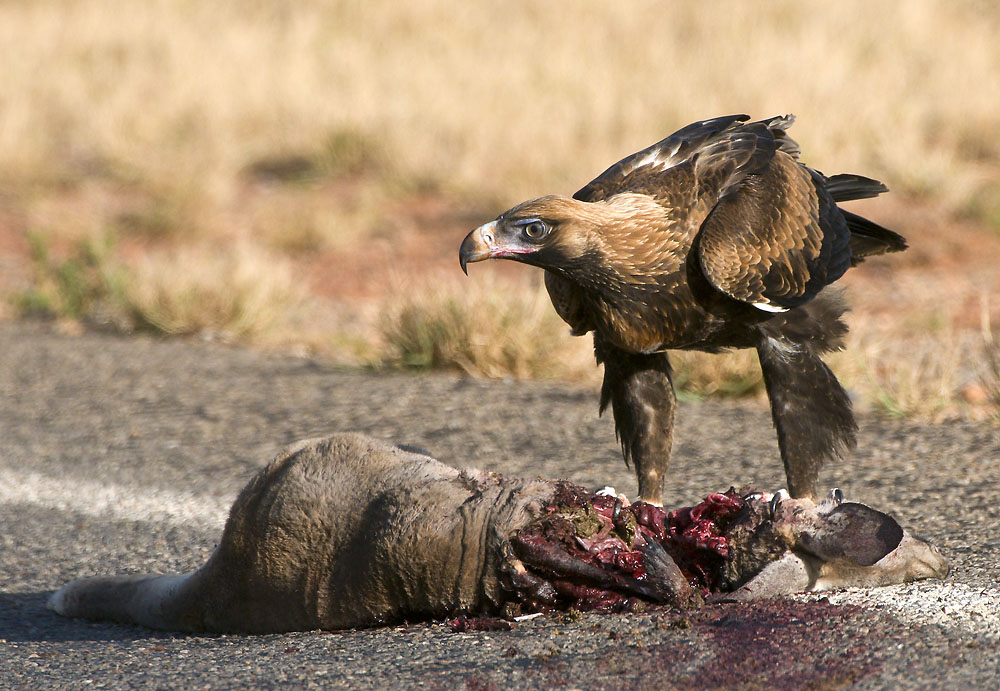
Carrion is an important food source for large carnivores and omnivores in most ecosystems. Examples of carrion-eating animals include vultures, eagles, hyenas, Virginia opossum, Tasmanian devils, and coyotes. Many invertebrates, for example carrion beetles, burying beetles, blow-fly maggots, and flesh-fly maggots, also eat carrion. All of these animals, together with microbial decomposers, help to recycle nitrogen and carbon in animal remains.
The act of eating carrion is termed necrophagy or necrophagia, and organisms that do this are described as necrophages or necrophagous animals. The term scavenger is widely used to describe carrion-eating animals too, but this term is broader in scope, encompassing also the consumption of refuse and dead plant material.
Carrion begins to decay at the moment of the animal's death, and it will increasingly attract insects and breed bacteria. Not long after the animal has died, its body will begin to exude a foul odor caused by the presence of bacteria and the emission of cadaverine and putrescine.
Carrion can harbor many infectious and disease-causing agents including viruses (e.g. rabies virus, West Nile virus), bacteria (e.g. Bacillus anthracis, Clostridium botulinum, Francisella tularensis, Listeria monocytogenes, Pasteurella multocida, Yersinia pestis), bacterial toxins (e.g. botulinum) and helminths (e.g. Trichinella species).
Several outbreaks of disease, attributed to direct or indirect contact with carrion, have been reported in humans and animals.
Hundreds of invertebrate animals feed on carrion. In terrestrial settings, some ant species eat carrion (e.g. red imported fire ants), as do some bees (i.e. vulture bees), and many beetles (e.g. burying beetles, dermestid beetles, silphine beetles) and flies (e.g. bone skippers, blow flies, flesh flies). Several species rely on carrion for survival or reproduction, including the vulture bee Trigona crassipes, the burying beetle Nicrophorus vespilloides, and the bone skipper fly Thyreophora cynophila.
Many aquatic animals also eat carrion. Necrophagous marine invertebrates include cephalopods (e.g. Octopus vulgaris), hermit crabs (e.g. Coenobita clypeatus), star fish (e.g. Luidia ciliaris), whelks (e.g. Tritia reticulata), amphipods (e.g. Eurythenes atacamensis), and annelids (e.g. zombie worms). Necrophagous freshwater invertebrates include the horse leech Haemopis marmorata, the crayfish Procambarus clarkii, and the diving beetle Thermonectus succinctus.
Hub AI
Carrion AI simulator
(@Carrion_simulator)
Carrion
Carrion (from Latin caro 'meat'), also known as a carcass, is the decaying flesh of dead animals. Carrion may be of natural or anthropic origin (e.g. wildlife, human remains, livestock), and enters the food chain via different routes (e.g. animals dying of disease or malnutrition, predators and hunters discarding parts of their prey, collisions with automobiles).
Carrion is an important food source for large carnivores and omnivores in most ecosystems. Examples of carrion-eating animals include vultures, eagles, hyenas, Virginia opossum, Tasmanian devils, and coyotes. Many invertebrates, for example carrion beetles, burying beetles, blow-fly maggots, and flesh-fly maggots, also eat carrion. All of these animals, together with microbial decomposers, help to recycle nitrogen and carbon in animal remains.
The act of eating carrion is termed necrophagy or necrophagia, and organisms that do this are described as necrophages or necrophagous animals. The term scavenger is widely used to describe carrion-eating animals too, but this term is broader in scope, encompassing also the consumption of refuse and dead plant material.
Carrion begins to decay at the moment of the animal's death, and it will increasingly attract insects and breed bacteria. Not long after the animal has died, its body will begin to exude a foul odor caused by the presence of bacteria and the emission of cadaverine and putrescine.
Carrion can harbor many infectious and disease-causing agents including viruses (e.g. rabies virus, West Nile virus), bacteria (e.g. Bacillus anthracis, Clostridium botulinum, Francisella tularensis, Listeria monocytogenes, Pasteurella multocida, Yersinia pestis), bacterial toxins (e.g. botulinum) and helminths (e.g. Trichinella species).
Several outbreaks of disease, attributed to direct or indirect contact with carrion, have been reported in humans and animals.
Hundreds of invertebrate animals feed on carrion. In terrestrial settings, some ant species eat carrion (e.g. red imported fire ants), as do some bees (i.e. vulture bees), and many beetles (e.g. burying beetles, dermestid beetles, silphine beetles) and flies (e.g. bone skippers, blow flies, flesh flies). Several species rely on carrion for survival or reproduction, including the vulture bee Trigona crassipes, the burying beetle Nicrophorus vespilloides, and the bone skipper fly Thyreophora cynophila.
Many aquatic animals also eat carrion. Necrophagous marine invertebrates include cephalopods (e.g. Octopus vulgaris), hermit crabs (e.g. Coenobita clypeatus), star fish (e.g. Luidia ciliaris), whelks (e.g. Tritia reticulata), amphipods (e.g. Eurythenes atacamensis), and annelids (e.g. zombie worms). Necrophagous freshwater invertebrates include the horse leech Haemopis marmorata, the crayfish Procambarus clarkii, and the diving beetle Thermonectus succinctus.
Recent media