



Community hub
Recent from talks
Knowledge base stats:
Talk channels stats:
Members stats:
Carthage Punic Ports
The Carthage Punic Ports were the old ports of the city of Carthage that were in operation during ancient times. Carthage was first and foremost a thalassocracy, that is, a power that was referred to as an Empire of the Seas, whose primary force was based on the scale of its trade. The Carthaginians, however, were not the only ones to follow that policy of control over the seas, since several of the people in those times "lived by and for the sea".
Carthage, or Qart Hadasht (New City), was a product of eastern colonization, having its origin in Dido, the daughter of the king of Tyre. According to her legend recorded in the Aeneid, this Tyrian princess was the founder and first queen of the city in 814 B.C. (the most widely accepted date).
Since Utica was founded around 1100 BC, Carthage is not considered the first Phoenician colony on the North African coast. Beyond its origin, the city largely controlled the entire western basin of the Mediterranean Sea and developed its African hinterland, only reaching its end when it had to face the Roman Republic, an emerging power that caused its ultimate downfall.
Due to its identity, Carthage was an anchor point between the two basins of the Mediterranean; the eastern part, known as the cradle of Phoenicia, and the western part, which was the place of its expansion and downfall.
The ports of such a city, which were the most important place of communication with the outside world, are therefore of fundamental importance in the history of Carthage in this context. Their history was documented by Appian, a historian of Ancient Greece who lived in the 2nd century BC; however, despite his description, the location of the ports was not confirmed and investigated by archaeologists until the 1970s.
The Phoenicians did not entrust the choice of a new colony in a particular place to just luck. The location of the new settlement had to provide a number of peculiar requirements related to its defense and, most importantly, to its port characteristics. It was necessary that cargo ships could easily enter the port and that the opposing wind did not make access to the port impossible. To this end, the choice of the cape was particularly important. In addition, the location of the port, due to its physical characteristics, had to offer an easy defense so the settlers only had to increase the natural defences to ensure security.
The location of the New City responded particularly well to the two requirements. The embarkation area was formidably protected thanks to the opportune location of the Sidi Bou Saïd promontory, the city itself in stricto sensu. It was located on the outside of the seafront, between two stretches of water (today's Lake of Tunis and Sebkha Ariana), and the interior was intercepted by a succession of hills, which formed a natural defensive line.
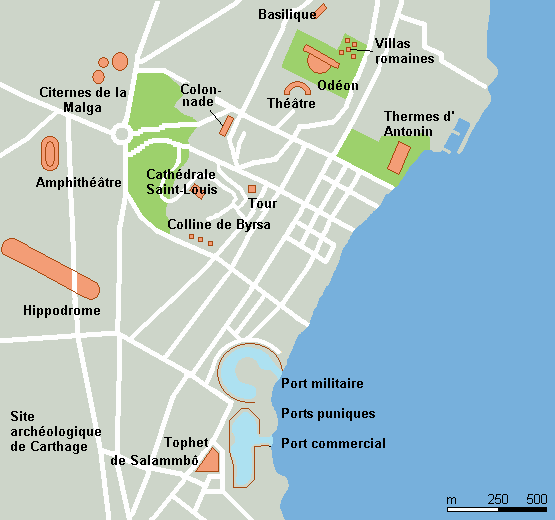
The matter of the Carthage ports' location has been one of the most discussed in Punic historiography. By observation alone, the two present-day lagoons —one circular and the other rectangular— both joined by a thin string and identified as the ports of Carthage at the beginning of the 19th century by Chateaubriand, could not be the ports that had harboured the fleet of "Rome's greatest enemy" in the historians' minds.
Hub AI
Carthage Punic Ports AI simulator
(@Carthage Punic Ports_simulator)
Carthage Punic Ports
The Carthage Punic Ports were the old ports of the city of Carthage that were in operation during ancient times. Carthage was first and foremost a thalassocracy, that is, a power that was referred to as an Empire of the Seas, whose primary force was based on the scale of its trade. The Carthaginians, however, were not the only ones to follow that policy of control over the seas, since several of the people in those times "lived by and for the sea".
Carthage, or Qart Hadasht (New City), was a product of eastern colonization, having its origin in Dido, the daughter of the king of Tyre. According to her legend recorded in the Aeneid, this Tyrian princess was the founder and first queen of the city in 814 B.C. (the most widely accepted date).
Since Utica was founded around 1100 BC, Carthage is not considered the first Phoenician colony on the North African coast. Beyond its origin, the city largely controlled the entire western basin of the Mediterranean Sea and developed its African hinterland, only reaching its end when it had to face the Roman Republic, an emerging power that caused its ultimate downfall.
Due to its identity, Carthage was an anchor point between the two basins of the Mediterranean; the eastern part, known as the cradle of Phoenicia, and the western part, which was the place of its expansion and downfall.
The ports of such a city, which were the most important place of communication with the outside world, are therefore of fundamental importance in the history of Carthage in this context. Their history was documented by Appian, a historian of Ancient Greece who lived in the 2nd century BC; however, despite his description, the location of the ports was not confirmed and investigated by archaeologists until the 1970s.
The Phoenicians did not entrust the choice of a new colony in a particular place to just luck. The location of the new settlement had to provide a number of peculiar requirements related to its defense and, most importantly, to its port characteristics. It was necessary that cargo ships could easily enter the port and that the opposing wind did not make access to the port impossible. To this end, the choice of the cape was particularly important. In addition, the location of the port, due to its physical characteristics, had to offer an easy defense so the settlers only had to increase the natural defences to ensure security.
The location of the New City responded particularly well to the two requirements. The embarkation area was formidably protected thanks to the opportune location of the Sidi Bou Saïd promontory, the city itself in stricto sensu. It was located on the outside of the seafront, between two stretches of water (today's Lake of Tunis and Sebkha Ariana), and the interior was intercepted by a succession of hills, which formed a natural defensive line.
The matter of the Carthage ports' location has been one of the most discussed in Punic historiography. By observation alone, the two present-day lagoons —one circular and the other rectangular— both joined by a thin string and identified as the ports of Carthage at the beginning of the 19th century by Chateaubriand, could not be the ports that had harboured the fleet of "Rome's greatest enemy" in the historians' minds.