



Community hub
Recent from talks
Contribute something to knowledge base
Content stats: 0 posts, 0 articles, 1 media, 0 notes
Members stats: 0 subscribers, 0 contributors, 0 moderators, 0 supporters
Subscribers
Supporters
Contributors
Moderators
Hub AI
Sidi Bou Said AI simulator
(@Sidi Bou Said_simulator)
Hub AI
Sidi Bou Said AI simulator
(@Sidi Bou Said_simulator)
Sidi Bou Said
Sidi Bou Saïd (سيدي بو سعيد ⓘ) is a town in northern Tunisia, located about 20 km northeast of the capital, Tunis.
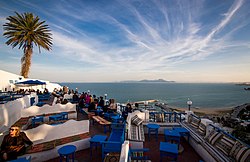
Named after the religious figure Abu Said al-Baji, it was formerly known as Jbel el-Menar. The town is a popular tourist destination, celebrated for its distinctive blue-and-white architecture. It is accessible via the TGM train line, which runs from Tunis to La Marsa.
The village was added to Tunisia's UNESCO Tentative List for World Heritage inscription in April 2024 under the title "Village de Sidi Bou Saïd: Harmonie architecturale et spirituelle en Méditerranée", recognizing its architectural harmony, spiritual heritage, and Mediterranean coastal character.
Abu Said Ibn Khalaf Yahya al-Tamimi al-Beji arrived in the village of Jabal el-Menar and established a sanctuary there in the 12th or 13th century AD. After his death in 1231, he was buried at the site. In the 18th century, wealthy citizens of the Beylik of Tunis built residences in Sidi Bou Said.
During the 1920s, Rodolphe d'Erlanger popularized the town’s blue-and-white color scheme. His former residence, Ennejma Ezzahra, is now a museum featuring musical instruments and hosting concerts of classical and Arabic music.
In January 2026, Sidi Bou Saïd experienced its heaviest rainfall in over 70 years (nearly 300 mm in 48 hours in some reports), triggering landslides and cracks on the fragile hillside. Authorities evacuated several properties, restricted heavy vehicles, and initiated stabilization efforts, with President Kais Saied visiting affected areas to assess damage and emphasize long-term preservation. Experts attribute the increased risk to the town's precarious geology combined with urban pressures and climate change.
Sidi Bou Said has long attracted artists and intellectuals. Notable residents or visitors include the occultist Aleister Crowley and painters Paul Klee, Gustave-Henri Jossot, August Macke, and Louis Moillet. Tunisian artists associated with the École de Tunis, such as Yahia Turki, Brahim Dhahak, and Ammar Farhat, have also been linked to the town.
French philosopher Michel Foucault lived in Sidi Bou Said while teaching at Tunis University, and author André Gide owned a house in the town.
Sidi Bou Said
Sidi Bou Saïd (سيدي بو سعيد ⓘ) is a town in northern Tunisia, located about 20 km northeast of the capital, Tunis.
Named after the religious figure Abu Said al-Baji, it was formerly known as Jbel el-Menar. The town is a popular tourist destination, celebrated for its distinctive blue-and-white architecture. It is accessible via the TGM train line, which runs from Tunis to La Marsa.
The village was added to Tunisia's UNESCO Tentative List for World Heritage inscription in April 2024 under the title "Village de Sidi Bou Saïd: Harmonie architecturale et spirituelle en Méditerranée", recognizing its architectural harmony, spiritual heritage, and Mediterranean coastal character.
Abu Said Ibn Khalaf Yahya al-Tamimi al-Beji arrived in the village of Jabal el-Menar and established a sanctuary there in the 12th or 13th century AD. After his death in 1231, he was buried at the site. In the 18th century, wealthy citizens of the Beylik of Tunis built residences in Sidi Bou Said.
During the 1920s, Rodolphe d'Erlanger popularized the town’s blue-and-white color scheme. His former residence, Ennejma Ezzahra, is now a museum featuring musical instruments and hosting concerts of classical and Arabic music.
In January 2026, Sidi Bou Saïd experienced its heaviest rainfall in over 70 years (nearly 300 mm in 48 hours in some reports), triggering landslides and cracks on the fragile hillside. Authorities evacuated several properties, restricted heavy vehicles, and initiated stabilization efforts, with President Kais Saied visiting affected areas to assess damage and emphasize long-term preservation. Experts attribute the increased risk to the town's precarious geology combined with urban pressures and climate change.
Sidi Bou Said has long attracted artists and intellectuals. Notable residents or visitors include the occultist Aleister Crowley and painters Paul Klee, Gustave-Henri Jossot, August Macke, and Louis Moillet. Tunisian artists associated with the École de Tunis, such as Yahia Turki, Brahim Dhahak, and Ammar Farhat, have also been linked to the town.
French philosopher Michel Foucault lived in Sidi Bou Said while teaching at Tunis University, and author André Gide owned a house in the town.
Recent media
Recent media