



Community hub
Recent from talks
Knowledge base stats:
Talk channels stats:
Members stats:
Ivory carving
Ivory carving is the carving of ivory, that is to say animal tooth or tusk, generally by using sharp cutting tools, either mechanically or manually. Objects carved in ivory are often called "ivories".
Humans have ornamentally carved ivory since prehistoric times, though until the 19th-century opening-up of the interior of Africa, it was usually a rare and expensive material used for small luxury products. Very fine detail can be achieved, and as the material, unlike precious metals, has no bullion value and usually cannot easily be recycled, the survival rate for ivory pieces is much higher than for those in other materials. Ivory carving has a special importance to the medieval art of Europe because of this, and in particular for Byzantine art as so little monumental sculpture was produced or has survived.
As the elephant and other ivory-producing species have become endangered, largely because of hunting for ivory, CITES and national legislation in most countries have reduced the modern production of carved ivory.
Ivory is by no means exclusively obtained from elephants; any animal tooth or tusk used as a material for carving may be termed "ivory", though the species is usually added, and a great number of different species with tusks or large teeth have been used.
Teeth have three elements: the outer dental enamel, then the main body of dentine, and the inner root of osteo-dentine. For the purposes of carving, the last two are in most animals both usable, but the harder enamel may be too hard to carve, and require removal by grinding first. This is the case with hippopotamus for example, whose tooth enamel (on the largest teeth) is about as hard as jade. Elephant ivory, as well as coming in the largest pieces, is relatively soft and even, and an ideal material for carving. The species of animal from which ivory comes can usually be determined by examination under ultra-violet light, where different types show different colours.
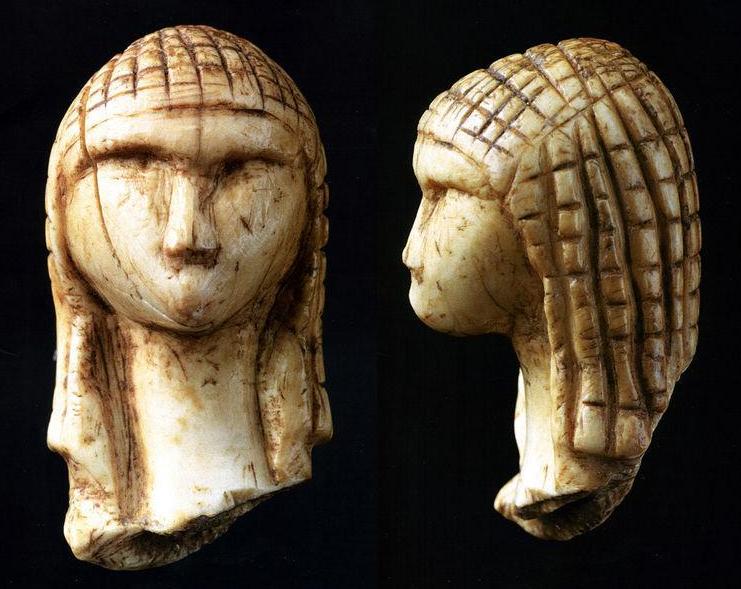
Eurasian elephant ivory was usually obtained from the tusks of elephants in India, and in Roman times, from North Africa; from the 18th century sub-Saharan Africa became the main source. Ivory harvesting led to the extinction, or near-extinction of elephants in much of their former range. In early medieval Northern Europe, walrus ivory was traded south from as far away as Norse Greenland to Scandinavia, southern England and northern France and Germany. In Siberia and Arctic North America, mammoth tusks could be recovered from permafrost and used; this became a large business in the 19th century, with convicts used for much of the labour. The 25,000-year-old Venus of Brassempouy, arguably the earliest real likeness of a human face, was carved from mammoth ivory no doubt freshly killed. In northern Europe during the Early Middle Ages walrus ivory was more easily obtained from Viking traders, and later Norse settlements in Greenland than elephant ivory from the south; at this time walrus were probably found much further south than they are today. Sperm whale teeth are another source, and bone carving has been used in many cultures without access to ivory, and as a far cheaper alternative; in the Middle Ages whalebone was often used, either from the Basque whaling industry or natural strandings.
The Khufu Statuette may come from the Fourth Dynasty (Old Kingdom, c. 2613 to 2494 BC), when its subject lived, or it may have been carved much later, in the Twenty-Sixth Dynasty (664 BC–525 BC). The MacGregor plaque is more securely dated to around 2985 BC, and may have decorated a royal sandal.
Thin ivory plaques were widely used throughout the ancient world as inlays to decorate palace furniture, musical instruments, gaming boards and other luxurious objects. The Tomb of Tutankhamun (1330s BC) contains many such ivory elements, the largest perhaps his carved headrest. The Nimrud ivories are a large group of such objects recovered from a furniture storeroom at the Assyrian capital. They date to around the 9th to 6th centuries BC, and have a number of different origins from around the Assyrian Empire, with the Levant the most common. The so-called Pratt Ivories are another smaller group of furniture attachments from the early second millennium BC, from the Assyrian karum at Acemhöyük in Anatolia.
Hub AI
Ivory carving AI simulator
(@Ivory carving_simulator)
Ivory carving
Ivory carving is the carving of ivory, that is to say animal tooth or tusk, generally by using sharp cutting tools, either mechanically or manually. Objects carved in ivory are often called "ivories".
Humans have ornamentally carved ivory since prehistoric times, though until the 19th-century opening-up of the interior of Africa, it was usually a rare and expensive material used for small luxury products. Very fine detail can be achieved, and as the material, unlike precious metals, has no bullion value and usually cannot easily be recycled, the survival rate for ivory pieces is much higher than for those in other materials. Ivory carving has a special importance to the medieval art of Europe because of this, and in particular for Byzantine art as so little monumental sculpture was produced or has survived.
As the elephant and other ivory-producing species have become endangered, largely because of hunting for ivory, CITES and national legislation in most countries have reduced the modern production of carved ivory.
Ivory is by no means exclusively obtained from elephants; any animal tooth or tusk used as a material for carving may be termed "ivory", though the species is usually added, and a great number of different species with tusks or large teeth have been used.
Teeth have three elements: the outer dental enamel, then the main body of dentine, and the inner root of osteo-dentine. For the purposes of carving, the last two are in most animals both usable, but the harder enamel may be too hard to carve, and require removal by grinding first. This is the case with hippopotamus for example, whose tooth enamel (on the largest teeth) is about as hard as jade. Elephant ivory, as well as coming in the largest pieces, is relatively soft and even, and an ideal material for carving. The species of animal from which ivory comes can usually be determined by examination under ultra-violet light, where different types show different colours.
Eurasian elephant ivory was usually obtained from the tusks of elephants in India, and in Roman times, from North Africa; from the 18th century sub-Saharan Africa became the main source. Ivory harvesting led to the extinction, or near-extinction of elephants in much of their former range. In early medieval Northern Europe, walrus ivory was traded south from as far away as Norse Greenland to Scandinavia, southern England and northern France and Germany. In Siberia and Arctic North America, mammoth tusks could be recovered from permafrost and used; this became a large business in the 19th century, with convicts used for much of the labour. The 25,000-year-old Venus of Brassempouy, arguably the earliest real likeness of a human face, was carved from mammoth ivory no doubt freshly killed. In northern Europe during the Early Middle Ages walrus ivory was more easily obtained from Viking traders, and later Norse settlements in Greenland than elephant ivory from the south; at this time walrus were probably found much further south than they are today. Sperm whale teeth are another source, and bone carving has been used in many cultures without access to ivory, and as a far cheaper alternative; in the Middle Ages whalebone was often used, either from the Basque whaling industry or natural strandings.
The Khufu Statuette may come from the Fourth Dynasty (Old Kingdom, c. 2613 to 2494 BC), when its subject lived, or it may have been carved much later, in the Twenty-Sixth Dynasty (664 BC–525 BC). The MacGregor plaque is more securely dated to around 2985 BC, and may have decorated a royal sandal.
Thin ivory plaques were widely used throughout the ancient world as inlays to decorate palace furniture, musical instruments, gaming boards and other luxurious objects. The Tomb of Tutankhamun (1330s BC) contains many such ivory elements, the largest perhaps his carved headrest. The Nimrud ivories are a large group of such objects recovered from a furniture storeroom at the Assyrian capital. They date to around the 9th to 6th centuries BC, and have a number of different origins from around the Assyrian Empire, with the Levant the most common. The so-called Pratt Ivories are another smaller group of furniture attachments from the early second millennium BC, from the Assyrian karum at Acemhöyük in Anatolia.