Hubbry Logo
BaleenBaleenMain
Open search
Baleen
Community hub
Baleen
logo
8 pages, 0 posts
0 subscribers
Be the first to start a discussion here.
Baleen
Baleen
from Wikipedia
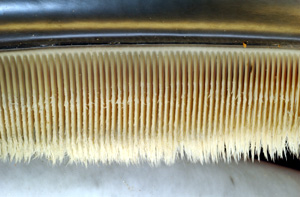
Photo displaying dozens of baleen plates. The plates face each other, and are evenly spaced at approximately 0.25 inches (1 cm) intervals. The plates are attached to the jaw at the top, and have hairs at the bottom end.
Baleen hair is attached to each baleen plate.
Appearance of baleen hair in a whale's open mouth
Cross-section of jaw showing bone a, gum b, rigid plate c and frayed baleen hairs d and e

Baleens, also referred to as "Baleen plates", are triangular sheets of keratin that make up a filter-feeding system (the "Baleen rack") inside the mouth of baleen whales. The feeding process starts as the animal opens its mouth to take in water. The whale then pushes the water out through a rack of baleen plates, so as to retain (filter) what will serve as food for the whale. A baleen is similar to a bristle and consists of keratin, the same substance found in human fingernails, skin and hair.[citation needed] Some whales, such as the bowhead whale, have baleen of differing lengths. Other whales, such as the gray whale, only use one side of their baleen. These baleen bristles are arranged in plates across the upper jaw of whales.

Depending on the species, a baleen plate can be 0.5 to 3.5 m (1.6 to 11.5 ft) long, and weigh up to 90 kg (200 lb). Its hairy fringes are called baleen hair or whalebone hair. They are also called baleen bristles, which in sei whales are highly calcified, with calcification functioning to increase their stiffness.[1][2] Baleen plates are broader at the gumline (base). The plates have been compared to sieves or Venetian blinds.

As a material for various human uses, baleen is usually called whalebone, which is a misnomer.

Etymology

[edit]

The word "baleen" derives from the Latin bālaena, related to the Greek phalaina – both of which mean "whale".

Evolution

[edit]

The oldest true fossils of baleen are only 15 million years old because baleen rarely fossilizes, but scientists believe it originated considerably earlier than that.[3] This is indicated by baleen-related skull modifications being found in fossils from considerably earlier, including a buttress of bone in the upper jaw beneath the eyes, and loose lower jaw bones at the chin. Baleen is believed to have evolved around 30 million years ago, possibly from a hard, gummy upper jaw, like the one a Dall's porpoise has; it closely resembles baleen at the microscopic level. The initial evolution and radiation of baleen plates is believed to have occurred during Early Oligocene when Antarctica broke off from Gondwana and the Antarctic Circumpolar Current was formed, increasing productivity of ocean environments.[4] This occurred because the current kept warm ocean waters away from the area that is now Antarctica, producing steep gradients in temperature, salinity, light, and nutrients, where the warm water meets the cold.[5]

Gray whale calf with mouth open, showing baleen

The transition from teeth to baleen is proposed to have occurred stepwise, from teeth to a hybrid to baleen. It is known that modern mysticetes have teeth initially and then develop baleen plate germs in utero, but lose their dentition and have only baleen during their juvenile years and adulthood. However, developing mysticetes do not produce tooth enamel because at some point this trait evolved to become a pseudogene. This is likely to have occurred about 28 million years ago and proves that dentition is an ancestral state of mysticetes. Using parsimony to study this and other ancestral characters suggests that the common ancestor of aetiocetids and edentulous mysticetes evolved lateral nutrient foramina, which are believed to have provided blood vessels and nerves a way to reach developing baleen. Further research suggests that the baleen of Aetiocetus was arranged in bundles between widely spaced teeth. If true, this combination of baleen and dentition in Aetiocetus would act as a transition state between odontocetes and mysticetes. This intermediate step is further supported by evidence of other changes that occurred with the evolution of baleen that make it possible for the organisms to survive using filter feeding, such as a change in skull structure and throat elasticity. It would be highly unlikely for all of these changes to occur at once. Therefore, it is proposed that Oligocene aetiocetids possess both ancestral and descendant character states regarding feeding strategies. This makes them mosaic taxa, showing that either baleen evolved before dentition was lost or that the traits for filter feeding originally evolved for other functions. It also shows that the evolution could have occurred gradually because the ancestral state was originally maintained. Therefore, the mosaic whales could have exploited new resources using filter feeding while not abandoning their previous prey strategies. The result of this stepwise transition is apparent in modern-day baleen whales, because of their enamel pseudogenes and their in utero development and reabsorbing of teeth.[3]

If it is true that many early baleen whales also had teeth, these were probably used only peripherally, or perhaps not at all (again like Dall's porpoise, which catches squid and fish by gripping them against its hard upper jaw). Intense research has been carried out to sort out the evolution and phylogenetic history of mysticetes, but much debate surrounds this issue.

Filter feeding

[edit]

A whale's baleen plates play the most important role in its filter-feeding process. To feed, a baleen whale opens its mouth widely and scoops in dense shoals of prey (such as krill, copepods, small fish, and sometimes birds that happen to be near the shoals), together with large volumes of water. It then partly shuts its mouth and presses its tongue against its upper jaw, forcing the water to pass out sideways through the baleen, thus sieving out the prey, which it then swallows.

Mechanical properties

[edit]

Whale baleen is the mostly mineralized keratin-based bio-material consisting of parallel plates suspended down the mouth of the whale. Baleen's mechanical properties of being strong and flexible made it a popular material for numerous applications requiring such a property (see Human uses section).

The basic structure of the whale baleen has been described as a tubular structure with a hollow medulla (inner core) enclosed by a tubular layer with a diameter varying from 60 to 900 micrometres, which had approximately 2.7 times higher calcium content than the outer solid shell. The elastic modulus in the longitudinal direction and the transverse direction are 270 megapascals (MPa) and 200 MPa, respectively. This difference in the elastic moduli could[clarification needed] be attributed to the way the sandwiched tubular structures are packed together.

Hydrated versus dry whale baleen also exhibit significantly different parallel and perpendicular compressive stress to compressive strain response. Although parallel loading for both hydrated and dry samples exhibit higher stress response (about 20 MPa and 140 MPa at 0.07 strain for hydrated and dry samples respectively) than that for perpendicular loading, hydration drastically reduced the compressive response.[6]

Crack formation is also different for both the transverse and longitudinal orientation. For the transverse direction, cracks are redirected along the tubules, which enhances the baleen's resistance to fracture and once the crack enters the tubule it is then directed along the weaker interface rather than penetrating through either the tubule or lamellae.

Human uses

[edit]
Iñupiat baleen basket, with an ivory handle, made by Kinguktuk (1871–1941) of Utqiaġvik, Alaska, displayed at the Museum of Us, San Diego, California

People formerly used baleen (usually referred to as "whalebone") for making numerous items where flexibility and strength were required, including baskets, backscratchers, collar stiffeners, buggy whips, parasol ribs, switches, crinoline petticoats, farthingales, busks, and corset stays,[7] but also pieces of armour.[8] It was commonly used to crease paper; its flexibility kept it from damaging the paper. It was also occasionally used in cable-backed bows. Synthetic materials are now usually used for similar purposes, especially plastic and fiberglass. Baleen was also used by Dutch cabinetmakers for the production of pressed reliefs.[9]

In the United States, the Marine Mammal Protection Act in 1972 makes it illegal "for any person to transport, purchase, sell, export, or offer to purchase, sell, or export any marine mammal or marine mammal product".[10]

See also

[edit]

References

[edit]

Further reading

[edit]
[edit]
Revisions and contributorsEdit on WikipediaRead on Wikipedia
from Grokipedia
Baleen is an epidermal keratinous tissue that forms a series of parallel plates hanging from the of the upper jaws in mysticete whales, serving as a filter-feeding apparatus to capture small prey such as , copepods, and from large volumes of ingested . These whales, numbering around 14 extant across six families, engulf mixed with prey aggregates through lunge, gulp, or skim feeding strategies, then expel the via muscular action while retaining on the baleen fringes. The plates, typically 200 to 700 in number depending on , consist of continuous sheets of α- reinforced with mineral components like , providing flexibility, tensile strength, and resistance to fracture under repeated loading during feeding cycles. Baleen grows incrementally from vascularized gum tissue at its base at rates of up to several centimeters per month, with the worn distal edges developing tubular fringes of finer keratin filaments that enhance particle retention efficiency, often exceeding 99% for prey items larger than 1 millimeter. This specialized structure evolved from toothed ancestors in the Eocene, enabling the exploitation of dense, micron-scale resources and facilitating the observed in like the .

Definition and Basic Characteristics

Description and Etymology

Baleen comprises a series of flexible, keratinous plates suspended from the upper jaws of mysticete whales, forming a sieving structure for filter feeding on small marine organisms such as , , and . These plates replace teeth in the suborder Mysticeti, enabling the whales to engulf large volumes of water and prey, then expel the water while retaining food particles. Mysticetes, distinguished from toothed cetaceans by this adaptation, include species ranging from the at about 7 meters in length to the exceeding 30 meters. The plates vary in size and shape across species but generally taper from a broad base attached to the palate to a narrower, fringed tip, with lengths ranging from 0.5 to 3.5 meters and weights up to 90 kilograms per plate in larger forms. Arranged in dense racks, a typical baleen whale possesses 200 to 400 plates per side of the upper jaw, spaced closely to create a mat-like filter when the mouth closes. For instance, blue whales have 260 to 400 plates per side, each measuring under 1 meter in length, while right whales feature longer plates exceeding 3 meters with finer fringes suited to smaller prey. The English term "baleen" derives from Latin bālaena (""), borrowed through Old French , originally denoting whalebone harvested for its elastic properties in pre-industrial applications. This nomenclature reflects early European encounters with whale carcasses during expeditions, where the material's utility overshadowed its biological role until anatomical studies in the 17th century, such as those by naturalist , began classifying cetaceans based on shared mammalian traits amid descriptions of their unique oral structures.

Occurrence in Baleen Whales

Baleen occurs exclusively in the suborder Mysticeti, comprising all baleen whales and distinguishing them from the suborder Odontoceti, whose members possess teeth instead of baleen plates for prey capture. The Mysticeti includes four extant families: (right whales and ), Balaenopteridae (rorquals such as blue, fin, sei, Bryde's, and minke whales, plus ), (), and Neobalaenidae (). All species in these families develop baleen plates along the upper jaws, with no known exceptions or vestigial occurrences outside Mysticeti. Variations in baleen structure exist across Mysticeti species, particularly in plate count, length, and fringe density, reflecting adaptations to prey size and distribution. Bowhead whales (Balaena mysticetus) exhibit the longest plates, measuring up to 5.2 meters, with 230–360 plates per side and long, fine fringes. Sei whales (Balaenoptera borealis) have 219–410 dark plates per side featuring fine, grayish-white inner fringes suited to smaller zooplankton. Humpback whales (Megaptera novaeangliae), by comparison, possess coarser fringes on their up to 400 plates per side. Baleen whales occupy a across all major basins, from and waters to equatorial regions, with presence tied to seasonal migrations between high-latitude summer feeding grounds abundant in euphausiids and and lower-latitude winter breeding areas. such as bowheads remain largely confined to and sub-Arctic seas year-round, while like blues and fins undertake transoceanic journeys spanning thousands of kilometers annually. No baleen whales inhabit permanently ice-covered polar extremes lacking sufficient prey concentrations, though many exploit seasonal productivity in sub-polar zones.

Anatomy and Composition

Macroscopic Structure

Baleen plates are elongated, keratinous structures suspended from the upper of baleen whales (Mysticeti) via an epidermal base embedded in gum-like , forming two symmetrical bilateral racks that extend downward into the oral cavity. These racks consist of hundreds of parallel, overlapping plates per side, arranged transversely across the width of the mouth, with the inner (lingual) edges featuring frayed fibrous fringes that interlock to create a sieve-like curtain for . The plates taper distally, with the longest and widest typically located in the posterior region of the rack, maximizing surface area for prey capture toward the back of the mouth. Morphological variations exist among mysticete families, reflecting adaptations to distinct feeding strategies. In balaenids such as right whales, plates are notably long, thin, and relatively straight, often with an arched configuration along the rack to facilitate continuous skim feeding on dense layers near the surface. In contrast, balaenopterids () possess shorter, broader plates—approximately one-fourth to one-fifth the length of those in comparably sized balaenids—often featuring transverse ridges on the medial surfaces that enhance during lunge feeding, where large volumes of water are engulfed rapidly. Baleen plates undergo continuous elongation from their proximal attachment points throughout the whale's life, with distal tips subject to abrasion from water flow and prey contact, resulting in gradual wear that maintains functional . Growth rates, derived from measurements of stranded specimens, average about 2 cm every 27–34 days in adult southern right whales, with annual increments discernible as layered growth bands in cross-sections of plates from and stranding records. This lifelong extension ensures adaptation to increasing body size and feeding demands, with bilateral symmetry preserved across racks despite localized wear patterns.

Microscopic and Material Composition

Baleen plates consist primarily of α-, a forming intermediate filaments embedded within an amorphous keratin matrix, analogous to the structure in mammalian and . This hierarchical arrangement includes a central medullary layer of longitudinally oriented keratin tubules surrounded by a denser cortical layer, creating a sandwich-like that contributes to the material's overall architecture. In some species, such as the , the tubules are packed with keratinized epithelial cells, while the matrix features concentrically oriented fibers derived from the Zwischensubstanz, the supportive tissue between papillae during development. The distal fringes of baleen plates emerge from fraying of the keratinous material at the plate edges, forming fine, brush-like filaments composed largely of the same but with increased due to differential wear and orientation. Mineralization occurs via embedded crystals within the keratin matrix, particularly in the harder proximal regions, enhancing structural integrity without altering the predominant organic composition. Biosynthesis of baleen keratin takes place in specialized epithelial folds of the upper , where mesenchymal papillae induce thickening and differentiation of the oral into keratin-producing cells. These folds elongate continuously from fetal stages onward, with keratin synthesis driven by cellular keratinization processes akin to those in epidermal appendages, resulting in incremental plate growth at rates varying by and . Stable isotope analysis of baleen cross-sections reveals longitudinal gradients in δ¹³C and δ¹⁵N, reflecting dietary incorporation of and carbon from prey such as and copepods, which in turn derive from primary producers. This isotopic record underscores the material's role as a biochemical archive, with no significant incorporation of inorganic elements like silica directly into the keratin structure.

Evolutionary History

Fossil Evidence and Origins

The fossil record of mysticetes, the encompassing baleen whales, first appears in the late Eocene, with the earliest known specimens dating to approximately 36.9–33.9 million years ago (Ma) from the in . Mystacodon peruvianus, described from a partial including a with functional teeth, represents a primitive toothed mysticete exhibiting early derived features such as a widened rostrum and consistent with the ancestry of baleen-bearing forms, though of baleen is absent due to its non-mineralized keratinous composition. Similarly, Llanocetus denticrenatus from the Eocene-Oligocene boundary (~34 Ma) in displays denticulate teeth and a robust structure, marking the initial of mysticetes from odontocetes (toothed whales) without preserved baleen but with inferred palatal adaptations. During the Oligocene (ca. 34–23 Ma), mysticete fossils diversify, revealing species with progressively reduced dentition alongside skeletal indicators of baleen precursors. Janjucetus hunderi from the late Oligocene (~25 Ma) Jan Juc Marl in preserves a skull with triangular teeth and palatal grooves that suggest early baleen-like structures, contributing to evidence of morphological experimentation in feeding apparatus prior to full edentulism. Aetiocetids, such as Aetiocetus weltoni from late Oligocene deposits (~25 Ma) in , exhibit small, homodontous teeth and numerous lateral palatal foramina, interpreted by some analyses as vascular supply channels potentially supporting baleen development, though this correlation remains debated as foramina alone may not conclusively indicate baleen presence. Computed tomography (CT) scans of Oligocene mysticete fossils have provided indirect empirical support for baleen origins through visualization of internal palatal anatomy. In Aetiocetus specimens, these scans reveal connections between palatal foramina and the superior alveolar canal, suggesting neurovascular pathways repurposed from dentition to nourish soft-tissue structures akin to baleen attachment sites, consistent with jaw morphologies adapted for filter-feeding precursors. This diversification phase, spanning ~36–30 Ma, underscores an among archaic toothed mysticetes before the Miocene dominance of toothless forms, with fossil distributions primarily in the and North Pacific.

Transitions from Teeth to Baleen

The evolutionary transition from to baleen in mysticete whales remains debated, with evidence indicating a shift from predatory or feeding to bulk , driven by selective pressures toward exploiting dense schools of small prey such as and copepods during the Eocene-Oligocene transition around 36-25 million years ago (Mya). Early mysticetes, including Mystacodon selenodon from the late Eocene of dated to approximately 36 Mya, retained teeth suited for grasping and piercing larger prey, with no osteological correlates for baleen such as expanded palatal nutrient foramina, suggesting a -feeding mode without . This aligns with causal inferences that initial mysticete diversification coincided with and productivity shifts favoring smaller, schooling invertebrates, rendering tooth-based predation less efficient than emerging filter mechanisms. A key controversy centers on whether teeth were lost prior to baleen origination or if a brief phase of co-occurrence enabled transitional feeding. Proponents of prior tooth loss cite Maiabalaena callista, an edentulous Oligocene mysticete from South Carolina dated to about 33 Mya, phylogenetically positioned crownward of all known toothed mysticetes yet lacking baleen indicators, implying complete dentition forfeiture before baleen plates evolved as a separate for keratinous . Supporting this, microwear analyses of toothed mysticete fossils reveal no filtration-induced abrasion patterns, contradicting hypotheses of teeth functioning as proto-baleen sieves and indicating instead that early mysticetes relied on or without overlap. Conversely, evidence for co-occurrence draws from aetiocetids, archaic mysticetes (~28-23 Mya) like Aetiocetus weltoni, where CT-scanned neurovascular canals in the —linked to the superior alveolar canal—suggest vascular supply sufficient for both teeth and nascent baleen racks medial to the , potentially allowing hybrid raptorial- before full . This interpretation revives earlier stepwise models but faces critique for inferring soft-tissue baleen from bony proxies alone, as such foramina occur variably in toothed mammals without implying structures, and the record shows abrupt gaps lacking direct intermediates with preserved both and baleen. No verified s display functional overlap, underscoring that baleen's rapid decay precludes definitive preservation and that evolutionary shifts likely involved decoupled genetic modules for and baleen .

Genetic and Adaptive Mechanisms

Genomic analyses of baleen whales (Mysticeti) have revealed signatures of positive selection in multiple families associated with their , including those influencing sensory perception, , and structural integrity of specialized tissues. A study sequencing genomes from eight cetacean , including balaenopterids, identified positive selection across over 3,150 genes, with convergent changes in balaenopterid lineages linked to filtration and endurance diving. These adaptations reflect molecular responses to selective pressures for processing vast prey volumes, though direct evidence for selection on genes—crucial for baleen's keratinous composition—remains limited in available datasets, potentially due to incomplete of baleen-specific isoforms. Gene duplications have played a role in enabling the hierarchical microstructure of baleen, facilitating its flexibility and filtration capacity through amplified expression of cytoskeletal and genes. Segmental duplications in the genome, detected in a 2024 assembly, include expansions of genes involved in tissue remodeling, which may underpin baleen's laminated keratin architecture, though functional validation is pending. Empirical phylogenetic reconstructions using molecular data correlate the emergence of modern baleen innovations with Miocene prey abundance surges, such as euphausiid blooms, driving adaptive radiations in and right whales; however, estimates often underestimate divergence times compared to calibrations, highlighting discrepancies in substitution rates that challenge precise timing of baleen-related innovations. Post-Eocene adaptive evolution prioritized body size increases before refined filter-feeding mechanics, as evidenced by early mysticete fossils like Llanocetus denticulatus from the late Eocene, which attained near-modern via feeding strategies predating baleen dominance. This sequence suggests causal realism in size-driven metabolic advantages enabling later baleen exploitation, with genomic evidence of relaxed selection on odontogenic genes post-transition, but persistent gaps in transitional molecular intermediates underscore empirical challenges in reconstructing the full adaptive pathway without invoking unverified mechanisms.

Function in Filter Feeding

Mechanism of Filtration

Baleen whales utilize , a process in which incoming water laden with prey passes through the porous baleen rack, with most water exiting via the sides and bottom of the while larger particles are retained on the fringes. This mechanism relies on hydrodynamic forces generated by the whale's locomotion or muscular actions, creating gradients that drive passive sieving without requiring active pumping by the oral cavity. In continuous skim feeding, employed by balaenid whales such as right and bowhead , the animal swims forward with its held open at a fixed angle, allowing from forward motion to force water continuously through the baleen at low velocities, typically below 1 m/s. The interlocking fringes form a dynamic mat that traps planktonic prey, with empirical studies using particle tracers demonstrating efficient capture as water flows parallel to the plates before diverting outward. In contrast, lunge-feeding balaenopterid whales, including and species, accelerate toward dense prey patches to engulf a massive bolus of water—up to tens of cubic meters in large individuals—using an expandable pouch, followed by via expulsion driven by tongue retraction and elevation. Animal-borne tags with accelerometers and have captured this sequence, revealing mouth opening durations of 2-5 seconds during engulfment and subsequent rapid clearance through the baleen, where cross-flow prevents clogging by directing cleared ventrally. Fringes selectively retain particles larger than the effective pore size, generally 0.5-5 mm depending on species-specific fringe density and matting, as validated by laboratory simulations with prey analogs showing retention efficiencies exceeding 80% for krill-sized targets under simulated flow conditions. This porosity-driven separation exploits the differential trajectories of and denser prey, enabling high throughput—estimated at volumes equivalent to 10-100 L/s in scaled models—while minimizing energy loss from drag.

Efficiency and Behavioral Adaptations

Baleen filtration in mysticete whales incorporates dynamic processes that enhance energy efficiency during . Recent biomechanical analyses reveal that baleen plates undergo active deformation and reorientation during mouth engorgement and expulsion, challenging earlier static models by enabling a tunable that adjusts to prey size and flow dynamics for optimized particle retention. This adaptability allows for higher capture rates of target planktonic prey while minimizing expenditure on non-nutritive processing, with hydrodynamic simulations indicating reduced drag and improved flow control compared to rigid filters. Behavioral adaptations further amplify foraging efficiency, as baleen whales time dives to coincide with dense aggregations, leveraging submesoscale oceanographic features that concentrate prey. In large , biologging data from 2025 demonstrate field metabolic rates during lunge-feeding that are less than half the rates predicted by allometric scaling from smaller mammals, attributable to low respiratory rates and efficient bulk filtration that sustains prolonged breath-hold dives with minimal post-dive recovery costs. These savings enable giants like blue whales to process vast volumes—up to 220,000 liters per lunge—while maintaining net gains from swarm-targeted feeds. Species-specific baleen traits refine prey selectivity and efficiency; for instance, minke whales (Balaenoptera bonaerensis) feature shorter plates with finer fringes (approximately 3 mm filament diameter), suited to filtering smaller like copepods alongside , thereby broadening dietary flexibility in patchy waters without compromising performance. Overall, these adaptations yield capture efficiencies exceeding those of passive sieves, with empirical models estimating 80-99% retention for particles in the optimal size range (0.1-10 mm) during ram , as validated by particle-tracking studies in controlled analogs.

Physical and Mechanical Properties

Material Strength and Flexibility

Baleen, formed from α-keratin, displays a of 0.65–1.22 GPa in hydrated conditions for species including minke, sei, and humpback whales, enabling a balance of stiffness for load-bearing and elasticity for deformation without permanent damage. in the keratin reinforces this, as decalcified samples exhibit lower moduli, such as 0.64 GPa for baleen. The hierarchical arrangement of mineralized tubules and medullary layers in baleen confers elevated , resisting crack propagation through and energy-absorbing mechanisms that avert catastrophic brittle failure under tensile or flexural loads. Tensile tests on harvested baleen reveal anisotropic properties, with longitudinal orientations yielding higher yield stresses (7.1–15.1 MPa) and breaking stresses (27–36 MPa) than transverse directions, reflecting the oriented filaments and tubular architecture. Hydrated baleen demonstrates superior flexibility over dried samples, with flexural reduced by over tenfold (58 N mm⁻² versus 633 N mm⁻²) and ductile that expels under stress, whereas dried baleen fractures brittlely at 20–30 N mm⁻², predominantly along the in 97% of cases. In bowhead whales inhabiting waters, baleen durability aligns with the species' lifespan exceeding 200 years and possession of the longest plates among mysticetes, suggesting enhanced preservation in environments compared to faster degradation in warmer waters for other baleen species.

Biomechanical Analysis

Hydrated baleen plates exhibit viscoelastic behavior that facilitates energy dissipation during , as evidenced by showing reduced and increased compared to dried samples, which brittlely under stresses of 20–30 N mm⁻². Three-point flexural tests indicate that baleen withstands peak oral cavity pressures up to 800–1000 kPa (10⁶ N m⁻²) through hierarchical structure, with stress concentrating at proximal attachment sites to the due to cantilever-like deflection under transverse flow. Kinematic models and high-speed videography of lunge feeding quantify hydrodynamic drag forces on the engulfed water mass and filter apparatus at 10–100 kN (10⁴–10⁵ N), primarily from mouth-open deceleration, requiring baleen to deform pliably while filtering dense prey patches without . Baleen's low at ventral regions—yielding high elasticity when wet—permits repeated bending cycles, with fringes undulating to modulate and mitigate shear stresses via internal shearing of mineralized tubules. These properties emerge from evolutionary pressures favoring resilience to variable flow regimes in filter feeding, where natural selection refines causal trade-offs between rigidity for sieve integrity and compliance for load accommodation, independent of teleological intent.

Human Uses and Ecological Interactions

Historical Exploitation

exploitation of baleen escalated in the as industrial demand grew for its keratin-based flexibility and strength, applied in products including corsets for , buggy whips for resilience, and umbrellas for ribbing. Bowhead and right whales were preferentially targeted for their elongated plates, often exceeding 4 meters in length, which maximized yield per animal; logbooks from American whaling fleets document these species yielding baleen that formed a substantial economic component, particularly after whale oil markets contracted mid-century. U.S. whalebone production peaked at 2.8 million pounds—roughly 1,400 short tons—in the 1850s, reflecting annual averages during the industry's height, with exports directed mainly to for processing. Baleen's real price surged from $0.10 per pound in 1820 to over $5 per pound by 1905, incentivizing extended voyages to remote grounds and enabling the whaling industry's expansion despite diminishing oil returns, until stocks were overexploited. Demand declined sharply after the with the rise of synthetic materials and alternatives, which provided comparable properties at lower cost, curtailing baleen harvesting as shifted toward other products.

Modern Conservation and Regulations

The (IWC) established a moratorium on commercial effective from the 1985/1986 season, following a 1982 decision, which prohibits the harvest of baleen-bearing great whales for commercial gain and has thereby curtailed direct exploitation of baleen structures. This measure, enforced through international agreements and national implementations, prioritizes population maintenance above calculations for depleted stocks, though it permits limited aboriginal subsistence under quotas tied to stock health assessments. Aboriginal exceptions include the Whaling Commission's quota for bowhead whales (Balaena mysticetus), allocated by the U.S. in coordination with the IWC; for 2023–2025, this allows up to 93 strikes annually within a multi-year block limit, with actual landings averaging 57 whales per year from 2017–2021 based on verified subsistence harvests by licensed captains. Enforcement relies on community reporting and federal oversight, ensuring strikes do not exceed sustainable removals calibrated to Bering-Chukchi-Beaufort Sea stock estimates exceeding 16,000 individuals. Persistent anthropogenic threats to baleen whales undermine conservation gains, with vessel strikes documented as a leading mortality factor globally, affecting migration and routes across major basins as of 2024 analyses. Entanglements in gear have risen in U.S. waters, with confirmed cases increasing through 2024 and causing sublethal injuries that impair baleen filtration via reduced mobility. Anthropogenic noise further compromises feeding efficacy by masking prey detection cues essential for baleen straining, as evidenced in studies linking elevated sound levels to diminished energy intake. Baleen whale populations exhibit variable recovery under the moratorium, with humpback whales (Megaptera novaeangliae) reaching an estimated 84,000 mature individuals worldwide by 2024, reflecting strong rebounds in multiple breeding stocks since the lows, per IWC assessments. However, not all mysticete populations have stabilized, prompting debates on resuming limited commercial harvests where empirical stock data—such as Norway's minke whale surveys indicating abundances over 100,000 in the Northeast Atlantic—support yields below maximum sustainable levels without depletion risk. Nations like , which lodged a formal objection to the moratorium, and , which withdrew from the IWC in to pursue domestic whaling, base operations on annual assessments showing targeted baleen species (e.g., Antarctic minke) as viable, countering absolutist anti-harvest positions with evidence of population resilience absent commercial pressure. These practices, averaging under 500 whales annually across objecting states as of 2023, highlight tensions between precautionary global bans and data-driven management, where biases in international bodies toward zero-tolerance may overlook harvest potentials in abundant stocks.

Role in Nutrient Cycling

Baleen whales contribute to marine nutrient cycling by assimilating and from consumed via baleen in nutrient-abundant high-latitude feeding grounds, then transporting these elements equatorward during migrations to oligotrophic tropical and subtropical breeding areas, where excretion occurs primarily through urine and . This process, quantified using bioenergetic models and population estimates for including gray, humpback, and right whales, results in an annual transfer of approximately 3,784 tons of and over 46,000 tons of to these low-nutrient regions. Pre-industrial whaling-era estimates suggest this flux was substantially higher, at around 7,800 tons of annually, highlighting the historical scale of whale-mediated biogeochemical transport. In recipient tropical ecosystems, such as coastal , whale-derived inputs—estimated at 3,142 kg per day—often surpass local fluxes (2,419 kg per day), directly fertilizing surface waters and promoting blooms that fix up to 18,180 tons of carbon yearly via enhanced . Fecal plumes, laden with bioavailable , , and iron from the of krill slurries in whales' large gastrointestinal systems, disperse these nutrients into the euphotic zone, countering natural oligotrophy and supporting cascading trophic effects. Empirical analyses of whale excreta confirm high concentrations of these elements, with models applying to link inputs to productivity gains. Locally in polar feeding grounds, baleen whales also recycle nutrients through and , releasing an estimated 147,000 tons of and 59,000 tons of annually across expansive areas like the Nordic and Barents Seas, based on multielement excreta assays integrated into models. This enhances offshore by up to 4.5% annually and 10% during peak summer feeding, particularly where ambient nutrients limit growth, as validated by end-to-end simulations without reliance on tagging data. Such recycling mitigates localized depletions from intense filter feeding, sustaining the krill-based food webs that baleen structures exploit. Overall, these mechanisms underscore whales' role in redistributing limiting nutrients, with implications for resilience amid historical that reduced these fluxes.

References

Add your contribution
Related Hubs
User Avatar
No comments yet.