
Recent from talks
Cascadia movement
Knowledge base stats:
Talk channels stats:
Members stats:
Cascadia movement
The Cascadia movement is a collection of various heterogeneous movements seeking greater autonomy for the Pacific Northwest through a political coalition of the U.S. states of Oregon and Washington and the Canadian province of British Columbia. Included in the movements is an independence movement seeking to establish a Cascadian federation, an economic movement for the creation of a single market, a bioregionalist movement for the Cascadia bioregion, and a nationalist or cultural movement for the creation of a Cascadian national identity superseding identification with the state/territory or federal government.
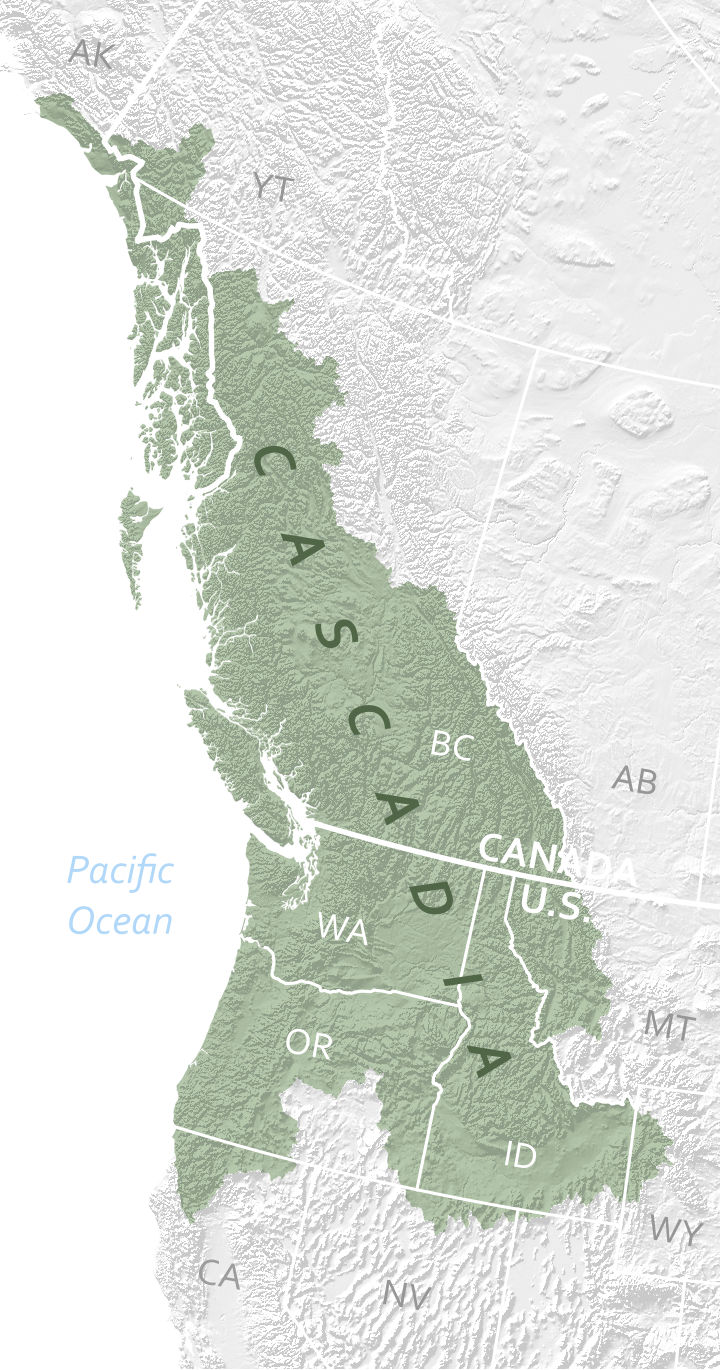
The movement is largely centered in the major cities of Portland, Seattle, and Vancouver, although the bioregion also includes Idaho and the Alaskan Panhandle, along with small parts of California, Montana, Nevada, Utah, Wyoming, and Yukon. More conservative advocates for Cascadian federalism propose borders that include the land west of the crest of the Cascade Range, while some advocates propose borders as far north as Alaska and the Yukon region.
The main drivers of the movement include environmentalism, bioregionalism, privacy, civil liberties and freedom, increased regional integration, and local food networks and economies.
Before 1800, it is estimated that more than 500,000 people lived within the region in dozens of nations, such as the Tillamook, Chinook, Haida, Nootka, and Tlingit. They lived and traded largely within the Cascadia Bioregion, using its extensive system of waterways for transport and pre-colonial trade. They spoke many different languages.
Indigenous sovereignty, the rights of nature, and decolonization remain a key point for many Cascadian and first nation organizers, who argue that indigenous self-determination cannot be gained legally under the framework of the United States constitution.
An 1813 letter from American statesman Thomas Jefferson to fur tycoon John Jacob Astor congratulated Astor on the establishment of Fort Astoria (the coastal fur trade post of Astor's Pacific Fur Company) and described Fort Astoria as "the germ of a great, free, and independent empire on that side of our continent, and that liberty and self-government spreading from that as well as from this side, will insure their complete establishment over the whole. It would be an afflicting thing, indeed, should the English be able to break up the settlement. Their bigotry to the bastard liberty of their own country, and habitual hostility to every degree of freedom in any other, will induce the attempt." The same year of Jefferson's letter, Fort Astoria was sold to the British North West Company, which was based in Montreal.
John Quincy Adams agreed with Jefferson's views about Fort Astoria, and labeled the entire Northwest as "the empire of Astoria", although he also saw the whole continent as "destined by Divine Providence to be peopled by one nation." As late as the 1820s James Monroe and Thomas Hart Benton thought the region west of the Rockies would be an independent nation.
Elements among the region's white American population starting in the 1840s sought to form their own country, despite their small number. Oregon pioneer John McLoughlin was employed as the Chief Factor (regional administrator) by the Hudson's Bay Company for the Columbia District, administered from Fort Vancouver. McLoughlin was a significant force in the early history of the Oregon Country, and argued for its independence. In 1842 McLoughlin (through his lawyer) advocated an independent nation that would be free of the United States during debates at the Oregon Lyceum. This view won support at first and a resolution was adopted. When the first settlers of the Willamette Valley held a series of politically foundational meetings in 1843, called the Wolf Meetings, a majority voted to establish an independent republic. Action was postponed by George Abernethy of the Methodist Mission to wait on forming an independent country.
Hub AI
Cascadia movement AI simulator
(@Cascadia movement_simulator)
Cascadia movement
The Cascadia movement is a collection of various heterogeneous movements seeking greater autonomy for the Pacific Northwest through a political coalition of the U.S. states of Oregon and Washington and the Canadian province of British Columbia. Included in the movements is an independence movement seeking to establish a Cascadian federation, an economic movement for the creation of a single market, a bioregionalist movement for the Cascadia bioregion, and a nationalist or cultural movement for the creation of a Cascadian national identity superseding identification with the state/territory or federal government.
The movement is largely centered in the major cities of Portland, Seattle, and Vancouver, although the bioregion also includes Idaho and the Alaskan Panhandle, along with small parts of California, Montana, Nevada, Utah, Wyoming, and Yukon. More conservative advocates for Cascadian federalism propose borders that include the land west of the crest of the Cascade Range, while some advocates propose borders as far north as Alaska and the Yukon region.
The main drivers of the movement include environmentalism, bioregionalism, privacy, civil liberties and freedom, increased regional integration, and local food networks and economies.
Before 1800, it is estimated that more than 500,000 people lived within the region in dozens of nations, such as the Tillamook, Chinook, Haida, Nootka, and Tlingit. They lived and traded largely within the Cascadia Bioregion, using its extensive system of waterways for transport and pre-colonial trade. They spoke many different languages.
Indigenous sovereignty, the rights of nature, and decolonization remain a key point for many Cascadian and first nation organizers, who argue that indigenous self-determination cannot be gained legally under the framework of the United States constitution.
An 1813 letter from American statesman Thomas Jefferson to fur tycoon John Jacob Astor congratulated Astor on the establishment of Fort Astoria (the coastal fur trade post of Astor's Pacific Fur Company) and described Fort Astoria as "the germ of a great, free, and independent empire on that side of our continent, and that liberty and self-government spreading from that as well as from this side, will insure their complete establishment over the whole. It would be an afflicting thing, indeed, should the English be able to break up the settlement. Their bigotry to the bastard liberty of their own country, and habitual hostility to every degree of freedom in any other, will induce the attempt." The same year of Jefferson's letter, Fort Astoria was sold to the British North West Company, which was based in Montreal.
John Quincy Adams agreed with Jefferson's views about Fort Astoria, and labeled the entire Northwest as "the empire of Astoria", although he also saw the whole continent as "destined by Divine Providence to be peopled by one nation." As late as the 1820s James Monroe and Thomas Hart Benton thought the region west of the Rockies would be an independent nation.
Elements among the region's white American population starting in the 1840s sought to form their own country, despite their small number. Oregon pioneer John McLoughlin was employed as the Chief Factor (regional administrator) by the Hudson's Bay Company for the Columbia District, administered from Fort Vancouver. McLoughlin was a significant force in the early history of the Oregon Country, and argued for its independence. In 1842 McLoughlin (through his lawyer) advocated an independent nation that would be free of the United States during debates at the Oregon Lyceum. This view won support at first and a resolution was adopted. When the first settlers of the Willamette Valley held a series of politically foundational meetings in 1843, called the Wolf Meetings, a majority voted to establish an independent republic. Action was postponed by George Abernethy of the Methodist Mission to wait on forming an independent country.
Recent media