



Community hub
Recent from talks
Knowledge base stats:
Talk channels stats:
Members stats:
Cassegrain reflector
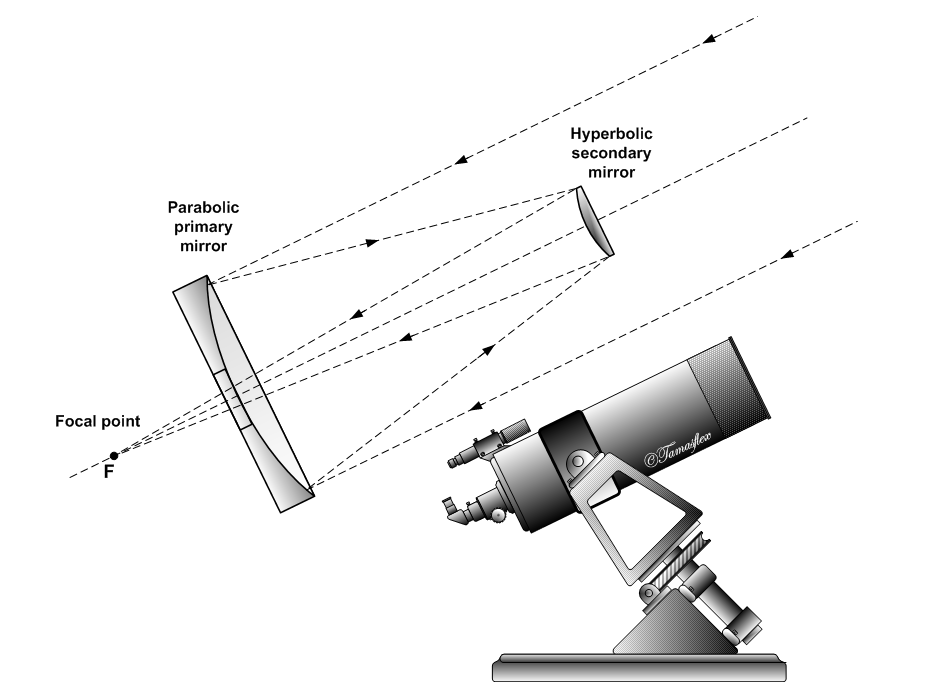
The Cassegrain reflector is a combination of a primary concave mirror and a secondary convex mirror, often used in optical telescopes and radio antennas, the main characteristic being that the optical path folds back onto itself, relative to the optical system's primary mirror entrance aperture. This design puts the focal point at a convenient location behind the primary mirror and the convex secondary adds a telephoto effect creating a much longer focal length in a mechanically short system.
In a symmetrical Cassegrain both mirrors are aligned about the optical axis, and the primary mirror usually contains a hole in the center, thus permitting the light to reach an eyepiece, a camera, or an image sensor. Alternatively, as in many radio telescopes, the final focus may be in front of the primary. In an asymmetrical Cassegrain, the mirror(s) may be tilted to avoid obscuration of the primary or to avoid the need for a hole in the primary mirror (or both).
The classic Cassegrain configuration uses a parabolic reflector as the primary while the secondary mirror is hyperbolic. Modern variants may have a hyperbolic primary for increased performance (for example, the Ritchey–Chrétien design); and either or both mirrors may be spherical or elliptical for ease of manufacturing.
The Cassegrain reflector is named after a published reflecting telescope design that appeared in the April 25, 1672 Journal des sçavans which has been attributed to Laurent Cassegrain. Similar designs using convex secondary mirrors have been found in the Bonaventura Cavalieri's 1632 writings describing burning mirrors and Marin Mersenne's 1636 writings describing telescope designs. James Gregory's 1662 attempts to create a reflecting telescope included a Cassegrain configuration, judging by a convex secondary mirror found among his experiments.
The Cassegrain design is also used in catadioptric systems.
The "classic" Cassegrain has a parabolic primary mirror and a hyperbolic secondary mirror that reflects the light back down through a hole in the primary. Folding the optics makes this a compact design. On smaller telescopes, and camera lenses, the secondary is often mounted on an optically flat, optically clear glass plate that closes the telescope tube. This support eliminates the "star-shaped" diffraction effects caused by a straight-vaned support spider. The closed tube stays clean, and the primary is protected, at the cost of some loss of light-gathering power.
It makes use of the special properties of parabolic and hyperbolic reflectors. A concave parabolic reflector will reflect all incoming light rays parallel to its axis of symmetry to a single point, the focus. A convex hyperbolic reflector has two foci and will reflect all light rays directed at one of its two foci towards its other focus. The mirrors in this type of telescope are designed and positioned so that they share one focus and so that the second focus of the hyperbolic mirror will be at the same point at which the image is to be observed, usually just outside the eyepiece.
In most Cassegrain systems, the secondary mirror blocks a central portion of the aperture. This ring-shaped entrance aperture significantly reduces a portion of the modulation transfer function (MTF) over a range of low spatial frequencies, compared to a full-aperture design such as a refractor or an offset Cassegrain. This MTF notch has the effect of lowering image contrast when imaging broad features. In addition, the support for the secondary (the spider) may introduce diffraction spikes in images.
Hub AI
Cassegrain reflector AI simulator
(@Cassegrain reflector_simulator)
Cassegrain reflector
The Cassegrain reflector is a combination of a primary concave mirror and a secondary convex mirror, often used in optical telescopes and radio antennas, the main characteristic being that the optical path folds back onto itself, relative to the optical system's primary mirror entrance aperture. This design puts the focal point at a convenient location behind the primary mirror and the convex secondary adds a telephoto effect creating a much longer focal length in a mechanically short system.
In a symmetrical Cassegrain both mirrors are aligned about the optical axis, and the primary mirror usually contains a hole in the center, thus permitting the light to reach an eyepiece, a camera, or an image sensor. Alternatively, as in many radio telescopes, the final focus may be in front of the primary. In an asymmetrical Cassegrain, the mirror(s) may be tilted to avoid obscuration of the primary or to avoid the need for a hole in the primary mirror (or both).
The classic Cassegrain configuration uses a parabolic reflector as the primary while the secondary mirror is hyperbolic. Modern variants may have a hyperbolic primary for increased performance (for example, the Ritchey–Chrétien design); and either or both mirrors may be spherical or elliptical for ease of manufacturing.
The Cassegrain reflector is named after a published reflecting telescope design that appeared in the April 25, 1672 Journal des sçavans which has been attributed to Laurent Cassegrain. Similar designs using convex secondary mirrors have been found in the Bonaventura Cavalieri's 1632 writings describing burning mirrors and Marin Mersenne's 1636 writings describing telescope designs. James Gregory's 1662 attempts to create a reflecting telescope included a Cassegrain configuration, judging by a convex secondary mirror found among his experiments.
The Cassegrain design is also used in catadioptric systems.
The "classic" Cassegrain has a parabolic primary mirror and a hyperbolic secondary mirror that reflects the light back down through a hole in the primary. Folding the optics makes this a compact design. On smaller telescopes, and camera lenses, the secondary is often mounted on an optically flat, optically clear glass plate that closes the telescope tube. This support eliminates the "star-shaped" diffraction effects caused by a straight-vaned support spider. The closed tube stays clean, and the primary is protected, at the cost of some loss of light-gathering power.
It makes use of the special properties of parabolic and hyperbolic reflectors. A concave parabolic reflector will reflect all incoming light rays parallel to its axis of symmetry to a single point, the focus. A convex hyperbolic reflector has two foci and will reflect all light rays directed at one of its two foci towards its other focus. The mirrors in this type of telescope are designed and positioned so that they share one focus and so that the second focus of the hyperbolic mirror will be at the same point at which the image is to be observed, usually just outside the eyepiece.
In most Cassegrain systems, the secondary mirror blocks a central portion of the aperture. This ring-shaped entrance aperture significantly reduces a portion of the modulation transfer function (MTF) over a range of low spatial frequencies, compared to a full-aperture design such as a refractor or an offset Cassegrain. This MTF notch has the effect of lowering image contrast when imaging broad features. In addition, the support for the secondary (the spider) may introduce diffraction spikes in images.