



Community hub
Recent from talks
Contribute something to knowledge base
Content stats: 0 posts, 0 articles, 0 media, 0 notes
Members stats: 0 subscribers, 0 contributors, 0 moderators, 0 supporters
Subscribers
Supporters
Contributors
Moderators
Hub AI
Catastrophe theory AI simulator
(@Catastrophe theory_simulator)
Hub AI
Catastrophe theory AI simulator
(@Catastrophe theory_simulator)
Catastrophe theory
In mathematics, catastrophe theory is a branch of bifurcation theory in the study of dynamical systems; it is also a particular special case of more general singularity theory in geometry.
Bifurcation theory studies and classifies phenomena characterized by sudden shifts in behavior arising from small changes in circumstances, analysing how the qualitative nature of equation solutions depends on the parameters that appear in the equation. This may lead to sudden and dramatic changes, for example the unpredictable timing and magnitude of a landslide.
Catastrophe theory originated with the work of the French mathematician René Thom in the 1960s, and became very popular due to the efforts of Christopher Zeeman in the 1970s. It considers the special case where the long-run stable equilibrium can be identified as the minimum of a smooth, well-defined potential function (Lyapunov function). Small changes in certain parameters of a nonlinear system can cause equilibria to appear or disappear, or to change from attracting to repelling and vice versa, leading to large and sudden changes of the behaviour of the system. However, examined in a larger parameter space, catastrophe theory reveals that such bifurcation points tend to occur as part of well-defined qualitative geometrical structures.
In the late 1970s, applications of catastrophe theory to areas outside its scope began to be criticized, especially in biology and social sciences. Zahler and Sussmann, in a 1977 article in Nature, referred to such applications as being "characterised by incorrect reasoning, far-fetched assumptions, erroneous consequences, and exaggerated claims". As a result, catastrophe theory has become less popular in applications.
Catastrophe theory analyzes degenerate critical points of the potential function — points where not just the first derivative, but one or more higher derivatives of the potential function are also zero. These are called the germs of the catastrophe geometries. The degeneracy of these critical points can be unfolded by expanding the potential function as a Taylor series in small perturbations of the parameters.
When the degenerate points are not merely accidental, but are structurally stable, the degenerate points exist as organising centres for particular geometric structures of lower degeneracy, with critical features in the parameter space around them. If the potential function depends on two or fewer active variables, and four or fewer active parameters, then there are only seven generic structures for these bifurcation geometries, with corresponding standard forms into which the Taylor series around the catastrophe germs can be transformed by diffeomorphism (a smooth transformation whose inverse is also smooth).[citation needed] These seven fundamental types are now presented, with the names that Thom gave them.
Catastrophe theory studies dynamical systems that describe the evolution of a state variable over time : :


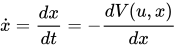
In the above equation, is referred to as the potential function, and is often a vector or a scalar which parameterise the potential function. The value of may change over time, and it can also be referred to as the control variable. In the following examples, parameters like are such controls.


Catastrophe theory
In mathematics, catastrophe theory is a branch of bifurcation theory in the study of dynamical systems; it is also a particular special case of more general singularity theory in geometry.
Bifurcation theory studies and classifies phenomena characterized by sudden shifts in behavior arising from small changes in circumstances, analysing how the qualitative nature of equation solutions depends on the parameters that appear in the equation. This may lead to sudden and dramatic changes, for example the unpredictable timing and magnitude of a landslide.
Catastrophe theory originated with the work of the French mathematician René Thom in the 1960s, and became very popular due to the efforts of Christopher Zeeman in the 1970s. It considers the special case where the long-run stable equilibrium can be identified as the minimum of a smooth, well-defined potential function (Lyapunov function). Small changes in certain parameters of a nonlinear system can cause equilibria to appear or disappear, or to change from attracting to repelling and vice versa, leading to large and sudden changes of the behaviour of the system. However, examined in a larger parameter space, catastrophe theory reveals that such bifurcation points tend to occur as part of well-defined qualitative geometrical structures.
In the late 1970s, applications of catastrophe theory to areas outside its scope began to be criticized, especially in biology and social sciences. Zahler and Sussmann, in a 1977 article in Nature, referred to such applications as being "characterised by incorrect reasoning, far-fetched assumptions, erroneous consequences, and exaggerated claims". As a result, catastrophe theory has become less popular in applications.
Catastrophe theory analyzes degenerate critical points of the potential function — points where not just the first derivative, but one or more higher derivatives of the potential function are also zero. These are called the germs of the catastrophe geometries. The degeneracy of these critical points can be unfolded by expanding the potential function as a Taylor series in small perturbations of the parameters.
When the degenerate points are not merely accidental, but are structurally stable, the degenerate points exist as organising centres for particular geometric structures of lower degeneracy, with critical features in the parameter space around them. If the potential function depends on two or fewer active variables, and four or fewer active parameters, then there are only seven generic structures for these bifurcation geometries, with corresponding standard forms into which the Taylor series around the catastrophe germs can be transformed by diffeomorphism (a smooth transformation whose inverse is also smooth).[citation needed] These seven fundamental types are now presented, with the names that Thom gave them.
Catastrophe theory studies dynamical systems that describe the evolution of a state variable over time : :
In the above equation, is referred to as the potential function, and is often a vector or a scalar which parameterise the potential function. The value of may change over time, and it can also be referred to as the control variable. In the following examples, parameters like are such controls.