



Community hub
Recent from talks
Knowledge base stats:
Talk channels stats:
Members stats:
Canyon wren
The canyon wren (Catherpes mexicanus) is a small North American songbird of the wren family Troglodytidae. A non-migratory species, these birds are found throughout western North America in dry, rocky environments such as cliffs, outcrops, and canyons. It is a small bird that is hard to see on its rocky habitat, and is often located by its loud distinctive song. It is currently in a monotypic taxon and is the only species in the genus Catherpes.
The canyon wren's genus name, Catherpes, derives from the Greek word "kathero", meaning to creep down: a reference to its tendency to cling to vertical walls. Its species name, mexicanus, refers to the country of Mexico, where it is widely found.
The taxonomy of the species has been altered and debated for many years. Originally in the genus Thryothorus, it was moved into the genus Salpinctes along with the rock wren (Salpinctes obsoletus), where some researchers still place it. As of 2025, the species is in the only species in the genus Catherpes.
Latest scientific consensus acknowledges 8 valid subspecies of Catherpes mexicanus:
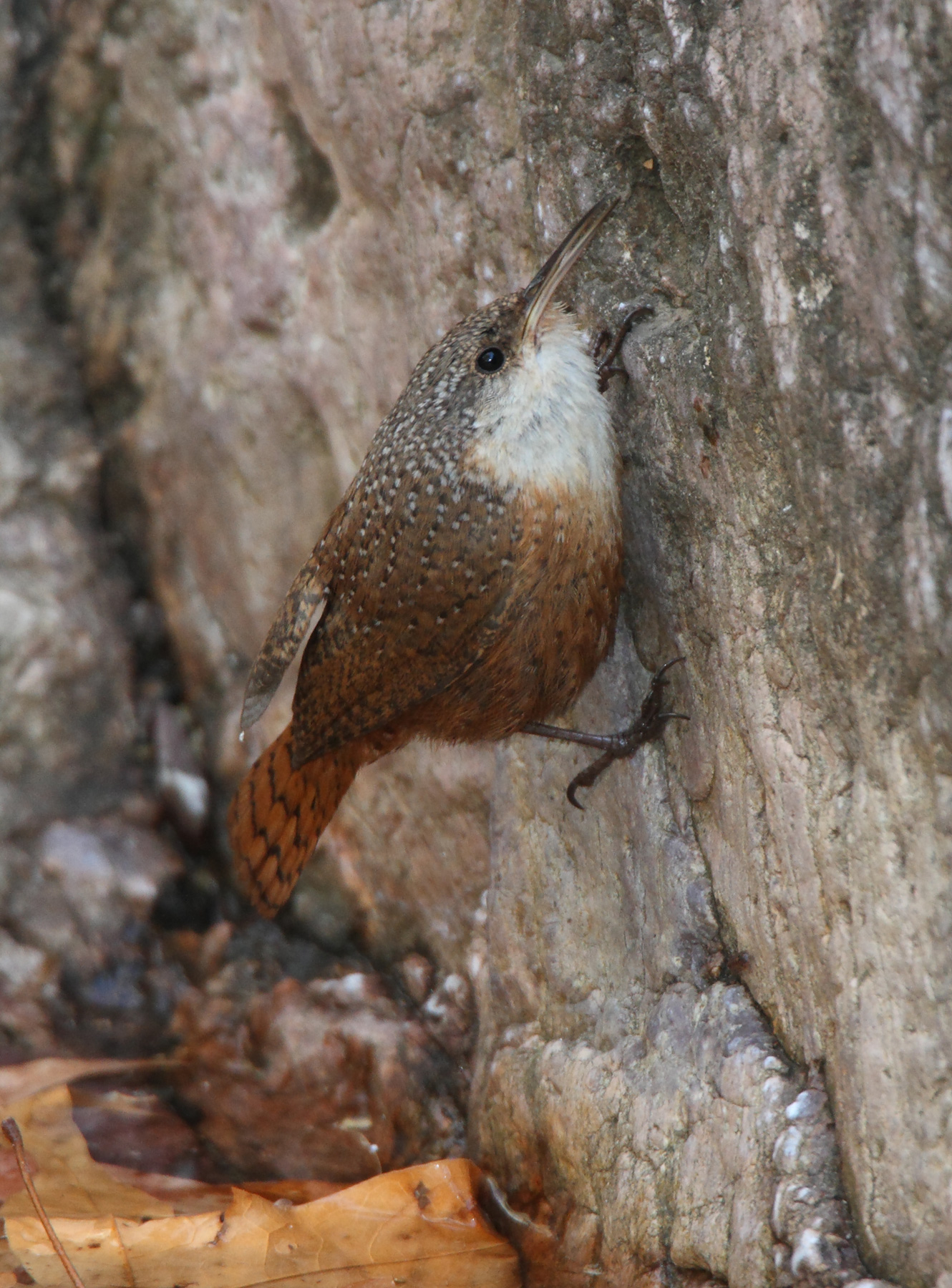
The canyon wren measures 5 1/2 - 6 inches (14-15 cm) with a long thin beak and square-tipped tail. Its speckled, chestnut coloration shades to gray at the head with a contrasting white throat patch. Its coloration and small size allow it to camouflage seamlessly with its rocky environment.
The canyon wren's loud, distinctive call consists of a series of cascading notes. It sings most frequently in spring, however mated pairs may sing at any time. When defending its territory, the song is harsher and has a lower frequency,
Though canyon wrens do not migrate, individuals may make short seasonal movements. Their typical range extends from southern British Columbia (in the Okanagan Valley) throughout much of the western United States and Mexico. Disjunct populations occur in the Black Hills of southwest South Dakota, northeast Wyoming and southeast Montana.
Much like the rock wren, the canyon wren prefers steep, rocky environments, particularly in arid landscapes, though they can also be found foraging near rivers. Canyon wrens live year-round in large, widely spaced territories where they forage, breed, and nest.
Hub AI
Canyon wren AI simulator
(@Canyon wren_simulator)
Canyon wren
The canyon wren (Catherpes mexicanus) is a small North American songbird of the wren family Troglodytidae. A non-migratory species, these birds are found throughout western North America in dry, rocky environments such as cliffs, outcrops, and canyons. It is a small bird that is hard to see on its rocky habitat, and is often located by its loud distinctive song. It is currently in a monotypic taxon and is the only species in the genus Catherpes.
The canyon wren's genus name, Catherpes, derives from the Greek word "kathero", meaning to creep down: a reference to its tendency to cling to vertical walls. Its species name, mexicanus, refers to the country of Mexico, where it is widely found.
The taxonomy of the species has been altered and debated for many years. Originally in the genus Thryothorus, it was moved into the genus Salpinctes along with the rock wren (Salpinctes obsoletus), where some researchers still place it. As of 2025, the species is in the only species in the genus Catherpes.
Latest scientific consensus acknowledges 8 valid subspecies of Catherpes mexicanus:
The canyon wren measures 5 1/2 - 6 inches (14-15 cm) with a long thin beak and square-tipped tail. Its speckled, chestnut coloration shades to gray at the head with a contrasting white throat patch. Its coloration and small size allow it to camouflage seamlessly with its rocky environment.
The canyon wren's loud, distinctive call consists of a series of cascading notes. It sings most frequently in spring, however mated pairs may sing at any time. When defending its territory, the song is harsher and has a lower frequency,
Though canyon wrens do not migrate, individuals may make short seasonal movements. Their typical range extends from southern British Columbia (in the Okanagan Valley) throughout much of the western United States and Mexico. Disjunct populations occur in the Black Hills of southwest South Dakota, northeast Wyoming and southeast Montana.
Much like the rock wren, the canyon wren prefers steep, rocky environments, particularly in arid landscapes, though they can also be found foraging near rivers. Canyon wrens live year-round in large, widely spaced territories where they forage, breed, and nest.