Hubbry Logo
search
logo

Causal system

logo
Community Hub0 Subscribers
Read side by side
from Wikipedia

In control theory, a causal system (also known as a physical or nonanticipative system) is a system where the output depends on past and current inputs but not future inputs—i.e., the output depends only on the input for values of .

The idea that the output of a function at any time depends only on past and present values of input is defined by the property commonly referred to as causality. A system that has some dependence on input values from the future (in addition to possible dependence on past or current input values) is termed a non-causal or acausal system, and a system that depends solely on future input values is an anticausal system. Note that some authors have defined an anticausal system as one that depends solely on future and present input values or, more simply, as a system that does not depend on past input values. [1]

Classically, nature or physical reality has been considered to be a causal system. Physics involving special relativity or general relativity require more careful definitions of causality, as described elaborately in Causality (physics).

The causality of systems also plays an important role in digital signal processing, where filters are constructed so that they are causal, sometimes by altering a non-causal formulation to remove the lack of causality so that it is realizable. For more information, see causal filter.

For a causal system, the impulse response of the system must use only the present and past values of the input to determine the output. This requirement is a necessary and sufficient condition for a system to be causal, regardless of linearity. Note that similar rules apply to either discrete or continuous cases. By this definition of requiring no future input values, systems must be causal to process signals in real time.[2]

Mathematical definitions

[edit]

Definition 1: A system mapping to is causal if and only if, for any pair of input signals , and any choice of , such that

the corresponding outputs satisfy

Definition 2: Suppose is the impulse response of any system described by a linear constant coefficient differential equation. The system is causal if and only if

otherwise it is non-causal.

Examples

[edit]

The following examples are for systems with an input and output .

Examples of causal systems

[edit]
  • Memoryless system
  • Memory-enabled system
  • Autoregressive filter

Examples of non-causal (acausal) systems

[edit]
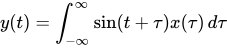
  • Central moving average

Examples of anti-causal systems

[edit]
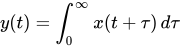
  • Look-ahead

Additional examples of causal systems

[edit]
  • Linear Time-Invariant (LTI) System

Additional examples of non-causal (acausal) systems

[edit]
  • Smoothing Filter
  • Ideal low-pass filter

Additional examples of anti-causal systems

[edit]
  • Future Input Dependence

See also

[edit]

References

[edit]
Revisions and contributorsEdit on WikipediaRead on Wikipedia
from Grokipedia
In systems theory, particularly within signal processing and control engineering, a causal system is defined as one in which the output at any given time depends only on the current input and past inputs, without reliance on future inputs, ensuring non-anticipatory behavior.[1][2] This property distinguishes causal systems from non-causal ones and is a fundamental requirement for modeling most physical processes, such as mechanical oscillators or electrical circuits, where effects cannot precede causes.[3][4] Causal systems are analyzed in both continuous-time and discrete-time domains, with the discrete case often expressed as the output $ y[n] $ depending on inputs $ x[m] $ for $ m \leq n $.[5] In the context of linear time-invariant (LTI) systems, causality holds if and only if the impulse response $ h(t) $ or $ h[k] $ is zero for negative arguments, meaning $ h(t) = 0 $ for $ t < 0 $ in continuous time or $ h[k] = 0 $ for $ k < 0 $ in discrete time.[6] This condition facilitates practical implementation, as it aligns with the unidirectional flow of time in real-world computations. The property of causality is indispensable for real-time applications, including telecommunications, audio processing, and feedback control systems, where inputs arrive sequentially and future values are unavailable, preventing delays or lookahead operations.[7][8] Conversely, non-causal systems, which incorporate future inputs, find utility in offline scenarios such as image enhancement or signal smoothing, where access to the entire dataset allows for superior accuracy at the cost of computational latency.[9] Causality interacts closely with other system properties like stability and linearity; for instance, a stable causal LTI system requires its region of convergence in the z-domain to include the unit circle exterior for discrete-time realizations.[10] Overall, the causality constraint underpins the design and analysis of reliable systems across engineering disciplines, ensuring realizability and adherence to physical laws.[11]

Introduction

Definition

A causal system is defined as one in which the output at any time $ t_0 $ depends solely on the values of the input for times $ t \leq t_0 $, and does not depend on input values for $ t > t_0 $. This property ensures that the system's response does not anticipate future inputs, aligning with the intuitive notion that effects follow causes in time.[12] An equivalent formulation of causality states that if two input signals are identical up to time $ t_0 $, then the corresponding outputs must also be identical up to $ t_0 $. This input-output perspective emphasizes the system's inability to distinguish between inputs that differ only in the future, reinforcing the non-anticipatory nature of causal systems.[13] The concept of causality in systems theory draws from the foundational principle in physics that causes precede their effects, prohibiting influences from the future on the present. This physical causality has been formalized and extended to abstract systems in engineering disciplines to model real-world processes where forward prediction is impossible.[14] Causal systems differ from memoryless (or instantaneous) systems, in which the output at any time depends only on the input at that exact time, with no reliance on prior history. While all memoryless systems are causal by virtue of ignoring future and past inputs alike, causal systems more broadly permit the use of past inputs, enabling richer dynamics such as those involving accumulation or delay.[15]

Importance

Causal systems play a pivotal role in real-time processing applications, where outputs must be generated instantaneously based solely on current and past inputs, as future values are inherently unavailable. This property ensures that systems like digital filters and control mechanisms can operate without delay, aligning with the temporal constraints of live data streams in fields such as telecommunications and audio processing. Without causality, real-time implementation would be impossible, as the system would need to "wait" for future information that does not yet exist.[16] In physical systems, causality is a fundamental requirement for realizability, reflecting the natural progression of cause preceding effect in the real world. All physically realizable systems are causal, as they cannot anticipate or depend on future events; for instance, electronic circuits or mechanical devices respond only to stimuli that have already occurred. This inherent constraint makes causal modeling essential for designing hardware that mirrors physical laws, preventing impractical or impossible configurations in engineering practice.[17] Across engineering disciplines, including signal processing, control theory, and embedded systems, causal systems provide the foundation for predictability and practical implementation in both hardware and software environments. They enable engineers to develop reliable algorithms and devices that function within finite computational resources, ensuring stability and efficiency in dynamic scenarios. By prioritizing causality, designs achieve robustness against uncertainties in input timing, which is critical for applications ranging from robotics to biomedical instrumentation.[15] Non-causal systems, by contrast, impose significant limitations due to their dependence on complete advance knowledge of inputs, rendering them suitable only for offline or post-processing tasks, such as image enhancement on stored data. These systems cannot be deployed in real-time settings, where inputs arrive sequentially, highlighting the practical superiority of causal approaches for most operational contexts.[18][16]

Mathematical Foundations

Discrete-Time Formulation

In discrete-time systems, causality is defined for a system $ T $ that maps an input sequence $ x[n] $ to an output sequence $ y[n] = T{x[n]} $. The system is causal if, for any two input sequences $ x_1[n] $ and $ x_2[n] $ that agree for all $ n \leq m $ (i.e., $ x_1[k] = x_2[k] $ for $ k \leq m $), the corresponding outputs satisfy $ y_1[m] = y_2[m] $.[19] This condition ensures that the output at any time index $ n $ depends solely on the input values up to and including time $ n $, and not on future inputs.[19] For linear time-invariant (LTI) discrete-time systems, causality manifests in the impulse response $ h[n] $, which is the output when the input is the unit impulse $ \delta[n] $. A necessary and sufficient condition for causality is that $ h[n] = 0 $ for all $ n < 0 $.[20] The output of such a system is then given by the convolution sum
y[n]=k=0h[k]x[nk], y[n] = \sum_{k=0}^{\infty} h[k] \, x[n - k],
where the lower limit starts at $ k = 0 $ due to the zero impulse response for negative indices.[19] Equivalently, this can be expressed as $ y[n] = \sum_{k=-\infty}^{n} h[k] , x[n - k] $, reflecting the dependence on inputs from the distant past up to the present.[19] Causal LTI discrete-time systems are often realized through linear constant-coefficient difference equations, in which the current output depends linearly on previous outputs and on the current and past inputs, with no reliance on future values. A simple first-order example is the recursive equation
y[n]=ay[n1]+bx[n], y[n] = a \, y[n-1] + b \, x[n],
where $ a $ and $ b $ are constants, ensuring causality since $ y[n] $ uses only $ y[n-1] $ and $ x[n] $.[19] Higher-order equations follow similarly, with terms involving $ y[n-k] $ for $ k \geq 1 $ and $ x[n-l] $ for $ l \geq 0 $. In the z-domain, the Z-transform provides a frequency-domain representation for analyzing causal systems. For a causal sequence like the impulse response $ h[n] $ (where $ h[n] = 0 $ for $ n < 0 $), the region of convergence (ROC) of its Z-transform $ H(z) = \sum_{n=0}^{\infty} h[n] z^{-n} $ includes the exterior of a circle $ |z| > r $ in the complex z-plane, with $ r $ determined by the system's poles.[21] This ROC property distinguishes causal systems from non-causal ones and facilitates stability analysis when combined with pole locations.[21]

Continuous-Time Formulation

In continuous-time systems, causality implies that the output $ y(t_0) $ at any time $ t_0 $ depends solely on the input $ x(t) $ for all $ t \leq t_0 $, ensuring no reliance on future inputs.[22] This property aligns with physical realizability, where effects cannot precede causes in time-domain signal processing.[9] For linear time-invariant (LTI) continuous-time systems, the output is expressed via the convolution integral, which incorporates causality through the impulse response $ h(t) $. Specifically, the output is given by
y(t)=h(τ)x(tτ)dτ, y(t) = \int_{-\infty}^{\infty} h(\tau) x(t - \tau) \, d\tau,
but for causal systems, $ h(\tau) = 0 $ for $ \tau < 0 $, limiting the integration to
y(t)=th(τ)x(tτ)dτ. y(t) = \int_{-\infty}^{t} h(\tau) x(t - \tau) \, d\tau.
[23] This form ensures the output at time $ t $ only involves past and present input values, weighted by the system's impulse response.[24] Many continuous-time causal systems are modeled by linear constant-coefficient differential equations, where causality is enforced by the forward-in-time solution and initial rest conditions (i.e., zero initial conditions before input application). A system is causal if the highest-order derivative of the output depends only on the current and past values of the output and input, without anticipating future terms. For instance, a first-order system follows
dy(t)dt=ay(t)+bx(t), \frac{dy(t)}{dt} = a y(t) + b x(t),
solvable causally from initial conditions at some starting time.[25] Such representations are common in electrical circuits and mechanical systems.[26] In the Laplace domain, the transfer function $ H(s) $ of a causal continuous-time LTI system has a region of convergence (ROC) that includes the right-half of the s-plane, specifically to the right of the rightmost pole, reflecting the right-sided nature of the causal impulse response $ h(t) = 0 $ for $ t < 0 $.[27] This ROC property facilitates stability analysis and inverse transforms for causal realizations.[28]

Properties

Impulse Response Characterization

In linear time-invariant (LTI) systems, the impulse response serves as a fundamental characteristic that uniquely determines causality. A continuous-time LTI system is causal if and only if its impulse response $ h(t) = 0 $ for all $ t < 0 $.[15] Similarly, for discrete-time LTI systems, causality holds if and only if $ h[n] = 0 $ for all $ n < 0 $.[29] This criterion arises directly from the convolution representation of the system's output. For LTI systems, the output $ y(t) $ is given by the convolution integral $ y(t) = \int_{-\infty}^{\infty} h(\tau) x(t - \tau) , d\tau $, where $ x(t) $ is the input. To ensure the output at time $ t $ depends only on inputs up to time $ t $ (i.e., no anticipation of future inputs), the kernel $ h(\tau) $ must be zero for $ \tau < 0 $; otherwise, terms involving $ x(t - \tau) $ with $ \tau < 0 $ would incorporate future input values.[23] The discrete-time analog follows from the convolution sum $ y[n] = \sum_{k=-\infty}^{\infty} h[k] x[n - k] $, requiring $ h[k] = 0 $ for $ k < 0 $ to prevent dependence on future samples $ x[n - k] $ where $ k < 0 $.[29] The unit step response $ s(t) $ of a causal LTI system relates closely to the impulse response, providing another diagnostic perspective. Specifically, $ s(t) = \int_{0}^{t} h(\tau) , d\tau $ for $ t \geq 0 $, reflecting the cumulative effect of the impulse response from the onset of the step input at $ t = 0 $.[30] This integral form underscores causality, as the step response remains zero for $ t < 0 $ when $ h(t) = 0 $ for $ t < 0 $. The discrete counterpart is the cumulative sum $ s[n] = \sum_{k=0}^{n} h[k] $ for $ n \geq 0 $.[31] For non-LTI systems, such as nonlinear or time-varying ones, the impulse response does not uniquely characterize the system, as the output to a scaled or shifted impulse may differ. Causality is instead defined more generally: the output at any time depends solely on current and past inputs, verifiable through responses to impulse-like inputs applied at specific times, though this approach is less direct than in the LTI case.[5]

Stability and Realizability

In linear time-invariant (LTI) systems, bounded-input bounded-output (BIBO) stability for causal systems requires that the impulse response satisfies specific integrability conditions, ensuring bounded outputs for bounded inputs. For continuous-time causal LTI systems, where the impulse response $ h(t) = 0 $ for $ t < 0 $, BIBO stability holds if and only if $ \int_{0}^{\infty} |h(t)| , dt < \infty $.[32] Similarly, for discrete-time causal LTI systems, with $ h[n] = 0 $ for $ n < 0 $, stability is guaranteed when $ \sum_{n=0}^{\infty} |h[n]| < \infty $.[33] These conditions restrict the analysis to the non-negative time domain, simplifying stability checks but imposing constraints on system design. Causality introduces significant realizability challenges in filter implementation, as ideal filters with sharp frequency cutoffs—such as brick-wall low-pass filters—are inherently non-causal and cannot be realized in real-time hardware or software.[34] Causal approximations to these ideal responses, while physically implementable, inevitably introduce phase distortion, altering the timing relationships in the signal and potentially degrading performance in applications sensitive to waveform shape.[35] This distortion arises because causal filters cannot achieve zero-phase responses without relying solely on past and present inputs, leading to group delays that vary with frequency. To balance causality with performance, engineers often employ finite-order approximations that trade off sharpness for realizability, such as Butterworth filters, which provide a maximally flat passband but require higher orders for steeper transitions approaching the infinite-order ideal.[36] These approximations mitigate phase issues through techniques like bilinear transforms but still necessitate careful order selection to avoid excessive computational demands or instability risks. Anti-causal systems, where outputs depend only on future inputs ($ h(t) = 0 $ for $ t > 0 $), can achieve BIBO stability under analogous conditions, such as $ \int_{-\infty}^{0} |h(t)| , dt < \infty $, but their reliance on future knowledge renders them impractical for real-time use and confines applications to offline post-processing scenarios.[37][38]

Classifications

Causal Systems

Causal systems exhibit behavioral traits where the output at any given time evolves predictably based solely on initial conditions and past inputs, ensuring no dependence on future inputs and thus preventing any form of anticipation.[39][9] This non-anticipatory nature aligns with the physical constraints of most real-world systems, such as electrical or mechanical devices, where effects cannot precede their causes.[39][40] Regarding memory, causal systems incorporate either finite or infinite memory of past inputs to determine current outputs, but they strictly exclude any influence from future inputs, distinguishing them from systems that might require lookahead.[9][31] This reliance on historical data allows the system to maintain state information accumulated over time without violating temporal order.[9] The predictability inherent in causal systems facilitates online computation and real-time simulation, as outputs can be generated sequentially using only available past and present data, making them suitable for applications demanding immediate responsiveness.[39][40] In the context of linear time-invariant (LTI) systems, causal variants form a significant subclass characterized by specific properties in their frequency-domain representations, such as constraints on the region of convergence in transform analyses.[31][40]

Non-Causal Systems

A non-causal system is defined as one whose output at any time $ t_0 $ depends on input values at times $ t > t_0 $, thereby relying on future inputs.[41] In linear time-invariant systems, this property manifests through an impulse response satisfying $ h(t) \neq 0 $ for $ t < 0 $ in the continuous-time case or $ h[n] \neq 0 $ for $ n < 0 $ in the discrete-time case, contrasting with the causality criterion where the impulse response vanishes for negative arguments.[41] Such systems are frequently termed acausal in signal processing contexts.[5] Non-causal systems necessitate access to the complete input sequence prior to computing outputs, which precludes real-time realization but enables their use in offline scenarios for enhanced optimization and performance.[41] They are particularly valuable in processing pre-recorded signals, such as in zero-phase filtering techniques that minimize distortion by leveraging bidirectional data flow.[41] In certain designs, particularly for finite impulse response filters, a non-causal system can be rendered causal by applying a time shift to its impulse response, though this introduces inherent delay and compromises immediate applicability in time-critical settings.[42]

Anti-Causal Systems

An anti-causal system is defined as one where the output at any time instant $ t_0 $ depends solely on the present input at $ t_0 $ and future inputs for $ t > t_0 $, with no dependence on past inputs.[5] This contrasts with causal systems, which rely only on past and present inputs. For linear time-invariant (LTI) systems, the anti-causal property is characterized by the impulse response $ h(t) $, which satisfies $ h(t) = 0 $ for all $ t > 0 $; in discrete time, this becomes $ h[n] = 0 $ for all $ n > 0 $, making the response left-sided.[29] Such systems form a strict subset of non-causal systems, as they exclude any influence from prior inputs while still incorporating future information.[43] In practice, anti-causal systems are implemented through backward recursion, where outputs are computed by processing signals from future to past times, often in offline scenarios. This approach enables recursive calculations starting from the end of the data sequence and proceeding backward.[44] A key application arises in smoothing algorithms, such as the backward pass of the Kalman smoother, which refines estimates by incorporating future observations in an anti-causal manner to achieve optimal state estimation over the entire data horizon.[45] Anti-causal systems also play a role in inverse filtering techniques, particularly for stabilizing unstable causal filters by time-reversing their impulse responses. For instance, in multirate filter banks, anti-causal inverses of analysis filters ensure perfect reconstruction by handling the time-reversed components in synthesis banks.[46] Additionally, they are employed in prediction error minimization methods for system identification, where anti-causal filtering helps decompose signals into causal and anti-causal parts to minimize estimation errors in non-minimum phase systems.[47]

Examples

Causal Examples

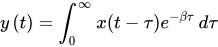
A classic example of a causal continuous-time system is the integrator, defined by the output equation $ y(t) = \int_{-\infty}^t x(\tau) , d\tau $, which accumulates the input signal from the distant past up to the present time $ t $, ensuring the output depends solely on past and present inputs without anticipating future values.[48] This system arises in applications like cumulative charge measurement in circuits, where the impulse response is the unit step function $ h(t) = u(t) $, confirming causality since $ h(t) = 0 $ for $ t < 0 $.[49] For an input step function $ x(t) = u(t) $, the output is a ramp $ y(t) = t , u(t) $, illustrating how the system integrates only up to the current time. Another representative causal continuous-time system is the exponential decay filter, characterized by the convolution $ y(t) = \int_0^\infty x(t - \tau) e^{-\beta \tau} , d\tau $, where $ \beta > 0 $ is a decay constant, and the impulse response $ h(\tau) = e^{-\beta \tau} u(\tau) $ vanishes for $ \tau < 0 $, enforcing causality by weighting only past inputs with an exponentially decaying influence.[23] This model describes physical phenomena such as the response of an RC low-pass filter or photon detectors, where the output at time $ t $ reflects a smoothed version of prior inputs. For a unit impulse input $ x(t) = \delta(t) $, the output recovers $ y(t) = e^{-\beta t} u(t) $, demonstrating the one-sided nature of the response. In the discrete-time domain, the accumulator serves as a fundamental causal system, given by $ y[n] = \sum_{k=-\infty}^n x[k] $, which sums all input samples from the infinite past up to the current index $ n $, with the impulse response $ h[n] = u[n] $ being zero for $ n < 0 $.[50] This structure is linear and time-invariant, commonly used in digital signal processing for running sums, and its causality ensures no dependence on future samples. For a unit step input $ x[n] = u[n] $, the output is $ y[n] = (n+1) u[n] $, highlighting the cumulative effect limited to past and present inputs. A straightforward discrete-time causal system is the simple delay, defined as $ y[n] = x[n-1] $, which shifts the input sequence by one sample into the future for the output but relies only on the immediate past input at each step, with impulse response $ h[n] = \delta[n-1] $ that is zero for $ n < 1 $.[51] This finite-memory system preserves the signal's shape while introducing a one-sample lag, essential in pipeline architectures and buffering. For an input sequence $ x[n] = \delta[n] $, the output is $ y[n] = \delta[n-1] $, confirming the causal shift without accessing future values.

Non-Causal and Anti-Causal Examples

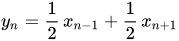
Non-causal systems are those whose outputs depend on current and future inputs, violating the causality condition where the impulse response $ h(t) = 0 $ for $ t < 0 $. A classic example is the ideal low-pass filter, defined by the convolution $ y(t) = \int_{-\infty}^{\infty} h(\tau) x(t - \tau) , d\tau $, where the impulse response $ h(t) $ is a sinc function $ h(t) = \frac{\sin(\omega_c t)}{\pi t} $ (normalized for cutoff frequency $ \omega_c $). This $ h(t) $ is nonzero for both $ t < 0 $ and $ t > 0 $, requiring knowledge of future inputs to compute the output at time $ t $, thus rendering the filter non-causal.[52] In discrete-time settings, non-causal systems similarly incorporate future samples. Consider the three-point moving average filter $ y[n] = \frac{x[n+1] + x[n] + x[n-1]}{3} $, which smooths the input by averaging the current sample with its immediate neighbors, including the future input $ x[n+1] $. This dependence on future values makes the system non-causal, as the output at time $ n $ cannot be determined solely from past and present inputs.[53] Zero-phase filters provide another non-causal example, particularly useful in offline processing where the entire signal is available. These filters have an impulse response $ h[n] $ that is symmetric around $ n = 0 $, ensuring zero phase distortion across all frequencies. In image processing, such filters are implemented by forward and backward filtering to achieve symmetry, allowing precise feature extraction without phase shifts, though at the cost of non-causality since future pixels must be accessed.[54] Anti-causal systems represent a subset where outputs depend exclusively on future inputs, with impulse responses nonzero only for negative times ($ h(t) = 0 $ for $ t > 0 $). An illustrative case is the future integrator $ y(t) = \int_t^{\infty} x(\tau) , d\tau $, which accumulates all future values of the input signal from time $ t $ onward. This system is inherently anti-causal, as computing $ y(t) $ requires complete knowledge of the input beyond $ t $, contrasting sharply with causal integrators that sum past values.

Applications

Signal Processing

In signal processing, causal filters are designed such that their impulse response $ h[n] $ satisfies $ h[n] = 0 $ for $ n < 0 $, ensuring that the output at any time depends only on current and past inputs. This constraint is fundamental to both finite impulse response (FIR) and infinite impulse response (IIR) filters, enabling real-time applications like audio equalization where the filter processes incoming signals without future knowledge. For FIR filters, causality is achieved through a tapped delay line structure, where the output is a weighted sum of the present input and a finite number of past inputs, as described in the general form of causal FIR implementations. IIR filters extend this by incorporating feedback, but their causal nature requires stable pole placements within the unit circle to prevent unbounded responses, often optimized for minimum mean square error in applications such as Wiener filtering.[55][56][57] Digital signal processors (DSPs) implement causal filtering on hardware chips to handle streaming data in real time, such as applying reverb effects to live audio. These chips process input samples sequentially, using causal algorithms like comb and allpass filters in parallel configurations to simulate room acoustics without latency from future data. For instance, reverberation systems based on tapped delay lines ensure causality by delaying only past echoes, allowing low-cost, versatile processing on dedicated DSP hardware for applications like concert sound reinforcement. This causal constraint is critical for maintaining synchronization in live environments, where non-causal methods would introduce unacceptable delays.[58][59] To approximate ideal non-causal filters, which have symmetric impulse responses extending to negative indices, causal versions are created via windowing or truncation of the infinite response, shifting the filter to start at $ n = 0 $ and introducing a group delay equal to half the filter length. This method preserves approximate frequency selectivity while ensuring realizability, though it incurs phase distortion measured by the non-constant group delay. Window functions like Hamming or Kaiser mitigate Gibbs phenomenon from truncation, balancing passband ripple and transition bandwidth in designs for audio or communications.[60][61][62] Multirate signal processing relies on causal decimation and interpolation to convert sampling rates efficiently without violating real-time constraints. Decimation involves lowpass filtering followed by downsampling, where the causal anti-aliasing filter processes inputs sequentially to retain baseband information. Interpolation upsamples by zero-insertion and causal lowpass smoothing to remove imaging, ensuring the overall system remains causal and computationally efficient for applications like audio resampling. These operations, when combined in polyphase structures, minimize delay while preserving signal integrity.[63][64][65]

Control Theory

In control theory, causal systems are fundamental to feedback loops, where the controller's output depends solely on current and past inputs to maintain stability and real-time responsiveness. Proportional-integral-derivative (PID) controllers exemplify this, as their structure—comprising proportional gain kpk_p for immediate error correction, integral gain kik_i for accumulating past errors, and derivative gain kdk_d for predicting based on the rate of error change—ensures the control signal influences only future system behavior without requiring foresight of inputs. This causality prevents instability in closed-loop configurations, such as those regulating industrial processes or mechanical systems, by avoiding anticipatory actions that could amplify disturbances. For instance, in a PID loop, the control law u(t)=kpe(t)+ki0te(τ)dτ+kdde(t)dtu(t) = k_p e(t) + k_i \int_0^t e(\tau) d\tau + k_d \frac{de(t)}{dt} processes the error e(t)e(t) causally, promoting robust tracking while adhering to physical realizability constraints.[66] State-space representations further underscore causality in control systems, modeling the evolution of internal states over time to enable real-time plant control. The standard form x˙(t)=Ax(t)+Bu(t)\dot{x}(t) = A x(t) + B u(t), y(t)=Cx(t)+Du(t)y(t) = C x(t) + D u(t) captures this, where the state vector x(t)x(t) encodes past dynamics, the system matrix AA governs forward state transitions, the input matrix BB applies current controls, and the output matrix CC (with direct feedthrough DD) produces observations based on present states without future dependencies. This structure ensures causal propagation: future outputs rely on the current state (a summary of history) and upcoming inputs, making it suitable for simulating and controlling physical plants like motors or actuators in dynamic environments. Such models facilitate the design of observers and compensators that operate in real time, aligning with the inherent causality of hardware implementations.[67] Causality in state-space realizations is critical for controllability, allowing engineers to achieve desired performance through techniques like pole placement without non-physical future knowledge. A system is controllable if the pair (A,B)(A, B) satisfies the rank condition of the controllability matrix [B AB  An1B][B \ AB \ \cdots \ A^{n-1}B] equaling the state dimension nn, enabling state feedback u(t)=Kx(t)+r(t)u(t) = -K x(t) + r(t) to shift closed-loop poles via the modified dynamics matrix ABKA - B K. This places eigenvalues at specified locations for stability and response shaping, such as damping oscillations in a second-order system, all while preserving causality since feedback uses only measurable current states. Methods like Ackermann's formula compute KK efficiently for causal forms, ensuring the controller is implementable on physical hardware without lookahead.[68] Causal designs enhance robustness in control applications involving physical plants with uncertainties, such as robotic manipulators subject to payload variations or environmental disturbances. Adaptive PID controllers, for example, adjust gains online to compensate for unmodeled dynamics like varying masses in robot arms, maintaining stability and trajectory accuracy without relying on non-causal predictions. In robotics, this causality allows real-time handling of parametric uncertainties—e.g., friction or inertia mismatches—through feedback mechanisms that bound error growth, as demonstrated in experiments with whole-arm manipulators (WAM) holding variable loads such as a baseball bat, where adaptive PID outperformed fixed-gain PID by reducing tracking errors under substantial payload changes up to 50% of arm mass.[69] Such approaches ensure reliable operation in uncertain settings, prioritizing safety and performance in deployed systems.

References

User Avatar
No comments yet.