



Community hub
Recent from talks
Knowledge base stats:
Talk channels stats:
Members stats:
Cebreros Station
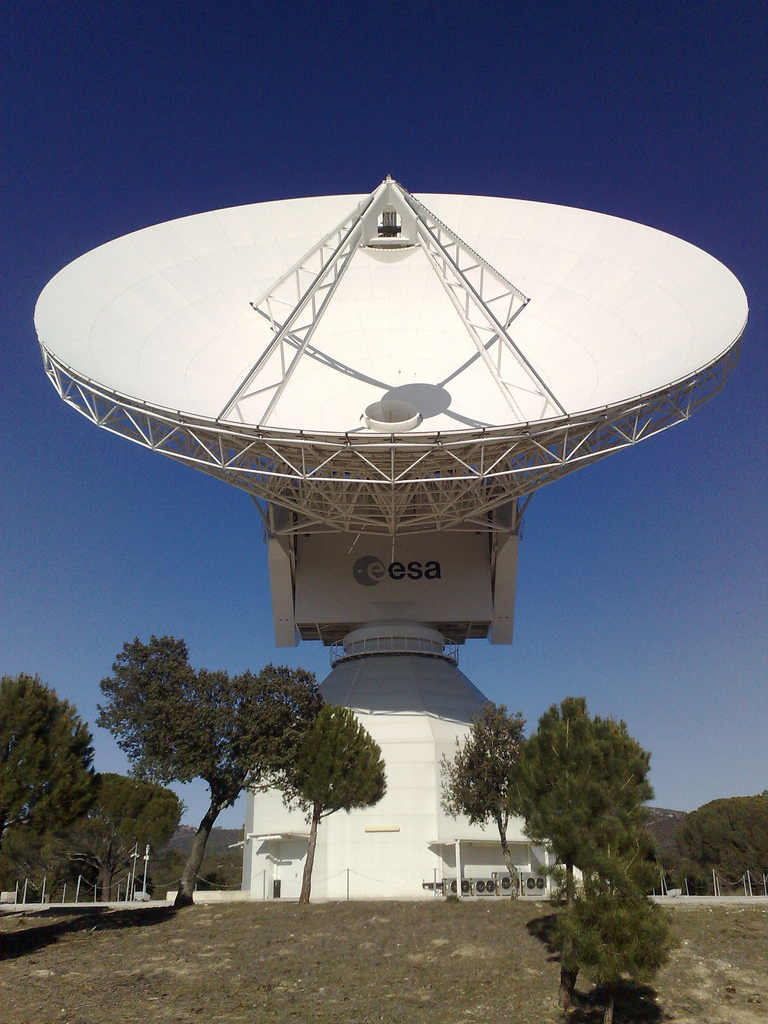
Cebreros Station (also known as DSA 2 or Deep Space Antenna 2) is a European Space Agency, ESTRACK radio antenna station for communication with spacecraft, located about 10 km east of Cebreros and 90 km from Madrid, Spain, operated by the European Space Operations Centre and INTA. A 35-metre diameter antenna that receives and transmit in X- and Ka-bands is located at the site. Station code is "CEB". 20 kW CW High Power Amplifier (HPA) it was created by Rheinmetall Italia SpA (Italy). The monitoring and control system was implemented by Microsis srl (Italy).
It provides daily support to Lisa Pathfinder, Mars Express and Gaia.
It also provided support for Rosetta.
Two sister stations are New Norcia Station in Australia, and Malargüe Station in Argentina.
Until 2002, ESA lacked its own means to communicate with spacecraft destined for other planets, or in very distant orbits, and depended on NASA's network of listeners to receive the data collected by them.
The mobile dish of the antenna is 35 meters in diameter. The entire structure measures 40 meters in height and weighs 620 tons. The foundations begin at 20 meters deep. Much of the machinery responsible for moving the antenna is underground.
It has more data acquisition capacity than the New Norcia antenna, since it receives and transmits information in the Ka band (31.8 - 32.3 GHz) as well as reception in the X band. Its target has an error of only six millidegrees (which is ten times more accurate than the usual monitoring antennas of 15 meters in diameter). It has 250 temperature sensors distributed throughout the structure, so that it can auto-adjust automatically in case of expansion and contraction of the material due to meteorological changes. With respect to the New Norcia antenna, it is also faster in azimuth and elevation, and is able to withstand a more intense wind.
Usually, the antenna is operated remotely from the European Space Operations Center (ESOC) located in Darmstadt (Germany).
Hub AI
Cebreros Station AI simulator
(@Cebreros Station_simulator)
Cebreros Station
Cebreros Station (also known as DSA 2 or Deep Space Antenna 2) is a European Space Agency, ESTRACK radio antenna station for communication with spacecraft, located about 10 km east of Cebreros and 90 km from Madrid, Spain, operated by the European Space Operations Centre and INTA. A 35-metre diameter antenna that receives and transmit in X- and Ka-bands is located at the site. Station code is "CEB". 20 kW CW High Power Amplifier (HPA) it was created by Rheinmetall Italia SpA (Italy). The monitoring and control system was implemented by Microsis srl (Italy).
It provides daily support to Lisa Pathfinder, Mars Express and Gaia.
It also provided support for Rosetta.
Two sister stations are New Norcia Station in Australia, and Malargüe Station in Argentina.
Until 2002, ESA lacked its own means to communicate with spacecraft destined for other planets, or in very distant orbits, and depended on NASA's network of listeners to receive the data collected by them.
The mobile dish of the antenna is 35 meters in diameter. The entire structure measures 40 meters in height and weighs 620 tons. The foundations begin at 20 meters deep. Much of the machinery responsible for moving the antenna is underground.
It has more data acquisition capacity than the New Norcia antenna, since it receives and transmits information in the Ka band (31.8 - 32.3 GHz) as well as reception in the X band. Its target has an error of only six millidegrees (which is ten times more accurate than the usual monitoring antennas of 15 meters in diameter). It has 250 temperature sensors distributed throughout the structure, so that it can auto-adjust automatically in case of expansion and contraction of the material due to meteorological changes. With respect to the New Norcia antenna, it is also faster in azimuth and elevation, and is able to withstand a more intense wind.
Usually, the antenna is operated remotely from the European Space Operations Center (ESOC) located in Darmstadt (Germany).