Hubbry Logo
ESTRACKESTRACKMain
Open search
ESTRACK
Community hub
ESTRACK
logo
8 pages, 0 posts
0 subscribers
Be the first to start a discussion here.
ESTRACK
ESTRACK
from Wikipedia

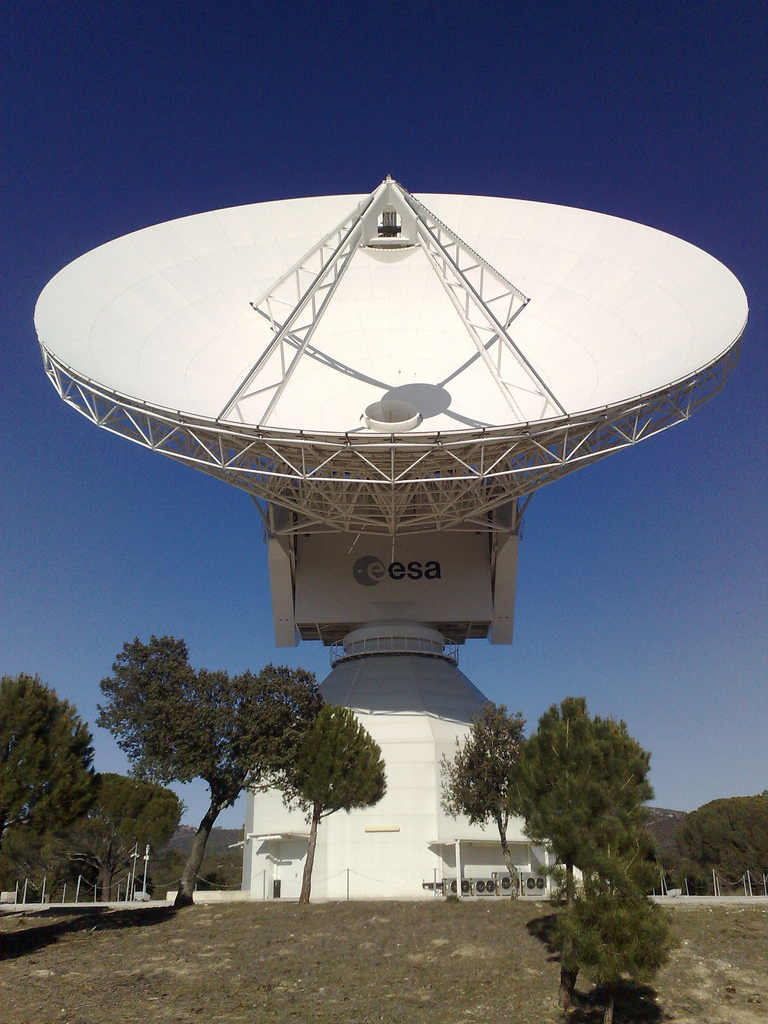
ESTRACK antenna in Cebreros

The European Space Tracking (ESTRACK) network consists of a number of ground-based space-tracking stations belonging to the European Space Agency (ESA), and operated by the European Space Operations Centre (ESOC) in Darmstadt, Germany. The stations support various ESA spacecraft and facilitate communications between ground operators and scientific probes such as XMM-Newton, Mars Express, BepiColombo, Gaia. Similar networks are run by the USA, China, Russia, Japan, and India.

Antennas

[edit]

Each ESTRACK station is different, supporting multiple missions, some sharing one or more of the same missions. The ESTRACK core network consists of:

Antennas of the ESTRACK-Network 2024
(Deep Space Antennas (DSA) highlighted in green)
Location Code Reflector
⌀ (m)
Construction date Up Down Description
New Norcia, Australia NNO1, (DSA 1) 35 2002 S, X S, X The Beam-Waveguide-Antenna was the first Deep Space antenna of ESA.[1] (31°02′53″S 116°11′31″E / 31.048°S 116.192°E / -31.048; 116.192 (New Norcia Ground Station)).
NNO2 4,5 2015 X S, X The small and fast antenna can be used for Launch and Early Orbit Phases and for tracking rain, Vega and Soyuz launchers operated from ESA's Spaceport at Kourou, French Guiana. It was built to take over some capabilities of the Perth station. The antenna has got a larger field of view and can locate spacecraft after launch.
NNO3, (DSA 4) 35 X, Ka X, K, Ka The new 35m antenna was inaugurated on 4 October 2025 and will enter in service NET March 2026.[2] It can support the latest missions like Bepi Colombo, Juice or Euclid by receiving in higher frequency bands than NNO-1.
Kiruna Station in Kiruna, Sweden KI1 15 1990 S S, X The station was built in 1990 and supports polar orbiting satellites. (67°51′25″N 20°57′50″E / 67.857°N 20.964°E / 67.857; 20.964 (Kiruna Station))
KI2 13 2000 S S, X [3]
ESEC in Redu, Belgium RED 15 (1967[4])

1995[5]

S S Redu is part of the ESTRACK network since the beginning. The site hosts more than 40 antennas including antennas for telecommunication satellites and Galileo. The current ESTRACK antenna was built in 1995 and is currently used for Galileo TT&C.
Cebreros, Spain CEB, (DSA 2) 35 2005 X X, K, Ka The site previously hosted an Antenna of the Deep Space Network. (40°27′11″N 4°22′05″W / 40.453°N 4.368°W / 40.453; -4.368 (Bodenstation Cebreros))
Santa Maria, Azores, Portugal SMA 5,5 S, X The station in Santa-Maria can be used to track Ariane launches with medium inclination and it is also capable of tracking Vega and Soyuz launchers operated from ESA's Spaceport at Kourou, French Guiana.[6]
Kourou, French Guiana KRU 15 S, X S, X The Antenna is equipped with a 1.3m dish that can be used to acquire signals in X-Band, if the location of the spacecraft is not accurately known.[7] (5°15′04″N 52°48′18″W / 5.251°N 52.805°W / 5.251; -52.805 (Bodenstation Kourou))
Malargüe, Argentina MLG, (DSA 3) 35 2012 X, Ka X, K, Ka The location in the southern hemisphere was chosen to complement the networks of NASA and JAXA that operate in the northern hemisphere.[8] (35°46′34″S 69°23′53″W / 35.776°S 69.398°W / -35.776; -69.398 (Bodenstation Malargüe)) The Pierre Auger Observatory is also located in Malargüe.

Former stations

[edit]

Composition

[edit]
Locations of ESTRACK's ESA owned stations (in blue) on a world map

The ESTRACK network consists of several ground station around the world. Some of them are owned by ESA itself while others are owned by commercial and other institutional operators. The core stations as well as all of the connections to the missions are operated through the Network Operations Centre at ESOC.

Core Ground Stations

[edit]

The Core ESTRACK network is composed of seven ESA-owned ground stations.[9] Four of the stations are used for tracking satellites and launchers near Earth and three are used for tracking deep-space probes. Details about the stations are shown in the next section.

Augmented Network

[edit]
ESTRACK Network Operations Centre in ESOC

Service contracts with commercially operated ground stations allows the network to track satellites that aren't in view of the ESA owned ground stations.[10] The most relevant operators include KSAT, SSC and Goonhilly Satellite Earth Station. The composition is constantly changing and for every launch different stations may be used.[11]

Cooperative Network

[edit]

Cooperation agreements with international partners further enhance the network. Some of these are Deep Space Stations and therefore can offer services that are not be provided by commercial operators. The agreements are usually made on an exchange of services or as a contribution to a mission, meaning that no exchange of funds is part of the agreement.[11]

See also

[edit]

References

[edit]
[edit]
Revisions and contributorsEdit on WikipediaRead on Wikipedia
from Grokipedia
ESTRACK, or the European Space TRACking network, is the European Space Agency's (ESA) global system of ground-based stations that establishes vital communication links between satellites in orbit and ESA's (ESOC) in , . Established in 1975 to support the International Explorer mission, ESTRACK began with a single 15-meter antenna at Villafranca del Castillo in and has since expanded into a comprehensive infrastructure essential for space operations. The network's primary purpose is to transmit commands to and receive scientific data, , and status updates throughout all mission phases, from launch and early orbit (LEOP) to end-of-life deorbiting. It comprises six core tracking stations—located in (), Santa Maria (), (), New Norcia (), Cebreros (), and Malargüe ()—equipped with antennas ranging from 13 to 35 meters in diameter, enabling round-the-clock coverage across equatorial, mid-latitude, and polar regions. Additionally, three dedicated deep-space antennas (35-meter dishes at New Norcia, Cebreros, and Malargüe), added in the early , extend ESTRACK's reach to distant missions, including those to comets, asteroids, and planets, using advanced technologies like X-band communications, GPS receivers, and delta-DOR (Delta Differential One-way Ranging) for precise positioning accurate to within a few hundred meters. Annually, ESTRACK delivers over 15,000 hours of tracking support to more than 20 ESA missions, achieving availability rates exceeding 99%, which underscores its reliability as the "bridge between and ." The network also facilitates international collaborations, providing services to missions from partners like , , and , such as Japan's Hayabusa-2 asteroid sample return and India's lunar landing. In 2025, ESTRACK marked its 50th anniversary, highlighting its evolution from a modest setup to a of European and global , with ongoing upgrades including the inauguration of a fourth 35-meter deep space antenna at New Norcia in 2025 to handle increasing data demands from constellations and deep-space ventures.

Overview

Purpose and Role

ESTRACK serves as the European Space Agency's (ESA) primary global network, enabling communication and control of satellites in and deep space by linking them to the (ESOC) in , . As ESA's dedicated infrastructure for mission operations, it ensures reliable connectivity for spacecraft across various phases, from launch to end-of-life, supporting the agency's diverse portfolio of scientific and exploratory endeavors. The network's core functions include telecommand uplink for sending instructions to , downlink for receiving scientific data and health status, ranging for measurements, Doppler measurements for tracking, and delta-DOR (Delta Differential One-way Ranging) for high-precision positioning of distant probes. These capabilities allow ESTRACK to provide essential radiometric and data-handling services, maintaining operational continuity for missions in challenging environments. In a typical year, ESTRACK supports over 20 missions with more than 15,000 tracking hours and achieves a service availability rate exceeding 99%. ESTRACK plays an analogous role to other major space agencies' networks, such as NASA's Deep Space Network and the , by offering geographically distributed coverage for interplanetary and orbital operations without relying on external infrastructure for core ESA tasks. It has been instrumental in enabling key missions, including the X-ray observatory for high-energy astrophysics observations, the orbiter for planetary exploration, the probe en route to Mercury, and the space mission mapping billions of stars.

Management and Operations

ESTRACK is centrally managed from the (ESOC) in , , through its Network Operations Centre (NOC), which oversees scheduling, monitoring, and coordination of all activities. The NOC utilizes advanced and remote control systems to configure stations according to precise timetables, ensuring seamless support for passes across various mission phases, from launch and early to routine operations and end-of-life disposal. This central oversight allows for efficient resource allocation, with the Ground Operations Manager coordinating directly with mission control teams during critical events like maneuvers or landings. Day-to-day operations rely on a 24/7 staffing model at the stations and NOC, where teams of operators handle real-time tasks such as signal acquisition, telemetry reception, and telecommand transmission. Automated systems generate pass predictions based on ephemeris data, enabling proactive scheduling and minimizing disruptions, while contingency protocols address anomalies like equipment failures or unexpected orbital changes through immediate reconfiguration and voice-loop coordination with flight controllers. For instance, as exemplified in data during high-demand periods, the network resolved operational contingencies requiring real-time support for about 19% of passes, maintaining overall service reliability. In 2025, ESTRACK marked its 50th anniversary, and on October 4, ESA inaugurated a fourth deep space antenna at New Norcia, , which will enter service in 2026 to support flagship missions and expand capabilities for and deep space operations. ESTRACK integrates closely with ESA's mission control infrastructure at ESOC, where commands are verified prior to uplink and downlink data is routed directly to science and engineering teams for analysis. This linkage ensures that radiometric data from tracking passes—typically lasting 5-15 minutes for low-Earth orbit missions and extending longer for deep-space operations—contributes to real-time orbit determination and mission planning. The network achieves global coverage, supporting spacecraft from near-Earth orbits to interplanetary distances. Operations are supported by dedicated teams of and operators across the stations and ESOC, functioning as a "team of teams" to maintain the network's high standards.

History

Establishment and Early Years

The European Space Tracking (ESTRACK) network was founded in 1975 by the (ESA) to enable independent European space operations, reducing reliance on national networks or those of other space agencies such as the ' systems. This initiative aligned with ESA's formation through the merger of the European Space Research Organisation (ESRO) and the European Launcher Development Organisation (ELDO) in May 1975, aiming to consolidate Europe's fragmented space infrastructure into a unified capability for satellite tracking and control. The inaugural station in the ESTRACK network was the 15-meter diameter facility at Villafranca del Castillo, near , , which became operational on 19 May 1975 after being assigned to ESRO for support of the International Ultraviolet Explorer mission. This station quickly supported early ESA missions, including the GEOS-1 scientific satellite launched in April 1977, providing essential telemetry, tracking, and command functions during its operations. Initially, ESTRACK focused on near-Earth tracking for scientific satellites, with the Villafranca antenna offering reliable S-band communications but limited deep-space capabilities due to its size and technology at the time. A key foundational event was the integration with the (ESOC), established in 1967 under ESRO, which provided the operational framework; however, ESTRACK was formally organized as ESA's dedicated network following the agency's creation in 1975. Early development faced significant budget constraints, prompting ESA to pursue cooperative agreements with member states for station hosting and maintenance, such as the pact with that enabled the Villafranca site's commissioning. These partnerships were crucial for stretching limited funds while building the network's core infrastructure. Over time, ESTRACK evolved from this modest beginning into a global system supporting diverse missions.

Expansion and Key Milestones

Following its establishment in the mid-1970s, ESTRACK underwent significant expansions in the and to enhance coverage for polar orbits and broader European operations. The station in was inaugurated on September 6, 1990, providing critical high-latitude support for missions requiring polar access. Later, in 1995, the Redu station in was integrated with upgraded facilities to bolster near-Earth tracking and telecommunications support across . The 2000s marked a pivotal shift toward deep-space capabilities, driven by ESA's growing portfolio of planetary and astronomical missions. The New Norcia station in opened in March 2003, enabling ESTRACK's first deep-space contact and providing essential downlink for deep-space missions like . This was followed by the Cebreros station in , inaugurated on September 28, 2005, which supported key operations for and enhanced X-band communications for deep-space probes. In the , ESTRACK further globalized its footprint to ensure continuous deep-space coverage. The Malargüe station in was inaugurated in December 2012, completing a southern hemisphere triad of 35-meter antennas and enabling round-the-clock tracking for interplanetary missions. Notable milestones during this period included ESTRACK's vital role in the mission, where in January 2014 it received signals from the spacecraft at over 800 million kilometers distance during its comet rendezvous. Similarly, the network supported the mission's launch in October 2018, facilitating telemetry and commands en route to Mercury. By 2025, ESTRACK celebrated its 50th anniversary, reflecting five decades of evolution from near-Earth to Solar System-spanning operations. A highlight was the inauguration of the NNO-3 35-meter antenna at New Norcia on October 4, 2025, designed for enhanced Ka-band communications and set to become operational in March 2026 to meet rising data demands from missions like and .

Network Composition

Core Ground Stations

The core ground stations of ESTRACK form the backbone of the European Space Agency's (ESA) global tracking network, consisting of seven fully owned and operated facilities that provide essential baseline coverage for spacecraft telemetry, telecommand, and ranging operations. These stations are strategically distributed across three continents to ensure reliable, continuous visibility of ESA missions, from launch and early orbit phases to routine and deep-space operations. ESA designs, builds, and maintains these assets, often through collaborations with local governments and institutions for land use, infrastructure, and regulatory support, ensuring operational autonomy while leveraging regional expertise. The stations are classified into four near-Earth facilities, optimized for missions in low-Earth orbit (LEO) and geostationary orbit (GEO), and three deep-space facilities for interplanetary and lunar missions. The near-Earth stations feature antennas of 5.5–15 m in diameter: Kourou (15 m, French Guiana) supports launches from Europe's Spaceport and LEO tracking; Santa Maria (5.5 m, Azores, Portugal) provides critical North Atlantic coverage for launcher ascent phases; Kiruna (13 m, Sweden) handles polar-orbiting Earth observation satellites; and Redu (15 m, Belgium) focuses on navigation and small satellite support. These installations operate primarily in S-band for near-Earth links, enabling high-volume data downlink and precise orbit determination with minimal latency. In contrast, the deep-space stations employ larger 35 m antennas for low-signal-strength communications at greater distances: New Norcia (Australia) includes a primary 35 m dish (operational since 2003), a second 35 m antenna (New Norcia 3, inaugurated in October 2025 and entering service in March 2026), and a 4.5 m auxiliary for backup and auxiliary functions; Cebreros () and Malargüe () each feature 35 m antennas equipped for X- and Ka-band operations. Positioned approximately 120° apart in longitude, these facilities ensure overlapping visibility for deep-space probes, such as those to Mars or beyond, supporting high-fidelity , science data return, and emergency recovery. Their roles extend to detection support and future exploration missions requiring ultra-precise timing and Doppler measurements. Collectively, the core stations deliver uninterrupted global coverage, limiting visibility gaps to no more than 30 minutes for LEO missions through their equatorial and polar distributions, while deep-space capabilities handle signal delays up to several hours for distant targets. This configuration achieves over 99% service availability annually, underpinning more than 20 missions per year. The network is augmented briefly by commercial partners for specialized or temporary needs, enhancing flexibility without compromising ESA's primary control.

Augmented and Cooperative Networks

The Augmented Network of ESTRACK consists of commercially operated ground stations accessed through service contracts with providers such as Kongsberg Satellite Services (KSAT), (SSC), and Instituto Nacional de Técnica Aeroespacial (INTA), enabling ESA to fill gaps in polar and equatorial coverage that the core network cannot fully address. These leases include KSAT's TrollSat station in and station in , which provide critical polar access; SSC's South Point facility in and Santiago station in for equatorial regions; and additional sites like Dongara in operated under similar commercial arrangements. Such augmentations are particularly vital during launch and early phases (LEOP), where continuous visibility is essential, and they adhere to ESA's compatibility standards for , tracking, and command (TT&C) operations. In practice, these leased passes are scheduled on demand through ESA's Network Operations Centre at ESOC, allowing flexible integration into mission timelines while maintaining high service availability above 99%. For instance, KSAT's facilities have supported LEOP for ESA's Sentinel missions, including Sentinel-3 from Troll and Svalbard stations, and Sentinel-6 from Troll, ensuring uninterrupted data downlink during critical initial orbits. The network's commercial partnerships, formalized through frame contracts since the early 2000s, extend overall coverage to near-100% for low-Earth polar orbits, enhancing data acquisition rates and reducing latency for Earth observation tasks. The Cooperative Network complements these commercial elements through reciprocal service exchanges with international space agencies, focusing on deep-space missions where mutual support maximizes resource efficiency. Key partners include NASA's Deep Space Network (DSN), with facilities like Goldstone providing tracking for ESA probes such as Mars Express; Japan's Aerospace Exploration Agency (JAXA), where ESTRACK supported the Hayabusa-2 asteroid sample return; India's Space Research Organisation (ISRO), aided during Chandrayaan-3's lunar landing; and France's Centre National d'Études Spatiales (CNES), alongside Germany's DLR and Italy's ASI for shared navigation and radio science experiments. These collaborations operate under formal memoranda of understanding (MOUs) established in the 2000s and renewed periodically, such as the 2007 ESA-NASA cross-support agreement covering bi-directional TT&C, spacecraft navigation via delta-DOR, and mission operations backup. The benefits of these cooperative ties include cost-sharing for high-demand deep-space passes, where agencies trade services to avoid redundant infrastructure investments, and improved global visibility that supports precise orbit determination during critical phases like planetary encounters. For example, ESTRACK's role in tracking NASA's Perseverance rover exemplifies reciprocity, while the overall augmented and cooperative framework has enabled over 15,000 hours of annual support across more than 20 missions, fostering international scientific returns without sole reliance on ESA assets.

Antenna Facilities

Current Stations

The ESTRACK network currently operates seven core ground stations across multiple continents, providing comprehensive coverage for spacecraft tracking, telemetry, and command operations. These stations feature a mix of large deep-space antennas and smaller near-Earth facilities, equipped primarily with S- and X-band systems for reliable communication, with select sites supporting Ka-band for high-data-rate missions. New Norcia, Australia (DSA 1, NNO 2, NNO 3): Located approximately 115 km north of Perth, this site hosts three antennas: the 35-meter DSA 1, operational since 2002, which serves as a primary deep-space facility for missions like and ; the 4.5-meter NNO 2 acquisition aid antenna, activated in 2015 to support launch and early orbit phases for vehicles such as Ariane and Soyuz; and the 35-meter NNO 3, inaugurated in October 2025 to enhance data downlink capacity amid growing mission demands. The station's strategic position enables continuous deep-space coverage, with capabilities in S-, X-, and Ka-bands for high-data-rate transfers. Cebreros, Spain (DSA 2): Situated in the Ávila province, this 35-meter deep-space antenna became operational in 2005 and plays a crucial role in supporting European time-zone missions, including and , through precise tracking and delta-DOR (differential one-way ranging) measurements. It features X- and Ka-band reception, along with K-band capabilities, ensuring robust links for interplanetary spacecraft. Malargüe, Argentina (DSA 3): This 35-meter antenna, activated in 2012 and located 30 km south of Malargüe, provides essential southern deep-space coverage, complementing northern sites for global visibility. It supports missions like with X-band transmit/receive, Ka-band full duplex, and K-band receive functions, enabling radio science experiments and high-resolution tracking. Kiruna, Sweden: Positioned 38 km east of , the station includes a 15-meter antenna operational since 1990 and a 13-meter antenna added in 2000, specializing in support for satellites such as CryoSat-2, Swarm, and Sentinel-1. These facilities operate in S- and X-bands, facilitating frequent passes over high-latitude regions. Redu, Belgium: Established as a site in 1967 with its 15-meter antenna activated in 1995, this station functions as a backup for European near-Earth missions, including Galileo and , from its location in the . It supports a wide range of bands including L-, S-, X-, Ku-, and Ka-, with emphasis on S- and X-band for and command. Santa Maria, Azores, : This mid-Atlantic station features a 13.5-meter antenna, leveraging its oceanic position for optimal launcher tracking from and near-Earth passes. Operational in S- and X-bands, it receives real-time during Ariane ascents and supports services like CleanSeaNet for maritime surveillance. Kourou, French Guiana: Integrated with the , the 15-meter antenna supports launch site operations, providing immediate tracking, , and validation for Ariane, Soyuz, and vehicles. It operates primarily in S- and X-bands to ensure seamless handover during ascent phases.

Former Stations

The Villafranca station in , operational from 1975 as ESA's inaugural ESTRACK facility, featured two 15-meter antennas (VIL-1 and VIL-2) and served as the network's foundational site for tracking and . It supported a wide array of early ESA missions, including the International Ultraviolet Explorer (IUE), , ERS-1 and ERS-2, Infrared Space Observatory (ISO), and , providing S-band communications for near-Earth and initial deep-space operations. By 2009, its deep-space capabilities were supplanted by the larger 35-meter Cebreros station (DSA 2), located nearby for enhanced visibility and signal strength in interplanetary tracking. In 2017, operational responsibility for the site transferred to European industry, with VIL-1 mothballed under 's CESAR program, marking its transition to a former ESTRACK asset while retaining historical significance at the European Space Astronomy Centre (ESAC). Another early former station was Port Stanley in the ( territory), established in the late as part of ESRO's precursor network. This temporary facility, upgraded under a -ESRO agreement for satellite telemetry, provided coverage during the network's initial expansion but was decommissioned by the end of 1973 due to logistical challenges and shifting priorities toward more permanent sites. Closures of these stations stemmed primarily from technological obsolescence, as smaller antennas like the 15-meter dishes at Villafranca became inadequate for evolving deep-space requirements demanding larger apertures and higher precision. Site relocations, such as Cebreros' positioning for optimal sky visibility, addressed limitations in geographic coverage and interference, while budget reallocations favored investments in the core ESTRACK network's modernization. These factors ensured the network's adaptation to missions like Cluster and , which outgrew legacy infrastructure. The legacy of former stations endures through their contributions to pivotal early missions, with and tracking data archived at the (ESOC) in , , supporting ongoing scientific analysis. Equipment from these sites, including antennas and receivers, was frequently refurbished and relocated to active facilities, facilitating seamless upgrades in ESTRACK's evolution toward deep-space focus.

Technical Capabilities

Communication and Tracking Systems

The ESTRACK network employs standardized bands for communication and , primarily S-band for near-Earth operations and X-band for higher data throughput. The S-band operates in the 2.025–2.300 GHz range, facilitating command uplinks and telemetry downlinks for low-Earth orbit missions. In contrast, the X-band, spanning 7.145–8.500 GHz, supports elevated data rates suitable for more demanding applications while maintaining compatibility across the network. Data rates in ESTRACK vary by mission phase and orbital distance, with uplink commands typically reaching up to 2 kbit/s to ensure reliable transmission over potentially weak links. Downlink telemetry and payload data range from 256 kbit/s for standard housekeeping to 8 Mbit/s for high-volume transfers, enabling efficient support for diverse ESA missions. These rates are modulated using phase-shift keying schemes to optimize signal integrity. Tracking capabilities rely on two-way Doppler measurements to determine velocity, providing range-rate accuracy of 0.1 mm/s, and ranging techniques for distance estimation with a precision of 1 m. These radiometric methods use coherent transponders on to generate return signals, allowing real-time essential for routine operations. For enhanced precision in select scenarios, Delta-DOR techniques supplement baseline tracking. Key equipment includes cryogenically cooled low-noise receivers, operating at temperatures below -253°C to minimize thermal and maximize sensitivity for faint signals. Uplink transmission utilizes high-power amplifiers, capable of up to 20 kW output, to deliver commands over vast distances while adhering to international spectrum regulations. All ESTRACK systems conform to CCSDS protocols, ensuring seamless interoperability with international partners such as and through standardized packet , telecommand, and ranging formats. This adherence facilitates collaborative missions and data exchange without proprietary adaptations.

Deep Space and Specialized Support

ESTRACK's deep space capabilities include advanced navigation techniques such as Delta Differential One-way Ranging (Delta-DOR), which employs s as reference points to achieve precise angular positioning of . This method measures the differential delay in radio signals from the and a nearby received at multiple ground stations, calibrating out atmospheric and instrumental errors to determine the 's position relative to the 's known coordinates. Operational within ESTRACK since the activation of the Cebreros deep space antenna in 2005, Delta-DOR provides angular accuracy on the order of 10 nanoradians, enabling reliable tracking during critical mission phases like planetary flybys. To support high-volume data return from distant probes, ESTRACK's 35-meter deep space antennas incorporate Ka-band (26-40 GHz) receivers for downlink operations, facilitating elevated rates compared to traditional X-band systems. These capabilities allow for downlinks up to 75 Mbit/s under optimal conditions, as demonstrated by the mission at the Sun-Earth L2 point, particularly beneficial for science-rich missions transmitting large datasets from interplanetary distances. In October 2025, ESA inaugurated the New Norcia 3 35-meter antenna, the fourth in the deep space network, supporting X-, K-, and Ka-band operations to bolster capabilities for missions to and beyond, with full operations planned for 2026. Radio science experiments represent a core specialized function of ESTRACK, leveraging the network's sensitive receivers to probe planetary environments through techniques like Doppler tracking and signal occultations. For gravity field measurements, the system analyzes spacecraft acceleration via two-way Doppler shifts, mapping mass distributions in celestial bodies such as and moons. Atmospheric occultations, where a spacecraft's signal passes through a planetary atmosphere en route to , enable profiling of , , and composition; a notable example is the 2005 Huygens probe descent to Titan, where ESTRACK stations contributed to Doppler wind measurements revealing atmospheric dynamics. Enhancing signal detection at extreme ranges, ESTRACK employs low-noise cryogenic amplifiers in its deep space facilities, which minimize added thermal noise to achieve signal-to-noise ratios exceeding 20 dB even from probes billions of kilometers away. These amplifiers, cooled to near-absolute zero, preserve weak signals from faint deep space transmitters, supporting both recovery and precise scientific observations over vast distances.

References

Add your contribution
Related Hubs
User Avatar
No comments yet.