Respect all members: no insults, harassment, or hate speech.
Be tolerant of different viewpoints, cultures, and beliefs. If you do not agree with others, just create separate note, article or collection.
Clearly distinguish between personal opinion and fact.
Verify facts before posting, especially when writing about history, science, or statistics.
Promotional content must be published on the “Related Services and Products” page—no more than one paragraph per service. You can also create subpages under the “Related Services and Products” page and publish longer promotional text there.
Do not post materials that infringe on copyright without permission.
Always credit sources when sharing information, quotes, or media.
Be respectful of the work of others when making changes.
Discuss major edits instead of removing others' contributions without reason.
If you notice rule-breaking, notify community about it in talks.
Do not share personal data of others without their consent.
Mars Express consisted of two parts, the Mars Express Orbiter and Beagle 2,[3] a lander designed to perform exobiology and geochemistry research. Although the lander failed to fully deploy after it landed on the Martian surface, the orbiter has been successfully performing scientific measurements since early 2004, namely, high-resolution imaging and mineralogical mapping of the surface, radar sounding of the subsurface structure down to the permafrost, precise determination of the atmospheric circulation and composition, and study of the interaction of the atmosphere with the interplanetary medium.[3]
Due to the valuable science return and the highly flexible mission profile, Mars Express has been granted several mission extensions. The latest was approved on March 7, 2023, consisting of a confirmed operating period until December 31, 2026, and a further provisional extension to December 31, 2028.[4][5] Arriving at Mars in 2003, 22 years, 1 month and 12 days ago (and counting), it is the second longest surviving, continually active spacecraft in orbit around a planet other than Earth, behind only NASA's still active 2001 Mars Odyssey.
"Express" in the name originally referred to the speed and efficiency with which the spacecraft was designed and built.[6] However, "Express" also describes the spacecraft's relatively short interplanetary voyage, a result of being launched when the orbits of Earth and Mars brought them closer than they had been in about 60,000 years.[7]
The Mars Express mission is dedicated to the study of the interior, subsurface, surface, atmosphere, and environment of the planet Mars. The spacecraft carried seven scientific instruments, a small lander, a lander relay, and a Visual Monitoring Camera, all designed to contribute to solving the mystery of Mars's missing water.
Some of the instruments on the orbiter, including the camera systems and some spectrometers, reuse designs from the failed launch of the Russian Mars 96 mission in 1996[2] (European countries had provided much of the instrumentation and financing for that unsuccessful mission). The scientific objectives of the Mars Express represent an attempt to fulfill in part the lost scientific goals of this failed Russian mission, complemented by exobiology research with Beagle-2.[8]
The design of Mars Express is based on ESA's Rosetta mission, on which a considerable sum was spent on development. The same design was also used for ESA's Venus Express mission in order to increase reliability and reduce development cost and time.
The total initial Mars Express budget excluding the lander was €150 million.[9][10] The prime contractor for the construction of Mars Express orbiter was EADS Astrium Satellites.
The Mars Express orbiter is a cube-shaped spacecraft with two solar panel wings extending from opposite sides. The launch mass of 1223 kg includes a main bus with 113 kg of payload, the 60 kg lander, and 457 kg of propellant. The main body is 1.5 m × 1.8 m × 1.4 m in size, with an aluminium honeycomb structure covered by an aluminium skin. The solar panels measure about 12 m tip-to-tip. Two 20 m long wire dipole antennas extend from opposite side faces perpendicular to the solar panels as part of the radar sounder.[11]
The Soyuz/Fregat launcher provided most of the thrust Mars Express needed to reach Mars. The final stage of the Soyuz, Fregat was jettisoned once the probe was safely on a course for Mars. The spacecraft's on-board means of propulsion was used to slow the probe for Mars orbit insertion and subsequently for orbit corrections.[11]
The body is built around the main propulsion system, which consists of a bipropellant 400 N main engine. The two 267-liter propellant tanks have a total capacity of 595 kg. Approximately 370 kg are needed for the nominal mission. Pressurized helium from a 35-liter tank is used to force fuel into the engine. Trajectory corrections will be made using a set of eight 10 N thrusters, one attached to each corner of the spacecraft bus. The spacecraft configuration is optimized for a Soyuz/Fregat, and was fully compatible with a Delta II launch vehicle.
Spacecraft power is provided by the solar panels which contain 11.42 square meters of silicon cells. The originally planned power was to be 660W at 1.5AU but a faulty connection has reduced the amount of power available by 30%, to about 460W. This loss of power does not significantly affect the science return of the mission. Power is stored in three lithium-ion batteries with a total capacity of 64.8Ah for use during eclipses. The power is fully regulated at 28V, and the Terma power module (also used in Rosetta) is redundant.[12][13] During routine phase, the spacecraft's power consumption is in the range of 450–550W.[14]
Attitude control (3-axis stabilization) is achieved using two 3-axis inertial measurement units, a set of two star cameras and two Sun sensors, gyroscopes, accelerometers, and four 12 N·m·s reaction wheels. Pointing accuracy is 0.04 degree with respect to the inertial reference frame and 0.8 degree with respect to the Mars orbital frame. Three on-board systems help Mars Express maintain a very precise pointing accuracy, which is essential to allow the spacecraft to use some of the science instruments.
The communications subsystem is composed of three antennas: A 1.6 m diameter parabolic dish high-gain antenna and two omnidirectional antennas. The first one provide links (telecommands uplink and telemetry downlink) in both X-band (8.4 GHz) and S-band (2.1 GHz) and is used during nominal science phase around Mars. The low gain antennas are used during launch and early operations to Mars and for eventual contingencies once in orbit. Two Mars lander relay UHF antennas are mounted on the top face for communication with the Beagle 2 or other landers, using a Melacom transceiver.[15]
Although communications with Earth were originally scheduled to take place with the ESA 35-meter wide Ground Station in New Norcia (Australia) New Norcia Station, the mission profile of progressive enhancement and science return flexibility have triggered the use of the ESA ESTRACK Ground Stations in Cebreros Station, Madrid, Spain and Malargüe Station, Argentina. In addition, further agreements with NASA Deep Space Network have made possible the use of American stations for nominal mission planning, thus increasing complexity but with a clear positive impact in scientific returns. This inter-agency cooperation has proven effective, flexible and enriching for both sides. On the technical side, it has been made possible (among other reasons) thanks to the adoption of both Agencies of the Standards for Space Communications defined in CCSDS.
Thermal control is maintained through the use of radiators, multi-layer insulation, and actively controlled heaters. The spacecraft must provide a benign environment for the instruments and on-board equipment. Two instruments, PFS and OMEGA, have infrared detectors that need to be kept at very low temperatures (about −180 °C). The sensors on the camera (HRSC) also need to be kept cool. But the rest of the instruments and on-board equipment function best at room temperatures (10–20 °C).
The spacecraft is covered in gold-plated aluminium-tin alloy thermal blankets to maintain a temperature of 10–20 °C inside the spacecraft. The instruments that operate at low temperatures to be kept cold are thermally insulated from this relatively high internal temperature, and emit excess heat into space using attached radiators.[11]
The spacecraft is run by two Control and Data management Units with 12 gigabits[11] of solid state mass memory for storage of data and housekeeping information for transmission. The on-board computers control all aspects of the spacecraft functioning including switching instruments on and off, assessing the spacecraft orientation in space and issuing commands to change it.
Another key aspect of the Mars Express mission is its artificial intelligence tool (MEXAR2).[16] The primary purpose of the AI tool is the scheduling of when to download various parts of the collected scientific data back to Earth, a process which used to take ground controllers a significant amount of time. The new AI tool saves operator time, optimizes bandwidth use on the DSN, prevents data loss, and allows better use of the DSN for other space operations as well. The AI decides how to manage the spacecraft's 12 gigabits of storage memory, when the DSN will be available and not be in use by another mission, how to make the best use of the DSN bandwidth allocated to it, and when the spacecraft will be oriented properly to transmit back to Earth.[16][17]
The Beagle 2 lander objectives were to characterize the landing site geology, mineralogy, and geochemistry, the physical properties of the atmosphere and surface layers, collect data on Martian meteorology and climatology, and search for possible signatures of life on Mars. However, the landing attempt was unsuccessful and the lander was declared lost.
A Commission of Inquiry on Beagle 2 identified several possible causes, including airbag problems, severe shocks to the lander's electronics which had not been simulated adequately before launch, and problems with parts of the landing system colliding; but was unable to reach any firm conclusions.[18]
The spacecraft's fate remained a mystery until it was announced in January 2015 that NASA's Mars Reconnaissance Orbiter, using HiRISE, had found the probe intact on the surface of Mars.[19][20] It was then determined that one of the spacecraft's four solar panels may have only partially opened, possibly blocking the spacecraft's communications.[21]Beagle 2 was the first British and first European probe to achieve a landing on Mars.
The scientific objectives of the Mars Express payload are to obtain global high-resolution photo-geology (10 m resolution), mineralogical mapping (100 m resolution) and mapping of the atmospheric composition, study the subsurface structure, the global atmospheric circulation, and the interaction between the atmosphere and the subsurface, and the atmosphere and the interplanetary medium. The total mass budgeted for the science payload is 116 kg.[22] The payload scientific instruments are:[23]
Visible and Infrared Mineralogical Mapping Spectrometer (OMEGA) (Observatoire pour la Minéralogie, l'Eau, les Glaces et l'Activité) – France – Determines mineral composition of the surface up to 100 m resolution. Is mounted inside pointing out the top face.[24] Instrument mass: 28.6 kg[25]
Ultraviolet and Infrared Atmospheric Spectrometer (SPICAM) – France – Assesses elemental composition of the atmosphere. Is mounted inside pointing out the top face. Instrument mass: 4.7 kg[25]
Sub-Surface Sounding Radar Altimeter (MARSIS) – Italy – A radar altimeter used to assess composition of sub-surface aimed at search for frozen water. Is mounted in the body and is nadir pointing, and also incorporates the two 20 m antennas. Instrument mass: 13.7 kg[25]
Planetary Fourier Spectrometer (PFS) – Italy – Makes observations of atmospheric temperature and pressure (observations suspended in September 2005). Is mounted inside pointing out the top face[26] and is currently working. Instrument mass: 30.8 kg[25]
Analyzer of Space Plasmas and Energetic Atoms (ASPERA) – Sweden – Investigates interactions between upper atmosphere and solar wind. Is mounted on the top face. Instrument mass: 7.9 kg[25]
High Resolution Stereo Camera (HRSC) – Germany – Produces color images with up to 2 m resolution. Is mounted inside the spacecraft body, aimed through the top face of the spacecraft, which is nadir pointing during Mars operations. Instrument mass: 20.4 kg[25]
Mars Express Lander Communications (MELACOM) – UK – Allows Mars Express to act as a communication relay for landers on the Martian surface. (Has been used on both Mars Exploration Rovers, and was used to support the landing of NASA's Phoenix mission)
Mars Radio Science Experiment (MaRS) – Uses radio signals to investigate atmosphere, surface, subsurface, gravity and solar corona density during solar conjunctions. It uses the communications subsystem itself.
Operations for Mars Express are carried out by a multinational team of engineers from ESA's Operation Centre (ESOC) in Darmstadt. The team began preparations for the mission about 3 to 4 years prior to the actual launch. This involved preparing the ground segment and the operational procedures for the whole mission.
The Mission Control Team is composed of the Flight Control Team, Flight Dynamics Team, Ground Operations Managers, Software Support and Ground Facilities Engineers. All of these are located at ESOC but there are additionally external teams, such as the Project and Industry Support teams, who designed and built the spacecraft. The Flight Control Team currently consists of:
The Spacecraft Operations Manager
Six Operations Engineers (including three Mission Planners)
The team build-up, headed by the Spacecraft Operations Manager, started about four years before launch. He was required to recruit a suitable team of engineers that could handle the varying tasks involved in the mission. For Mars Express the engineers came from various other missions. Most of them had been involved with Earth orbiting satellites.
In the years preceding the launch of a spacecraft numerous teams of experts distributed over the contributing companies and organisations prepared the space and ground segments. Each of these teams focussed on the area of its responsibility and interfacing as required. A major additional requirement raised for the Launch and Early Orbit Phase (LEOP) and all critical operational phases was that it was not enough merely to interface; the teams had to be integrated into one Mission Control Team. All the different experts had to work together in an operational environment and the interaction and interfaces between all elements of the system (software, hardware and human) had to run smoothly for this to happen:
the flight operations procedures had to be written and validated down to the smallest detail
Animation of Mars Express's trajectory around Sun Mars Express· Sun· Earth· Mars
The spacecraft was launched on June 2, 2003, at 23:45 local time (17:45 UT, 1:45 p.m. EDT) from Baikonur Cosmodrome in Kazakhstan, using a Soyuz-FG/Fregat rocket. The Mars Express and Fregat booster were initially put into a 200 km Earth parking orbit, then the Fregat was fired again at 19:14 UT to put the spacecraft into a Mars transfer orbit. The Fregat and Mars Express separated at approximately 19:17 UT. The solar panels were then deployed and a trajectory correction manoeuvre was performed on June 4 to aim Mars Express towards Mars and allow the Fregat booster to coast into interplanetary space. The Mars Express was the first Russian-launched probe to successfully make it out of low Earth orbit since the Soviet Union fell.
The Near Earth commissioning phase extended from the separation of the spacecraft from the launcher upper stage until the completion of the initial check out of the orbiter and payload. It included the solar array deployment, the initial attitude acquisition, the declamping of the Beagle-2 spin-up mechanism, the injection error correction manoeuvre and the first commissioning of the spacecraft and payload (final commissioning of payload took place after Mars Orbit Insertion). The payload was checked out one instrument at a time. This phase lasted about one month.
This five month phase lasted from the end of the Near Earth Commissioning phase until one month prior to the Mars capture manoeuvre and included trajectory correction manoeuvres and payloads calibration. The payload was mostly switched off during the cruise phase, with the exception of some intermediate check-outs. Although it was originally meant to be a "quiet cruise" phase, It soon became obvious that this "cruise" would be indeed very busy. There were star tracker problems, a power wiring problem, extra manoeuvres, and on October 28, the spacecraft was hit by one of the largest solar flares ever recorded.
The Beagle 2 lander was released on December 19, 2003, at 8:31 UTC (9:31 CET) on a ballistic cruise towards the surface. It entered Mars's atmosphere on the morning of December 25. Landing was expected to occur at about 02:45 UT on December 25 (9:45 p.m. EST December 24). However, after repeated attempts to contact the lander failed using the Mars Express craft and the NASAMars Odyssey orbiter, it was declared lost on February 6, 2004, by the Beagle 2 management board. An inquiry was held and its findings were published later that year.[18]
Mars Express's trajectory around Mars from December 25, 2003, to January 1, 2010 Mars Express·MarsMARSIS antenna deployed
Mars Express arrived at Mars after a 400 million km journey and course corrections in September and in December 2003.
On December 20 Mars Express fired a short thruster burst to put it into position to orbit the planet. The Mars Express orbiter then fired its main engine and went into a highly elliptical initial-capture orbit of 250 km × 150,000 km with an inclination of 25 degrees on December 25 at 03:00 UT (10:00 p.m., December 24 EST).
First evaluation of the orbital insertion showed that the orbiter had reached its first milestone at Mars. The orbit was later adjusted by four more main engine firings to the desired 259 km × 11,560 km near-polar (86 degree inclination) orbit with a period of 7.5 hours. Near periapsis (nearest to Mars) the top deck is pointed down towards the Martian surface and near apoapsis (farthest from Mars in its orbit) the high gain antenna will be pointed towards Earth for uplink and downlink.
After 100 days the apoapsis was lowered to 10,107 km and periapsis raised to 298 km to give an orbital period of 6.7 hours.
The MARSIS radar booms were originally scheduled to be deployed in April 2004, but this was delayed to 2005 out of fear that the deployment could damage the spacecraft through a whiplash effect.[27]
Since orbit insertion Mars Express has been progressively fulfilling its original scientific goals. Nominal science observations began during July 2005. Nominally the spacecraft points to Mars while acquiring science and then slews to Earth-pointing to downlink the data, although some instruments like MARSIS or Radio Science might be operated while spacecraft is Earth-pointing.
For more than 20,000 orbits, Mars Express payload instruments have been nominally and regularly operated. The HRSC camera has been consistently mapping the Martian surface with unprecedented resolution and has acquired many images.
January 23: ESA announced the discovery of water ice in the south polar ice cap, using data collected by the OMEGA instrument.
January 28: Mars Express orbiter reaches final science orbit altitude around Mars.
March 17: Orbiter detects polar ice caps that contain 85% carbon dioxide (CO2) ice and 15% water ice.[28]
March 30: A press release announces that the orbiter has detected methane in the Martian atmosphere. Although the amount is small, about 10 parts in a thousand million, it has excited scientists to question its source. Since methane is removed from the Martian atmosphere very rapidly, there must be a current source that replenishes it. Because one of the possible sources could be microbial life, it is planned to verify the reliability of these data and especially watch for difference in the concentration in various places on Mars. It is hoped that the source of this gas can be discovered by finding its location of release.[29]
April 28: ESA announced that the deployment of the boom carrying the radar-based MARSIS antenna was delayed. It described concerns with the motion of the boom during deployment, which can cause the spacecraft to be struck by elements of it. Further investigations are planned to make sure that this will not happen.
July 15: Scientists working with the PFS instrument announced that they tentatively discovered the spectral features of the compound ammonia in the Martian atmosphere. Just like methane discovered earlier (see above), ammonia breaks down rapidly in Mars's atmosphere and needs to be constantly replenished. This points towards the existence of active life or geological activity; two contending phenomena whose presence so far have remained undetected.[30]
In 2005, ESA scientists reported that the OMEGA instrument data indicates the presence of hydrated sulphates, silicates and various rock-forming minerals.[31][32]
February 8: The delayed deployment of the MARSIS antenna, planned for early May 2005, has been given a green light by ESA.[27]
May 5: The first boom of the MARSIS antenna was successfully deployed.[33] At first, there was no indication of any problems, but later it was discovered that one segment of the boom did not lock.[34] The deployment of the second boom was delayed to allow for further analysis of the problem.
May 11: Using the Sun's heat to expand the segments of the MARSIS antenna, the last segment locked in successfully.[35]
June 14: The second boom was deployed, and on June 16 ESA announced it was a success.[36]
June 22: ESA announces that MARSIS is fully operational and will soon begin acquiring data. This comes after the deployment of the third boom on June 17, and a successful transmission test on June 19.[37]
Dust Storm, North Polar Cap, processed by Andrea Luck'Face on Mars' in Cydonia region, 2006
September 21: The High Resolution Stereo Camera (HRSC) has obtained images of the Cydonia region, the location of the famous "Face on Mars". The massif became famous in a photo taken in 1976 by the American Viking 1 Orbiter. The image recorded with a ground resolution of approximately 13.7 metres per pixel.[38]
September 26: The Mars Express spacecraft emerged from an unusually demanding eclipse introducing a special, ultra-low-power mode nicknamed 'Sumo' – an innovative configuration aimed at saving the power necessary to ensure spacecraft survival. This mode was developed through teamwork between ESOC mission controllers, principal investigators, industry, and mission management.[39]
October: In October 2006 the Mars Express spacecraft encountered a superior solar conjunction (alignment of Earth-Sun-Mars-orbiter). The angle Sun-Earth-orbiter reached a minimum on October 23 at 0.39° at a distance of 2.66 AU. Operational measures were undertaken to minimize the impact of the link degradation, since the higher density of electrons in the solar plasma heavily impacts the radio frequency signal.[40]
December: Following the loss of NASA's Mars Global Surveyor (MGS), Mars Express team was requested to perform actions in the hopes of visually identifying the American spacecraft. Based on last ephemeris of MGS provided by JPL, the on-board high definition HRSC camera swept a region of the MGS orbit. Two attempts were made to find the craft, both unsuccessful.
January: First agreements with NASA undertaken for the support by Mars Express on the landing of the American lander Phoenix in May 2008.
February: The small camera VMC (used only once to monitor the lander ejection) was recommissioned and first steps were taken to offer students the possibility to participate in a campaign "Command Mars Express Spacecraft and take your own picture of Mars".
February 23: As result of the science return, the Science Program Committee (SPC) granted a mission extension until May 2009.[41]
June 28: The High Resolution Stereo Camera (HRSC) has produced images of key tectonic features in Aeolis Mensae.[42]
In March 2008, the Mars Express Team was the winner of the Sir Arthur Clarke Award for Best Team Achievement.[43]
During a Phobos flyby on 23 July 2008, Mars Express observed backscattering of solar wind protons at Phobos, a process previously reported at the Earth's Moon, suggesting that it is common at airless bodies covered by regolith.[44] The next such observation occurred in January 2016.[45]
October 16: Safe mode following a Solid-State Mass Memory problem.[49]
November 24: Science operations are resumed using the Short Mission Timeline and Command Files instead of the Long Time Line resident on the suspect Solid-State Mass Memory.[50]
February 16: Resumes full science operations. There is still enough fuel for up to 14 additional years of operation.[51]
In March 2012, a paper was published in JGR Planets documenting the first detection of a faint infrared glow above the winter poles of Mars. This discovery was based on Mars Express's OMEGA observations from 2004, 2005, and 2006.[52][53]
During a Phobos flyby in January 2016, Mars Express again observed solar wind proton backscattering from the moon's surface. This was only second such observation by the spacecraft (first occurred in 2008) and, as of 2025, this intermittency remains unexplained.[61][62]
October 19: Assisted with data collection and transfer for the Schiaparelli EDM lander landing.
On 19 June, the spacecraft took a notable image spanning from the North Pole up to Alba Mons and even farther south.[63] The image was released in December 20, 2017, and was captured by HRSC.[63][64]
December 2018: Mars Express relays images of the 80-kilometer wide Korolev Crater filled with approximately 2200 cubic kilometers of water ice on the Martian surface.[71] Based on further evidence the crater ice is still part of much vaster ice resources at Mars poles.[72]
Between March and April 2020, Mars Express (along with other interplanetary missions by ESA) was briefly placed into a largely unattended safe configuration with science instruments turned off due to the worsening COVID-19 pandemic and the need to reduce on-site personnel at ESOC.[75][76]
In September 2020, a discovery was reported based on MARSIS radar studies, of three more subglacial lakes on Mars, 1.5 km (0.93 mi) below the southern polar ice cap. The size of the first lake found, and the largest, has been corrected to 30 km (19 mi) wide. It is surrounded by 3 smaller lakes, each a few kilometres wide.[77]
A study published in December 2020 in JGR Planets utilized the wide field of view of the Visual Monitoring Camera, in combination with other instruments on Mars Express and other orbiters, to describe the life cycle of a large elongated orographic cloud that grows and fades on a daily basis during spring and summer over Arsia Mons.[78][79] A follow-up study published in 2022 used computational modeling to describe the physical mechanisms behind the cloud's formation.[80]
Two studies published in December 2020[81] and January 2021,[82] that analyzed SPICAM data, show that water escape to space is accelerated by dust storms and Mars's proximity to the Sun, and suggest that some water may have retreated underground.[83]
A study published in April 2021, that used SPICAM data to analyze the relationship between ozone and water vapour in the atmosphere of Mars, identified a previously unknown problem with climate models, that might be relevant also to studying the Earth's atmosphere.[84][85]
In November 2021, an experiment was performed to test whether Mars Express and the TGO lander relay communications radio could be used to perform radio occultation science,[86] as well as a series of tests of data relay from the CNSA Zhurong rover.[87]
In February 2022, a study was published in Earth and Planetary Science Letters demonstrating that liquid brines (water with perchlorate and chloride) are the best explanation for the MARSIS observations from 2018 interpreted as liquid water under the South pole of Mars. Such brines might not form actual underground lakes but could exist between grains of ice or sediment.[88][89]
On 14 February 2022, Mars Express observed a rare astronomical event — Deimos passing in front of Jupiter and its Galilean moons. Measuring the duration of the occultation enabled a more precise determination of the position and orbit of Deimos.[90]
In June 2022, an upgrade of the MARSIS instrument software was completed. The new version improved the performance of the instrument to push its performance beyond some of the old limitations.[91][92]
On 23 September 2022, Mars Express conducted a close flyby of Phobos and used the MARSIS instrument to probe the moon's subsurface structure from as close as 83 km. Operating MARSIS at such close distance was enabled by the recent software upgrade. The instrument was originally designed for studying Mars – at more than 250 km from the spacecraft.[93]
In November 2022, Mars Express performed data relay tests with NASA Perseverance rover, bringing the total number of other spacecraft supported by Mars Express in this way up to a record-breaking seven.[94]
In January 2023, the first global high-resolution map of aqueous minerals (formed through interaction with water) at Mars was published using data from Mars Express's OMEGA and MRO's CRISM instruments.[95][96]
June 3: To celebrate the 20th anniversary of the spacecraft's launch, a livestream of images from the Visual Monitoring Camera was streamed online, marking the first livestream direct from Mars.[97]
Published in January 2024, a new research analysed MARSIS radar data collected over the preceding decade and concluded that the Medusae Fossae Formation at Mars equator, previously thought to be likely composed of dry deposits, instead includes a large amount of water ice.[98][99]
In May 2024, computers on Mars Express (as well as on another ESA mission, BepiColombo) reported a sharp increase in the number of memory errors, coinciding with a massive solar flare from the active region AR3664, at that time facing away from Earth. The event was also observed in detail by ESA's Solar Orbiter.[100]
In June 2024, a new study was published in Nature Geoscience, providing first evidence for water frost near Mars equator, specifically atop the Tharsis volcanoes. This work used data from ESA's Mars Express and TGO missions.[101][102]
In July 2024, a study was published in Radio Science documenting the first routine use of mutual radio occultation technique at another planet, specifically the measurements of physical properties of the Martian atmosphere conducted using a radio link between ESA's Mars Express and TGO orbiters between 2020 and 2023.[103][104]
In September 2024, a new cloud atlas of Mars has been published, containing images of Martian clouds by Mars Express from the past 20 years.[105][106]
In February 2025, a study was published in Nature Communications suggesting that the red color of Mars is caused by iron oxides containing water, known as ferrihydrite, and not by hematite that forms under dry conditions, as thought before. This work used data from Mars Express and other spacecraft.[107][108]
In May 2025, ESA updated the software solution from 2018 which was meant to prolong the lifetime of the spacecraft's gyroscopes. This new update could allow Mars Express to stay operational until 2034 and be ready to support the MMX spacecraft in 2029.[109]
In June 2025, a comprehensive data set from Mars Express—TGOradio occultation observations has been made publicly available with a publication of a new study in JGR Planets analysing 71 full vertical profiles from such observations.[110][111]
In September 2025, scientists presented a method for predicting the green visible light aurora on Mars, which they developed using data from Mars Express, MAVEN, and Perseverance.[112][113]
In October 2025, scientists published a catalogue of 1039 Martian dust devils observed by Mars Express and TGO during past two decades. Their analyses show near-surface wind speeds of up to 44 m/s, faster than ever observed by surface probes.[114][115][116]
^"MEX — ASI-PROC". Planetary Radar Operational Center. March 29, 2016. Archived from the original on April 13, 2016. Retrieved March 29, 2016.
^"QinetiQ to put Mars in the picture". Qinetiq. Archived from the original on August 31, 2006. Retrieved March 29, 2016. Consisting of a lightweight bespoke transponder and transceiver weighing less than 650 grams, the system will provide the 10,000-kilometre UHF radio communications link between the Mars Express orbiter and Beagle-2 lander.
^Bargery, AS; et al. (2006). "Near-Infrared Analysis of Tempe Terra, Olympica Fossae and Nili Fossae From Omega Data". Lunar and Planetary Science. XXXVII: 1684.
Missions are ordered by launch date. Sign † indicates failure en route or before intended mission data returned. ‡ indicates use of the planet as a gravity assist en route to another destination.
Launches are separated by dots ( • ), payloads by commas ( , ), multiple names for the same satellite by slashes ( / ). Crewed flights are underlined. Launch failures are marked with the † sign. Payloads deployed from other spacecraft are (enclosed in parentheses).
Mars Express is a space exploration mission led by the European Space Agency (ESA) to investigate the planet Mars, launched on 2 June 2003 from Baikonur Cosmodrome in Kazakhstan aboard a Soyuz-Fregat rocket.[1] The mission comprises an orbiter spacecraft that entered Mars orbit on 25 December 2003 and has been conducting scientific observations ever since, complemented by a small lander called Beagle 2 that was deployed on 19 December 2003 but failed to communicate after landing.[1] As ESA's inaugural planetary mission, Mars Express focuses on mapping the Martian surface at resolutions down to 10 meters per pixel (and 2 meters in selected areas), analyzing its mineralogy, geology, atmosphere, and subsurface structure, with a primary emphasis on searching for evidence of past and present water.[1]The orbiter, developed by a consortium of 15 European countries and the United States under lead contractor Astrium SAS, carries eight scientific instruments powered by solar panels and a lithium-ion battery.[1] Key instruments include the High Resolution Stereo Camera (HRSC) for high-definition surface imaging, the OMEGA spectrometer for mineralogical mapping, the MARSIS radar for subsurface probing up to several kilometers deep, and others such as the Planetary Fourier Spectrometer (PFS), SPICAM for atmospheric studies, ASPERA for plasma analysis, the Visual Monitoring Camera (VMC), and the Mars Express Radio Science experiment (MaRS).[1] These tools enable comprehensive data collection on Mars' climate evolution, potential habitability, and interactions with its moons, Phobos and Deimos.[1]Notable achievements include the discovery of hydrated minerals indicating ancient water flows, subsurface ice deposits, evidence of relatively recent volcanic activity, and detailed atmospheric gas variations, such as the absence of methane during specific events monitored in coordination with NASA's Curiosity rover.[1] In 2015, the wreckage of Beagle 2 was imaged on the Martian surface by NASA's Mars Reconnaissance Orbiter, confirming it reached Isidis Planitia but likely failed due to a partial deployment issue.[1] More recently, Mars Express has supported NASA's Perseverance rover by observing the Jezero crater landing site, revealing insights into its formation and ancient lake history, and has monitored dust storms at Mars' north pole.[2]As of November 2025, the mission remains operational after more than two decades in orbit, with ongoing science activities including data calibration and archival releases, such as VMC imagery from 2007 to mid-2020 now available on ESA's Planetary Science Archive.[2] In May 2025, a software update was implemented to potentially extend operations into the spacecraft's third decade, and recent HRSC observations in November 2025 revealed remnants of a past Martian ice age in Coloe Fossae. Originally planned for a two-year primary mission, it has been extended multiple times, demonstrating the spacecraft's durability and continued contributions to Mars science.[3][4]
Mission Background
Objectives and Naming
The Mars Express mission, approved unanimously by the European Space Agency's (ESA) Science Programme Committee on 19–20 May 1999, represented ESA's debut in planetary exploration as part of the Horizon 2000 long-term scientific program.[5] Classified as the inaugural flexible, low-cost mission within this framework, it capitalized on off-the-shelf components from the Rosetta mission to enable accelerated development and budget efficiency, with a total cost capped at approximately 150 million euros for the orbiter.[5] The project emerged as a partial successor to the ill-fated Russian Mars-96 mission, aiming to salvage and advance several of its unachieved scientific aspirations following the 1996 launch failure.[6]Primary scientific objectives centered on unraveling Mars' geological and hydrological history, atmospheric dynamics, and potential for habitability. These encompassed high-resolution photogeological mapping of the surface at 10-meter global resolution—focusing on topography, morphology, and paleoclimatic indicators—with super-resolution imaging of targeted sites down to 2 meters per pixel to reveal detailed landforms and volcanic features.[6] The mission prioritized probing the subsurface for ice and water signatures at kilometer-scale depths, extending to permafrost layers, to assess past liquid water presence and stability.[7] Atmospheric studies targeted global circulation patterns, vertical structure, and chemical composition, including interactions with the surface and the interplanetary medium, while the Beagle 2 lander was tasked with in-situ searches for biosignatures through geochemical analysis and exobiology experiments at a selected landing site.[6][7]Complementing these core aims, secondary objectives provided broader contextual data to support primary findings. Global mineralogical mapping extended from kilometer-scale surveys to resolutions of several hundred meters, identifying compositional variations indicative of aqueous alteration and volcanic activity.[6] Investigations into the plasma environment examined ionospheric and magnetospheric interactions between the Martian atmosphere and solar wind, while radio science experiments utilized spacecraft signals to delineate the planet's interior density profile, neutral atmosphere, and ionospheric layers.[6]The designation "Mars Express" originated from the mission's unprecedented development pace, spanning only five years from initial approval to launch in June 2003, far quicker than the typical decade for similar planetary probes, and its emphasis on cost-effective "express delivery" of scientific payloads.[8] This nomenclature highlighted ESA's streamlined approach, reusing hardware and minimizing new developments to achieve rapid orbital insertion and data return by December 2003.[9]
Development and International Collaboration
The Mars Express mission was preliminarily approved by the European Space Agency's (ESA) science program committee on 2-3 November 1998 as a low-cost endeavor to explore Mars, with the orbiter budget strictly capped at 150 million ECU (equivalent to approximately 150 million euros) to demonstrate efficient procurement and management practices.[10] This approval followed the failure of Russia's Mars 96 mission in 1996, prompting ESA to repurpose available resources for a swift response to scientific opportunities at Mars.[11] The final unanimous approval occurred on 19-20 May 1999.[12]Development proceeded rapidly, achieving launch in just under five years from approval, a timeline enabled by extensive reuse of hardware and designs from the canceled Mars 96 mission and ESA's ongoing Rosetta comet probe, which significantly reduced costs and development risks.[1] The prime contractor, Astrium SAS (now Airbus Defence and Space) in Toulouse, France, led a consortium of 24 companies from 15 European countries and the United States.[1] International partnerships were central: Russia provided the Fregat upper stage for the Soyuz-Fregat launch vehicle, procured through the company Starsem for a cost of about 32 million euros, enabling a low-cost liftoff from Baikonur Cosmodrome on 2 June 2003.[13] The United States, through NASA, contributed to instrument development—particularly the MARSIS radar in collaboration with the Italian Space Agency—and provided Deep Space Network support for communications during portions of the mission.[14] Contributions from ESA member states and international partners underscored the collaborative model.[15]The Beagle 2 lander, developed as a UK-led hitchhiker payload under separate national funding, was integrated onto the orbiter without impacting the core mission budget; its total cost was approximately 45 million GBP, sourced from a mix of UK government grants, private sponsorships, and limited ESA contributions of about 20 million euros.[16] The mission's cost structure emphasized affordability: the orbiter development remained within the 150 million euro cap, the launch added roughly 80 million euros including vehicle and site preparations (with the Soyuz-Fregat portion at 32 million euros), and initial operations for the two-year nominal phase were budgeted at about 110 million euros, covering ground segment and data handling.[17] This breakdown highlighted Mars Express as ESA's first planetary mission, achieved at a fraction of comparable international efforts through strategic reuse and multinational efficiency.[10]
Spacecraft Design
Orbiter Structure and Dimensions
The Mars Express orbiter employs a compact, box-shaped main body measuring 1.5 m in height, 1.8 m in width, and 1.4 m in depth, providing a stable platform for its scientific payload in Martian orbit.[18] This structure utilizes aluminum honeycomb panels clad in an aluminum skin, offering high strength-to-weight ratio essential for launch stresses and long-duration spaceflight while minimizing mass.[18] The overall launch mass reached 1223 kg, encompassing the 116 kg orbiter scientific instruments, the 71 kg Beagle 2 lander, propellants, and structural elements.[19]The orbiter's architecture divides into a payload module, which accommodates the instruments for direct observation of Mars, and a service module that supports core bus functions such as attitude control and thermal management.[20] Instrument bays within the payload module are strategically arranged to provide thermal isolation—using multi-layer insulation and heaters—and electromagnetic shielding, preventing interference between sensitive detectors like spectrometers and radar systems.[21] Deployable elements enhance operational flexibility; for instance, the two-winged solar arrays unfold to a 12 m tip-to-tip span, optimizing power collection in the varying solar conditions of a polar orbit.[18]Prominent external components include a 1.6 m diameter high-gain antenna mounted on the nadir-facing side, enabling high-data-rate communications with Earth over distances up to 400 million km.[21] The MARSIS subsurface radar instrument deploys three booms—two 20 m dipole antennas orthogonal to the solar arrays and a 7 m monopole perpendicular to them—to facilitate ionospheric and ground-penetrating measurements while maintaining structural integrity and minimal electromagnetic coupling with other systems.[22] This design draws heritage from the ARTEMIS and Cluster II platforms, with adaptations for the mission's highly elliptical polar orbit to ensure stability during pericenter passes at altitudes as low as 300 km.[23]
Propulsion, Power, and Thermal Systems
The propulsion system of Mars Express employs a bipropellant configuration using monomethyl hydrazine (MMH) as fuel and nitrogen tetroxide (NTO) as oxidizer, pressurized by helium gas to deliver precise thrust for orbit insertion and maintenance maneuvers.[24] The system features a single 400 N main engine for major delta-V changes, such as the initial Mars orbit insertion that required approximately 800 m/s, with the overall capability supporting up to 1.3 km/s total delta-V including corrections and attitude adjustments.[25] Complementing this are eight 10 N thrusters arranged in two sets of four for fine attitude control, momentum dumping, and minor trajectory adjustments during cruise and orbital phases.[21] This setup, derived from heritage telecommunications satellite designs, has a capacity for about 595 kg of propellants but was loaded with 427 kg in two tanks, ensuring reliable performance despite the mission's demanding interplanetary transfer and elliptical polar orbit around Mars.[19][7]Power generation on the orbiter relies on two deployable solar wings equipped with triple-junction gallium arsenide (GaAs) cells, providing a total illuminated area of 11.42 m² and nominal output of approximately 650 W at Mars distance (1.52 AU average), though early wiring anomalies reduced effective capacity to about 70% of planned levels, or roughly 450 W under optimal conditions.[21][26]Energy is distributed via a 28 V regulated bus through a power conditioning unit that manages array power regulation and battery charging, with three lithium-ion batteries offering a combined capacity of 67.5 Ah (22.5 Ah each) to support operations during orbital eclipses lasting up to 90 minutes.[7] Over the mission's lifespan, solar arrayefficiency has degraded at an average rate of 1.4% per year due to radiation exposure and micrometeoroid impacts; as of November 2025, after more than 22 years, the batteries retain about half their original capacity, necessitating adaptive power budgeting for extended operations beyond the original two-year design life.[27][21]Thermal control maintains operational temperatures across the spacecraft's components in the harsh Martian environment, where surface temperatures fluctuate from -140°C to +20°C and orbital distances vary. The system combines passive elements like multilayer insulation (MLI) blankets covering most surfaces to minimize heat loss and radiators for dissipating excess thermal energy from avionics and instruments.[21] Active regulation includes 14 redundant electric heater lines, powered selectively to keep critical subsystems—such as scientific payloads and the propulsion tanks—within a -20°C to +40°C range, with specialized coolers and dedicated radiators for infrared detectors like those on PFS and OMEGA to prevent overheating during periapsis passes.[7][28] This hybrid approach ensures stability without fluid loops for primary control, relying instead on ground-commanded heater profiles adjusted for seasonal eclipse periods and varying solar illumination.
Avionics, Communications, and Data Handling
The Mars Express orbiter employs a redundant onboard computer (OBC) system based on the ERC32 single-chip processor, which operates under a real-time operating system to manage command execution, fault detection, and spacecraft autonomy.[26] The OBC forms the core of the Data Management System (DMS), interpreting telecommands from Earth, distributing them to subsystems, and collecting telemetry data for downlink, with redundancy allowing seamless switching between primary and backup units in case of anomalies, as demonstrated during solid-state memory faults in 2011.[11] This setup ensures reliable operation in the harsh radiation environment of interplanetary space, supporting onboard control procedures (OBCPs) that have been updated since 2009 to enhance autonomy and reduce ground intervention.[11]Communications rely on dual-band transponders for X-band (8.4 GHz downlink at 65 W traveling wave tube amplifier) and S-band (2.3 GHz at 5 W) operations, enabling telemetry rates from 9.3 bps in safe mode up to 228.5 kbps for science data transmission, depending on the Mars-Earth distance.[11] The primary 1.6 m high-gain antenna (HGA), fixed to the spacecraft body along the +X axis, is oriented toward Earth through 3-axis attitude control maneuvers for optimal signal strength during passes, while two omnidirectional low-gain antennas serve as backups for emergency low-rate communications and initial acquisition.[11][29] Uplink telecommands are received at rates up to 2 kbps via S-band.[11]Data handling is centered on a solid-state mass memory (SSMM) unit with 12 Gbit capacity, providing redundant buffering for up to 1.7 Gbit of science data and 100 Mbit of housekeeping information per day before transmission.[11][29] The system uses prioritized downlink schemes, including AI-driven selection since 2011, to manage data flow efficiently, with onboard software patches enabling file activity on short timelines (FAST) to store and execute command timelines autonomously.[11] Instrument-specific compression algorithms, such as those for the High Resolution Stereo Camera, reduce image data volume by factors of 3-5 times to fit within memory and bandwidth constraints.[30]Ground interactions occur via ESA's ESTRACK network, utilizing 35 m antennas at Cebreros (Spain) and New Norcia (Australia), with additional support from NASA's Deep Space Network stations at Goldstone, Canberra, and Madrid for extended coverage.[11][31] These facilities enable daily tracking passes of approximately 8 hours, facilitating real-time telemetry reception, command uplink, and orbit determination essential for mission longevity.[11] The avionics draw power from the spacecraft's solar arrays and batteries to maintain continuous operation.[11]
Beagle 2 Lander
Design and Objectives
The Beagle 2 lander was primarily designed to perform in-situ astrobiological investigations on Mars, focusing on the search for evidence of extinct or extant life through the detection of organic molecules, minerals, and atmospheric gases that might indicate past biological processes.[32] Its objectives also encompassed assessing whether conditions at the landing site in Isidis Planitia had ever been suitable for life, while conducting environmental monitoring to characterize local geology, atmosphere, and surface properties post-landing.[33] This approach aimed to complement orbital observations by providing ground-truth data on potential habitability.[32]The lander's design emphasized compactness and minimal mass for integration with the Mars Express orbiter, featuring a foldable entry, descent, and landing system with a deployed diameter of 0.65 m and a total landed mass of 33 kg.[32] The EDL configuration included an aeroshell for atmospheric deceleration, parachutes for initial slowing, and an airbag system to cushion the impact at speeds up to 17 m/s, enabling a soft touchdown without propulsion.[33] This lightweight, integrated structure, constructed with materials like Kevlar and carbon fiber, allowed for efficient deployment via a spring-ejection mechanism from the orbiter.[32]Scientific instruments were selected to support the astrobiology goals, including the PAW (Panoramic Annular Window) camera system mounted on a robotic arm for stereo imaging and sample collection, a gas chromatograph/mass spectrometer (PZ) within the Gas Analysis Package (GAP) for detecting organic volatiles and isotopic ratios, a microscope offering 4 μm resolution for examining dust and microfossils, and environmental sensors to measure temperature, pressure, wind, UV flux, and radiation.[33] These instruments enabled the analysis of surface soils and rocks, with the robotic arm facilitating sample delivery to internal analyzers for precise chemical characterization.[32]Power for operations was supplied by four fold-out solar panels using triple-junction gallium arsenide cells, providing up to 40 W during daylight hours for 60-90 minutes of active daily science collection, supplemented by lithium-ion batteries to maintain survival through the cold Martian nights.[32] This energy system supported a primary mission duration of approximately 180 sols, prioritizing efficient use of limited insolation at the equatorial landing site.[33]
Integration and Deployment Plan
The Beagle 2 lander was mounted on the base of the Mars Express orbiter during final spacecraft assembly at the Astrium facility in Toulouse, France, following its delivery there on 30 January 2003.[34] Integration occurred at the Intespace cleanroom in Toulouse, where the lander was secured using a clamp band assembly and pyrotechnic bolts to ensure structural integrity during launch and cruise.[35] This setup allowed for a spin-stabilized ejection mechanism, which would impart an axial velocity of approximately 0.35 m/s to the lander upon release, providing rotational stability during its independent coast phase toward Mars.[36]The deployment plan called for jettisoning Beagle 2 six days prior to the orbiter's Mars orbit insertion, specifically on 19 December 2003, to position it on a trajectory targeting a landing in Isidis Planitia at coordinates 11.6°N, 265.0°W on 25 December 2003.[32] Separation would be initiated by firing pyrotechnic devices to release the bolts, followed by activation of a spring-powered mechanism to eject and spin up the lander at about 14 rpm, ensuring it entered the Martian atmosphere with the correct angle of attack and orientation.[32] The six-day coast phase after separation was designed to be passive, with no active propulsion on the lander, relying solely on the initial ejection dynamics for trajectory control.[37]Upon atmospheric entry at approximately 20,000 km/h (Mach 31.5), the lander's aeroshell would provide initial deceleration to subsonic speeds, after which pyrotechnic bolts would release the back cover and deploy a pilot parachute to pull away the heatshield and initiate main parachute deployment at around 2.6 km altitude.[32] The main parachute would further slow the descent to a terminal velocity of 16-18 m/s over about 15 seconds, triggering airbag inflation at roughly 200 m altitude to cushion the impact, which was expected to involve 10-20 bounces across the surface before coming to rest.[38] Once stationary, the airbags would be jettisoned, and the lander's four solar panel petals—along with the lid—would open via hinges to expose the panels for solar power generation, enabling instrument activation.[32]As a non-redundant component of the mission, Beagle 2 had no backup deployment systems or redundant hardware for separation or entry; failure in any phase would preclude landing success.[39] Communication post-landing was planned exclusively via a UHF relay link to the Mars Express orbiter, using the CCSDS Proximity-1 protocol for data transmission during overflights, with no direct Earth link capability.[32]
Scientific Instruments
Orbiter Payload Overview
The Mars Express orbiter carries a suite of eight core scientific instruments designed to investigate the Martian surface, subsurface, atmosphere, ionosphere, and interaction with the solar wind, providing a comprehensive dataset for understanding the planet's geology, climate history, and potential habitability. These instruments collectively enable global mapping, mineralogical analysis, atmospheric profiling, and plasma measurements, with data acquired during the spacecraft's polar orbit to cover diverse terrains and seasonal variations.[40]The core payload includes the MARSIS (Mars Advanced Radar for Subsurface and Ionosphere Sounding), a radar sounder that probes subsurface structures up to several kilometers deep for evidence of water or ice and maps ionospheric electron density using low-frequency signals. The HRSC (High Resolution Stereo Camera) captures high-resolution color stereo images at 10-meter resolution to generate 3D topography and monitor surface changes. OMEGA (Visible and Infrared Mineralogical Mapping Spectrometer) identifies surface minerals and atmospheric components across visible to near-infrared wavelengths, revealing geological processes and water-related signatures. The PFS (Planetary Fourier Spectrometer) measures atmospheric temperature, composition, and trace gases like water vapor in the thermalinfrared, aiding climate studies. SPICAM (Spectroscopy for Investigation of Characteristics of the Atmosphere of Mars) profiles ozone, water vapor, and aerosols in ultraviolet and infrared spectra to assess atmospheric dynamics and escape. ASPERA (Analyzer of Space Plasmas and Energetic Atoms) analyzes ions, electrons, and neutral atoms to quantify atmospheric loss driven by solar wind interactions. The VMC (Visual Monitoring Camera) provides wide-angle imaging for monitoring spacecraft operations, public outreach, and scientific observations of surface features and atmospheric phenomena. Finally, the MaRS (Mars Express Radio Science Experiment) uses spacecraft radio signals for gravity field measurements, atmospheric occultations, and ionospheric sounding without dedicated hardware.[40][41]Additional elements encompass the integration of the Beagle 2 lander for delivery to the surface. The total orbiter payload mass is approximately 116 kg, with a maximum power draw of up to 100 W across instruments, enabling efficient operation within the spacecraft's solar-powered constraints. Many components draw heritage from earlier missions, such as the Mars-96 orbiter for HRSC, OMEGA, PFS, and SPICAM, and radio science techniques from Cassini for MaRS, allowing cost-effective reuse of proven technology.[41]Pre-launch calibration of the instruments occurred at ESA's European Space Technology Centre (ESTEC) in Noordwijk, Netherlands, involving vacuum chamber tests, spectral verification, and performance checks to ensure data accuracy. In-flight commissioning included further validation during the initial orbital phase, confirming operational readiness for long-term science acquisition.[41]
Key Instrument Capabilities
The High Resolution Stereo Camera (HRSC) on the Mars Express orbiter provides high-resolution stereo imaging with a nadir resolution of approximately 10 meters per pixel, enabling the creation of detailed 3D topographic models of the Martian surface. It employs a pushbroom technique using nine parallel CCD line sensors, capturing simultaneous stereo views at different angles along with color and photometric data in five spectral bands, which supports the generation of orthorectified image mosaics and digital elevation models with vertical accuracy down to 2 meters.[42]The Mars Advanced Radar for Subsurface and Ionospheric Sounding (MARSIS) utilizes low-frequency radar pulses in the 0.2–7.5 MHz range, with a 40-meter dipole antenna, to penetrate up to several kilometers into the Martian subsurface, though effective depths for ice detection are typically around 100 meters in dry regolith. It transmits chirped radar signals with 1 MHz bandwidth and receives echoes to map subsurface interfaces, such as potential water ice layers, while also profiling the ionosphere through active sounding modes that distinguish between surface reflections and buried structures.[43]The Observatoire pour la Minéralogie, l'Eau, les Glaces et l'Activité (OMEGA) performs hyperspectral imaging across the 0.35–5.1 μm wavelength range, with spectral sampling of 7–20 nm, to map mineral compositions on the surface and atmospheric components. Operating in pushbroom mode, it acquires 352 contiguous channels per pixel, achieving spatial resolutions from 300 meters to several kilometers depending on orbital altitude, which allows identification of key minerals like hematite and phyllosilicates through diagnostic absorption features in the visible-near infrared spectrum.[44]The Analyzer of Space Plasmas and Energetic Atoms (ASPERA-3) includes an Ion Mass Analyzer (IMA) that serves as an ion mass spectrometer, measuring major ion species such as H⁺, O⁺, and molecular ions in the energy range of 0.01–40 keV to study solar wind-Mars atmosphere interactions. It employs time-of-flight mass spectrometry with electrostatic analyzers to determine ion composition, directionality, and flux, enabling quantification of atmospheric escape processes with rates on the order of 10²⁵ ions per second through in-situ plasma sampling and energetic neutral atom imaging.[45]The Spectroscopy for Investigation of Characteristics of the Atmosphere of Mars (SPICAM) and Planetary Fourier Spectrometer (PFS) together provide complementary atmospheric profiling capabilities. SPICAM, a dual UV-IR spectrometer, measures vertical distributions of CO₂, H₂O vapor, and dust via nadir viewing and solar/stellar occultation modes, with UV coverage from 118–310 nm (1.5 nm resolution) for ozone detection and IR at 1.3–1.7 μm for water vapor. PFS, a Fourier transform interferometer, offers high spectral resolution of 2 cm⁻¹ across 1.2–45 μm in two channels, enabling precise mapping of trace gases like methane and temperature profiles through infrared emission and absorption spectroscopy.[40]
Launch and Trajectory
Pre-Launch Preparation
The final assembly of the Mars Express orbiter took place at Alenia Spazio's facility in Turin, Italy, where assembly, integration, and testing activities began in the summer of 2001 under the leadership of prime contractor Astrium SAS. This phase involved integrating the spacecraft bus, scientific instruments, and subsystems derived from the Rosetta mission to achieve cost efficiency and rapid development. The Critical Design Review, a key milestone confirming the spacecraft design maturity, was successfully completed in August 2001.[46][47]Following assembly, the orbiter underwent comprehensive environmental testing to verify performance under launch and space conditions. This included vibration, electromagnetic compatibility, and thermal vacuum tests conducted at facilities such as ESA's ESTEC in Noordwijk, the Netherlands, and INTESPACE in Toulouse, France, spanning 2002 and early 2003. These tests simulated acoustic loads, mechanical stresses, and extreme temperature variations to ensure structural integrity and operational reliability. The Beagle 2 lander flight model was delivered to Astrium in Toulouse in February 2003 for integration with the orbiter, followed by joint system tests to validate interfaces and overall functionality. The Flight Acceptance Review for Beagle 2, approving its readiness, occurred in March 2003.[26][48][49]The integrated spacecraft was transported to the Baikonur Cosmodrome in Kazakhstan on 19 March 2003 via an Antonov An-124 aircraft for launch site preparations. At Baikonur, final ground operations included fueling the orbiter with 427 kg of propellant, including approximately 178 kg of monomethylhydrazine and 249 kg of nitrogen tetroxide for the main bipropellant engine, and hydrazine monopropellant for the reaction control system thrusters, as well as mating it to the Fregat upper stage of the Soyuz-Fregat launch vehicle. These steps culminated in the Flight Acceptance Review for the full stack in late May 2003, clearing the mission for launch during the open window from 23 May to 20 June.[50][19]
Launch Sequence and Early Operations
The Mars Express spacecraft was launched on June 2, 2003, at 17:45 UTC from the Baikonur Cosmodrome in Kazakhstan aboard a Soyuz-Fregat rocket, marking the European Space Agency's (ESA) inaugural venture to another planet. The Soyuz launcher placed the Fregat upper stage and Mars Express stack into a low Earth parking orbit at approximately 200 km altitude about 9 minutes after liftoff. Shortly thereafter, the Fregat's first burn circularized this orbit, followed by a second burn starting around 19:14 UTC, which injected the stack into a direct Mars transfer trajectory with a heliocentric velocity of roughly 32.7 km/s, setting the stage for a 180-day Hohmann transfer orbit covering approximately 400 million kilometers.[51][13][52]Separation of Mars Express from the Fregat upper stage occurred nominally at 19:17 UTC on the same day, about 1 hour and 32 minutes after launch, with the spacecraft achieving initial attitude acquisition and deploying its solar arrays by 19:51 UTC to generate power. Ground control at ESA's ESOC in Darmstadt established first contact at 19:44 UTC via the New Norcia station, confirming telemetry signals and initial spacecraft health. However, a temporary loss of star tracker measurements prompted a transition to safe hold mode at 23:22 UTC, which was resolved through attitude slews and software patching by June 5. The high-gain antenna was activated on June 3 at 02:47 UTC, enabling higher data rates, and normal operations were fully restored by 21:21 UTC that day, with comprehensive health checks verifying all subsystems as nominal.[51][52]The initial trajectory followed a standard Hohmann transfer path optimized for the launch window, with the spacecraft's onboard navigation systems and ground-based tracking used to monitor deviations. Two primary mid-course corrections were executed during the early cruise: the first on September 10, 2003 (TCM-2), imparting a delta-v of 0.49 m/s to refine the path, and the second on November 10, 2003 (TCM-3), with a delta-v of 0.96 m/s to adjust for an emerging collision risk with Mars and ensure precise targeting for subsequent lander release. These maneuvers, performed using the spacecraft's main engine, confirmed the robustness of the propulsion system and kept the mission on track for Mars arrival in December.[52]
Interplanetary Cruise and Mars Arrival
Cruise Phase Activities
The cruise phase of the Mars Express mission spanned approximately 206 days, from launch on 2 June 2003 to arrival at Mars on 25 December 2003, during which the spacecraft traveled about 400 million kilometers with an initial absolute velocity of 116,800 km/h relative to the Sun.[53] Operations transitioned to routine housekeeping shortly after launch, including daily communication passes using the low-gain antenna near Earth and the high-gain antenna as distance increased, to monitor spacecraft health and perform minor trajectory correction maneuvers that refined the path toward Mars.[53] The first such correction occurred two days after launch, at about 600,000 km from Earth, using the spacecraft's thrusters to adjust the trajectory onto a precise collision course with Mars.[53]Instrument checkouts were conducted primarily in the first month post-launch, with most payloads powered down thereafter to conserve resources, though select activations occurred later for calibration. For instance, the MARSIS radar instrument was tested on 19 June 2003, successfully transmitting radio waves in deep space to verify its functionality ahead of Mars operations. The High Resolution Stereo Camera (HRSC) was activated twice during cruise: once in early July 2003 to capture images of Earth and the Moon from about 13.6 million km away, providing a unique outbound view of the home planet system, and again in November 2003 to image Mars from 5.5 million km, aiding approach navigation.[53] These activities ensured payload readiness without interfering with the primary transit.On 19 December 2003 at 08:31 UTC, the Beagle 2 lander was released from the spacecraft using pyrotechnic devices and a spring-powered ejection mechanism, imparting a stabilizing spin rate of approximately 11 rpm to the lander for its ballistic trajectory toward Mars, arriving six days later.[54][55] Following release, Mars Express continued its uncrewed cruise, with ground teams focusing on final health verifications.A minor power subsystem anomaly emerged in early July 2003, stemming from a fault in the connection between the solar arrays and the power distribution unit, reducing available power to about 70 percent; this was managed through operational adjustments and software workarounds without impacting the mission timeline.[56][57] Overall, the cruise phase proceeded nominally, with no further significant issues affecting transit or arrival preparations.[18]
Orbit Insertion Maneuver
The Mars Express spacecraft arrived at Mars on December 25, 2003, approaching the planet at approximately 20,000 km/h with an initial periapsis altitude of about 250 km.[58] The orbit insertion maneuver (MOI) commenced around 03:00 UTC, marking Europe's first successful planetary orbit capture. This high-risk phase relied on the spacecraft's 400 N main engine to decelerate and transition from a hyperbolic trajectory into a bound orbit around the Red Planet.[52]The MOI sequence featured a primary main engine burn delivering a delta-V of approximately 807 m/s, lasting about 37 minutes and establishing an initial highly elliptical orbit with a periapsis of 250 km, apoapsis of 11,560 km, and 86° inclination.[59] Four subsequent main engine firings, beginning on December 30, 2003, refined the orbit to 259 km × 11,560 km while maintaining the near-polar inclination and achieving a 7.5-hour period.[60] These adjustments collectively contributed to a total delta-V exceeding 1,200 m/s for the early orbital phase, ensuring stable conditions for instrument activation.[58]By mid-2004, additional propulsive maneuvers had lowered the apoapsis to approximately 10,100 km and raised the periapsis to around 300 km, reducing the orbital period to 6.7 hours.[60]Orbit success was confirmed via Doppler tracking from ground stations, which detected the expected velocity shift post-burn, and by the acquisition of the first High Resolution Stereo Camera (HRSC) images on January 9, 2004, during orbit 8, verifying precise positioning over the Martian surface.[25]
Orbital Operations
Nominal Mission Phases
Following orbit insertion on 25 December 2003, the Mars Express orbiter entered its nominal mission phase in a highly elliptical polar orbit with a pericentre altitude of approximately 330 km, an apocentre of 10,530 km, an inclination of 86.9°, and a period of 7 hours.[19] This orbit was designed to enable comprehensive global mapping during pericentre passes, which lasted about 1 hour for observations, while the remaining 6.5–7 hours were allocated to communications with Earth.[19] The primary mission duration was planned for one Martian year, equivalent to 687 Earth days starting from orbit insertion, focusing on systematic science data acquisition across multiple orbital cycles.[18] Additionally, the orbit geometry included targeted passes over potential lander sites to support relay communications.The nominal mission began with a commissioning phase from January to March 2004, during which all eight scientific instruments were activated, calibrated, and tested in the Martian environment.[61] This period involved initial payload verifications, orbit fine-tuning maneuvers, and assessments of spacecraft subsystems to ensure operational readiness.[18] Following successful commissioning, the nominal science phase commenced in April 2004 and continued through December 2005, structured around sequential mapping cycles that covered the planet's surface, atmosphere, and subsurface in a coordinated manner.[61] Science acquisition prioritized high-resolution imaging and spectroscopic observations during pericentre, with instruments operating in complementary modes to maximize coverage efficiency.[18]Data return during the nominal phases averaged 1–5 Gbits per day, stored temporarily in the 12 Gbit solid-state mass memory before downlink via the ESA New Norcia ground station at rates up to 230 kbps.[18] Transmission priorities emphasized high-resolution data from instruments like the High Resolution Stereo Camera, with archiving handled at the European Space Astronomy Centre.[18] The spacecraft entered safe mode twice in 2004—once on 15 March—due to subsystem anomalies, necessitating ground-commanded recoveries to resume operations.[62]In parallel with its scientific role, Mars Express provided UHF relay support for surface missions, initially prepared for the Beagle 2 lander and later demonstrated through successful data relay demonstrations with NASA's Mars Exploration Rovers (Spirit and Opportunity) starting in 2004. This capability involved overflights for command uplink and telemetry downlink, establishing Mars Express as a key node in the international Mars relay network.
Extended Mission and Trajectory Adjustments
Following the successful completion of its nominal one-Martian-year mission in 2005, the European Space Agency (ESA) approved the first extension of Mars Express operations until 2009, citing the spacecraft's robust performance and ongoing scientific productivity.[63] Subsequent extensions were granted in 2009 to 2012, in 2012 to 2014, in 2016 to 2018, in 2018 to 2022, and in 2022 to 2026 as the ninth overall extension, reflecting the mission's adaptability and value in studying Mars' atmosphere, surface, and moons.[64] In March 2023, ESA further approved an indicative tenth extension from 2027 to 2028, contingent on supporting Japan's Martian Moons eXploration (MMX) mission and subject to review after MMX's launch.[65]To sustain the highly elliptical orbit and optimize observation opportunities during extended phases, Mars Express conducts propulsive maneuvers roughly every one to two years, consuming modest amounts of propellant (typically 50–165 g per maneuver) for orbit control and phase adjustments.[66] For instance, targeted maneuvers, including adjustments in prior years, enabled a series of close Phobos flybys in 2019-2021, allowing detailed imaging and spectral analysis of the moon at distances under 100 km.[67] Early post-insertion adjustments progressively lowered the apoapsis from over 11,000 km to approximately 10,000 km by 2010, enhancing coverage of Mars' polar regions while preserving fuel efficiency.[68]As of 2023, Mars Express retains sufficient propellant—estimated at a few kilograms from its original 595 kg load—to support continued operations well into the 2030s, with annual consumption minimized through optimized thrusting strategies.[69] This reserve underpins projections for mission longevity beyond 2030, barring unforeseen anomalies. In May 2025, ESA mission controllers uploaded a critical software patch to address recurring memory errors in the onboard computer, further securing the spacecraft's viability for a third decade of service.[3][70] As of November 2025, Mars Express continues active observations, including imaging traces of a past Martian ice age in Coloe Fossae and tracking the interstellar comet 3I/ATLAS during a close pass.[4][71]
Scientific Discoveries and Achievements
Subsurface and Atmospheric Findings
The Mars Advanced Radar for Subsurface and Ionosphere Sounding (MARSIS) instrument on Mars Express has provided key insights into the planet's subsurface structure, particularly at the polar regions. Early observations in 2005 revealed that the south polar layered deposits consist primarily of water ice, with thicknesses varying from approximately 1 km to over 3 km in some areas, indicating vast reservoirs of frozen water equivalent to a global liquid layer about 11 meters deep if melted.[72]In 2018, MARSIS data analysis identified unusually bright radar reflections beneath the south polar ice cap, at depths of about 1.5 km and frequencies around 1.5 MHz, suggestive of a subglacial lake of liquid water roughly 20 km wide. These reflections exhibit properties consistent with liquid water, potentially stabilized by high salt concentrations that lower the freezing point despite the cold temperatures.[73]Atmospheric investigations by the SPICAM ultraviolet spectrometer detected auroral emissions in 2005, manifesting as localized ultraviolet glows driven by proton precipitation from solar wind particles interacting with the upper atmosphere, particularly over regions with crustal magnetic anomalies. Complementary measurements from SPICAM's infrared channel and the Planetary Fourier Spectrometer (PFS) have mapped water vapor cycles, revealing seasonal abundances reaching up to 0.03% by volume in the lower atmosphere during northern summer aphelion, with transport from polar caps influencing global distribution.SPICAM observations also highlighted ozone dynamics, including a seasonal layer buildup over the south pole during winter due to reduced photolysis, contrasted by depletions of up to 40% in summer near the pole from catalytic destruction involving water vapor and odd hydrogen species.[74]The Analyzer of Space Plasmas and Energetic Atoms (ASPERA-3) has quantified plasma interactions, measuring atmospheric escape rates of approximately 10^{25} ions per second, primarily oxygen and hydrogen, stripped by solar wind through processes like charge exchange and pickup ion acceleration, resulting in a mass loss of about 1 kg per second.OMEGA near-infrared spectrometer data have confirmed extensive deposits of hydrated minerals, such as phyllosilicates and sulfates, within Valles Marineris, indicating past aqueous alteration and water-rock interactions over large canyon wall exposures.[75]
Surface Geology and Auroral Observations
The High Resolution Stereo Camera (HRSC) and Observatoire pour la Minéralogie, l'Eau, les Glaces et l'Activité (OMEGA) instruments aboard Mars Express have enabled extensive mapping of the Martian surface, achieving coverage of approximately 90% of the planet in stereo and color at resolutions better than 20 meters per pixel since 2004.[76] This effort has produced detailed topographic and mineralogical datasets, revealing diverse geological features from ancient craters to volcanic constructs. OMEGA's infrared spectroscopy, in particular, has identified hydrated minerals across vast regions, providing insights into Mars' early aqueous history without relying on deeper subsurface probing.A key discovery came in 2007 when OMEGA detected large outcrops of phyllosilicates, such as smectites and kaolins, in Noachian-aged terrains like Mawrth Vallis (around 25°N, 20°W), indicating prolonged water-rock interactions during the planet's wetter past.[77] These minerals, formed through chemical alteration, are concentrated in layered deposits up to several hundred meters thick, suggesting stable lacustrine or pedogenic environments billions of years ago. In the Tharsis region, HRSC and gravity data from the Mars Express subsatellite MaRS have traced volcanic evolution, showing that shield volcanoes like Olympus Mons and the Tharsis Montes were active until approximately 100 million years ago, with lava flows densifying over time and influencing crustal thickness variations up to 50 kilometers.[78][79]In January 2026, HRSC captured high-definition images revealing wind-eroded yardangs—elongated ridges and grooves sculpted by persistent martian winds carrying sand grains that act as a cosmic sandblaster—near the northern end of the Eumenides Dorsum mountains in the Tharsis region and the Medusae Fossae Formation, close to Mars' equator.[80] These features, formed by the erosion of softer materials around more resistant structures and oriented by prevailing winds from the southeast, provide evidence of ongoing aeolian processes shaping the Martian surface and offer insights into current wind patterns and geological evolution.The SPICAM ultraviolet spectrometer has uncovered discrete auroral phenomena on Mars, distinct from planetary auroras elsewhere due to the absence of a global magnetic field. In 2005, SPICAM detected localized proton aurorae during nightside observations from altitudes of 300 to 700 kilometers, with emissions peaking around 130 kilometers and spanning patches about 30 kilometers across in the southern hemisphere (52°S, 177°E).[81][82] These events, driven by solar wind protons precipitating along crustal magnetic anomalies, produce ultraviolet emissions from excited hydrogen and carbon monoxide, offering a window into upper atmospheric dynamics. Subsequent analyses, including a 2017 study of SPICAM data, linked approximately 9 discrete auroral occurrences to strong crustal fields, revealing their patchy, short-lived nature (lasting minutes) and variability with solar activity, though high-resolution spectral profiles rather than images highlighted emission intensities up to 3 kilorayleighs.[83]HRSC imagery has facilitated the cataloging of more than 10,000 impact craters globally, aiding in the assessment of surface modification processes. In polar regions, such as the south polar layered deposits, crater depth-to-diameter ratios and preservation states indicate extremely low erosion rates, less than 1 micrometer per year, reflecting minimal aeolian or periglacial activity over billions of years.[58] These findings underscore the stability of icy terrains, where fresh craters remain sharp-edged despite exposure to sublimation cycles.During targeted flybys of Phobos, HRSC has captured images at resolutions down to a few meters per pixel, enabling detailed mapping of the moon's grooves—linear features up to 3 kilometers wide and 100 meters deep that crisscross its surface.[84] These observations, part of over 150 flybys since 2004, reveal the grooves' radial patterns emanating from the Stickney crater, supporting models of tidal stress or impact-related fracturing rather than extensive volcanism.
Timeline of Major Events and Discoveries
The Mars Express mission, launched by the European Space Agency (ESA), has marked numerous milestones since its inception, encompassing successful orbital insertion, instrument deployments, scientific breakthroughs, and operational challenges over more than two decades. This timeline highlights key events, from initial launch activities to recent extensions, drawing on verified mission logs and discoveries that have advanced understanding of Mars' geology, atmosphere, and subsurface.
2003–2004: The spacecraft launched successfully on June 2, 2003, from Baikonur Cosmodrome aboard a Soyuz-Fregat rocket, marking ESA's first planetary mission. The Beagle 2 lander separated on December 19, 2003, and attempted landing on December 25, but went silent with no communication received thereafter, later confirmed lost via orbital imaging. Following arrival and orbit insertion on December 25, 2003, the High Resolution Stereo Camera (HRSC) captured its first images of the Martian surface in January 2004, revealing detailed topography including Valles Marineris. The Mars Advanced Radar for Subsurface and Ionosphere Sounding (MARSIS) instrument was activated in May 2004, though initial operations were limited pending antenna boom deployment, which was delayed until 2005 due to concerns over potential damage to the spacecraft.
2005–2010: Mapping of Mars' polar layered deposits advanced significantly using HRSC and the Visible and Infrared Mineralogical Mapping Spectrometer (OMEGA), identifying water ice-rich layers in the south polar region by 2005. The Planetary Fourier Spectrometer (PFS) detected localized methane plumes in the atmosphere in 2004, suggesting possible geological or biological sources. In August 2005, the Spectroscopy for the Investigation of the Characteristics of the Atmosphere of Mars (SPICAM) instrument observed the first aurorae on Mars, proton aurorae in the southern hemisphere.
2011–2015: Analysis of recurring slope lineae (RSL) began intensifying in 2014 using HRSC and other instruments, linking these seasonal dark streaks to hydrated salts and possible transient water flows on slopes.
2016–2020: Routine solar conjunction operations were conducted, including a two-week communications blackout in October 2017, with pre-planned commands ensuring safe passage. Ground operations faced disruptions in 2020 due to COVID-19 restrictions, requiring remote working protocols for the ESOC team while maintaining spacecraft health. Close flybys of Phobos and Deimos occurred in March 2020, with Mars Express achieving its nearest approach to Phobos at 81 km, yielding high-resolution images.
2021–2025: The mission celebrated its 20-year anniversary in June 2023, having completed over 25,000 orbits and contributing to more than 5,000 scientific publications. A software update in May 2025 optimized onboard systems, enabling a proposed extension of operations potentially to 2034 pending further reviews.
By November 2025, the mission has archived over 100 terabytes of data in the ESA Planetary Science Archive, supporting ongoing analysis and interdisciplinary research.
Mission Challenges and Extensions
Technical Anomalies and Resolutions
During the early operational phase of the Mars Express mission, the spacecraft entered safe mode multiple times in 2004 and 2006, primarily due to radiation-induced errors in the attitude control system and star trackers, triggered by cosmic ray impacts during periods of high solar activity. These events, including a notable entry on March 15, 2004, were addressed via ground-commanded reboots and activation of redundant star trackers, allowing recovery within hours to days and minimizing operational downtime.[62][85]In mid-mission, the Mars Advanced Radar for Subsurface and Ionosphere Sounding (MARSIS) instrument faced a significant deployment failure in May 2005, when the first dipole boom only partially extended due to a stuck hinge at approximately 40 degrees, preventing full antenna configuration for ionospheric sounding. Engineers resolved this by using the spacecraft's orientation to expose the hinge to solar heating, which straightened and locked the boom into position after several days; the second boom deployed successfully in June 2005 following adjusted slew maneuvers. Partial operations continued in subsurface radar mode, enabling limited ionospheric and geological observations without full boom extension.[86][87] During the 2011 Martian dust storm season, which raised atmospheric opacity and reduced solar array efficiency, the spacecraft's power budget became critically tight, compounding issues with the Solid-State Mass Memory (SSMM) that caused command execution failures in the mission timeline. This was mitigated by switching to a FAST operational concept with shortened timelines and onboard procedure calls (OBCPs) to reduce command volume by up to 50%, preserving power margins and ensuring no extended science interruptions.[68]More recently, in May 2024, Mars Express reported a sharp increase in onboard memory errors, linked to cosmic ray fluxes from heightened solar energetic particle activity, a phenomenon also observed simultaneously on the BepiColombo mission. These errors, detected via error detection and correction (EDAC) counters in housekeeping data, posed risks to data integrity and command processing but were contained through immediate activation of redundant memory banks and selective reboots.[89][90] Across all these incidents, resolutions relied on redundant systems, targeted ground interventions, and iterative software enhancements, ensuring no sciencedata loss exceeded one month and sustaining the mission's longevity beyond its nominal duration.[11]
Operational Extensions and Future Prospects
The rationale for extending the Mars Express mission stems from its continued high scientific return, including synergies with other Mars missions such as relaying data from NASA's Perseverance rover as part of the Mars Relay Network.[91] This capability enhances data transmission efficiency for surface operations, allowing more time for scientific activities on the rover. Additionally, the mission's robust performance, supported by innovative operational adjustments like reduced reliance on aging gyroscopes, justifies further prolongation beyond the nominal phases.[3]Future plans include the ninth mission extension, approved in 2023, which secures operations until the end of 2026, with an application for a tenth extension under review in 2026 to cover 2027-2028.[65] A recent software update implemented in May 2025 enables potential operations into the spacecraft's third decade, possibly extending to 2030-2034 through optimizations that minimize hardware wear, such as a 97% reduction in gyroscope usage via star tracker compensation.[3]Prospects for the mission encompass continued monitoring of Phobos in support of JAXA's Mars Moons eXploration (MMX) mission, which launches in 2026 and arrives at Mars in 2029, providing complementary orbital observations.[92] Mars Express is also positioned to assist with the Mars Sample Return campaign starting in 2028 by offering relay services and atmospheric data. Ongoing tracking of Mars' climate dynamics, including seasonal changes in the atmosphere, will further contribute to long-term environmental models. At end-of-life, the spacecraft is planned for a controlled deorbit to minimize orbital debris risks, adhering to international space sustainability guidelines.As ESA's inaugural Mars orbiter, launched in 2003, Mars Express has laid foundational infrastructure for subsequent missions like ExoMars, demonstrating cost-effective deep-space operations and yielding a vast dataset for future scientific reanalysis.

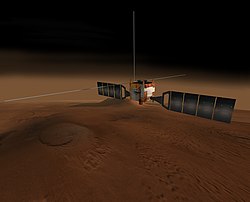


.jpg)
.png)


.jpg)


.png)
.png)


.jpg)
.jpg)
