



Community hub
Recent from talks
Knowledge base stats:
Talk channels stats:
Members stats:
Celtiberians
The Celtiberians were a group of Celts and Celticised peoples inhabiting an area in the central-northeastern Iberian Peninsula during the final centuries BC. They were explicitly mentioned as being Celts by several classic authors (e.g. Strabo). These tribes spoke the Celtiberian language and wrote it by adapting the Iberian alphabet, in the form of the Celtiberian script. The numerous inscriptions that have been discovered, some of them extensive, have enabled scholars to classify the Celtiberian language as a Celtic language, one of the Hispano-Celtic (also known as Iberian Celtic) languages that were spoken in pre-Roman and early Roman Iberia. Archaeologically, many elements link Celtiberians with Celts in Central Europe, but also show large differences with both the Hallstatt culture and La Tène culture.
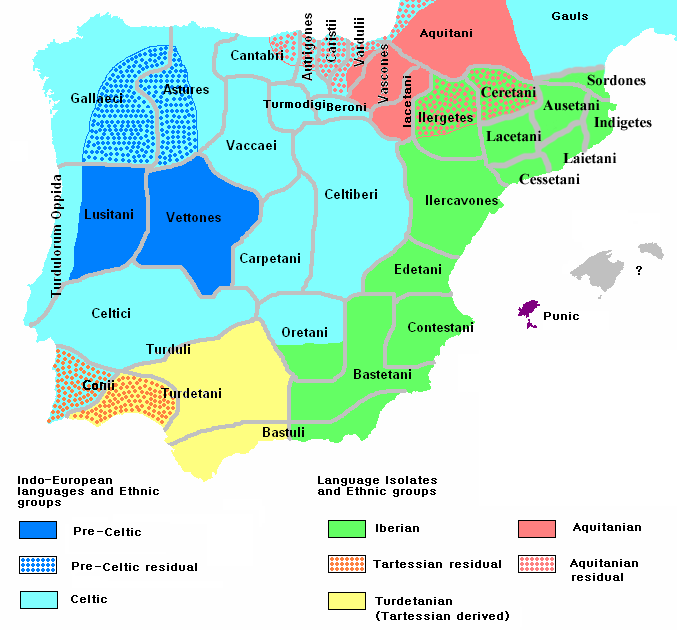
There is no complete agreement on the exact definition of Celtiberians among classical authors, nor modern scholars. The Ebro river clearly divides the Celtiberian areas from non-Indo-European speaking peoples. In other directions, the demarcation is less clear. Most scholars include the Arevaci, Pellendones, Belli, Titti and Lusones as Celtiberian tribes, and occasionally the Berones, Vaccaei, Carpetani, Olcades or Lobetani.
In 195 BC, part of Celtiberia was conquered by the Romans, and by 72 BC the entire region had become part of the Roman province of Hispania Citerior. The subjugated Celtiberians waged a protracted struggle against the Roman conquerors, staging uprisings in 195–193 BC, 181–179 BC, 153–151 BC, and 143–133 BC. In 105 BC, Celtiberian warriors drove the Germanic Cimbri from Spain in the Cimbrian War (113–101 BC) and also played an important role in the Sertorian War (80–72 BC).
The term Celtiberi appears in accounts by Diodorus Siculus, Appian and Martial who recognised intermarriage between Celts and Iberians after a period of continuous warfare, though Barry Cunliffe says "this has the ring of guesswork about it." Strabo just saw the Celtiberians as a branch of the Celti. Pliny the Elder thought that the original home of the Celts in Iberia was the territory of the Celtici in the south-west, on the grounds of an identity of sacred rites, language, and the names of cities.
Strabo cites Ephorus's belief that there were Celts in the Iberian peninsula as far as Cádiz.
Celtic presence in Iberia likely dates to as early as the 6th century BC, when the castros evinced a new permanence with stone walls and protective ditches. Archaeologists Martín Almagro Gorbea and Alberto José Lorrio Alvarado recognise the distinguishing iron tools and extended family social structure of developed Celtiberian culture as evolving from the archaic castro culture which they consider "proto-Celtic".
Archaeological finds identify the culture as continuous with the culture reported by Classical writers from the late 3rd century onwards (Almagro-Gorbea and Lorrio). The ethnic map of Celtiberia was highly localised however, composed of different tribes and nations from the 3rd century centered upon fortified oppida and representing a wide-ranging degree of local assimilation with the autochthonous cultures in a mixed Celtic and Iberian stock.
The cultural stronghold of Celtiberians was the northern area of the central meseta in the upper valleys of the Tagus and Douro east to the Iberus (Ebro) river, in the modern provinces of Soria, Guadalajara, Zaragoza and Teruel. There, when Greek and Roman geographers and historians encountered them, the established Celtiberians were controlled by a military aristocracy that had become a hereditary elite. The dominant tribe were the Arevaci, who dominated their neighbors from powerful strongholds at Okilis (Medinaceli) and who rallied the long Celtiberian resistance to Rome. Other Celtiberians were the Belli and Titti in the Jalón valley, and the Lusones to the east.
Hub AI
Celtiberians AI simulator
(@Celtiberians_simulator)
Celtiberians
The Celtiberians were a group of Celts and Celticised peoples inhabiting an area in the central-northeastern Iberian Peninsula during the final centuries BC. They were explicitly mentioned as being Celts by several classic authors (e.g. Strabo). These tribes spoke the Celtiberian language and wrote it by adapting the Iberian alphabet, in the form of the Celtiberian script. The numerous inscriptions that have been discovered, some of them extensive, have enabled scholars to classify the Celtiberian language as a Celtic language, one of the Hispano-Celtic (also known as Iberian Celtic) languages that were spoken in pre-Roman and early Roman Iberia. Archaeologically, many elements link Celtiberians with Celts in Central Europe, but also show large differences with both the Hallstatt culture and La Tène culture.
There is no complete agreement on the exact definition of Celtiberians among classical authors, nor modern scholars. The Ebro river clearly divides the Celtiberian areas from non-Indo-European speaking peoples. In other directions, the demarcation is less clear. Most scholars include the Arevaci, Pellendones, Belli, Titti and Lusones as Celtiberian tribes, and occasionally the Berones, Vaccaei, Carpetani, Olcades or Lobetani.
In 195 BC, part of Celtiberia was conquered by the Romans, and by 72 BC the entire region had become part of the Roman province of Hispania Citerior. The subjugated Celtiberians waged a protracted struggle against the Roman conquerors, staging uprisings in 195–193 BC, 181–179 BC, 153–151 BC, and 143–133 BC. In 105 BC, Celtiberian warriors drove the Germanic Cimbri from Spain in the Cimbrian War (113–101 BC) and also played an important role in the Sertorian War (80–72 BC).
The term Celtiberi appears in accounts by Diodorus Siculus, Appian and Martial who recognised intermarriage between Celts and Iberians after a period of continuous warfare, though Barry Cunliffe says "this has the ring of guesswork about it." Strabo just saw the Celtiberians as a branch of the Celti. Pliny the Elder thought that the original home of the Celts in Iberia was the territory of the Celtici in the south-west, on the grounds of an identity of sacred rites, language, and the names of cities.
Strabo cites Ephorus's belief that there were Celts in the Iberian peninsula as far as Cádiz.
Celtic presence in Iberia likely dates to as early as the 6th century BC, when the castros evinced a new permanence with stone walls and protective ditches. Archaeologists Martín Almagro Gorbea and Alberto José Lorrio Alvarado recognise the distinguishing iron tools and extended family social structure of developed Celtiberian culture as evolving from the archaic castro culture which they consider "proto-Celtic".
Archaeological finds identify the culture as continuous with the culture reported by Classical writers from the late 3rd century onwards (Almagro-Gorbea and Lorrio). The ethnic map of Celtiberia was highly localised however, composed of different tribes and nations from the 3rd century centered upon fortified oppida and representing a wide-ranging degree of local assimilation with the autochthonous cultures in a mixed Celtic and Iberian stock.
The cultural stronghold of Celtiberians was the northern area of the central meseta in the upper valleys of the Tagus and Douro east to the Iberus (Ebro) river, in the modern provinces of Soria, Guadalajara, Zaragoza and Teruel. There, when Greek and Roman geographers and historians encountered them, the established Celtiberians were controlled by a military aristocracy that had become a hereditary elite. The dominant tribe were the Arevaci, who dominated their neighbors from powerful strongholds at Okilis (Medinaceli) and who rallied the long Celtiberian resistance to Rome. Other Celtiberians were the Belli and Titti in the Jalón valley, and the Lusones to the east.