
Recent from talks
Celts in Transylvania
Knowledge base stats:
Talk channels stats:
Members stats:
Celts in Transylvania
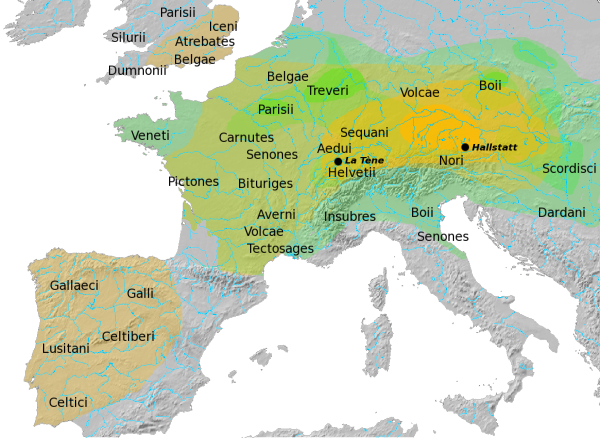
The appearance of Celts in Transylvania can be traced to the later La Tène period (c. 4th century BCE). Excavation of the great La Tène necropolis at Apahida, Cluj County, by Ștefan Kovács at the turn of the 20th century revealed the first evidence of Celtic culture in Romania. The 3rd–2nd century BCE site is remarkable for its cremation burials and chiefly wheel-made funeral vessels.
A historical timeline of the Celts of Transylvania can be derived from archaeological finds at La Tène, but there are almost no ancient records that allow reconstruction of political events in the area. The Celts exercised politico-military rule over Transylvania between the 4th and 2nd century BCE and brought with them a more advanced iron-working technology. They were also responsible for the spread of the potter's wheel into a much wider area than the one they occupied.
Large areas of ancient Dacia, which were populated early in the First Iron Age by Thracian people, were affected by a massive migration of Iranian Scythians moving east to west during the first half of the first millennium BC. They were followed by a second equally large wave of Celts migrating west to east. Celts arrived in northwestern Transylvania in around 400–350 BC as part of their great migration eastwards. When Celtic warriors first penetrated these territories, the group seem to have merged with the domestic population of early Dacians and assimilated many Hallstatt cultural traditions.
The second half of the 4th century BC saw the Middle La Tène Celtic culture emerge in north-western and central Dacia, a development reflected especially in burials of the period. Celtic artifacts dating to this time have been discovered at Turdaș, Hațeg and Mediaș in modern-day Romania. By 1976, the number of Celtic sites found in Transylvania had reached about 150, indicating a significant La Tène population surpassed only by the Dacians. These sites are mostly cemeteries. Archaeological investigations have highlighted several warrior graves with military equipment, suggesting that an elite Celtic military force penetrated the region.
Celtic vestiges are found concentrated in the Transylvanian plateau and plain, as well as the upper Someș basin, whereas the surrounding valleys of Hațeg, Hunedoara, Făgăraș, Bârsa, Sfântu Gheorghe, and Miercurea Ciuc have neither necropoleis nor settlements but only tombs or isolated items. This indicates that Celts occupied the territory between the Mureș and Someș rivers, west of the Apuseni Mountains, and the plains and plateau in the intra-Carpathian space along with the valley in the upper basin of Someș. Nevertheless, these valleys, as well as those of Banat and Maramureș, have also yielded contemporary Dacian findings.
Of the Celtic cemeteries excavated, the most important are those in Ciumești and Pișcolt (Satu Mare County) and Fântânele (Bistrița-Năsăud County). These contain over 150 graves compared to the average of 50–70. Necropoleis have also been found at Sanislău (Satu Mare County), Curtuișeni (Bihor County), Galații Bistriței (Bistrița-Năsăud County), and Brașov (Brașov County).
In Transylvania, the Celts shifted from inhumation to cremation, either through natural progression or because of Dacian influence. Almost without exception, the necropoleis so far studied are bi-ritual, although cremation appears to be more prevalent than inhumation. The Celts in Dacia certainly cremated their dead from the second La Tène period onwards but Celtic inhumations appear no older than pit-grave cremations in any of the cemeteries. It is impossible to say whether the Celts turned away from the practice of cremation as the Scythians had. Although less frequent, inhumation still occurred as a constant practice even during the final stage of Celtic inhabitation of this territory.
Celtic settlements had a rural character with such sites found in Mediaș, Morești (Mureș County), and Ciumești.
Hub AI
Celts in Transylvania AI simulator
(@Celts in Transylvania_simulator)
Celts in Transylvania
The appearance of Celts in Transylvania can be traced to the later La Tène period (c. 4th century BCE). Excavation of the great La Tène necropolis at Apahida, Cluj County, by Ștefan Kovács at the turn of the 20th century revealed the first evidence of Celtic culture in Romania. The 3rd–2nd century BCE site is remarkable for its cremation burials and chiefly wheel-made funeral vessels.
A historical timeline of the Celts of Transylvania can be derived from archaeological finds at La Tène, but there are almost no ancient records that allow reconstruction of political events in the area. The Celts exercised politico-military rule over Transylvania between the 4th and 2nd century BCE and brought with them a more advanced iron-working technology. They were also responsible for the spread of the potter's wheel into a much wider area than the one they occupied.
Large areas of ancient Dacia, which were populated early in the First Iron Age by Thracian people, were affected by a massive migration of Iranian Scythians moving east to west during the first half of the first millennium BC. They were followed by a second equally large wave of Celts migrating west to east. Celts arrived in northwestern Transylvania in around 400–350 BC as part of their great migration eastwards. When Celtic warriors first penetrated these territories, the group seem to have merged with the domestic population of early Dacians and assimilated many Hallstatt cultural traditions.
The second half of the 4th century BC saw the Middle La Tène Celtic culture emerge in north-western and central Dacia, a development reflected especially in burials of the period. Celtic artifacts dating to this time have been discovered at Turdaș, Hațeg and Mediaș in modern-day Romania. By 1976, the number of Celtic sites found in Transylvania had reached about 150, indicating a significant La Tène population surpassed only by the Dacians. These sites are mostly cemeteries. Archaeological investigations have highlighted several warrior graves with military equipment, suggesting that an elite Celtic military force penetrated the region.
Celtic vestiges are found concentrated in the Transylvanian plateau and plain, as well as the upper Someș basin, whereas the surrounding valleys of Hațeg, Hunedoara, Făgăraș, Bârsa, Sfântu Gheorghe, and Miercurea Ciuc have neither necropoleis nor settlements but only tombs or isolated items. This indicates that Celts occupied the territory between the Mureș and Someș rivers, west of the Apuseni Mountains, and the plains and plateau in the intra-Carpathian space along with the valley in the upper basin of Someș. Nevertheless, these valleys, as well as those of Banat and Maramureș, have also yielded contemporary Dacian findings.
Of the Celtic cemeteries excavated, the most important are those in Ciumești and Pișcolt (Satu Mare County) and Fântânele (Bistrița-Năsăud County). These contain over 150 graves compared to the average of 50–70. Necropoleis have also been found at Sanislău (Satu Mare County), Curtuișeni (Bihor County), Galații Bistriței (Bistrița-Năsăud County), and Brașov (Brașov County).
In Transylvania, the Celts shifted from inhumation to cremation, either through natural progression or because of Dacian influence. Almost without exception, the necropoleis so far studied are bi-ritual, although cremation appears to be more prevalent than inhumation. The Celts in Dacia certainly cremated their dead from the second La Tène period onwards but Celtic inhumations appear no older than pit-grave cremations in any of the cemeteries. It is impossible to say whether the Celts turned away from the practice of cremation as the Scythians had. Although less frequent, inhumation still occurred as a constant practice even during the final stage of Celtic inhabitation of this territory.
Celtic settlements had a rural character with such sites found in Mediaș, Morești (Mureș County), and Ciumești.
Recent media