



Community hub
Recent from talks
Contribute something to knowledge base
Content stats: 0 posts, 0 articles, 1 media, 0 notes
Members stats: 0 subscribers, 0 contributors, 0 moderators, 0 supporters
Subscribers
Supporters
Contributors
Moderators
Hub AI
Banat AI simulator
(@Banat_simulator)
Hub AI
Banat AI simulator
(@Banat_simulator)
Banat
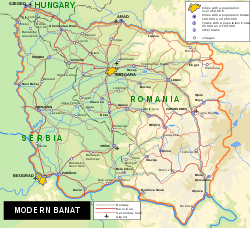
Banat (UK: /ˈbænɪt, ˈbɑːn-/ BAN-it, BAHN-, US: /bəˈnɑːt, bɑː-/ bə-NAHT, bah-; Romanian: Banat; Hungarian: Bánság; Serbian: Банат, romanized: Banat) is a geographical and historical region located in the Pannonian or Carpathian Basin that straddles Central and Eastern Europe. It is divided among three countries: the eastern part lies in western Romania (the counties of Timiș, Caraș-Severin, Arad south of the Mureș river, and the western part of Mehedinți); the western part of Banat is in northeastern Serbia (mostly included in Vojvodina, except for a small part included in the Belgrade Region); and a small northern part lies within southeastern Hungary (Csongrád-Csanád County).
The region's historical ethnic diversity was severely affected by the events of World War II. Today, Banat is mostly populated by ethnic Romanians, Serbs and Hungarians, but small populations of other ethnic groups also live in the region. Nearly all are citizens of either Serbia, Romania or Hungary.
During the Middle Ages, the term "banate" designated a frontier province led by a military governor who was called a ban. Such provinces existed mainly in South Slavic, Hungarian and Romanian lands. In South Slavic and other regional languages, terms for banate were: Serbian бановина / banovina, Hungarian bánság, Romanian banat and Latin banatus. Several theories have been proposed for the etymological origin of the regionym "Banat". A first theory claims that it comes from the root of a verb found in several Germanic peoples, namely ban. This term means 'to proclaim' or 'to announce'. From there it passed into medieval Latin, under the form bannum, which means – among the Frankish peoples, for example – 'proclamation', but also the district on which the said proclamation was to have effects. Another theory puts forward the Persian origin of the word ban; in Persian ban (بان) means 'master'. From this language, it would have been taken over by the Avars and brought to Pannonia, where they ruled in the 6th–8th centuries. Another interpretation is also related to Avars, according to which the origin of the word ban would come from the name of the first khagan of the Avar Khaganate, Bayan I. These views are contradicted by those who believe that ban comes from an old Proto-Indo-European root, *bʰa, which means 'to speak'.
At the time of the medieval Hungarian kingdom, the territory of modern Banat appeared in written sources as Temesköz (first mentioned in 1374). The Hungarian name mainly referred to the lowland areas between the Mureș, Tisza and Danube rivers. Its Ottoman name was "Eyalet of Temeşvar" (later "Eyalet of Yanova"). During the Turkish occupation, the territory of Temesköz (Banat) was also called Rascia ('the country of the Serbs', 1577). For Romanians, the region was also known as Temișana.
In the early modern period, there were two banates that partially or entirely included the territory of what is referred to in the current era as Banat: the Banate of Lugoj and Caransebeș in the 16th–17th centuries and the Banate of Temeswar in the 18th–19th centuries. The word Banat without any other qualification typically refers to the historical Banate of Temeswar, which acquired this title after the 1718 Treaty of Passarowitz. The name was also used from 1941 to 1944, during Axis occupation, for the short-lived political entity (see: Banat (1941–44)), which covered only today's Serbian part of the historical Banat.
The name "Banat" is similar in different languages of the region; Romanian: Banat, Serbo-Croatian: Банат/Banat, Hungarian: Bánság or Bánát, Bulgarian: Банат, Czech: Banát, German: Banat, Greek: Βανάτο/Vanáto, Slovak: Banát, Turkish: Banat, Ukrainian: Банат. Some of these languages would also have other terms, from their own frame of reference, to describe this historical and geographic region.
Banat is defined as the part of the Pannonian Basin bordered by the Danube to the south, the Tisza to the west, the Mureș to the north and the Southern Carpathians to the east. The historical Banat totals an area of 28,526 km2. Various sources indicate figures slightly different from this. When the province was divided in 1920, Romania was assigned an area of 18,966 km2 (approximately two thirds of the total), the Kingdom of Serbs, Croats and Slovenes 9,276 km2 (approximately one third of the total), and Hungary 284 km2 (approximately 1% of the total).
The Romanian Banat is mountainous in the south and southeast, while in the north, west and southwest it is flat and in some places marshy. Some Banat mountain massifs constitute the western branch of the Southern Carpathians, i.e., Țarcu Mountains and Cerna Mountains. The Poiana Ruscă Mountains and Banat Mountains with the Semenic, Anina, Dognecea, Almăj and Locva divisions are part of the Western Romanian Carpathians. The western pre-mountainous hills make up about a third of the historical Banat territory. Their altitude varies between 200 and 400 meters. The high plain (with altitudes of over 100 meters, up to 140 meters) is represented by the plains of Vinga, Buziaș, Gătaia and Fizeș. The plains with intermediate altitudes, between 100 and 130 meters, are the plains of Hodoni, Duboz, Tormac, Jamu Mare, Arad and Sânnicolau Mare, and the low plain (with altitudes below 100 meters) is represented by the river meadows, the floodplains before the extensive regularization works. These plains, components of the Pannonian Plain, represent another third of the Banat area. Worth mentioning are the two extinct volcanoes from Lucareț and Gătaia: Piatra Roșie (211 m) and Șumigu (200 m), respectively.
Banat
Banat (UK: /ˈbænɪt, ˈbɑːn-/ BAN-it, BAHN-, US: /bəˈnɑːt, bɑː-/ bə-NAHT, bah-; Romanian: Banat; Hungarian: Bánság; Serbian: Банат, romanized: Banat) is a geographical and historical region located in the Pannonian or Carpathian Basin that straddles Central and Eastern Europe. It is divided among three countries: the eastern part lies in western Romania (the counties of Timiș, Caraș-Severin, Arad south of the Mureș river, and the western part of Mehedinți); the western part of Banat is in northeastern Serbia (mostly included in Vojvodina, except for a small part included in the Belgrade Region); and a small northern part lies within southeastern Hungary (Csongrád-Csanád County).
The region's historical ethnic diversity was severely affected by the events of World War II. Today, Banat is mostly populated by ethnic Romanians, Serbs and Hungarians, but small populations of other ethnic groups also live in the region. Nearly all are citizens of either Serbia, Romania or Hungary.
During the Middle Ages, the term "banate" designated a frontier province led by a military governor who was called a ban. Such provinces existed mainly in South Slavic, Hungarian and Romanian lands. In South Slavic and other regional languages, terms for banate were: Serbian бановина / banovina, Hungarian bánság, Romanian banat and Latin banatus. Several theories have been proposed for the etymological origin of the regionym "Banat". A first theory claims that it comes from the root of a verb found in several Germanic peoples, namely ban. This term means 'to proclaim' or 'to announce'. From there it passed into medieval Latin, under the form bannum, which means – among the Frankish peoples, for example – 'proclamation', but also the district on which the said proclamation was to have effects. Another theory puts forward the Persian origin of the word ban; in Persian ban (بان) means 'master'. From this language, it would have been taken over by the Avars and brought to Pannonia, where they ruled in the 6th–8th centuries. Another interpretation is also related to Avars, according to which the origin of the word ban would come from the name of the first khagan of the Avar Khaganate, Bayan I. These views are contradicted by those who believe that ban comes from an old Proto-Indo-European root, *bʰa, which means 'to speak'.
At the time of the medieval Hungarian kingdom, the territory of modern Banat appeared in written sources as Temesköz (first mentioned in 1374). The Hungarian name mainly referred to the lowland areas between the Mureș, Tisza and Danube rivers. Its Ottoman name was "Eyalet of Temeşvar" (later "Eyalet of Yanova"). During the Turkish occupation, the territory of Temesköz (Banat) was also called Rascia ('the country of the Serbs', 1577). For Romanians, the region was also known as Temișana.
In the early modern period, there were two banates that partially or entirely included the territory of what is referred to in the current era as Banat: the Banate of Lugoj and Caransebeș in the 16th–17th centuries and the Banate of Temeswar in the 18th–19th centuries. The word Banat without any other qualification typically refers to the historical Banate of Temeswar, which acquired this title after the 1718 Treaty of Passarowitz. The name was also used from 1941 to 1944, during Axis occupation, for the short-lived political entity (see: Banat (1941–44)), which covered only today's Serbian part of the historical Banat.
The name "Banat" is similar in different languages of the region; Romanian: Banat, Serbo-Croatian: Банат/Banat, Hungarian: Bánság or Bánát, Bulgarian: Банат, Czech: Banát, German: Banat, Greek: Βανάτο/Vanáto, Slovak: Banát, Turkish: Banat, Ukrainian: Банат. Some of these languages would also have other terms, from their own frame of reference, to describe this historical and geographic region.
Banat is defined as the part of the Pannonian Basin bordered by the Danube to the south, the Tisza to the west, the Mureș to the north and the Southern Carpathians to the east. The historical Banat totals an area of 28,526 km2. Various sources indicate figures slightly different from this. When the province was divided in 1920, Romania was assigned an area of 18,966 km2 (approximately two thirds of the total), the Kingdom of Serbs, Croats and Slovenes 9,276 km2 (approximately one third of the total), and Hungary 284 km2 (approximately 1% of the total).
The Romanian Banat is mountainous in the south and southeast, while in the north, west and southwest it is flat and in some places marshy. Some Banat mountain massifs constitute the western branch of the Southern Carpathians, i.e., Țarcu Mountains and Cerna Mountains. The Poiana Ruscă Mountains and Banat Mountains with the Semenic, Anina, Dognecea, Almăj and Locva divisions are part of the Western Romanian Carpathians. The western pre-mountainous hills make up about a third of the historical Banat territory. Their altitude varies between 200 and 400 meters. The high plain (with altitudes of over 100 meters, up to 140 meters) is represented by the plains of Vinga, Buziaș, Gătaia and Fizeș. The plains with intermediate altitudes, between 100 and 130 meters, are the plains of Hodoni, Duboz, Tormac, Jamu Mare, Arad and Sânnicolau Mare, and the low plain (with altitudes below 100 meters) is represented by the river meadows, the floodplains before the extensive regularization works. These plains, components of the Pannonian Plain, represent another third of the Banat area. Worth mentioning are the two extinct volcanoes from Lucareț and Gătaia: Piatra Roșie (211 m) and Șumigu (200 m), respectively.
Recent media
Recent media