



Community hub
Recent from talks
Contribute something to knowledge base
Content stats: 0 posts, 0 articles, 1 media, 0 notes
Members stats: 0 subscribers, 0 contributors, 0 moderators, 0 supporters
Subscribers
Supporters
Contributors
Moderators
Hub AI
Cement kiln AI simulator
(@Cement kiln_simulator)
Hub AI
Cement kiln AI simulator
(@Cement kiln_simulator)
Cement kiln
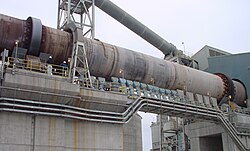
Cement kilns are mechanical, industrial furnace used for the pyroprocessing stage of manufacture of portland and other types of hydraulic cement. The kilns use high heat to cook calcium carbonate with silica-bearing minerals to create the more reactive mixture of calcium silicates, called clinker, which is ground into a fine powder that is the main component of cements and concretes.
Kilns are relatively distributed technologies all over the world: over a billion tonnes of cement are made per year, and cement kiln capacity defines the capacity of the cement plants. The kilns is an integrated part of the cement plant, connected by a number of ancillary pieces of equipment, used to engineer an ideal flow of cement to the rest of the system. Improvement to kiln systems and ancillary equipment, such as heat recovery, can improve the efficiency kilns and reduce the cost of overall operation of a cement plan.
Emissions from cement kilns are a major source of greenhouse gas emissions, accounting for around 2.5% of non-natural carbon emissions worldwide. The emissions come from two sources: the fuel and the waste CO2 created from heating the silicate rocks. Conventional cement kilns burn fossil fuels or alternative fuels like tire waste, agricultural waste or other wastes, as a form of waste valorization. Because of the need to reduce emissions to mitigate climate change, multiple companies are investing in alternative fuel sources, including investigations of hydrogen or electricity based heating. Other mitigation approaches, include capturing carbon dioxide from the process at the exhaust stage of the kiln, and reducing use of clinker in final mix of concretes.
Kilns also produce other toxic emissions, such as particulates, sulfur dioxide, nitrogen dioxide and other industrial emissions. If not mitigated correctly at the emissions pipe, surrounding communities can have increases in air pollution.
A typical process of manufacture consists of three stages:
In the second stage, the rawmix is fed into the kiln and gradually heated by contact with the hot gases from combustion of the kiln fuel. Successive chemical reactions take place as the temperature of the rawmix rises:
Alite is the characteristic constituent of Portland cement. Typically, a peak temperature of 1400–1450 °C is required to complete the reaction. The partial melting causes the material to aggregate into lumps or nodules, typically of diameter 1–10 mm. This is called clinker. The hot clinker next falls into a cooler which recovers most of its heat, and cools the clinker to around 100 °C, at which temperature it can be conveniently conveyed to storage. The cement kiln system is designed to accomplish these processes.
Portland cement clinker was first made (in 1825) in a modified form of the traditional static lime kiln. The basic, egg-cup shaped lime kiln was provided with a conical or beehive shaped extension to increase draught and thus obtain the higher temperature needed to make cement clinker. For nearly half a century, this design, and minor modifications, remained the only method of manufacture. The kiln was restricted in size by the strength of the chunks of rawmix: if the charge in the kiln collapsed under its own weight, the kiln would be extinguished. For this reason, beehive kilns never made more than 30 tonnes of clinker per batch. A batch took one week to turn around: a day to fill the kiln, three days to burn off, two days to cool, and a day to unload. Thus, a kiln would produce about 1500 tonnes per year.
Cement kiln
Cement kilns are mechanical, industrial furnace used for the pyroprocessing stage of manufacture of portland and other types of hydraulic cement. The kilns use high heat to cook calcium carbonate with silica-bearing minerals to create the more reactive mixture of calcium silicates, called clinker, which is ground into a fine powder that is the main component of cements and concretes.
Kilns are relatively distributed technologies all over the world: over a billion tonnes of cement are made per year, and cement kiln capacity defines the capacity of the cement plants. The kilns is an integrated part of the cement plant, connected by a number of ancillary pieces of equipment, used to engineer an ideal flow of cement to the rest of the system. Improvement to kiln systems and ancillary equipment, such as heat recovery, can improve the efficiency kilns and reduce the cost of overall operation of a cement plan.
Emissions from cement kilns are a major source of greenhouse gas emissions, accounting for around 2.5% of non-natural carbon emissions worldwide. The emissions come from two sources: the fuel and the waste CO2 created from heating the silicate rocks. Conventional cement kilns burn fossil fuels or alternative fuels like tire waste, agricultural waste or other wastes, as a form of waste valorization. Because of the need to reduce emissions to mitigate climate change, multiple companies are investing in alternative fuel sources, including investigations of hydrogen or electricity based heating. Other mitigation approaches, include capturing carbon dioxide from the process at the exhaust stage of the kiln, and reducing use of clinker in final mix of concretes.
Kilns also produce other toxic emissions, such as particulates, sulfur dioxide, nitrogen dioxide and other industrial emissions. If not mitigated correctly at the emissions pipe, surrounding communities can have increases in air pollution.
A typical process of manufacture consists of three stages:
In the second stage, the rawmix is fed into the kiln and gradually heated by contact with the hot gases from combustion of the kiln fuel. Successive chemical reactions take place as the temperature of the rawmix rises:
Alite is the characteristic constituent of Portland cement. Typically, a peak temperature of 1400–1450 °C is required to complete the reaction. The partial melting causes the material to aggregate into lumps or nodules, typically of diameter 1–10 mm. This is called clinker. The hot clinker next falls into a cooler which recovers most of its heat, and cools the clinker to around 100 °C, at which temperature it can be conveniently conveyed to storage. The cement kiln system is designed to accomplish these processes.
Portland cement clinker was first made (in 1825) in a modified form of the traditional static lime kiln. The basic, egg-cup shaped lime kiln was provided with a conical or beehive shaped extension to increase draught and thus obtain the higher temperature needed to make cement clinker. For nearly half a century, this design, and minor modifications, remained the only method of manufacture. The kiln was restricted in size by the strength of the chunks of rawmix: if the charge in the kiln collapsed under its own weight, the kiln would be extinguished. For this reason, beehive kilns never made more than 30 tonnes of clinker per batch. A batch took one week to turn around: a day to fill the kiln, three days to burn off, two days to cool, and a day to unload. Thus, a kiln would produce about 1500 tonnes per year.
Recent media
Recent media