



Community hub
Recent from talks
Contribute something to knowledge base
Content stats: 0 posts, 0 articles, 1 media, 0 notes
Members stats: 0 subscribers, 0 contributors, 0 moderators, 0 supporters
Subscribers
Supporters
Contributors
Moderators
Hub AI
Central Eastern Alps AI simulator
(@Central Eastern Alps_simulator)
Hub AI
Central Eastern Alps AI simulator
(@Central Eastern Alps_simulator)
Central Eastern Alps
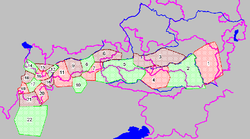
The Central Eastern Alps (German: Zentralalpen or Zentrale Ostalpen), also referred to as Austrian Central Alps (German: Österreichische Zentralalpen) or just Central Alps, comprise the main chain of the Eastern Alps in Austria and the adjacent regions of Switzerland, Liechtenstein, Italy and Slovenia. South of them is the Southern Limestone Alps.
The term "Central Alps" is very common in the Geography of Austria as one of the seven major landscape regions of the country. "Central Eastern Alps" is usually used in connection with the Alpine Club classification of the Eastern Alps (Alpenvereinseinteilung, AVE). The Central Alps form the eastern part of the Alpine divide, its central chain of mountains, as well as those ranges that extend or accompany it to the north and south.
The highest mountain in the Austrian Central Alps is Grossglockner at 3,798 metres (12,461 ft).
The Central Alps have the highest peaks of the Eastern Alps, and are located between the Northern Limestone Alps and the Southern Limestone Alps, from which they differ in geological composition.
The term "Central Eastern Alps" may also be used more broadly to refer to a larger area of the Eastern Alps, mainly located in Austria, extending from the foot of the Bergamasque Alps at Lake Como and the Bernina Range in the Graubünden canton of eastern Switzerland along the Liechtenstein shore of the Rhine in the west as far as to the lower promontories east of the river Mur including the Hochwechsel in Austrian Styria. The valleys of the rivers Inn, Salzach and Enns mark their northern boundary, the Drau river (roughly corresponding to the Periadriatic Seam) their southern border. In the proposed SOIUSA system, the "Central-eastern Alps" include the Rhaetian Alps, of which the Bernina Range includes the 4,049-meter Piz Bernina in Switzerland, the easternmost 4,000-meter peak of the Alps. In the AVE system, however, the full list of mountain groups in the Alpine Club classification of the Eastern Alps includes the Bernina and neighboring ranges within the Western Limestone Alps, not the Central Eastern Alps as the Alpine Club defines them.
In Austria, the Eastern Alps are divided into the Northern Alps, the Greywacke zone, the Central Alps and the Southern Alps. The latter lie partly in South Carinthia, but mainly in Northeast Italy.
The Central and Northern Alps are separated by the Northern Longitudinal Trough (nördliche Längstalfurche), the line Klostertal–Arlberg–Inn Valley–Salzach Valley as far as Lake Zell–Wagrain Heights–Upper Enns Valley–Schober Pass–Mürz Valley Alps–Semmering–southern Vienna Basin. The Central Alps and Southern Alps are separated from one another by the Southern Longitudinal Valley (südlichen Längstalzug) Puster Valley (Rienz Valle–Toblach Field–upper Drava (Drau) Valley)–Drava Valley–Klagenfurt Basin–Meža (Mieß), or the Periadriatic Seam, which is not entirely identical with the Southern Longitudinal Trough.
The range has the highest summits in the Eastern Alps and is the most glaciated. In the transition zone between the East and West Alps, its peaks clearly dominate the region to the west (Piz d'Err, Piz Roseg). On the perimeter, however, there are also less high, often less rugged mountain chains, like the Gurktal Alps and the eastern foothills.
Central Eastern Alps
The Central Eastern Alps (German: Zentralalpen or Zentrale Ostalpen), also referred to as Austrian Central Alps (German: Österreichische Zentralalpen) or just Central Alps, comprise the main chain of the Eastern Alps in Austria and the adjacent regions of Switzerland, Liechtenstein, Italy and Slovenia. South of them is the Southern Limestone Alps.
The term "Central Alps" is very common in the Geography of Austria as one of the seven major landscape regions of the country. "Central Eastern Alps" is usually used in connection with the Alpine Club classification of the Eastern Alps (Alpenvereinseinteilung, AVE). The Central Alps form the eastern part of the Alpine divide, its central chain of mountains, as well as those ranges that extend or accompany it to the north and south.
The highest mountain in the Austrian Central Alps is Grossglockner at 3,798 metres (12,461 ft).
The Central Alps have the highest peaks of the Eastern Alps, and are located between the Northern Limestone Alps and the Southern Limestone Alps, from which they differ in geological composition.
The term "Central Eastern Alps" may also be used more broadly to refer to a larger area of the Eastern Alps, mainly located in Austria, extending from the foot of the Bergamasque Alps at Lake Como and the Bernina Range in the Graubünden canton of eastern Switzerland along the Liechtenstein shore of the Rhine in the west as far as to the lower promontories east of the river Mur including the Hochwechsel in Austrian Styria. The valleys of the rivers Inn, Salzach and Enns mark their northern boundary, the Drau river (roughly corresponding to the Periadriatic Seam) their southern border. In the proposed SOIUSA system, the "Central-eastern Alps" include the Rhaetian Alps, of which the Bernina Range includes the 4,049-meter Piz Bernina in Switzerland, the easternmost 4,000-meter peak of the Alps. In the AVE system, however, the full list of mountain groups in the Alpine Club classification of the Eastern Alps includes the Bernina and neighboring ranges within the Western Limestone Alps, not the Central Eastern Alps as the Alpine Club defines them.
In Austria, the Eastern Alps are divided into the Northern Alps, the Greywacke zone, the Central Alps and the Southern Alps. The latter lie partly in South Carinthia, but mainly in Northeast Italy.
The Central and Northern Alps are separated by the Northern Longitudinal Trough (nördliche Längstalfurche), the line Klostertal–Arlberg–Inn Valley–Salzach Valley as far as Lake Zell–Wagrain Heights–Upper Enns Valley–Schober Pass–Mürz Valley Alps–Semmering–southern Vienna Basin. The Central Alps and Southern Alps are separated from one another by the Southern Longitudinal Valley (südlichen Längstalzug) Puster Valley (Rienz Valle–Toblach Field–upper Drava (Drau) Valley)–Drava Valley–Klagenfurt Basin–Meža (Mieß), or the Periadriatic Seam, which is not entirely identical with the Southern Longitudinal Trough.
The range has the highest summits in the Eastern Alps and is the most glaciated. In the transition zone between the East and West Alps, its peaks clearly dominate the region to the west (Piz d'Err, Piz Roseg). On the perimeter, however, there are also less high, often less rugged mountain chains, like the Gurktal Alps and the eastern foothills.
Recent media
Recent media