



Community hub
Recent from talks
Knowledge base stats:
Talk channels stats:
Members stats:
Central London Railway
The Central London Railway (CLR), also known as the Twopenny Tube, was a deep-level, underground "tube" railway that opened in London in 1900. The CLR's tunnels and stations form the central section of what became London Underground's Central line.
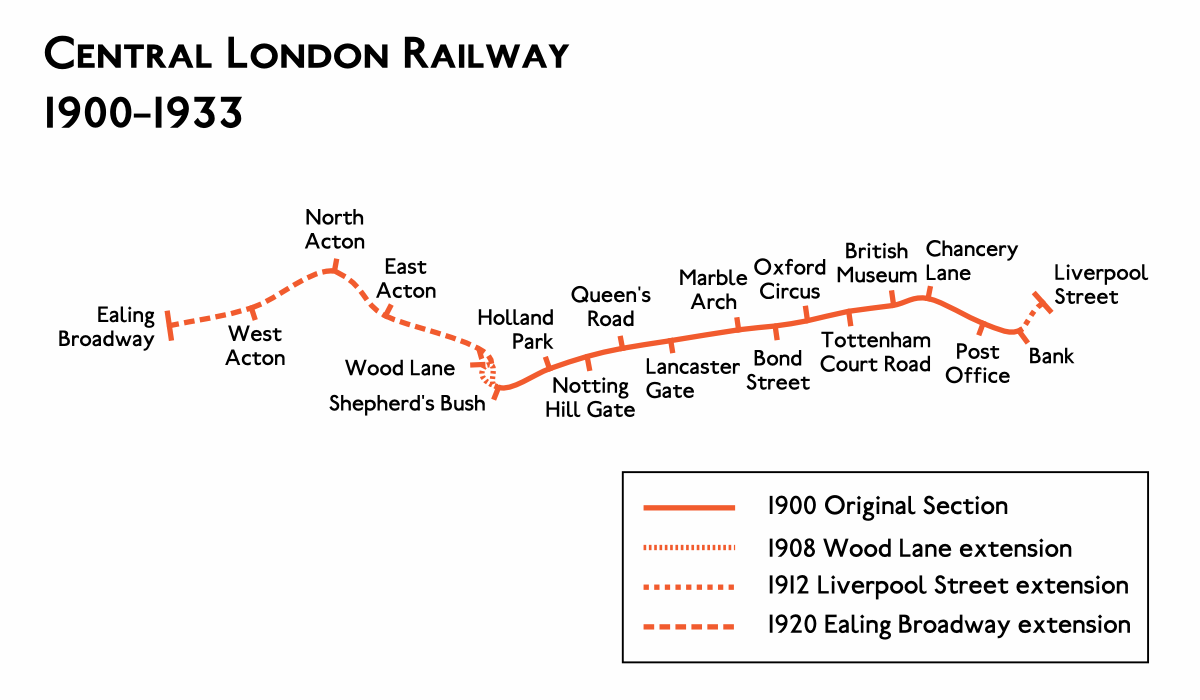
The railway company was established in 1889, funding for construction was obtained in 1895 through a syndicate of financiers and work took place from 1896 to 1900. When opened, the CLR served 13 stations and ran completely underground in a pair of tunnels for 9.14 kilometres (5.68 mi) between its western terminus at Shepherd's Bush and its eastern terminus at the Bank of England, with a depot and power station to the north of the western terminus. After a rejected proposal to turn the line into a loop, it was extended at the western end to Wood Lane in 1908 and at the eastern end to Liverpool Street station in 1912. In 1920, it was extended along a Great Western Railway line to Ealing to serve a total distance of 17.57 kilometres (10.92 mi).
After initially making good returns for investors, the CLR suffered a decline in passenger numbers due to increased competition from other underground railway lines and new motorised buses. In 1913, it was taken over by the Underground Electric Railways Company of London (UERL), operator of the majority of London's underground railways. In 1933 the CLR was taken into public ownership along with the UERL.
In November 1889, the CLR published a notice of a private bill that would be presented to Parliament for the 1890 parliamentary session. The bill proposed an underground electric railway running from the junction of Queen's Road (now Queensway) and Bayswater Road in Bayswater to King William Street in the City of London with a connection to the then-under construction, City and South London Railway (C&SLR) at Arthur Street West. The CLR was to run in a pair of tunnels under Bayswater Road, Oxford Street, New Oxford Street, High Holborn, Holborn, Holborn Viaduct, Newgate Street, Cheapside, and Poultry. Stations were planned at Queen's Road, Stanhope Terrace, Marble Arch, Oxford Circus, Tottenham Court Road, Southampton Row, Holborn Circus, St. Martin's Le Grand and King William Street.
The tunnels were to be 11 feet (3.35 m) in diameter, constructed with a tunnelling shield, and would be lined with cast iron segments. At stations, the tunnel diameter would be 22 feet (6.71 m) or 29 feet (8.84 m) depending on layout. A depot and power station were to be constructed on a 1.5-acre (0.61 ha) site on the west side of Queen's Road. Hydraulic lifts from the street to the platforms were to be provided at each station.
The proposals faced strong objections from the Metropolitan and District railways (MR and DR) whose routes on the Inner Circle, to the north and the south respectively, the CLR route paralleled; and from which the new line was expected to take passengers. The City Corporation also objected, concerned about potential damage to buildings close to the route caused by subsidence as was experienced during the construction of the C&SLR. The Dean and Chapter of St Paul's Cathedral objected, concerned about the risks of undermining the cathedral's foundations. Sir Joseph Bazalgette objected that the tunnels would damage the city's sewer system. The bill was approved by the House of Commons, but was rejected by the House of Lords, which recommended that any decision be postponed until after the C&SLR had opened and its operation could be assessed.
In November 1890, with the C&SLR about to start operating, the CLR announced a new bill for the 1891 parliamentary session. The route was extended at the western end to run under Notting Hill High Street (now Notting Hill Gate) and Holland Park Avenue to end at the eastern corner of Shepherd's Bush Green, with the depot and power station site relocated to be north of the terminus on the east side of Wood Lane. The westward extension of the route was inspired by the route of abandoned plans for the London Central Subway, a sub-surface railway that was briefly proposed in early 1890 to run directly below the roadway on a similar route to the CLR. The eastern terminus was changed to Cornhill and the proposed Southampton Row station was replaced by one in Bloomsbury. Intermediate stations were added at Lansdowne Road, Notting Hill Gate, Davies Street (which the CLR planned to extend northwards to meet Oxford Street) and at Chancery Lane. The earlier plan to connect to the C&SLR was dropped and the diameter of the CLR's tunnels was increased to 11 feet 6 inches (3.51 m). This time the bill was approved by both Houses of Parliament and received royal assent on 5 August 1891 as the Central London Railway Act 1891 (54 & 55 Vict. c. cxcvi). In November 1891, the CLR publicised another bill. The eastern end of the line was re-routed north-east and extended to end under the Great Eastern Railway's (GER's) terminus at Liverpool Street station with the Cornhill terminus dropped and a new station proposed at the Royal Exchange. The proposals received assent as the Central London Railway Act 1892 (55 & 56 Vict. c. ccxli) on 28 June 1892.
The money to build the CLR was obtained through a syndicate of financiers including Ernest Cassel, Henry Oppenheim, Darius Ogden Mills, and members of the Rothschild family. On 22 March 1894, the syndicate incorporated a contractor to construct the railway, the Electric Traction Company Limited (ETCL), which agreed a construction cost of £2,544,000 (approximately £366 million today) plus £700,000 in 4 per cent debenture stock. When the syndicate offered 285,000 CLR company shares for sale at £10 each in June 1895, only 14 per cent was bought by the British public, which was cautious of such investments following failures of similar railway schemes. Some shares were sold in Europe and the United States, but the unsold remainder was bought by members of the syndicate or by the ETCL.
Hub AI
Central London Railway AI simulator
(@Central London Railway_simulator)
Central London Railway
The Central London Railway (CLR), also known as the Twopenny Tube, was a deep-level, underground "tube" railway that opened in London in 1900. The CLR's tunnels and stations form the central section of what became London Underground's Central line.
The railway company was established in 1889, funding for construction was obtained in 1895 through a syndicate of financiers and work took place from 1896 to 1900. When opened, the CLR served 13 stations and ran completely underground in a pair of tunnels for 9.14 kilometres (5.68 mi) between its western terminus at Shepherd's Bush and its eastern terminus at the Bank of England, with a depot and power station to the north of the western terminus. After a rejected proposal to turn the line into a loop, it was extended at the western end to Wood Lane in 1908 and at the eastern end to Liverpool Street station in 1912. In 1920, it was extended along a Great Western Railway line to Ealing to serve a total distance of 17.57 kilometres (10.92 mi).
After initially making good returns for investors, the CLR suffered a decline in passenger numbers due to increased competition from other underground railway lines and new motorised buses. In 1913, it was taken over by the Underground Electric Railways Company of London (UERL), operator of the majority of London's underground railways. In 1933 the CLR was taken into public ownership along with the UERL.
In November 1889, the CLR published a notice of a private bill that would be presented to Parliament for the 1890 parliamentary session. The bill proposed an underground electric railway running from the junction of Queen's Road (now Queensway) and Bayswater Road in Bayswater to King William Street in the City of London with a connection to the then-under construction, City and South London Railway (C&SLR) at Arthur Street West. The CLR was to run in a pair of tunnels under Bayswater Road, Oxford Street, New Oxford Street, High Holborn, Holborn, Holborn Viaduct, Newgate Street, Cheapside, and Poultry. Stations were planned at Queen's Road, Stanhope Terrace, Marble Arch, Oxford Circus, Tottenham Court Road, Southampton Row, Holborn Circus, St. Martin's Le Grand and King William Street.
The tunnels were to be 11 feet (3.35 m) in diameter, constructed with a tunnelling shield, and would be lined with cast iron segments. At stations, the tunnel diameter would be 22 feet (6.71 m) or 29 feet (8.84 m) depending on layout. A depot and power station were to be constructed on a 1.5-acre (0.61 ha) site on the west side of Queen's Road. Hydraulic lifts from the street to the platforms were to be provided at each station.
The proposals faced strong objections from the Metropolitan and District railways (MR and DR) whose routes on the Inner Circle, to the north and the south respectively, the CLR route paralleled; and from which the new line was expected to take passengers. The City Corporation also objected, concerned about potential damage to buildings close to the route caused by subsidence as was experienced during the construction of the C&SLR. The Dean and Chapter of St Paul's Cathedral objected, concerned about the risks of undermining the cathedral's foundations. Sir Joseph Bazalgette objected that the tunnels would damage the city's sewer system. The bill was approved by the House of Commons, but was rejected by the House of Lords, which recommended that any decision be postponed until after the C&SLR had opened and its operation could be assessed.
In November 1890, with the C&SLR about to start operating, the CLR announced a new bill for the 1891 parliamentary session. The route was extended at the western end to run under Notting Hill High Street (now Notting Hill Gate) and Holland Park Avenue to end at the eastern corner of Shepherd's Bush Green, with the depot and power station site relocated to be north of the terminus on the east side of Wood Lane. The westward extension of the route was inspired by the route of abandoned plans for the London Central Subway, a sub-surface railway that was briefly proposed in early 1890 to run directly below the roadway on a similar route to the CLR. The eastern terminus was changed to Cornhill and the proposed Southampton Row station was replaced by one in Bloomsbury. Intermediate stations were added at Lansdowne Road, Notting Hill Gate, Davies Street (which the CLR planned to extend northwards to meet Oxford Street) and at Chancery Lane. The earlier plan to connect to the C&SLR was dropped and the diameter of the CLR's tunnels was increased to 11 feet 6 inches (3.51 m). This time the bill was approved by both Houses of Parliament and received royal assent on 5 August 1891 as the Central London Railway Act 1891 (54 & 55 Vict. c. cxcvi). In November 1891, the CLR publicised another bill. The eastern end of the line was re-routed north-east and extended to end under the Great Eastern Railway's (GER's) terminus at Liverpool Street station with the Cornhill terminus dropped and a new station proposed at the Royal Exchange. The proposals received assent as the Central London Railway Act 1892 (55 & 56 Vict. c. ccxli) on 28 June 1892.
The money to build the CLR was obtained through a syndicate of financiers including Ernest Cassel, Henry Oppenheim, Darius Ogden Mills, and members of the Rothschild family. On 22 March 1894, the syndicate incorporated a contractor to construct the railway, the Electric Traction Company Limited (ETCL), which agreed a construction cost of £2,544,000 (approximately £366 million today) plus £700,000 in 4 per cent debenture stock. When the syndicate offered 285,000 CLR company shares for sale at £10 each in June 1895, only 14 per cent was bought by the British public, which was cautious of such investments following failures of similar railway schemes. Some shares were sold in Europe and the United States, but the unsold remainder was bought by members of the syndicate or by the ETCL.