
Recent from talks
District Railway
Knowledge base stats:
Talk channels stats:
Members stats:
District Railway
The Metropolitan District Railway, also known as the District Railway, was a passenger railway that served London, England, from 1868 to 1933. Established in 1864 to complete an "inner circle" of lines connecting railway termini in London, the first part of the line opened using gas-lit wooden carriages hauled by steam locomotives. The Metropolitan Railway operated all services until the District Railway introduced its own trains in 1871. The railway was soon extended westwards through Earl's Court to Fulham, Richmond, Ealing and Hounslow. After completing the inner circle and reaching Whitechapel in 1884, it was extended to Upminster in Essex in 1902.
To finance electrification at the beginning of the 20th century, American financier Charles Yerkes took it over and made it part of his Underground Electric Railways Company of London (UERL) group. Electric propulsion was introduced in 1905, and by the end of the year electric multiple units operated all of the services. On 1 July 1933, the District Railway and the other UERL railways were merged with the Metropolitan Railway and the capital's tramway and bus operators to form the London Passenger Transport Board.
Today, former District Railway tracks and stations are used by the London Underground's District, Piccadilly and Circle lines.
In 1863, the Metropolitan Railway (also known as the Met) opened the world's first underground railway. The line was built from Paddington beneath the New Road, connecting the main line railway termini at Paddington, Euston and King's Cross. Then it followed Farringdon Road to a station at Farringdon Street in Smithfield, near the capital's financial heart in the City.
The Met's early success prompted a flurry of applications to Parliament in 1863 for new railways in London, many competing for similar routes. The House of Lords established a select committee that recommended an "inner circuit of railway that should abut, if not actually join, nearly all of the principal railway termini in the Metropolis". For the 1864 parliamentary session, railway schemes were presented that met the recommendation in varying ways and a joint committee composed of members of both Houses of Parliament reviewed the options.
Proposals to extend west and then south from Paddington to South Kensington and east from Moorgate to Tower Hill were accepted and received royal assent on 29 July 1864 in the Metropolitan Railway (Notting Hill and Brompton Extension) Act 1864 (27 & 28 Vict. c. ccxci) and the Metropolitan Railway (Tower Hill Extension) Act 1864 (27 & 28 Vict. c. cccxv) respectively. To complete the circuit, the committee encouraged the amalgamation of two other schemes proposed to run via different routes between Kensington and the City and a combined proposal under the name Metropolitan District Railway passed into law on the same day in the Metropolitan District Railways Act 1864 (27 & 28 Vict. c. cccxxii). Initially, the District and the Met were closely associated and it was intended that they would soon merge. The Met's chairman and three other directors were on the board of the District, John Fowler was the engineer of both companies and the construction works for all of the extensions were let as a single contract. The District was established as a separate company to enable funds to be raised independently of the Met.
Unlike the Metropolitan, the route did not follow an easy alignment under existing roads and land values were higher, so compensation payments for property were much higher. Major landowners, including Lord Kensington, sold parcels of land to the railway company. To ensure ventilation, the line west of Gloucester Road was carried in open cuttings, the rest mainly in a cut and cover tunnel 25 feet (7.6 m) wide and 15 feet 9 inches (4.80 m) deep; at the stations the platform ends were left open. Construction costs and compensation payments were so high that the cost of the first section of the District from South Kensington to Westminster was £3 million, almost three times the cost of the Met's original, longer line. On 24 December 1868, the District opened its line from South Kensington to Westminster, with stations at South Kensington, Sloane Square, Victoria, St James's Park and Westminster Bridge (now Westminster), the Met extending eastwards from Brompton to a shared station at South Kensington on the same day.
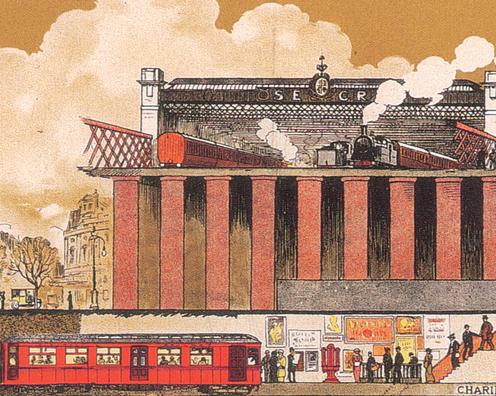
The District also had parliamentary permission to extend westward from Brompton (Gloucester Road) station and, on 12 April 1869, it opened a single track line from there to West Brompton on the West London Railway. There were no intermediate stations and this service initially operated as a shuttle. By summer 1869 additional tracks had been laid between South Kensington and Brompton (Gloucester Road) and from Kensington (High Street) to a junction with the line to West Brompton. During the night of 5 July 1870 the District secretly built the disputed Cromwell Curve connecting Brompton (Gloucester Road) and Kensington (High Street). East of Westminster, the next section ran in the newly constructed Victoria Embankment built by the Metropolitan Board of Works along the north bank of the River Thames. The line was opened from Westminster to Blackfriars on 30 May 1870 with stations at Charing Cross (now Embankment), The Temple (now Temple) and Blackfriars.
Hub AI
District Railway AI simulator
(@District Railway_simulator)
District Railway
The Metropolitan District Railway, also known as the District Railway, was a passenger railway that served London, England, from 1868 to 1933. Established in 1864 to complete an "inner circle" of lines connecting railway termini in London, the first part of the line opened using gas-lit wooden carriages hauled by steam locomotives. The Metropolitan Railway operated all services until the District Railway introduced its own trains in 1871. The railway was soon extended westwards through Earl's Court to Fulham, Richmond, Ealing and Hounslow. After completing the inner circle and reaching Whitechapel in 1884, it was extended to Upminster in Essex in 1902.
To finance electrification at the beginning of the 20th century, American financier Charles Yerkes took it over and made it part of his Underground Electric Railways Company of London (UERL) group. Electric propulsion was introduced in 1905, and by the end of the year electric multiple units operated all of the services. On 1 July 1933, the District Railway and the other UERL railways were merged with the Metropolitan Railway and the capital's tramway and bus operators to form the London Passenger Transport Board.
Today, former District Railway tracks and stations are used by the London Underground's District, Piccadilly and Circle lines.
In 1863, the Metropolitan Railway (also known as the Met) opened the world's first underground railway. The line was built from Paddington beneath the New Road, connecting the main line railway termini at Paddington, Euston and King's Cross. Then it followed Farringdon Road to a station at Farringdon Street in Smithfield, near the capital's financial heart in the City.
The Met's early success prompted a flurry of applications to Parliament in 1863 for new railways in London, many competing for similar routes. The House of Lords established a select committee that recommended an "inner circuit of railway that should abut, if not actually join, nearly all of the principal railway termini in the Metropolis". For the 1864 parliamentary session, railway schemes were presented that met the recommendation in varying ways and a joint committee composed of members of both Houses of Parliament reviewed the options.
Proposals to extend west and then south from Paddington to South Kensington and east from Moorgate to Tower Hill were accepted and received royal assent on 29 July 1864 in the Metropolitan Railway (Notting Hill and Brompton Extension) Act 1864 (27 & 28 Vict. c. ccxci) and the Metropolitan Railway (Tower Hill Extension) Act 1864 (27 & 28 Vict. c. cccxv) respectively. To complete the circuit, the committee encouraged the amalgamation of two other schemes proposed to run via different routes between Kensington and the City and a combined proposal under the name Metropolitan District Railway passed into law on the same day in the Metropolitan District Railways Act 1864 (27 & 28 Vict. c. cccxxii). Initially, the District and the Met were closely associated and it was intended that they would soon merge. The Met's chairman and three other directors were on the board of the District, John Fowler was the engineer of both companies and the construction works for all of the extensions were let as a single contract. The District was established as a separate company to enable funds to be raised independently of the Met.
Unlike the Metropolitan, the route did not follow an easy alignment under existing roads and land values were higher, so compensation payments for property were much higher. Major landowners, including Lord Kensington, sold parcels of land to the railway company. To ensure ventilation, the line west of Gloucester Road was carried in open cuttings, the rest mainly in a cut and cover tunnel 25 feet (7.6 m) wide and 15 feet 9 inches (4.80 m) deep; at the stations the platform ends were left open. Construction costs and compensation payments were so high that the cost of the first section of the District from South Kensington to Westminster was £3 million, almost three times the cost of the Met's original, longer line. On 24 December 1868, the District opened its line from South Kensington to Westminster, with stations at South Kensington, Sloane Square, Victoria, St James's Park and Westminster Bridge (now Westminster), the Met extending eastwards from Brompton to a shared station at South Kensington on the same day.
The District also had parliamentary permission to extend westward from Brompton (Gloucester Road) station and, on 12 April 1869, it opened a single track line from there to West Brompton on the West London Railway. There were no intermediate stations and this service initially operated as a shuttle. By summer 1869 additional tracks had been laid between South Kensington and Brompton (Gloucester Road) and from Kensington (High Street) to a junction with the line to West Brompton. During the night of 5 July 1870 the District secretly built the disputed Cromwell Curve connecting Brompton (Gloucester Road) and Kensington (High Street). East of Westminster, the next section ran in the newly constructed Victoria Embankment built by the Metropolitan Board of Works along the north bank of the River Thames. The line was opened from Westminster to Blackfriars on 30 May 1870 with stations at Charing Cross (now Embankment), The Temple (now Temple) and Blackfriars.
Recent media