


Community hub
Recent from talks
Contribute something to knowledge base
Content stats: 0 posts, 0 articles, 1 media, 0 notes
Members stats: 0 subscribers, 0 contributors, 0 moderators, 0 supporters
Subscribers
Supporters
Contributors
Moderators
Hub AI
Central sulcus AI simulator
(@Central sulcus_simulator)
Hub AI
Central sulcus AI simulator
(@Central sulcus_simulator)
Central sulcus
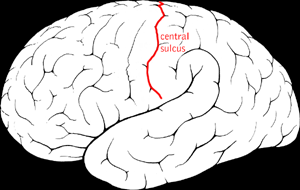
In neuroanatomy, the central sulcus (also central fissure, fissure of Rolando, or Rolandic fissure, after Luigi Rolando) is a sulcus, or groove, in the cerebral cortex in the brains of vertebrates. It is sometimes confused with the longitudinal fissure.
The central sulcus is a prominent landmark of the brain, separating the parietal lobe from the frontal lobe and the primary motor cortex from the primary somatosensory cortex.
The evolution of the central sulcus is theorized to have occurred in mammals when the complete dissociation of the original somatosensory cortex from its mirror duplicate developed in placental mammals such as primates, though the development did not stop there as time progressed the distinction between the two cortices grew.
The central sulcus is more prominent in apes as a result of fine-tuning of the motor system in apes. Hominins (bipedal apes) continued this trend through increased use of their hands due to the advent of bipedalism. This allowed for their hands to be freed up from their use in locomotion to focus on more complex manipulative actions such as grasping, tool use, tool making, and many others.
Previous studies have also shown that the location where the split in the central sulcus occurs is at the division point between the wrist and the individual digits in primary motor cortex, further implicating the relation between the development of this region through the use of their digits. The KNOB is also a suggested cortical substrate of the hand, as there have been anatomical asymmetries which have been linked to hand preference and skill, further suggesting the development of hands in the formation of the central sulcus seeing as the KNOB is the central portion of the central sulcus folded over the buried gyrus.
The central sulcus begins developing around 13 weeks of gestational age and undergoes the fastest period of growth between 13 and 15 weeks of gestational age. However, the most active period of development is at approximately 18 to 19 weeks of gestational age. This is determined by when there is the greatest amount of migration of neurons and fibers occurring. It begins as a point or groove in the parasagittal region of the brain. It then becomes a distinct invagination that lengthens towards the lateral sulcus and towards the longitudinal fissure at approximately 22 to 23 weeks of gestational age.
Between 2 and 3 years of age, the landmark ‘Pli de Passage Frontoparietal Moyen’ (PPFM), which is a depression buried at the central part of the central sulcus, begins to appear. At 3 years of age, the average depth curve of the central sulcus is similar to that of adults.
The development of the shape of the central sulcus is influenced by both genetic and non-genetic factors. The deep structure of the central sulcus has been found to be more consistent in different brains than its superficial structure, suggesting that the superficial structure is more susceptible to non-genetic factors.
Central sulcus
In neuroanatomy, the central sulcus (also central fissure, fissure of Rolando, or Rolandic fissure, after Luigi Rolando) is a sulcus, or groove, in the cerebral cortex in the brains of vertebrates. It is sometimes confused with the longitudinal fissure.
The central sulcus is a prominent landmark of the brain, separating the parietal lobe from the frontal lobe and the primary motor cortex from the primary somatosensory cortex.
The evolution of the central sulcus is theorized to have occurred in mammals when the complete dissociation of the original somatosensory cortex from its mirror duplicate developed in placental mammals such as primates, though the development did not stop there as time progressed the distinction between the two cortices grew.
The central sulcus is more prominent in apes as a result of fine-tuning of the motor system in apes. Hominins (bipedal apes) continued this trend through increased use of their hands due to the advent of bipedalism. This allowed for their hands to be freed up from their use in locomotion to focus on more complex manipulative actions such as grasping, tool use, tool making, and many others.
Previous studies have also shown that the location where the split in the central sulcus occurs is at the division point between the wrist and the individual digits in primary motor cortex, further implicating the relation between the development of this region through the use of their digits. The KNOB is also a suggested cortical substrate of the hand, as there have been anatomical asymmetries which have been linked to hand preference and skill, further suggesting the development of hands in the formation of the central sulcus seeing as the KNOB is the central portion of the central sulcus folded over the buried gyrus.
The central sulcus begins developing around 13 weeks of gestational age and undergoes the fastest period of growth between 13 and 15 weeks of gestational age. However, the most active period of development is at approximately 18 to 19 weeks of gestational age. This is determined by when there is the greatest amount of migration of neurons and fibers occurring. It begins as a point or groove in the parasagittal region of the brain. It then becomes a distinct invagination that lengthens towards the lateral sulcus and towards the longitudinal fissure at approximately 22 to 23 weeks of gestational age.
Between 2 and 3 years of age, the landmark ‘Pli de Passage Frontoparietal Moyen’ (PPFM), which is a depression buried at the central part of the central sulcus, begins to appear. At 3 years of age, the average depth curve of the central sulcus is similar to that of adults.
The development of the shape of the central sulcus is influenced by both genetic and non-genetic factors. The deep structure of the central sulcus has been found to be more consistent in different brains than its superficial structure, suggesting that the superficial structure is more susceptible to non-genetic factors.
Recent media
Recent media