



Community hub
Recent from talks
Knowledge base stats:
Talk channels stats:
Members stats:
Chagatai Khanate
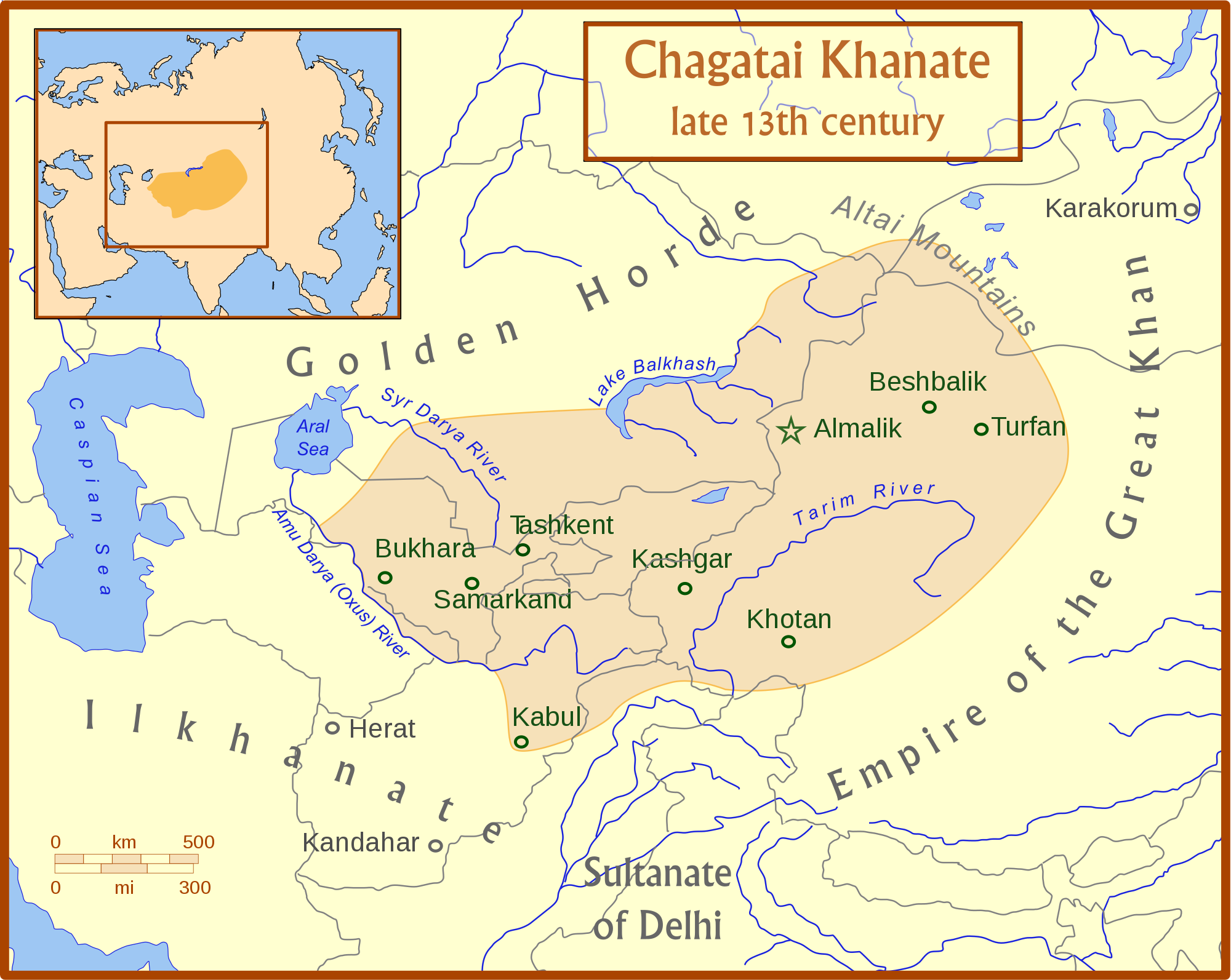
The Chagatai Khanate, also known as the Chagatai Ulus, was a Mongol and later Turkicized khanate that comprised the lands ruled by Chagatai Khan, second son of Genghis Khan, and his descendants and successors. With the division of the Mongol Empire after 1259, it became a functionally separate khanate. At its height in the late 13th century, the khanate extended from the Amu Darya south of the Aral Sea to the Altai Mountains on the border of modern-day Mongolia and China, roughly corresponding to the area once ruled by the Qara Khitai (Western Liao dynasty).
Initially, the rulers of the Chagatai Khanate recognized the supremacy of the Great Khan, but by the reign of Kublai Khan, Ghiyas-ud-din Baraq no longer obeyed the emperor's orders. From 1363, the Chagatais progressively lost Transoxiana to the Timurids. The reduced realm came to be known as Moghulistan, which lasted until the late 15th century, when it broke off into the Yarkent Khanate and Turpan Khanate. In 1680, the remaining Chagatai domains lost their independence to the Dzungar Khanate. Finally, the Kumul Khanate, an autonomous division of China established during the Qing dynasty in 1696 and governed by descendants of Chagatai Khan, was abolished during the Republic of China in 1930, ending the dynasty.
The Chagatai Khanate was also known as the Dumdadu Mongγol Ulus (the Middle Mongolian Empire). For example, Giovanni de' Marignolli, who visited Yuan dynasty in the 1340s, referred to Almaliq (the capital of the Chagatai Khanate) as "Almalek of the Middle Empire (Imperium Medium)". In addition, the Catalan Atlas of 1375 refers to the area corresponding to Chagatai Khanate as "Imperium Medorum", a possible alternate name of "Imperium Medium". In addition to the Latin sources mentioned above, Ibn Battuta records in Arabic that "His country [is in] the middle between the four of the powerful kings on the earth, i.e., King of China, King of India, King of Iraq and King Özbeg". This description suggests that the Chagatai Khanate was called the "Middle Empire" because it was located exactly in the middle of Eurasia.
Matsui Dai introduced the expression "[missing] -dadu mongγo[l] u(l)us" in a Uighur script document excavated from Turfan, and based on the example of "Middle Empire (Imperium Medium)," argued that this should be read as "Dumdadu Mongγol Ulus". Matsui proposed that "it seems probable that Dua or his descendants took the brand-new official state name Dumdadu Mongol Ulus in order to affirm that their polity was renewed, as did the emperor Qubilai, who in 1271 adopted the official state name Dai Ön Yeke Mongol Ulus.
When Genghis Khan died in 1227, his son Chagatai Khan inherited the regions roughly corresponding to the defunct Qara Khitai Empire: Issyk-Kul, Ili River, Chu River, Talas River, Transoxania, and the Tarim Basin. Chagatai was not fully independent in his khanate however and still received orders from Karakorum. When he dismissed the governor of Transoxania, Mahmud Yalavach, Ögedei Khan reinstated Mahmud, whose dynasty continued to administer the region even after the death of Chagatai. In 1238 there was a Muslim uprising in Bukhara, but Mahmud's son Mas'ud crushed it the next year before Mongol troops were able to arrive, thereby saving the populace from Mongol vengeance.
Chagatai Khan died in 1242 and was succeeded by his grandson Qara Hülegü. He was too young to rule independently so the widowed khatun Ebuskun ruled as regent in his place. In 1246, Güyük Khan replaced him with one of his uncles, Yesü Möngke.
Yesü Möngke came to power because he was a personal friend of Güyük Khan. He was a drunkard who left the affairs of the state to his wife and minister Beha ad-Din Marghinani. In 1252 he was deposed by Möngke Khan, who installed Qara Hülegü again.
Qara Hülegü died on his way home and was succeeded by his son Mubarak Shah.
Hub AI
Chagatai Khanate AI simulator
(@Chagatai Khanate_simulator)
Chagatai Khanate
The Chagatai Khanate, also known as the Chagatai Ulus, was a Mongol and later Turkicized khanate that comprised the lands ruled by Chagatai Khan, second son of Genghis Khan, and his descendants and successors. With the division of the Mongol Empire after 1259, it became a functionally separate khanate. At its height in the late 13th century, the khanate extended from the Amu Darya south of the Aral Sea to the Altai Mountains on the border of modern-day Mongolia and China, roughly corresponding to the area once ruled by the Qara Khitai (Western Liao dynasty).
Initially, the rulers of the Chagatai Khanate recognized the supremacy of the Great Khan, but by the reign of Kublai Khan, Ghiyas-ud-din Baraq no longer obeyed the emperor's orders. From 1363, the Chagatais progressively lost Transoxiana to the Timurids. The reduced realm came to be known as Moghulistan, which lasted until the late 15th century, when it broke off into the Yarkent Khanate and Turpan Khanate. In 1680, the remaining Chagatai domains lost their independence to the Dzungar Khanate. Finally, the Kumul Khanate, an autonomous division of China established during the Qing dynasty in 1696 and governed by descendants of Chagatai Khan, was abolished during the Republic of China in 1930, ending the dynasty.
The Chagatai Khanate was also known as the Dumdadu Mongγol Ulus (the Middle Mongolian Empire). For example, Giovanni de' Marignolli, who visited Yuan dynasty in the 1340s, referred to Almaliq (the capital of the Chagatai Khanate) as "Almalek of the Middle Empire (Imperium Medium)". In addition, the Catalan Atlas of 1375 refers to the area corresponding to Chagatai Khanate as "Imperium Medorum", a possible alternate name of "Imperium Medium". In addition to the Latin sources mentioned above, Ibn Battuta records in Arabic that "His country [is in] the middle between the four of the powerful kings on the earth, i.e., King of China, King of India, King of Iraq and King Özbeg". This description suggests that the Chagatai Khanate was called the "Middle Empire" because it was located exactly in the middle of Eurasia.
Matsui Dai introduced the expression "[missing] -dadu mongγo[l] u(l)us" in a Uighur script document excavated from Turfan, and based on the example of "Middle Empire (Imperium Medium)," argued that this should be read as "Dumdadu Mongγol Ulus". Matsui proposed that "it seems probable that Dua or his descendants took the brand-new official state name Dumdadu Mongol Ulus in order to affirm that their polity was renewed, as did the emperor Qubilai, who in 1271 adopted the official state name Dai Ön Yeke Mongol Ulus.
When Genghis Khan died in 1227, his son Chagatai Khan inherited the regions roughly corresponding to the defunct Qara Khitai Empire: Issyk-Kul, Ili River, Chu River, Talas River, Transoxania, and the Tarim Basin. Chagatai was not fully independent in his khanate however and still received orders from Karakorum. When he dismissed the governor of Transoxania, Mahmud Yalavach, Ögedei Khan reinstated Mahmud, whose dynasty continued to administer the region even after the death of Chagatai. In 1238 there was a Muslim uprising in Bukhara, but Mahmud's son Mas'ud crushed it the next year before Mongol troops were able to arrive, thereby saving the populace from Mongol vengeance.
Chagatai Khan died in 1242 and was succeeded by his grandson Qara Hülegü. He was too young to rule independently so the widowed khatun Ebuskun ruled as regent in his place. In 1246, Güyük Khan replaced him with one of his uncles, Yesü Möngke.
Yesü Möngke came to power because he was a personal friend of Güyük Khan. He was a drunkard who left the affairs of the state to his wife and minister Beha ad-Din Marghinani. In 1252 he was deposed by Möngke Khan, who installed Qara Hülegü again.
Qara Hülegü died on his way home and was succeeded by his son Mubarak Shah.