
Recent from talks
Qara Khitai
Knowledge base stats:
Talk channels stats:
Members stats:
Qara Khitai
The Qara Khitai, or Kara Khitai (simplified Chinese: 哈剌契丹; traditional Chinese: 喀喇契丹; pinyin: Kālā Qìdān or Chinese: 黑契丹; pinyin: Hēi Qìdān; lit. 'Black Khitan'), also known as the Western Liao (Chinese: 西遼; pinyin: Xī Liáo), officially the Great Liao (Chinese: 大遼; pinyin: Dà Liáo), was a dynastic regime based in Central Asia ruled by the Yelü clan of the Khitan people. Being a rump state of the Khitan-led Liao dynasty, Western Liao was culturally Sinicized to a large extent, especially among the elites consisting of Liao refugees.
The dynasty was founded by Yelü Dashi (Emperor Dezong), who led the remnants of the Liao dynasty from Manchuria to Central Asia after fleeing from the Jurchen-led Jin dynasty conquest of northern China. The empire was usurped by the Naimans under Kuchlug in 1211; traditional Chinese, Persian, and Arab sources consider the usurpation to be the end of the dynasty, even though the empire would not fall until the Mongol conquest in 1218. Some remnants of the Qara Khitai would form the Qutlugh-Khanid dynasty in southern Iran.
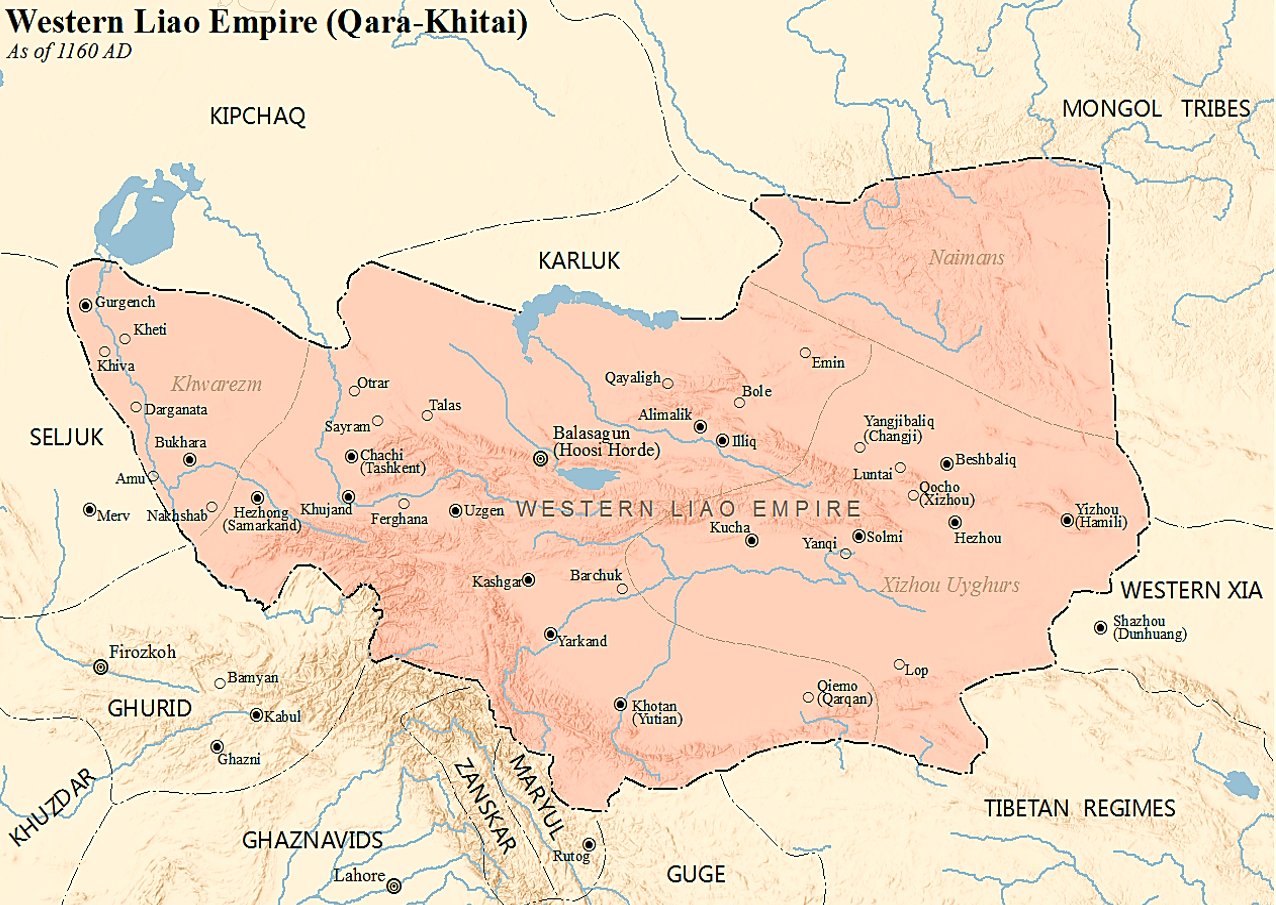
The territories of the Qara Khitai corresponded to parts of modern-day China, Kazakhstan, Kyrgyzstan, Mongolia, Tajikistan and Uzbekistan. The Anushtegin dynasty, the Karluks, Qocho kingdom, the Kankalis, and the Kara-Khanid Khanate were vassal states of the Qara Khitai at some point in history. Chinese and Muslim historiographical sources, such as the History of Liao, considered the Qara Khitai to be a legitimate Chinese dynasty.
In 1124, the Qara Khitai established by Yelü Dashi continued to use the Chinese dynastic name of "Great Liao". In historiography, however, this regime is more commonly called the "Western Liao" or "Qara Khitai". The Qara Khitans used neither "Western Liao" or "Qara Khitai" to refer to themselves. They regarded themselves as the legitimate continuation of the Liao dynasty and continued to use the Khitan name "Great Liao Khitan" ("Great Liao" in Chinese) as their self designation. Western Liao is a Chinese designation and Qara Khitai is a Turko-Mongol term. "Qara Khitai" cannot be found in any Muslim sources before the Mongol invasions, after which Turko-Mongol speakers mistook the word for "Liao" (Hura) as qara (black). "Qara Khitai" became a common Central Asian name for the state and it is often translated as the "Black Khitans" according to the Turko-Mongol understanding of qara. "Black Khitans" (黑契丹) has also been seen used in Chinese. "Qara", which literally means "black", corresponds with the Liao's dynastic color black and its dynastic element water, according to the theory of five elements (wuxing). Muslim historians initially referred to the state as "Khitai", which may have come from the Uyghur form of "Khitan", in whose language the final -n or -ń became -y. They adopted the name "Qara Khitai" after the Mongol invasions.
Due to the dominance of the Khitans during the Liao dynasty in Northeast China and Mongolia and later the Qara Khitai in Central Asia where they were seen as Chinese, the term "Khitai" came to mean "China" to people near them in Central Asia, Russia and northwestern China. The name was then introduced to medieval Europe via Islamic and Russian sources, and became "Cathay". In the modern era, words related to Khitay are still used as a name for China by Turkic peoples, such as the Uyghurs in China's Xinjiang region and the Kazakhs of Kazakhstan and areas adjoining it, and by some Slavic peoples, such as the Russians and Bulgarians.
The Qara Khitai empire, also known as the Western Liao dynasty, was the remnant offshoot of the Khitan-led Liao dynasty. From 1114 to 1125, the Jurchen-led Jin dynasty conquered the Liao. In 1122, two groups of Khitans fled westward to escape the Jin invasion. One of these groups was led by Yelü Dashi, who joined the Liao emperor, Tianzuo, at the border of the Western Xia kingdom. Dashi was captured by the Jin in 1123 and forced to lead them to Tianzuo's camp, resulting in the capture of the entire Liao imperial family except for Tianzuo and one of his sons. Dashi later rejoined Tianzuo but the emperor was captured in early 1125 and died at the Jin court in 1128.
In 1124, Yelü Dashi fled northwest and established his headquarter at the military garrison of Kedun (Zhenzhou) on the Orkhon River. Dashi secured the allegiance of the garrison forces numbering 20,000 and set himself up as gurkhan (universal khan). He conquered two Jin tribes in 1129. In 1130, Dashi led his host further west in search of new territory, whereupon he settled a town and his first base by the Emil river. Within a year, he had established himself as suzerain of Qocho and gained a foothold in Transoxiana. In 1131, he attacked the Karakhanids at Kashgar but was repelled. Later though, after being occupied by Yelü Yudu in the east, he returned and strengthened his forces to eventually expand his authority in Qayaliq and Almaliq regions. In 1134 he conquered the Karakhanid city of Balasaghun (in modern Kyrgyzstan), resulting in the vassalization of the nearby Kankalis, Karluks, Kyrgyz, and the Kingdom of Qocho. Kashgar, Khotan, and Beshbalik. In 1137, he defeated the Western Karakhanids near Khujand and annexed Fergana and Tashkent. Yelü Dashi's host was further bolstered by 10,000 Khitans who had previously been subjects of the Karakhanids. They went on to conquer Kashgar, Khotan, and Beshbalik.
The Western Karakhanids were vassals of the Seljuk Empire and the Karakhanid ruler Mahmud II appealed to his Seljuk overlord Ahmad Sanjar for protection. In 1141, Sanjar with his army arrived in Samarkand. The Khitans were invited by the Khwarazmians (also a vassal of the Seljuks) to conquer the lands of the Seljuks and responded to an appeal to intervene by the Karluks who were involved in a conflict with the Karakhanids and Seljuks.
Hub AI
Qara Khitai AI simulator
(@Qara Khitai_simulator)
Qara Khitai
The Qara Khitai, or Kara Khitai (simplified Chinese: 哈剌契丹; traditional Chinese: 喀喇契丹; pinyin: Kālā Qìdān or Chinese: 黑契丹; pinyin: Hēi Qìdān; lit. 'Black Khitan'), also known as the Western Liao (Chinese: 西遼; pinyin: Xī Liáo), officially the Great Liao (Chinese: 大遼; pinyin: Dà Liáo), was a dynastic regime based in Central Asia ruled by the Yelü clan of the Khitan people. Being a rump state of the Khitan-led Liao dynasty, Western Liao was culturally Sinicized to a large extent, especially among the elites consisting of Liao refugees.
The dynasty was founded by Yelü Dashi (Emperor Dezong), who led the remnants of the Liao dynasty from Manchuria to Central Asia after fleeing from the Jurchen-led Jin dynasty conquest of northern China. The empire was usurped by the Naimans under Kuchlug in 1211; traditional Chinese, Persian, and Arab sources consider the usurpation to be the end of the dynasty, even though the empire would not fall until the Mongol conquest in 1218. Some remnants of the Qara Khitai would form the Qutlugh-Khanid dynasty in southern Iran.
The territories of the Qara Khitai corresponded to parts of modern-day China, Kazakhstan, Kyrgyzstan, Mongolia, Tajikistan and Uzbekistan. The Anushtegin dynasty, the Karluks, Qocho kingdom, the Kankalis, and the Kara-Khanid Khanate were vassal states of the Qara Khitai at some point in history. Chinese and Muslim historiographical sources, such as the History of Liao, considered the Qara Khitai to be a legitimate Chinese dynasty.
In 1124, the Qara Khitai established by Yelü Dashi continued to use the Chinese dynastic name of "Great Liao". In historiography, however, this regime is more commonly called the "Western Liao" or "Qara Khitai". The Qara Khitans used neither "Western Liao" or "Qara Khitai" to refer to themselves. They regarded themselves as the legitimate continuation of the Liao dynasty and continued to use the Khitan name "Great Liao Khitan" ("Great Liao" in Chinese) as their self designation. Western Liao is a Chinese designation and Qara Khitai is a Turko-Mongol term. "Qara Khitai" cannot be found in any Muslim sources before the Mongol invasions, after which Turko-Mongol speakers mistook the word for "Liao" (Hura) as qara (black). "Qara Khitai" became a common Central Asian name for the state and it is often translated as the "Black Khitans" according to the Turko-Mongol understanding of qara. "Black Khitans" (黑契丹) has also been seen used in Chinese. "Qara", which literally means "black", corresponds with the Liao's dynastic color black and its dynastic element water, according to the theory of five elements (wuxing). Muslim historians initially referred to the state as "Khitai", which may have come from the Uyghur form of "Khitan", in whose language the final -n or -ń became -y. They adopted the name "Qara Khitai" after the Mongol invasions.
Due to the dominance of the Khitans during the Liao dynasty in Northeast China and Mongolia and later the Qara Khitai in Central Asia where they were seen as Chinese, the term "Khitai" came to mean "China" to people near them in Central Asia, Russia and northwestern China. The name was then introduced to medieval Europe via Islamic and Russian sources, and became "Cathay". In the modern era, words related to Khitay are still used as a name for China by Turkic peoples, such as the Uyghurs in China's Xinjiang region and the Kazakhs of Kazakhstan and areas adjoining it, and by some Slavic peoples, such as the Russians and Bulgarians.
The Qara Khitai empire, also known as the Western Liao dynasty, was the remnant offshoot of the Khitan-led Liao dynasty. From 1114 to 1125, the Jurchen-led Jin dynasty conquered the Liao. In 1122, two groups of Khitans fled westward to escape the Jin invasion. One of these groups was led by Yelü Dashi, who joined the Liao emperor, Tianzuo, at the border of the Western Xia kingdom. Dashi was captured by the Jin in 1123 and forced to lead them to Tianzuo's camp, resulting in the capture of the entire Liao imperial family except for Tianzuo and one of his sons. Dashi later rejoined Tianzuo but the emperor was captured in early 1125 and died at the Jin court in 1128.
In 1124, Yelü Dashi fled northwest and established his headquarter at the military garrison of Kedun (Zhenzhou) on the Orkhon River. Dashi secured the allegiance of the garrison forces numbering 20,000 and set himself up as gurkhan (universal khan). He conquered two Jin tribes in 1129. In 1130, Dashi led his host further west in search of new territory, whereupon he settled a town and his first base by the Emil river. Within a year, he had established himself as suzerain of Qocho and gained a foothold in Transoxiana. In 1131, he attacked the Karakhanids at Kashgar but was repelled. Later though, after being occupied by Yelü Yudu in the east, he returned and strengthened his forces to eventually expand his authority in Qayaliq and Almaliq regions. In 1134 he conquered the Karakhanid city of Balasaghun (in modern Kyrgyzstan), resulting in the vassalization of the nearby Kankalis, Karluks, Kyrgyz, and the Kingdom of Qocho. Kashgar, Khotan, and Beshbalik. In 1137, he defeated the Western Karakhanids near Khujand and annexed Fergana and Tashkent. Yelü Dashi's host was further bolstered by 10,000 Khitans who had previously been subjects of the Karakhanids. They went on to conquer Kashgar, Khotan, and Beshbalik.
The Western Karakhanids were vassals of the Seljuk Empire and the Karakhanid ruler Mahmud II appealed to his Seljuk overlord Ahmad Sanjar for protection. In 1141, Sanjar with his army arrived in Samarkand. The Khitans were invited by the Khwarazmians (also a vassal of the Seljuks) to conquer the lands of the Seljuks and responded to an appeal to intervene by the Karluks who were involved in a conflict with the Karakhanids and Seljuks.
Recent media