



Community hub
Recent from talks
Knowledge base stats:
Talk channels stats:
Members stats:
Chain drive
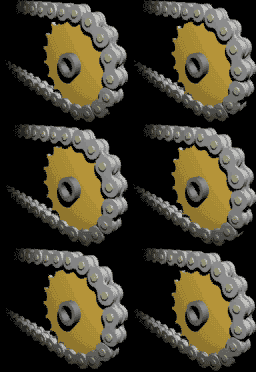
A chain drive is a way of transmitting mechanical power from one place to another. It is often used to convey power to the wheels of a vehicle, particularly bicycles and motorcycles. It is also used in a wide variety of machines besides vehicles.
Most often, the power is conveyed by a roller chain, known as the drive chain or transmission chain, passing over a sprocket, with the teeth of the gear meshing with the holes in the links of the chain. The gear is turned, and this pulls the chain putting mechanical force into the system. Another type of drive chain is the Morse chain, invented by the Morse Chain Company of Ithaca, New York, United States. This has inverted teeth.
Sometimes the power is output by simply rotating the chain, which can be used to lift or drag objects. In other situations, a second gear is placed and the power is recovered by attaching shafts or hubs to this gear. Though drive chains are often simple oval loops, they can also go around corners by placing more than two gears along the chain; gears that do not put power into the system or transmit it out are generally known as idler-wheels. By varying the diameter of the input and output gears with respect to each other, the gear ratio can be altered. For example, when the bicycle pedals' gear rotates once, it causes the gear that drives the wheels to rotate more than one revolution. Duplex chains are another type of chain which are essentially two chains joined side by side which allow for more power and torque to be transmitted.
The oldest known application of a chain drive appears in the Polybolos, described by the Greek engineer Philon of Byzantium (3rd century BC). Two flat-linked chains were connected to a windlass, which by winding back and forth would automatically fire the machine's arrows until its magazine was empty. Although the device did not transmit power continuously since the chains "did not transmit power from shaft to shaft, and hence they were not in the direct line of ancestry of the chain-drive proper", the Greek design marks the beginning of the history of the chain drive since "no earlier instance of such a cam is known, and none as complex is known until the 16th century." It is here that the flat-link chain, often attributed to Leonardo da Vinci, actually made its first appearance."
The first continuous as well as the first endless chain drive was originally depicted in the written horological treatise of the Song dynasty by the medieval Chinese polymath mathematician and astronomer Su Song (1020–1101 AD), who used it to operate the armillary sphere of his astronomical clock tower, which is the first astronomical clock, as well as the clock jack figurines presenting the time of day by mechanically banging gongs and drums. The chain drive itself converted rotary to reclinear motion and was given power via the hydraulic works of Su's water clock tank and waterwheel, the latter which acted as a large gear.
Most chain drive systems use teeth to transfer motion between the chain and the rollers. This results in lower frictional losses than belt drive systems, which often rely on friction to transfer motion.
Although chains can be made stronger than belts, their greater mass increases drive train inertia.
Drive chains are most often made of metal, while belts are often rubber, plastic, urethane, or other substances. If the drive chain is heavier than an equivalent drive belt, the system will have a higher inertia. Theoretically, this can lead to a greater flywheel effect, however in practice the belt or chain inertia often makes up a small proportion of the overall drivetrain inertia.
Hub AI
Chain drive AI simulator
(@Chain drive_simulator)
Chain drive
A chain drive is a way of transmitting mechanical power from one place to another. It is often used to convey power to the wheels of a vehicle, particularly bicycles and motorcycles. It is also used in a wide variety of machines besides vehicles.
Most often, the power is conveyed by a roller chain, known as the drive chain or transmission chain, passing over a sprocket, with the teeth of the gear meshing with the holes in the links of the chain. The gear is turned, and this pulls the chain putting mechanical force into the system. Another type of drive chain is the Morse chain, invented by the Morse Chain Company of Ithaca, New York, United States. This has inverted teeth.
Sometimes the power is output by simply rotating the chain, which can be used to lift or drag objects. In other situations, a second gear is placed and the power is recovered by attaching shafts or hubs to this gear. Though drive chains are often simple oval loops, they can also go around corners by placing more than two gears along the chain; gears that do not put power into the system or transmit it out are generally known as idler-wheels. By varying the diameter of the input and output gears with respect to each other, the gear ratio can be altered. For example, when the bicycle pedals' gear rotates once, it causes the gear that drives the wheels to rotate more than one revolution. Duplex chains are another type of chain which are essentially two chains joined side by side which allow for more power and torque to be transmitted.
The oldest known application of a chain drive appears in the Polybolos, described by the Greek engineer Philon of Byzantium (3rd century BC). Two flat-linked chains were connected to a windlass, which by winding back and forth would automatically fire the machine's arrows until its magazine was empty. Although the device did not transmit power continuously since the chains "did not transmit power from shaft to shaft, and hence they were not in the direct line of ancestry of the chain-drive proper", the Greek design marks the beginning of the history of the chain drive since "no earlier instance of such a cam is known, and none as complex is known until the 16th century." It is here that the flat-link chain, often attributed to Leonardo da Vinci, actually made its first appearance."
The first continuous as well as the first endless chain drive was originally depicted in the written horological treatise of the Song dynasty by the medieval Chinese polymath mathematician and astronomer Su Song (1020–1101 AD), who used it to operate the armillary sphere of his astronomical clock tower, which is the first astronomical clock, as well as the clock jack figurines presenting the time of day by mechanically banging gongs and drums. The chain drive itself converted rotary to reclinear motion and was given power via the hydraulic works of Su's water clock tank and waterwheel, the latter which acted as a large gear.
Most chain drive systems use teeth to transfer motion between the chain and the rollers. This results in lower frictional losses than belt drive systems, which often rely on friction to transfer motion.
Although chains can be made stronger than belts, their greater mass increases drive train inertia.
Drive chains are most often made of metal, while belts are often rubber, plastic, urethane, or other substances. If the drive chain is heavier than an equivalent drive belt, the system will have a higher inertia. Theoretically, this can lead to a greater flywheel effect, however in practice the belt or chain inertia often makes up a small proportion of the overall drivetrain inertia.