Hubbry Logo
WindlassWindlassMain
Open search
Windlass
Community hub
Windlass
logo
8 pages, 0 posts
0 subscribers
Be the first to start a discussion here.
Windlass
Windlass
from Wikipedia
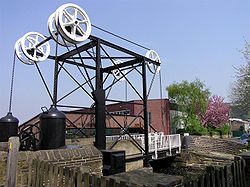
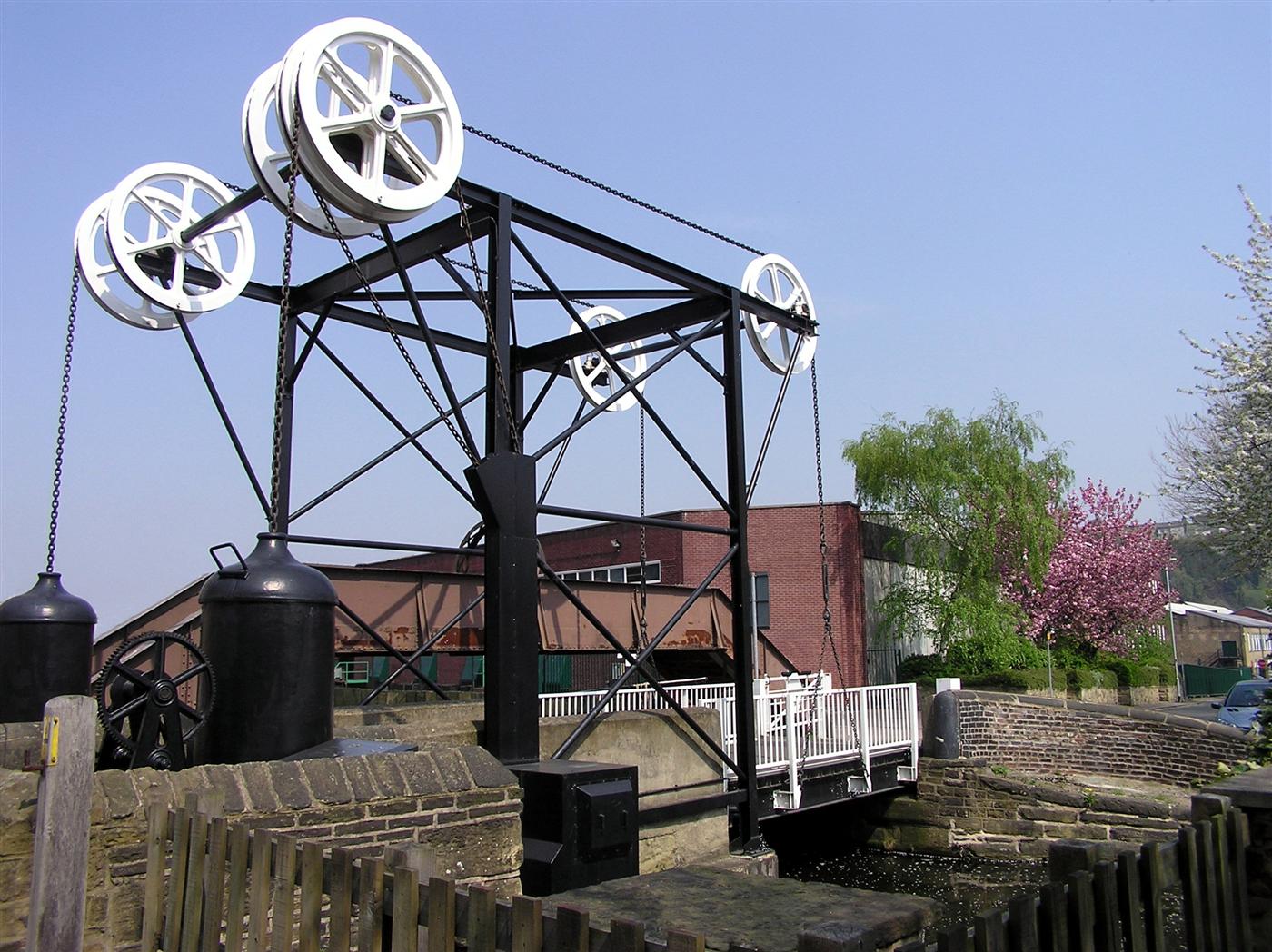
Turnbridge windlass lifting road bridge over Huddersfield Broad Canal
Differential windlass

The windlass /ˈwɪndləs/ is an apparatus for moving heavy weights. Typically, a windlass consists of a horizontal cylinder (barrel), which is rotated by the turn of a crank or belt. A winch is affixed to one or both ends, and a cable or rope is wound around the winch, pulling a weight attached to the opposite end. The Greek scientist Archimedes was the inventor of the windlass.[1] A surviving medieval windlass, dated to 1360 –1400, is in the Church of St Mary and All Saints, Chesterfield.[2] The oldest depiction of a windlass for raising water can be found in the Book of Agriculture published in 1313 by the Chinese official Wang Zhen of the Yuan Dynasty (fl. 1290–1333).[3]

Uses

[edit]
  • Vitruvius, a military engineer writing about 28 BC, defined a machine as "a combination of timber fastened together, chiefly efficacious in moving great weights". About a century later, Hero of Alexandria summarized the practice of his day by naming the "five simple machines" for "moving a given weight by a given force" as the lever, windlass, screw for power, wedge, and tackle block (pulley). Until nearly the end of the nineteenth century it was held that these "five mechanical powers" were the building blocks from which all more complex assemblages were constructed.[4]
  • During the Middle Ages the windlass was used to raise materials for the construction of buildings such as in Chesterfield's crooked spire church.[5]
  • A windlass cocking mechanism on crossbows was used as early as 1215 in England, and most European crossbows had one by the Late Middle Ages.[6]
  • Windlasses are sometimes used on boats to raise the anchor as an alternative to a vertical capstan (see anchor windlass).
  • The handle used to open locks on the UK's inland waterways is called a windlass.
  • Windlasses can be used to raise water from a well. The oldest description of a well windlass, a rotating wooden rod installed across the mouth of a well, is found in Isidore of Seville's (c. 560–636) Origenes (XX, 15, 1–3).[7]
  • Windlasses have also been used in gold mining. A windlass would be constructed above a shaft which allowed heavy buckets to be hauled up to the surface.[8] This process would be used until the shaft got below 40 metres deep, when the windlass would be replaced by a "whip" or a "whim".[9]

Differential windlass

[edit]
Comparison of a differential pulley, or chain hoist, at left, and a differential windlass, or Chinese windlass, at right. The rope of the windlass is depicted as spirals for clarity, but it is typically helices with axes perpendicular to the image.

In a differential windlass, also called a Chinese windlass,[10][11][12] there are two coaxial drums of different radii r and r′. The rope is wound onto one drum while it unwinds from the other, with a movable pulley hanging in the bight between the drums. Since each turn of the crank raises the pulley and attached weight by only π(rr′), very large mechanical advantages can be obtained.

Spanish windlass

[edit]
Two Spanish windlasses on a bunch of sticks, in the starting position and tightened

A Spanish windlass is a device for tightening a rope or cable by twisting it using a stick as a lever. The rope or cable is looped around two points so that it is fixed at either end. The stick is inserted into the loop and twisted, tightening the rope and pulling the two points toward each other. It is commonly used to move a heavy object such as a pipe or a post a short distance. It can be an effective device for pulling cars or cattle out of mud.[13] A Spanish windlass is sometimes used to tighten a tourniquet or a straitjacket. A Spanish windlass trap can be used to kill small game. An 1898 report to the US Senate Committee on Foreign Relations about an American vessel captured by a Spanish gunboat described the Spanish windlass as a torture device.[14] One of the captives' wrists were tied together. The captor then twisted a stick in the rope until it tightened and caused the man's wrists to swell.

See also

[edit]

References

[edit]
[edit]
Revisions and contributorsEdit on WikipediaRead on Wikipedia
from Grokipedia
A windlass is a mechanical device designed for hoisting, hauling, or pulling heavy loads, typically consisting of a horizontal or barrel around which a , , or cable is wound, rotated manually by a crank or , or powered by a motor, , or . This simple yet versatile apparatus amplifies human or mechanical force through leverage, making it essential for tasks requiring significant lifting capacity without excessive effort. The term "windlass" entered the in the 13th century, derived from the vindāss (from vinda, "to wind," and āss, "pole" or "beam"), via guindas, reflecting its origins in Scandinavian and medieval European . Early windlasses trace their roots to ancient civilizations, with precursor winch-like devices documented in Assyrian records around 700–600 BCE and described by Greek historian for use in the Persian Wars (499–449 BCE), often employed in , warfare, and . By the , windlasses were commonplace in European wells, ships, and mills, evolving from wooden constructions to more robust iron and models during the , particularly in the 19th century when steam-powered variants revolutionized maritime anchor handling on merchant vessels. Windlasses come in several notable types, each adapted for specific applications and mechanical advantages. The differential windlass, featuring two drums of different diameters connected coaxially, allows for efficient lifting of heavy weights with minimal input force and has been used historically in cranes and hoists. The Chinese windlass, a variant of the differential design observed by Western engineers in the 19th century but likely originating much earlier in , excels at raising massive loads like stone blocks in construction, leveraging unequal drum sizes for superior . In modern maritime use, anchor windlasses—often electric or hydraulic with horizontal or vertical configurations—dominate, handling chain rodes on vessels up to 65 feet, while manual lever or capstan types persist on smaller boats for reliability and simplicity. Beyond seafaring, windlasses remain vital in for shaft hoisting, for well pumping, and operations, underscoring their enduring role in human-powered and mechanized labor.

Etymology and History

Etymology

The term "windlass" originates from Old Norse vindass, a compound word formed from vinda ("to wind" or "to twist") and áss ("pole" or "staff"), denoting a simple device consisting of a winding pole for hoisting loads by coiling rope around it. This Old Norse form entered Middle English around the late 13th century as windas or wyndas, later altering to wyndlas or wyndelasse through influence from native English words like windel ("basket" or "winding"), reflecting the mechanism's action of winding material. By the 14th century, the modern spelling "windlass" had stabilized in English usage, specifically describing a mechanical hoist rather than broader winding tools. Cognates appear across Germanic languages, underscoring shared linguistic roots. In Dutch, the term is windas, directly paralleling the Old Norse compound and referring to a similar hauling device. German uses Winde for "windlass," derived from the same Proto-Germanic windaną ("to wind"), which traces back to the Proto-Indo-European root *wendh- ("to turn, wind, or weave"). These related forms highlight how the concept of a winding mechanism spread through medieval trade and technical exchanges in Northern Europe. Initially, "windlass" encompassed any basic apparatus for winding or in the 13th century, but its meaning narrowed by the early to denote specialized hoists for lifting heavy weights, such as in or early maritime applications. This semantic shift aligned with the device's increasing adoption in practical contexts like and seafaring.

Historical Development

The windlass, a simple mechanical device consisting of a horizontal turned by a crank to wind rope or , has origins tracing back to ancient civilizations, with precursor winch-like devices documented in Assyrian records around 700–600 BCE and described by Greek historian for water drawing in the 5th century BCE, often employed in , warfare, and . In these contexts, the windlass was often paired with basic pulleys, allowing workers to raise heavy loads like stones or water more efficiently than with levers alone, marking an early step in the evolution of hoisting technology. During the medieval period in , from the 12th to 15th centuries, the windlass saw significant advancements and widespread adoption in both defensive architecture and resource extraction. In castles, it was integral to operating drawbridges, with ropes or chains connected to the device in the chamber to raise or lower the bridge against threats, enhancing security across and broader European regions. Concurrently, in operations, windlasses powered by human or animal cranks were employed to haul and from shafts, supporting the growth of iron and silver extraction in areas like medieval and , where they replaced less efficient bucket systems. By the late medieval era, these devices were refined for greater durability, often incorporating wooden frames to withstand repeated use in harsh underground environments. Ratchet mechanisms, known from ancient designs and integrated into windlasses for crossbows by the 13th century, saw further refinements in the for improved safety by preventing unintended unwinding of loads during operation, particularly in and maritime settings where slippage could be hazardous. This innovation allowed for more controlled hoisting and was pivotal in expanding applications. The 19th-century industrialization further transformed the windlass, with steam-powered variants emerging in the mid-19th century for shipping and railways, enabling faster and more powerful handling on vessels and material transport on rail lines. These steam models, patented extensively in Britain and America, marked a shift from manual labor, boosting efficiency in global trade and projects.

Design and Operation

Basic Components

A traditional windlass features a horizontal axle, often referred to as the barrel or , which serves as the central cylindrical component around which the rope or is wound to lift or lower loads. This is typically mounted parallel to the ground and rotates to spool the line, providing the primary mechanism for mechanical elevation in applications such as wells, ships, or construction sites. Attached to one or both ends of the axle are cranks or handles designed for manual rotation, enabling users to turn the barrel with applied force. These cranks often incorporate spokes in a wheel-like configuration to enhance leverage, allowing for efficient operation by distributing effort across multiple points of grip and reducing the physical strain on the operator during heavy lifting tasks. To prevent unintended back-slipping of the load, a pawl and ratchet system is integrated into the windlass assembly, where the pawl—a pivoting —engages with the toothed ratchet wheel on the to lock rotation in one direction only. This mechanism ensures secure holding once the load is raised, and in some designs, a band complements the system by applying frictional resistance around the or to further control descent or maintain position under tension. The entire assembly is supported by a sturdy frame or mounting base, which provides stability and anchors the windlass to a fixed surface such as a deck, post, or ground. Historically, early were constructed from for simplicity and availability, while later iterations transitioned to iron or for greater durability and load-bearing capacity in demanding environments.

Mechanical Principles

The mechanical advantage of a windlass is derived from its function as a , where rotational applied to a crank or is converted into greater lifting on the load via the . The input τin\tau_{in} is given by the product of the applied FF and the crank arm length RcrankR_{crank}, so τin=F×Rcrank\tau_{in} = F \times R_{crank}. This is transmitted to the , producing an output τout=Fload×Rbarrel\tau_{out} = F_{load} \times R_{barrel}, where FloadF_{load} is the lifting and RbarrelR_{barrel} is the barrel radius. Assuming ideal conditions without losses, the (MA) equals the ratio of these radii: MA=RcrankRbarrelMA = \frac{R_{crank}}{R_{barrel}} This ratio allows a smaller input force to lift heavier loads by trading distance: the crank travels a larger circumference per rotation than the rope winds on the barrel. In manual windlasses, a pawl-and-ratchet mechanism prevents reverse rotation and holds the load stationary when not actively cranking, relying on the frictional engagement between the pawl tip and ratchet teeth to resist unwinding torque. The pawl's spring-loaded or gravity-biased contact creates a mechanical interlock augmented by friction, ensuring the system withstands loads without slippage during pauses. In powered variants, such as electric or hydraulic models, gear trains further amplify mechanical advantage by increasing torque multiplication through successive gear ratios, typically ranging from 10:1 to 50:1 depending on design, while reducing rotational speed to match lifting requirements. Energy transfer in a windlass occurs through the winding of or onto the rotating barrel, converting rotational from the input (crank or motor) into linear of the lifted load. Each full advances the load by the barrel's (2πRbarrel2\pi R_{barrel}), with work input Win=τin×[θ](/page/Theta)W_{in} = \tau_{in} \times [\theta](/page/Theta) equaling work output Wout=Fload×dW_{out} = F_{load} \times d in an ideal system, where [θ](/page/Theta)[\theta](/page/Theta) is and dd is linear distance, though real is approximately 60% due to frictional losses. Key limitations include slippage under overload, where excessive can cause the rope to slip on the barrel or disengage clutches, potentially damaging components; modern designs incorporate slip clutches set to 130-150% of rated load to protect against this. Additionally, in bearings and necessitates regular to minimize and maintain , as inadequate greasing can lead to premature .

Types of Windlasses

Simple Windlass

The simple windlass is a fundamental hoisting mechanism characterized as a single-barrel device operated by manual cranking, designed for raising light to moderate loads such as buckets of water from wells or similar low-depth applications. This basic form relies on human power without gears or multiple drums, making it suitable for straightforward lifting tasks where efficiency is secondary to simplicity and portability. Construction of the simple windlass typically involves a sturdy frame made of or metal to support the assembly over the load point, such as a well shaft. At its core is a plain horizontal , often 5 to 6 inches in and constructed from with iron reinforcements like ferrules for , around which winds. One or two cranks, usually wooden handles attached to the drum's , allow one or two operators to turn the device; flanges on the drum ends prevent the rope from slipping off during use. A pawl or ratchet mechanism, engaging with gear teeth on the , secures the load against unintended unwinding. Operation begins by securing one end of the rope to the load, such as a , and lowering it by allowing the to rotate freely or reversing the cranks. To raise the load, the operator(s) turn the crank(s) clockwise, winding the rope evenly onto the and lifting the attached item vertically. Once raised, the pawl is engaged to lock the in place, holding the load steady without continuous effort. This process provides a basic through the longer crank arms compared to the radius, reducing the force needed relative to direct pulling. Historical examples of the simple windlass abound in agricultural settings, particularly as well pumps on 18th- and 19th-century farms where manual water extraction was essential for daily needs. For instance, archaeological findings at National reveal a wooden-drum windlass with iron crank handles installed over a cribbed well shaft in the mid-19th century, exemplifying its use in farming communities for reliable, low-technology lifting. Such devices were commonplace in rural America, as described in early 20th-century geological surveys documenting traditional well infrastructure on farms.

Differential Windlass

The differential windlass, also known as the Chinese windlass, consists of two coaxial of different diameters rigidly mounted on the same to a crank handle for operation. This design allows for a differential effect where a single is draped over both drums, with the load attached to the loop between them; rotation winds the chain onto the smaller drum while more unwinds from the larger drum, resulting in net lift equal to the difference in their circumferences per revolution. The drums rotate together without requiring a full crank turn for incremental progress, as the net lift per revolution equals the difference in the drums' circumferences. The differential windlass has origins in , where it was first observed and documented by Western engineers in the , particularly during the Second Opium War in 1860 when British forces noted its use for raising drawbridges in . It was later adopted in during the , particularly for applications such as lifting in Cornish mines by the 1860s, following adaptations like the Weston differential pulley that built on its principles. In these contexts, the mechanism's gear ratio—determined by the ratio of the drum diameters—provides a typically around 2:1 in basic configurations, though higher ratios are achievable with closer drum diameters, enabling the device to handle loads up to 500 kg with significantly reduced operator effort. This advantage arises because the applied to the crank is amplified by the differential unwinding: for drums with radii rr (smaller) and RR (larger, where R>rR > r), the MAMA is given by MA=2RRr,MA = \frac{2R}{R - r}, assuming the crank radius matches the larger for simplicity; a small difference RrR - r yields greater leverage, making it ideal for slow, powerful lifts without complex additional gearing. A basic ratchet mechanism may be incorporated to prevent back-rotation during pauses.

Spanish Windlass

The Spanish windlass is a compact tensioning device featuring a or strap formed into a loop around an object, such as a limb or load, with a sturdy stick or bar inserted through the loop and rotated to twist the material, thereby generating significant tension for applications like tourniquets. This simple design leverages to apply pressure efficiently without complex mechanisms, making it suitable for field or improvised use. Originating in the period of the , particularly in , the device was employed for securing loads during transport and in medical contexts for compressing limbs to staunch arterial bleeding on battlefields or in surgical settings. German surgeon Wilhelm Fabry documented its use in 1593 as a method to maintain pressure, highlighting its popularity in European for rapid hemorrhage control. To operate, the bar is threaded through the rope loop and turned repeatedly to apply , tightening the band until sufficient compression is achieved, as governed by basic principles of rotational force. Care must be taken to avoid over-tightening, which can cause the rope to fray, snap, or fail under excessive strain, potentially leading to loss of tension or . In contemporary survival situations, the Spanish windlass remains valuable for fabricating improvised tourniquets to halt life-threatening in remote or environments, where commercial devices may be unavailable. It is also adapted for creating tension in bandages to secure splints, immobilizing broken bones and reducing further damage during evacuation or self-aid.

Modern Variants

Modern variants of the windlass have evolved to incorporate electric and hydraulic power systems, enhancing operational efficiency and safety in maritime and industrial settings. Electric windlasses, featuring integrated motors, gearboxes, and mechanisms, became common in applications starting in the , allowing operators to deploy and retrieve anchors from the helm without manual effort. These systems typically use DC motors for reliable performance on smaller vessels, with gearboxes providing multiplication to handle loads up to several hundred kilograms, while enable precise operation via foot switches or wireless devices. Hydraulic windlasses represent another key advancement, particularly for industrial uses such as offshore platforms and heavy handling, where they deliver variable speed control and high power capacities exceeding several tons. Driven by hydraulic pumps connected to engines or electric motors, these variants convert into rotational via low-speed, high-torque hydraulic motors, enabling smooth speed adjustments from slow hauling to rapid lowering under . Their design supports demanding environments, with features like auto-tensioning to maintain consistent load handling. Material advancements have shifted windlass construction from traditional to lightweight alloys and composites, prioritizing resistance in marine conditions. Aluminum alloys, often anodized for enhanced against saltwater degradation, reduce overall weight while maintaining structural , as seen in modern deck-mounted units. and chromed components further improve durability and resistance to pitting, replacing heavier in exposed parts to minimize and extend service life. Innovations since the include automatic load sensors and advanced chain stoppers, which integrate safety and into windlass operations. Motor load sensors monitor in real-time, automatically halting operation to prevent overloads or gear during anchoring, a feature standard in systems like those from Lewmar. Chain stoppers, positioned between the windlass and bow roller, secure the rode under tension, relieving stress from the mechanism; recent designs incorporate hydraulic or roller mechanisms for quick and compatibility with modern gypsies. These enhancements collectively reduce operator fatigue and improve reliability in contemporary applications.

Applications

Maritime Uses

In maritime contexts, the windlass functions primarily as an on ships, designed to heave up heavy anchor chains and s that can collectively weigh 20 to 60 tons or more, depending on vessel size and chain length. This capability ensures secure anchoring and efficient retrieval, allowing ships to maintain position against currents and winds while facilitating departure. For instance, on large merchant or naval vessels, the windlass handles the substantial load of galvanized chains, often 48 to 114 millimeters in diameter or more, to prevent dragging or loss of the . Since the , windlasses on vessels have integrated specialized components such as wildcats—also referred to as gypsies or chain wheels—for precise handling of both and . These ridged, concave drums engage the links of anchor chains, enabling smooth paying out and retrieval without slippage, while separate warping heads accommodate ropes for lines or auxiliary tasks. This design evolution improved efficiency on and ships, reducing crew exertion during operations at sea. Operational challenges in maritime environments include severe from prolonged exposure to saltwater, which accelerates wear on metal components like gears and housings. To mitigate this, modern electric windlasses incorporate waterproofing measures, such as sealed motors and -resistant coatings, ensuring reliability in harsh marine conditions. Historically, during the Age of Sail, windlasses held significant importance in , enabling crews to rapidly raise anchors amid battles to maneuver ships into advantageous positions or evade enemy fire. This quick deployment was crucial in engagements where positioning determined tactical outcomes, as seen in pursuits and fleet actions where vessels needed to under duress.

Industrial and Construction Uses

In mining operations, have historically been used to hoist and materials from underground shafts, evolving from manual mechanisms in early to powered systems in the . These devices, often integrated into hoist houses, allowed for the extraction of buckets or skips containing , with steam-powered variants significantly increasing lifting speeds and capacities. By the mid-20th century, such hoists in larger mines could manage loads of about 2.5 tons in some operations, with larger examples handling up to 10 tons or more, enabling efficient transport from depths exceeding 600 feet at rates approaching 600 feet per minute. In construction applications, windlasses function as key components in temporary cranes and pile drivers, providing the mechanical advantage needed to lift and position heavy loads like structural beams or foundation piles. These land-based systems are typically powered by internal combustion engines or electric motors, offering controlled tension for precise operations in building sites or infrastructure projects. For instance, in pile driving, the windlass winds cable to raise and drop hammers, ensuring stable penetration into soil or bedrock. Safety regulations have been integral to windlass deployment since the establishment of the (OSHA) in 1970, with standards emphasizing load limits based on equipment ratings and mandatory operator training to prevent accidents from overload or improper handling. Under OSHA standards for construction equipment (e.g., 29 CFR 1926.600), operators must be trained on equipment evaluation, signal interpretation, and emergency procedures, while hoisting devices require regular inspections to avoid hazards like over-travel. Notable examples include windlasses on , where they handle pipes and tools by winding heavy cables to position tubulars during extraction operations. In , windlasses support cable yarding systems, pulling logs across uneven via suspended cables to centralized areas, often using hydraulic models for capacities up to 10 tons in extraction. The differential windlass variant has been briefly noted for improving mechanical efficiency in hoists.

Other Applications

In agricultural contexts, windlasses have been employed since ancient times to lift water from wells for in rural areas, facilitating crop cultivation in regions with limited access. Archaeological and historical records indicate that simple windlass mechanisms, consisting of a horizontal axle wound with and a , were used in ancient as early as the (c. 1046-771 BCE) for drawing to irrigate fields. This technology spread to other civilizations, including those in the and , where manual windlasses remained a staple for small-scale farming until the advent of mechanized pumps in the . The Spanish windlass finds application in medical and survival scenarios as an improvised to control severe bleeding from limb injuries. This technique involves twisting a rigid stick or rod inserted into a loop of cloth or around the affected limb to apply focused on arteries, a method documented in emergency protocols since the . Modern guidelines from healthcare authorities recommend the Spanish windlass as a low-tech alternative when commercial tourniquets are unavailable, emphasizing its role in pre-hospital care to prevent life-threatening hemorrhage until professional treatment arrives. Recreational uses of manual windlasses include anchoring systems on small dinghies and haul mechanisms in gear for safe ascents. On lightweight dinghies, compact manual windlasses enable solo operators to raise and lower anchors efficiently without electrical power, enhancing maneuverability during leisure outings on inland waters or coastal areas. In and access activities, the Spanish windlass variant serves as a progress-capture device in haul systems, allowing climbers to tension s for controlled upward progress on rock faces or operations, providing in remote outdoor settings. By the 2020s, windlass mechanisms have been integrated into robotic systems for precise load handling in , leveraging differential designs to achieve fine control. These cable-driven actuators, often using coaxial drums to wind and unwind ropes with high repeatability, enable robots to manipulate pallets or goods with minimal backlash, improving efficiency in e-commerce fulfillment centers. Patents and engineering advancements highlight their adoption in parallel cable robots for tasks requiring both lifting capacity and positional accuracy, such as sorting and stacking operations.

References

Add your contribution
Related Hubs
User Avatar
No comments yet.