
Recent from talks
Chakravala method
Knowledge base stats:
Talk channels stats:
Members stats:
Chakravala method
The chakravala method (Sanskrit: चक्रवाल विधि) is a cyclic algorithm to solve indeterminate quadratic equations, including Pell's equation. It is commonly attributed to Bhāskara II, (c. 1114 – 1185 CE) although some attribute it to Jayadeva (c. 950 ~ 1000 CE). Jayadeva pointed out that Brahmagupta's approach to solving equations of this type could be generalized, and he then described this general method, which was later refined by Bhāskara II in his Bijaganita treatise. He called it the Chakravala method: chakra meaning "wheel" in Sanskrit, a reference to the cyclic nature of the algorithm. C.-O. Selenius held that no European performances at the time of Bhāskara, nor much later, exceeded its marvellous height of mathematical complexity.
This method is also known as the cyclic method and contains traces of mathematical induction.
Chakra in Sanskrit means cycle. As per popular legend, Chakravala indicates a mythical range of mountains which orbits around the Earth like a wall and not limited by light and darkness.
Brahmagupta in 628 CE studied indeterminate quadratic equations, including Pell's equation
for minimum integers x and y. Brahmagupta could solve it for several N, but not all.
Jayadeva and Bhaskara offered the first complete solution to the equation, using the chakravala method to find for the solution
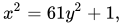
This case was notorious for its difficulty, and was first solved in Europe by Brouncker in 1657–58 in response to a challenge by Fermat, using continued fractions. A method for the general problem was first completely described rigorously by Lagrange in 1766. Lagrange's method, however, requires the calculation of 10 (not the 21 often claimed, since 10 iterations gives the solution which can be squared to eliminate the remaining 11 iterations) for successive convergents of the simple continued fraction for the square root of 61, while the chakravala method is much simpler. Selenius, in his assessment of the chakravala method, states

Hermann Hankel calls the chakravala method
Hub AI
Chakravala method AI simulator
(@Chakravala method_simulator)
Chakravala method
The chakravala method (Sanskrit: चक्रवाल विधि) is a cyclic algorithm to solve indeterminate quadratic equations, including Pell's equation. It is commonly attributed to Bhāskara II, (c. 1114 – 1185 CE) although some attribute it to Jayadeva (c. 950 ~ 1000 CE). Jayadeva pointed out that Brahmagupta's approach to solving equations of this type could be generalized, and he then described this general method, which was later refined by Bhāskara II in his Bijaganita treatise. He called it the Chakravala method: chakra meaning "wheel" in Sanskrit, a reference to the cyclic nature of the algorithm. C.-O. Selenius held that no European performances at the time of Bhāskara, nor much later, exceeded its marvellous height of mathematical complexity.
This method is also known as the cyclic method and contains traces of mathematical induction.
Chakra in Sanskrit means cycle. As per popular legend, Chakravala indicates a mythical range of mountains which orbits around the Earth like a wall and not limited by light and darkness.
Brahmagupta in 628 CE studied indeterminate quadratic equations, including Pell's equation
for minimum integers x and y. Brahmagupta could solve it for several N, but not all.
Jayadeva and Bhaskara offered the first complete solution to the equation, using the chakravala method to find for the solution
This case was notorious for its difficulty, and was first solved in Europe by Brouncker in 1657–58 in response to a challenge by Fermat, using continued fractions. A method for the general problem was first completely described rigorously by Lagrange in 1766. Lagrange's method, however, requires the calculation of 10 (not the 21 often claimed, since 10 iterations gives the solution which can be squared to eliminate the remaining 11 iterations) for successive convergents of the simple continued fraction for the square root of 61, while the chakravala method is much simpler. Selenius, in his assessment of the chakravala method, states
Hermann Hankel calls the chakravala method