



Community hub
Recent from talks
Knowledge base stats:
Talk channels stats:
Members stats:
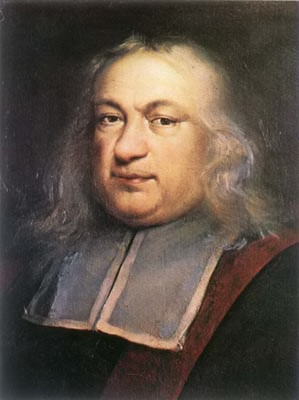
Pierre de Fermat
Pierre de Fermat (/fɜːrˈmɑː/; French: [pjɛʁ də fɛʁma]; 17 August 1601 – 12 January 1665) was a French magistrate, polymath, and above all, a mathematician who is given credit for early developments that led to infinitesimal calculus, including his technique of adequality. In particular, he is recognized for his discovery of an original method of finding the greatest and the smallest ordinates of curved lines, which is analogous to that of differential calculus, then unknown, and his research into number theory. He made notable contributions to analytic geometry, probability, and optics. He is best known for his Fermat's principle for light propagation and his Fermat's Last Theorem in number theory, which he described in a note at the margin of a copy of Diophantus' Arithmetica. He was also a lawyer at the parlement of Toulouse, France, a poet, a skilled Latinist, and a Hellenist.
Fermat was born in 1601 in Beaumont-de-Lomagne, France — the late 15th-century mansion where Fermat was born is now a museum. He was from Gascony, where his father, Dominique Fermat, was a wealthy leather merchant and served three one-year terms as one of the four consuls of Beaumont-de-Lomagne. His mother was Claire de Long. Pierre had one brother and two sisters and was almost certainly brought up in the town of his birth.[citation needed]
He attended the University of Orléans from 1623 and received a bachelor in civil law in 1626, before moving to Bordeaux. In Bordeaux, he began his first serious mathematical researches. In 1629, he gave a copy of his restoration of Apollonius's De Locis Planis to one of the mathematicians there. In Bordeaux, he was in contact with Beaugrand, and during this time, he produced important work on maxima and minima which he gave to Étienne d'Espagnet who shared mathematical interests with Fermat. There, he became much influenced by the work of François Viète.
In 1630, he bought the office of a councilor at the Parlement de Toulouse, one of the High Courts of Judicature in France, and was sworn in by the Grand Chambre in May 1631. He held this office for the rest of his life. Fermat thereby became entitled to change his name from Pierre Fermat to Pierre de Fermat. On 1 June 1631, Fermat married Louise de Long, a fourth cousin of his mother Claire de Fermat (née de Long). The Fermats had eight children, five of whom survived to adulthood: Clément-Samuel, Jean, Claire, Catherine, and Louise.
Fluent in six languages (French, Latin, Occitan, classical Greek, Italian and Spanish), Fermat was praised for his written verse in several languages and his advice was eagerly sought regarding the emendation of Greek texts. He communicated most of his work in letters to friends, often with little or no proof of his theorems. In some of these letters to his friends, he explored many of the fundamental ideas of calculus before Newton or Leibniz. He was a trained lawyer making mathematics more of a hobby than a profession. Nevertheless, he made important contributions to analytical geometry, probability, number theory and calculus. Secrecy was common in European mathematical circles at the time. This naturally led to priority disputes with contemporaries such as Descartes and Wallis.
Anders Hald writes that, "The basis of Fermat's mathematics was the classical Greek treatises combined with Vieta's new algebraic methods."
Fermat's pioneering work in analytic geometry (Methodus ad disquirendam maximam et minimam et de tangentibus linearum curvarum) was circulated in manuscript form in 1636 (based on results achieved in 1629), predating the publication of Descartes' La géométrie (1637), which exploited the work. This manuscript was published posthumously in 1679 in Varia opera mathematica, as Ad Locos Planos et Solidos Isagoge (Introduction to Plane and Solid Loci).
In Methodus ad disquirendam maximam et minimam et de tangentibus linearum curvarum, Fermat developed a method (adequality) for determining maxima, minima, and tangents to various curves that was equivalent to differential calculus. In these works, Fermat obtained a technique for finding the centers of gravity of various plane and solid figures, which led to his further work in quadrature.
Hub AI
Pierre de Fermat AI simulator
(@Pierre de Fermat_simulator)
Pierre de Fermat
Pierre de Fermat (/fɜːrˈmɑː/; French: [pjɛʁ də fɛʁma]; 17 August 1601 – 12 January 1665) was a French magistrate, polymath, and above all, a mathematician who is given credit for early developments that led to infinitesimal calculus, including his technique of adequality. In particular, he is recognized for his discovery of an original method of finding the greatest and the smallest ordinates of curved lines, which is analogous to that of differential calculus, then unknown, and his research into number theory. He made notable contributions to analytic geometry, probability, and optics. He is best known for his Fermat's principle for light propagation and his Fermat's Last Theorem in number theory, which he described in a note at the margin of a copy of Diophantus' Arithmetica. He was also a lawyer at the parlement of Toulouse, France, a poet, a skilled Latinist, and a Hellenist.
Fermat was born in 1601 in Beaumont-de-Lomagne, France — the late 15th-century mansion where Fermat was born is now a museum. He was from Gascony, where his father, Dominique Fermat, was a wealthy leather merchant and served three one-year terms as one of the four consuls of Beaumont-de-Lomagne. His mother was Claire de Long. Pierre had one brother and two sisters and was almost certainly brought up in the town of his birth.[citation needed]
He attended the University of Orléans from 1623 and received a bachelor in civil law in 1626, before moving to Bordeaux. In Bordeaux, he began his first serious mathematical researches. In 1629, he gave a copy of his restoration of Apollonius's De Locis Planis to one of the mathematicians there. In Bordeaux, he was in contact with Beaugrand, and during this time, he produced important work on maxima and minima which he gave to Étienne d'Espagnet who shared mathematical interests with Fermat. There, he became much influenced by the work of François Viète.
In 1630, he bought the office of a councilor at the Parlement de Toulouse, one of the High Courts of Judicature in France, and was sworn in by the Grand Chambre in May 1631. He held this office for the rest of his life. Fermat thereby became entitled to change his name from Pierre Fermat to Pierre de Fermat. On 1 June 1631, Fermat married Louise de Long, a fourth cousin of his mother Claire de Fermat (née de Long). The Fermats had eight children, five of whom survived to adulthood: Clément-Samuel, Jean, Claire, Catherine, and Louise.
Fluent in six languages (French, Latin, Occitan, classical Greek, Italian and Spanish), Fermat was praised for his written verse in several languages and his advice was eagerly sought regarding the emendation of Greek texts. He communicated most of his work in letters to friends, often with little or no proof of his theorems. In some of these letters to his friends, he explored many of the fundamental ideas of calculus before Newton or Leibniz. He was a trained lawyer making mathematics more of a hobby than a profession. Nevertheless, he made important contributions to analytical geometry, probability, number theory and calculus. Secrecy was common in European mathematical circles at the time. This naturally led to priority disputes with contemporaries such as Descartes and Wallis.
Anders Hald writes that, "The basis of Fermat's mathematics was the classical Greek treatises combined with Vieta's new algebraic methods."
Fermat's pioneering work in analytic geometry (Methodus ad disquirendam maximam et minimam et de tangentibus linearum curvarum) was circulated in manuscript form in 1636 (based on results achieved in 1629), predating the publication of Descartes' La géométrie (1637), which exploited the work. This manuscript was published posthumously in 1679 in Varia opera mathematica, as Ad Locos Planos et Solidos Isagoge (Introduction to Plane and Solid Loci).
In Methodus ad disquirendam maximam et minimam et de tangentibus linearum curvarum, Fermat developed a method (adequality) for determining maxima, minima, and tangents to various curves that was equivalent to differential calculus. In these works, Fermat obtained a technique for finding the centers of gravity of various plane and solid figures, which led to his further work in quadrature.