



Community hub
Recent from talks
Knowledge base stats:
Talk channels stats:
Members stats:
Chaotic mixing
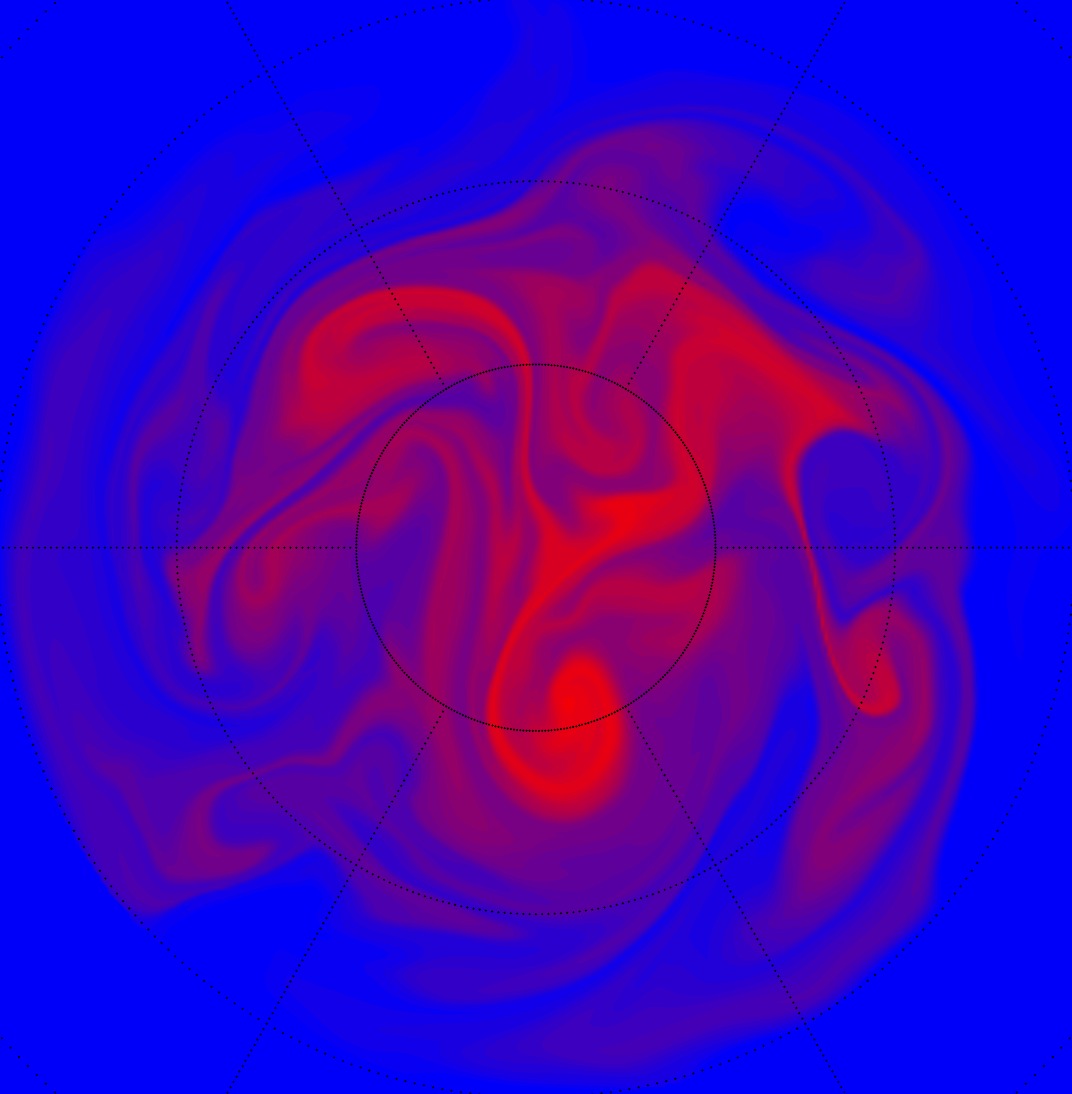
In chaos theory and fluid dynamics, chaotic mixing is a process by which flow tracers develop into complex fractals under the action of a fluid flow. The flow is characterized by an exponential growth of fluid filaments. Even very simple flows, such as the blinking vortex, or finitely resolved wind fields can generate exceptionally complex patterns from initially simple tracer fields.
The phenomenon is still not well understood and is the subject of much current research.
Two basic mechanisms are responsible for fluid mixing: diffusion and advection. In liquids, molecular diffusion alone is hardly efficient for mixing. Advection, that is the transport of matter by a flow, is required for better mixing.
The fluid flow obeys fundamental equations of fluid dynamics (such as the conservation of mass and the conservation of momentum) called Navier–Stokes equations. These equations are written for the Eulerian velocity field rather than for the Lagrangian position of fluid particles. Lagrangian trajectories are then obtained by integrating the flow. Studying the effect of advection on fluid mixing amounts to describing how different Lagrangian fluid particles explore the fluid domain and separate from each other.
A fluid flow can be considered as a dynamical system, that is a set of ordinary differential equations that determines the evolution of a Lagrangian trajectory. These equations are called advection equations:
where are the components of the velocity field, which are assumed to be known from the solution of the equations governing fluid flow, such as the Navier-Stokes equations, and is the physical position. If the dynamical system governing trajectories is chaotic, the integration of a trajectory is extremely sensitive to initial conditions, and neighboring points separate exponentially with time. This phenomenon is called chaotic advection.


Dynamical systems and chaos theory state that at least 3 degrees of freedom are necessary for a dynamic system to be chaotic. Three-dimensional flows have three degrees of freedom corresponding to the three coordinates, and usually result in chaotic advection, except when the flow has symmetries that reduce the number of degrees of freedom. In flows with less than 3 degrees of freedom, Lagrangian trajectories are confined to closed tubes, and shear-induced mixing can only proceed within these tubes.
This is the case for 2-D stationary flows in which there are only two degrees of freedom and . For stationary (time-independent) flows, Lagrangian trajectories of fluid particles coincide with the streamlines of the flow, that are isolines of the stream function. In 2-D, streamlines are concentric closed curves that cross only at stagnation points. Thus, a spot of dyed fluid to be mixed can only explore the region bounded by the most external and internal streamline, on which it is lying at the initial time. Regarding practical applications, this configuration is not very satisfying.


Hub AI
Chaotic mixing AI simulator
(@Chaotic mixing_simulator)
Chaotic mixing
In chaos theory and fluid dynamics, chaotic mixing is a process by which flow tracers develop into complex fractals under the action of a fluid flow. The flow is characterized by an exponential growth of fluid filaments. Even very simple flows, such as the blinking vortex, or finitely resolved wind fields can generate exceptionally complex patterns from initially simple tracer fields.
The phenomenon is still not well understood and is the subject of much current research.
Two basic mechanisms are responsible for fluid mixing: diffusion and advection. In liquids, molecular diffusion alone is hardly efficient for mixing. Advection, that is the transport of matter by a flow, is required for better mixing.
The fluid flow obeys fundamental equations of fluid dynamics (such as the conservation of mass and the conservation of momentum) called Navier–Stokes equations. These equations are written for the Eulerian velocity field rather than for the Lagrangian position of fluid particles. Lagrangian trajectories are then obtained by integrating the flow. Studying the effect of advection on fluid mixing amounts to describing how different Lagrangian fluid particles explore the fluid domain and separate from each other.
A fluid flow can be considered as a dynamical system, that is a set of ordinary differential equations that determines the evolution of a Lagrangian trajectory. These equations are called advection equations:
where are the components of the velocity field, which are assumed to be known from the solution of the equations governing fluid flow, such as the Navier-Stokes equations, and is the physical position. If the dynamical system governing trajectories is chaotic, the integration of a trajectory is extremely sensitive to initial conditions, and neighboring points separate exponentially with time. This phenomenon is called chaotic advection.
Dynamical systems and chaos theory state that at least 3 degrees of freedom are necessary for a dynamic system to be chaotic. Three-dimensional flows have three degrees of freedom corresponding to the three coordinates, and usually result in chaotic advection, except when the flow has symmetries that reduce the number of degrees of freedom. In flows with less than 3 degrees of freedom, Lagrangian trajectories are confined to closed tubes, and shear-induced mixing can only proceed within these tubes.
This is the case for 2-D stationary flows in which there are only two degrees of freedom and . For stationary (time-independent) flows, Lagrangian trajectories of fluid particles coincide with the streamlines of the flow, that are isolines of the stream function. In 2-D, streamlines are concentric closed curves that cross only at stagnation points. Thus, a spot of dyed fluid to be mixed can only explore the region bounded by the most external and internal streamline, on which it is lying at the initial time. Regarding practical applications, this configuration is not very satisfying.