
Recent from talks
Charles Cooper Penrose-Fitzgerald
Knowledge base stats:
Talk channels stats:
Members stats:
Charles Cooper Penrose-Fitzgerald
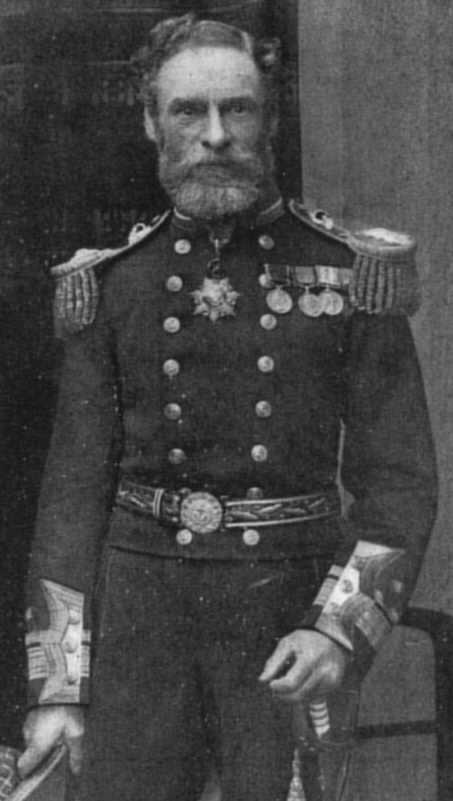
Admiral Charles Cooper Penrose-Fitzgerald (30 April 1841 – 11 August 1921) was a senior officer in the Royal Navy.
His father was Robert Uniacke Penrose (1800–1857) who married Francis Matilda Austin, daughter of the Revd Robert Austin, prebendary of Cloyne Cathedral. Charles married Henrietta Elizabeth Hewson on 29 November 1882, daughter of Revd Francis Hewson of Dunganston, Wicklow. They had a son John Uniacke Penrose Fitzgerald (27 July 1888 – 11 December 1940) who also joined the navy and was killed on active service in World War II. In 1896 Charles changed his own surname to Uniacke-Penrose-Fitzgerald.
He was educated at Dr. Burney's academy, Gosport, and joined the navy in 1854 on board HMS Victory at Portsmouth. In 1855 he served in the Baltic and then the Black Sea in 1856. He served on HMS Retribution on the China station and in 1860 on HMS Ariadne.
On 22 May 1861 he was made lieutenant. On 24 July 1871 he became a commander while serving as first lieutenant on HMS Hercules under Captain Lord Gilford. He was appointed to second in command of HMS Agincourt, flagship of the second division of the Mediterranean squadron, commander Captain Hopkins. Hercules had been involved in the rescue of Agincourt when her previous commander had allowed her to run aground near Gibraltar. He spent three years on HMS Asia, which was an old hulk moored near Fareham. Lord Gilford was once again in command. The posting was a bad one for an officer concerned about his career, but allowed plenty of leave and hunting. The most onerous duty was that he was sometimes called to sit on courts-martial. In the summer he had a small yacht to sail about in the Solent so as not to get out of practice. After Asia he spent a period on half pay and while in Ireland had a bad hunting accident which required him to lie flat for most of a year while recovering.
On 4 January 1878 he was appointed to his first independent command in HMS Rapid in the Mediterranean. Lord Gilford was now a junior Lord of the Admiralty so was able to assist in obtaining the command. Rapid was the slowest ship in the fleet, so was normally used for 'detached' duties. It was fourteen months before Fitzgerald met the squadron commander, Admiral Geoffrey Hornby.
On 19 March 1880 he was promoted to captain and was appointed to HMS Inconstant, flagship of the flying squadron. Although he wrote on the subject of sailing, he was an advocate of the complete removal of sails from naval vessels (which frequently were equipped with both engines and sails at this time).
In 1884 he was the captain of the Royal Naval college, Greenwich. In 1886, he commanded HMS Bellerophon. He was one of the public supporters of a campaign for increased Naval funding (alongside Captain Lord Charles Beresford and Admiral Sir Geoffrey Hornby) which led to the Naval Defence Act 1889 and he continued to be involved in public debate on naval matters throughout his life.
On 7 November 1889 he was made captain of HMS Collingwood in the Mediterranean. He was a proponent of Rear Admiral George Tryon's ideas that a simplified system of flag signals was needed for battle conditions. After Tryon's death, he distributed a pamphlet seeking to continue the campaign for their adoption. Tryon drowned when his flagship HMS Victoria was sunk by a collision with HMS Camperdown during fleet manoeuvres, which caused both public and naval opinion to turn against him and his ideas. Tryon was held responsible for the sinking and his flag system also blamed. Fitzgerald wrote a biography describing Tryon's achievements during his career, but these efforts rebounded to the detriment of his own career.
Hub AI
Charles Cooper Penrose-Fitzgerald AI simulator
(@Charles Cooper Penrose-Fitzgerald_simulator)
Charles Cooper Penrose-Fitzgerald
Admiral Charles Cooper Penrose-Fitzgerald (30 April 1841 – 11 August 1921) was a senior officer in the Royal Navy.
His father was Robert Uniacke Penrose (1800–1857) who married Francis Matilda Austin, daughter of the Revd Robert Austin, prebendary of Cloyne Cathedral. Charles married Henrietta Elizabeth Hewson on 29 November 1882, daughter of Revd Francis Hewson of Dunganston, Wicklow. They had a son John Uniacke Penrose Fitzgerald (27 July 1888 – 11 December 1940) who also joined the navy and was killed on active service in World War II. In 1896 Charles changed his own surname to Uniacke-Penrose-Fitzgerald.
He was educated at Dr. Burney's academy, Gosport, and joined the navy in 1854 on board HMS Victory at Portsmouth. In 1855 he served in the Baltic and then the Black Sea in 1856. He served on HMS Retribution on the China station and in 1860 on HMS Ariadne.
On 22 May 1861 he was made lieutenant. On 24 July 1871 he became a commander while serving as first lieutenant on HMS Hercules under Captain Lord Gilford. He was appointed to second in command of HMS Agincourt, flagship of the second division of the Mediterranean squadron, commander Captain Hopkins. Hercules had been involved in the rescue of Agincourt when her previous commander had allowed her to run aground near Gibraltar. He spent three years on HMS Asia, which was an old hulk moored near Fareham. Lord Gilford was once again in command. The posting was a bad one for an officer concerned about his career, but allowed plenty of leave and hunting. The most onerous duty was that he was sometimes called to sit on courts-martial. In the summer he had a small yacht to sail about in the Solent so as not to get out of practice. After Asia he spent a period on half pay and while in Ireland had a bad hunting accident which required him to lie flat for most of a year while recovering.
On 4 January 1878 he was appointed to his first independent command in HMS Rapid in the Mediterranean. Lord Gilford was now a junior Lord of the Admiralty so was able to assist in obtaining the command. Rapid was the slowest ship in the fleet, so was normally used for 'detached' duties. It was fourteen months before Fitzgerald met the squadron commander, Admiral Geoffrey Hornby.
On 19 March 1880 he was promoted to captain and was appointed to HMS Inconstant, flagship of the flying squadron. Although he wrote on the subject of sailing, he was an advocate of the complete removal of sails from naval vessels (which frequently were equipped with both engines and sails at this time).
In 1884 he was the captain of the Royal Naval college, Greenwich. In 1886, he commanded HMS Bellerophon. He was one of the public supporters of a campaign for increased Naval funding (alongside Captain Lord Charles Beresford and Admiral Sir Geoffrey Hornby) which led to the Naval Defence Act 1889 and he continued to be involved in public debate on naval matters throughout his life.
On 7 November 1889 he was made captain of HMS Collingwood in the Mediterranean. He was a proponent of Rear Admiral George Tryon's ideas that a simplified system of flag signals was needed for battle conditions. After Tryon's death, he distributed a pamphlet seeking to continue the campaign for their adoption. Tryon drowned when his flagship HMS Victoria was sunk by a collision with HMS Camperdown during fleet manoeuvres, which caused both public and naval opinion to turn against him and his ideas. Tryon was held responsible for the sinking and his flag system also blamed. Fitzgerald wrote a biography describing Tryon's achievements during his career, but these efforts rebounded to the detriment of his own career.
Recent media