Hubbry Logo
Charleville CastleCharleville CastleMain
Open search
Charleville Castle
Community hub
Charleville Castle
logo
8 pages, 0 posts
0 subscribers
Be the first to start a discussion here.
Charleville Castle
Charleville Castle
from Wikipedia

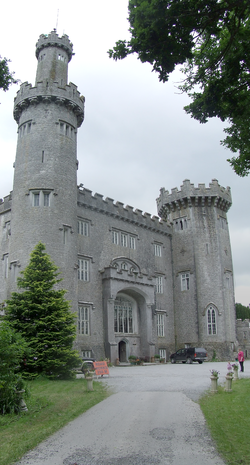
Charleville Castle is a Gothic-style castle located in County Offaly, Ireland, bordering the town of Tullamore, near the River Clodiagh. It is considered one of the finest of its type in the country.[1]

Key Information

History

[edit]

The first mansion house to be built on the site of Charleville Castle was by Thomas Moore circa 1641. The estate passed through the hands of Charles Moore, Lord Tullamore, grandson of Thomas, and when he died in 1674 it went via his sister Jane to Charles William Bury. Charles William was later (1806) created the 1st Earl of Charleville in a second creation of the title. The new earl decided to build a new house on the estate. Commissioned in 1798, it was designed by Francis Johnston, and was built between 1800 and 1812.[2]

The castle was not continuously occupied, owing to the castle owners' lack of resources. Each re-opening of the house resulted in the addition of new rooms or refurbishment. This included engaging William Morris, who designed the ceiling within the dining room. The castle played host to Lord Byron, who held many parties here. The house once boasted a painting from 1789 called Henry VIII, Act V, Scene 4 by Matthew William Peters, which having been removed from the house in 1970 is now in a Canadian collection.[3]

The castle remained uninhabited from 1912 when Colonel Howard-Bury left to live in Belvedere House, County Westmeath.[2] By 1968 the roof had been removed. Work on its restoration was commenced by Michael McMullen in 1973 and later by Constance Heavey Seaquist and Bonnie Vance. A Charitable Trust has been formed to help with the restoration.[4]

Present day

[edit]

As of 2014, the Charleville Castle Heritage Trust was managed by Dudley Stewart,[2] with the day-to-day running handled by volunteers. Events held at the castle have included "fright nights", an auction, and a play by the English Chamber Theatre called Dearest Nancy, Darling Evelyn. The Mór Festival and its successor, Castlepalooza, have been held at the castle, as has Facefest, a not-for-profit festival held in the Summer Solstice Weekend. As of 2014, the castle hosted a museum, "The Explorers' Museum", covering the history of exploration and dedicated to Charles Howard-Bury.[5][6]

The castle itself has been claimed to be the most haunted building and grounds in Europe, appearing on both Living TV's Most Haunted and Fox's Scariest Places on Earth. The most famous of these ghosts is that of a little girl called Harriet, who reputedly died after a fall in a staircase.[7] The castle has also been visited by several paranormal investigators and psychics.[4] It has been photographed by Simon Marsden, and has appeared on Ghost Hunters International. It was also used as a filming location for Becoming Jane (2007),[8][9] Northanger Abbey (2007), The Knight Before Christmas (2019) and The Green Knight (2020). The castle has also been used, alongside Ashford Castle in County Mayo, as a set for the "French Court" in the pilot episode of Reign (2013). And most famously for the second season of Wednesday 2025 [citation needed]

Charleville Forest, which borders the castle, is classified as a Special Area of Conservation.[10]

References

[edit]
[edit]
Revisions and contributorsEdit on WikipediaRead on Wikipedia
from Grokipedia
Charleville Castle is a Gothic Revival mansion located near in , , constructed between 1798 and 1812 for Charles William Bury, 1st Earl of Charleville, and designed by the renowned architect Francis Johnston. Regarded as one of the finest examples of neo-Gothic in , the castle features elaborate interiors including a grand gallery, an entrance hall with a cantilevered stone staircase, a , and rooms adorned with intricate and wood carvings. The lands were first granted to the Moore family in 1577 by Queen Elizabeth I, with the estate expanding to up to 24,000 acres before passing to the Bury family through inheritance in the late . The castle's construction followed a fire in Tullamore in 1785, which destroyed much of the town during Bury's 21st birthday celebrations, prompting the earl to rebuild and expand his family seat in a fashionable Gothic style that reflected the era's romantic ideals. Ownership remained with the Bury family until 1878, when the earldom became extinct, and the estate transitioned to the Howard-Bury family through marriage; notable descendants include Colonel Charles Kenneth Howard-Bury, who led the 1920–1921 reconnaissance expedition. The castle fell into disuse after the colonel's death in 1963, with the roof removed by 1968, leading to significant decay. Restoration efforts began in 1971 under American businessman Michael McMullen, who acquired the property and initiated repairs, followed by further work by subsequent owners Constance Heavy-Seaquist and Bonnie Vance. In 1994, the Charleville Castle Heritage Trust was established to oversee conservation, now managed by volunteers focused on sustainable practices. Today, the castle serves as a heritage site open for guided tours, hosting events such as weddings, music festivals like Castlepalooza, and investigations due to its reputed hauntings, including the of a young girl named Harriet.

Location and Setting

Geographical Position

Charleville Castle is situated in , in the Midlands region of , at coordinates of 53°15′37″N 7°31′41″W. This positioning places it bordering the southwestern outskirts of , approximately 2.5–3 kilometers from the town center, and in close proximity to the River Clodiagh, a of the broader Shannon River system. The castle's location within these historical estate lands underscores its integration into the local landscape, enhancing accessibility via nearby roads. The site is enveloped by ancient oak woodlands, remnants of Ireland's primordial forests, including the renowned King Oak, estimated to be over 400 years old and a key feature of the surrounding . These woodlands, part of the Charleville , provide a natural boundary that has historically contributed to the castle's secluded atmosphere, though the broader estate's environmental role is explored further elsewhere. Topographically, Charleville Castle occupies terrain at an elevation of approximately 80 meters (262 feet) above , characteristic of the gently undulating lowlands in central . This modest elevation and relatively flat to rolling landscape, free from steep gradients, have supported ease of access and development since the early , with no significant geological barriers impeding connectivity to and regional transport routes.

Surrounding Estate

The original estate associated with Charleville Castle encompassed approximately 24,000 acres at its peak during the , forming a vast landed property that included agricultural lands, parklands, and woodlands. Over time, economic shifts and land disposals reduced its scope, with the current boundaries extending over 2,000 acres under the ownership of the Charleville Estate Company, encompassing the castle and its immediate surrounding parkland and forest areas. A prominent component of the estate is Charleville Wood, designated as a (SAC 000571) pursuant to the EU Habitats Directive for its priority alluvial forest habitat and the presence of the Annex II species Desmoulin's whorl snail (Vertigo moulinsiana). This , one of Ireland's most significant examples, features pedunculate oak () and ash ()-dominated canopies, interspersed with wet alluvial forests around a small lake and swampy margins, supporting a rich understory of ramsons (), mosses like Rhytidiadelphus triquetris, and rare myxomycetes such as Hemitrichia calyculata and Perichaena depressa. The site's extends to fauna including wildfowl like mute swans (Cygnus olor), whooper swans (Cygnus cygnus), and ( crecca), as well as the Mycetobia obscura, all within an that has remained largely undisturbed for over 200 years. The estate's expansive forests and parklands play a crucial role in providing seclusion, isolating the castle from the nearby town of and amplifying its Gothic aesthetic through the dense, timeless canopy of ancient oaks that evokes a sense of romantic mystery.

History

Early Site and Construction

The site of Charleville Castle traces its origins to a 6th-century monastic settlement at Lynally, near in , , which was associated with the nearby monastery of Durrow founded by Saint Columba. In 1577, Queen Elizabeth I granted approximately 1,700 acres of land in the area to John Moore as part of the Tudor plantation efforts in Ireland, marking the beginning of the estate's assembly by the Moore family. The land was subsequently leased to English settler Robert Forth, who constructed an early house known as Redwood adjacent to the River Clodiagh in the late 16th or early . By the , Charles Moore, 2nd Baron Moore and 1st Earl of Charleville (of the first creation), had purchased the lease, establishing it as the and renaming the property Charleville after himself. The current castle's construction was commissioned between 1798 and 1800 by Charles William Bury (1764–1835), a wealthy landowner who had inherited the Charleville estate as an infant in 1764 following the death of his uncle, the 1st Earl of Charleville. Bury, then known as Lord , sought to replace the existing residence with a grander structure befitting his status, initiating the project amid the architectural trends of the post-Union era in Ireland. In 1806, King George III elevated Bury to the peerage as the 1st Earl of Charleville (second creation), further solidifying the estate's prestige and tying the castle's development to his newly acquired title. Actual building work commenced in 1800 and continued intermittently until completion in 1812, with some finishing touches extending to 1814, reflecting the project's scale and the architect's divided attentions. Renowned Dublin-based architect Francis Johnston was selected to design the castle, producing initial plans that incorporated Gothic Revival elements inspired by medieval Irish architecture and contemporary Romantic ideals, such as pointed arches, castellated towers, and ornate detailing. Johnston, who later became president of the Royal Hibernian Academy, drew from his experience with other Gothic projects, including St. Catherine's Church in , to create what is regarded as one of Ireland's finest examples of the style. The construction demanded significant resources, encompassing roughly 1,400 man-years of labor over the 14-year period, carried out largely by skilled local Irish craftsmen using local and timber. This intensive effort underscores the castle's role as a major patronage project, though exact costs remain undocumented in surviving records.

Ownership and Occupancy

Charleville Castle, completed in 1812 under the commission of Charles William Bury, 1st Earl of Charleville, served as the primary residence for the Bury family and their successors for much of the 19th century. The 1st Earl, who inherited the estate as an infant in 1764 and was elevated to the peerage in 1806, occupied the castle with his family, using it as a center for social and estate activities, including the development of the nearby town of Tullamore. During his tenure, the castle hosted notable visitors, such as the poet Lord Byron in the early 1800s, who frequently attended parties and social gatherings there. Upon the 1st Earl's death in 1835, the estate passed to his son, Charles William Bury, 2nd Earl of Charleville (1801–1851), who continued to maintain the property as a while serving as a and . The 2nd Earl's occupancy was marked by ongoing estate management, though financial strains began to emerge toward the end of his life in 1851. Succession then fell to his son, Charles William George Bury, 3rd Earl (1822–1859), who reoccupied the castle briefly after inheriting in 1851, despite a reduced family fortune; he resided there until his early death in 1859. The title continued through the family line with Charles William Francis Bury, 4th Earl (1852–1874), who succeeded as a minor and lived at the castle during his short adulthood before dying unmarried in 1874. The earldom then passed to his uncle, Alfred Bury, 5th and last Earl (1829–1875), who held the property for only a year until his death without male heirs, extinguishing the title in 1875. The estates, including the castle, devolved to the 3rd Earl's daughter, Lady Emily Alfreda Julia Bury (1856–1931), who had married Captain Kenneth Howard-Bury in 1881; the family adopted the surname Howard-Bury. Under Lady Emily's occupancy from 1885, the castle remained an active family home, where her son, Colonel Charles Kenneth Howard-Bury (1883–1963), was born and raised. During this period, modifications included the addition of stenciling to in the late 1860s, enhancing its aesthetic with Arts and Crafts influences. also featured a large 1789 painting by Matthew William Peters depicting a scene from (Act V, Scene 4), which covered much of one wall and was a prominent fixture until its removal in 1970 due to deterioration. Daily life at the castle involved estate oversight, social entertaining, and Colonel Howard-Bury's early pursuits in exploration and botany, though the family increasingly favored other properties. In 1912, Lady Emily relocated to Belvedere House, marking the end of continuous residency at Charleville Castle.

Decline and Restoration

Following the departure of Lady Emily Bury, the last surviving family member, in 1912, Charleville Castle remained uninhabited, initiating a period of prolonged neglect amid the and ensuing economic hardships. Over the ensuing decades, the structure deteriorated progressively, with exposure to weather accelerating decay after the deliberate removal of the roof in 1968 to circumvent property taxes; this act, combined with vandalism and looting during the 1970s, left the castle in near-ruinous condition, prompting authorities to classify it as such. Restoration commenced in 1971 under Michael McMullen, who undertook emergency repairs in the 1970s and 1980s, stabilizing the building and restoring the six principal public rooms through hands-on work with local craftsmen. Efforts continued under subsequent stewards Constance Heavy-Seaquist in the 1990s and Bonnie Vance in the 2000s, who relied on volunteer labor to advance conservation amid limited resources. In , the Charleville Castle Heritage Trust was founded as a volunteer-run charity to coordinate systematic preservation, addressing funding shortfalls through public donations and events while achieving incremental milestones, such as structural reinforcements by 2014. As of November 2025, the Trust's ongoing work persists with challenges in securing consistent financing, yet notable progress includes the reopening to the public in 2025, with the castle now open for guided tours and events, bolstered by hosted film productions such as the second season of and community support.

Architecture

Design and Style

Charleville Castle embodies the Gothic Revival style, a movement rooted in 18th-century that sought to evoke the grandeur and mystery of medieval castles through ornate, asymmetrical forms and pointed arches. This architectural approach, prominent in early 19th-century Britain and , emphasized emotional and effects over classical symmetry, aligning with broader cultural shifts toward celebrating the sublime in and . Architect Francis Johnston, renowned for blending Neo-Classical and Neo-Gothic elements in his works, led the design, drawing specific influences from Horace Walpole's —a pioneering Gothic villa in that the commissioning Bury family visited during their travels. Johnston adapted these motifs to create a cohesive vision, incorporating fan-vaulting inspired by Strawberry Hill's interiors, which themselves echoed Henry VII's Chapel at Westminster Abbey, to infuse the structure with a sense of historical revival. Commissioned by Charles William Bury, 1st Earl of Charleville, construction spanned from 1798 to 1812, employing local Irish craftsmen to build the castle using high-quality blue-grey limestone ashlar, which provided both durability and a textured, weathered appearance suited to the Gothic aesthetic. Scaled as an imposing yet compact country house rather than a defensive fortress, the design prioritized residential comfort with theatrical elevations, avoiding the sprawling irregularity of later Victorian Gothic examples. A distinctive feature of the castle's design is its deliberate integration with the surrounding landscape, sited within ancient primordial oak woods near the River Shannon to amplify dramatic vistas and a sense of romantic seclusion. This placement enhances the building's qualities, where the structure emerges suddenly from the forest, creating an immersive, storybook-like approach that underscores the era's fascination with nature as a framing device for architecture. The overall concept evolved from preliminary sketches by Lady Catherine Maria Bury, Johnston's patroness, which guided refinements toward a more personalized and evocative form during the planning phase.

Interior and Exterior Features

The exterior of Charleville Castle showcases Gothic Revival elements through its high square battlemented block of snecked rubble with trim, crowned by simple crenels on the main structure and more elaborate Irish-style battlements on the towers. A heavily machicolated octagonal tower rises at the northwest corner, while a slender round tower, reaching 125 feet, stands at the northeast like a castellated . The entrance facade centers on a massive corbelled arch framing the main door, surmounted by a great window and flanked by pointed arches that emphasize the Gothic aesthetic. To the right extends a long, low range of battlemented offices and a , accented by pinnacles and a gateway. Inside, the grand , constructed from heavy with intricate Gothic , ascends through three storeys from the hall, where it is framed by galleries and a groined supported on graceful shafts; the features a panelled dado with ogee-headed niches. preserves a coffered stenciled in gold leaf by during his late 1860s visit, complemented by a modeled on the west door of , and double-cusped paneling. The library holds a rib-vaulted , built-in Gothic bookcases, and heraldic windows, while the drawing rooms feature a main space with a adorned by heraldic panels, a panelled dado, and a , linking to an adjacent rib-vaulted music room. The state bedrooms reflect the castle's Gothic furnishings, including arched ceilings and elements that align with the overall ornamental and . The vast saloon on the garden front displays a fan-vaulted with gigantic pendants, paired with carved Gothic fireplaces and grained wood paneling that mimics . Preserved details such as these fireplaces, rib-vaulted ceilings, and Gothic paneling underscore the interior's cohesive design.

Hauntings and Legends

Reported Apparitions

One of the most prominent apparitions reported at Charleville Castle is that of Lady Harriet Bury, the youngest daughter of Charles William Francis Bury, the 3rd Earl of Charleville. She tragically died on April 3, 1861, at the age of eight, after falling from the banister of the castle's main oak staircase in the nursery area, plummeting two stories to her death. Visitors and residents have frequently described sightings of her ghost as a little girl dressed in a blue and white gown, with golden curls and blue ribbons, often appearing on or near the staircase. Accompanying phenomena include the sounds of her singing, laughing, or sobbing echoing through the halls, particularly at night, as well as sudden cold touches and screams emanating from the staircase area. Beyond Harriet, accounts of other spectral figures persist, including gatherings of ghostly in hooded robes, reportedly seen processing through certain rooms or circling beds in the upper chambers. These monk apparitions are sometimes linked to the castle's location on ancient ley lines—magnetic strips beneath the believed by the original builders, who were Freemasons with interests, to amplify energies. Malevolent spirits have also been noted in a now-sealed room, contributing to reports of poltergeist-like disturbances such as doors slamming shut unaided and unexplained bumps or footsteps in the bedrooms. Historical anecdotes further describe auditory hauntings, including the distant sounds of children playing in disused areas like the nursery, evoking the castle's past as a family residence. These manifestations are said to be tied to the site's setting, potentially enhanced by the ley lines that the 1st of Charleville deliberately incorporated into the estate's design during construction in the early . Overall, the Bury family's lingering presence is felt strongly, with multiple active spirits reported by volunteers and guests, underscoring the castle's reputation as a focal point for .

Investigations and Media

Charleville Castle has been the subject of numerous investigations, attracting teams equipped with (EVP) recorders, thermal imaging, and other detection tools to document reported activity. Independent groups, such as the Paranormal Research Association of , have conducted overnight sessions, capturing audio anomalies interpreted as EVPs, including whispers and childlike voices in areas like the main and . These investigations often report sudden temperature drops of up to 10 degrees in unoccupied rooms, alongside fluctuations, which investigators attribute to spirit presence. The castle gained significant media exposure through television programs focused on hauntings. In 2002, the British series , hosted by , filmed an episode at the site, where the team documented poltergeist-like object movements and conducted a Victorian-style in the , resulting in claimed spirit communications via table tipping. Fielding's group reported personal encounters, including physical touches and auditory responses during EVP sessions, contributing to the castle's growing notoriety. Earlier, in 2001, the Fox Family Channel's featured the Ulrich family attempting an overnight "haunted castle dare," during which they experienced locked doors, unexplained noises, and apparitions, fleeing before dawn. Ghost hunts remain a staple of the castle's event calendar, particularly during Halloween periods, with organized vigils allowing public participation in controlled investigations using spirit boxes and REM pods. In October 2025, Investigations Ireland Limited led a hunt, capturing real-time EVP responses and shadow figures on camera, further amplifying the site's lore. The castle's reputation as one of Europe's locations has been reinforced by recent global rankings. In 2023, it was highlighted as a premier hotspot in European guides due to consistent visitor reports of activity. By 2024, it featured in lists of Ireland's top haunted sites, drawing international investigators. A 2025 TripAdvisor analysis of traveler reviews ranked Charleville eighth among the world's scariest Halloween destinations, based on mentions of eerie encounters and ghostly sightings. Despite this, no formal scientific debunking has occurred, though some experts suggest psychological factors like suggestion and environmental acoustics may influence perceptions of hauntings.

Present Day

Management and Preservation

The Charleville Castle Heritage Trust, a voluntary founded in , has managed the castle since 2014 under the leadership of Stewart, with day-to-day operations supported by a core team of international volunteers. The trust focuses on the site's restoration and sustainable conservation, relying on volunteer efforts for maintenance, event coordination, and heritage research to ensure the castle's viability as a cultural landmark. As a protected structure under Irish law—designated with Record of Protected Structures number 23-06 by Offaly County Council in accordance with the Planning and Development Act 2000—the castle receives legal protections that mandate careful conservation of its Gothic Revival features. However, preservation faces significant challenges, including the high costs of structural upkeep for a 19th-century building prone to weather damage and deterioration. The trust depends almost entirely on public donations, campaigns, and grants from heritage organizations, such as those administered by the Heritage Council of Ireland, to finance these efforts without consistent government funding. For instance, a 2023 initiative raised funds specifically for urgent roof repairs, highlighting the precarious financial position that limits the scope and pace of work. As of 2025, notable progress has been made on roof repairs, with conservation work on the main roof and King's Tower (also known as the Octagonal Tower) continuing from 2024 to address aging timber, weather-induced wear, and water ingress risks. These repairs, essential for preventing further interior damage, were partially supported by revenues from hosted film projects in early 2025, though additional fundraising remains critical for completion. As of November 2025, additional fundraising campaigns continue for roof repairs to prevent further damage. Efforts toward were constrained by ongoing maintenance, leading to a temporary closure of guided public access in spring 2025, with the castle reopening in late summer 2025 to allow safe improvements. Sustainability initiatives emphasize long-term conservation practices, including targeted repairs to minimize environmental impact on the surrounding , though these are integrated into broader volunteer-led projects rather than standalone programs.

Events and Cultural Role

Charleville Castle has gained prominence as a filming location for various media productions, leveraging its Gothic Revival architecture to evoke period authenticity and atmospheric fantasy. In 2007, it served as the primary setting for Lady Gresham's house in the biographical drama Becoming Jane, starring Anne Hathaway as Jane Austen, with interior and exterior scenes capturing the castle's ornate halls and grounds during a three-week shoot in Tullamore. The 2021 fantasy film The Green Knight, directed by David Lowery, utilized the castle as the Lord's opulent residence, filming key interior sequences amid its vaulted ceilings and stonework to enhance the Arthurian tale's medieval grandeur. More recently, in season 2 of Netflix's Wednesday (premiered 2025), the castle's corridors and chambers were transformed into interiors for Nevermore Academy, providing continuity with the series' gothic aesthetic after season 1's Romanian locations, with production wrapping in late 2024. The visibility from season 2 has significantly amplified to the castle and surrounding Offaly region, as part of a broader "screen tourism" trend. Tourism Ireland invested nearly €200,000 in a targeted campaign to highlight Irish filming sites from the series, resulting in increased inquiries and bookings for guided experiences at Charleville. This surge underscores the castle's role in promoting 's heritage through contemporary entertainment. The also hosts cultural exhibitions that celebrate its historical ties to exploration and architecture. Housed within its premises is the Explorers Museum, established in 2014, whose inaugural display focuses on Charles Howard-Bury—former owner and leader of the 1921 British reconnaissance expedition—with artifacts including rare photographs, journals, and expedition memorabilia from the 1920s climbs, drawing on his personal collection preserved at the site. In 2025, the museum continues to feature updated digital elements from the 2021 centenary exhibition, alongside temporary displays on Irish exploration history, while the grounds host cultural events, having previously included the Castlepalooza (2005–2018). As a quintessential symbol of the Irish Gothic Revival, Charleville Castle embodies the 19th-century that influenced and , inspiring narratives of mystery and grandeur in Irish . Its dramatic silhouette and haunted lore have appeared in artistic depictions of Gothic estates, reinforcing its status as an icon of Ireland's architectural and folkloric legacy.

References

Add your contribution
Related Hubs
User Avatar
No comments yet.