


Charlottenlund
View on Wikipedia | This article needs additional citations for verification. (August 2024) |

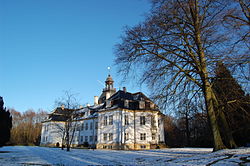
Charlottenlund is a suburban area on the coast north of Copenhagen, Denmark. It is the administrative seat of Gentofte Municipality. Bordered to the east by the Øresund, to the South by Hellerup and to the north by Klampenborg, it is one of the wealthiest areas in Denmark. The neighbourhood takes its name after Charlottenlund Palace.
History
[edit] |

In 1733, King Christian VI of Denmark rebuilt the Gyldenlund Palace, renaming it Charlottenlund Palace after his sister Princess Charlotte Amalie.
In the 19th century, it became popular with the bourgeoisie in Copenhagen to make excursions to the countryside north of the city. Charlottenlund Forest was a popular destination.
The postal code of Charlottenlund is 2920.
Schools
[edit]Culture and recreation
[edit]Local landmarks include Charlottenlund Palace and Gentofte Town Hall.
The Ordrupgaard Museum boasts collections of Danish and French art from the 19th and beginning of the 20th century.
Charlottenlund Fort is located in Charlottenlund Beach Park. It houses a popular camp site. The beach park and the adjacent Charlottenlund Forest forms the largest green space in Gentofte Municipality. Charlottenlund Racetrack is situated just north of Charlottenlund Forest, and has weekly harness races. Most horses and jockeys are from Denmark, but several times every year the track hosts international events, with entries from Europe and North America.
Notable people
[edit]

Public Service
[edit]- Ernst Heinrich, Baron von Schimmelmann (1747–1831) was a German-Danish politician, businessman and patron of the arts; eponym of Schimmelmannsvej in Charlottenlund
- Thomas Arboe (1837 – 1917 in Charlottenlund) architect
- Christian X of Denmark (1870 Charlottenlund Palace – 1947) King of Denmark from 1912/1947
- Princess Dagmar of Denmark (1890 in Charlottenlund Palace – 1961) was the youngest child and fourth daughter of Frederick VIII of Denmark
- Tine Susanne Miksch Roed (born 1964) deputy director-general at the Confederation of Danish Industry, lives in Charlottenlund
- Sabine Auken (born 1965) German bridge player, lives in Charlottenlund
- Peter Fischer-Møller (born 1955 in Charlottenlund) prelate, Bishop of Roskilde
The Arts
[edit]- Carl Ewald (1856 – 1908 in Charlottenlund) novelist and satirist known for his fairy tales.[1]
- Johannes Hauerslev (1860 – 1921 in Charlottenlund) photographer of street scenes and buildings in Copenhagen
- Ruth Berlau (1906 in Charlottenlund – 1974) actress, director, photographer and writer; collaborated with Bertolt Brecht[2]
- Axel Strøbye (1928 – 2005 in Charlottenlund) stage and film actor [3]
- Anne Marie Helger (born 1946 in Charlottenlund) actress in theatre, films and TV [4]
- Bitte Kai Rand (born 1956) fashion designer for mature women; brought up in Charlottenlund
- Claus Norreen (born 1970 in Charlottenlund) musician and record producer, in the band Aqua
- Catharina Svensson (born 1982 in Charlottenlund) lawyer, a professional equestrienne, model and beauty queen; Miss Earth 2001
- Stephania Potalivo (born 1986 in Charlottenlund) actress and former child star [5]
Sports
[edit]- Holger Rune (born 2003) a tennis player
See also
[edit]References
[edit]- ^ . Encyclopedia Americana. Vol. X. 1920.
- ^ IMDb Database retrieved 21 April 2020
- ^ IMDb Database retrieved 20 April 2020
- ^ IMDb Database retrieved 22 April 2020
- ^ IMDb Database retrieved 20 April 2020
External links
[edit] Media related to Charlottenlund at Wikimedia Commons
55°45′02″N 12°33′07″E / 55.750472°N 12.552073°E
| International | |
|---|---|
| National | |
| Geographic | |
| Other | |

Charlottenlund
View on GrokipediaGeography
Location and Borders
Charlottenlund is a suburban area located in Gentofte Municipality, part of the Capital Region of Denmark. Positioned along the western shore of the Øresund strait, it serves as a coastal extension of the greater Copenhagen metropolitan area, situated approximately 10 kilometers north of the city center. This placement integrates Charlottenlund into Denmark's densely populated Hovedstaden region, where it functions as a key residential and administrative hub.[11][12] The area's boundaries are clearly delineated by natural and urban features: to the east, it is bordered by the Øresund strait, providing direct access to the Baltic Sea; to the south, it adjoins the neighboring suburb of Hellerup; to the north, it meets Klampenborg; and to the west, it transitions into the more inland portions of Gentofte Municipality. These borders encompass a compact urban landscape that blends residential zones with proximity to natural waterways, emphasizing Charlottenlund's role as a transitional space between Copenhagen's urban core and the surrounding countryside.[11] Geographically, Charlottenlund is centered at coordinates 55°45′13″N 12°35′31″E, with the postal code 2920 assigned to the district. As the administrative seat of Gentofte Municipality, it hosts key municipal offices and governance functions, underscoring its central position within local administration.[13][14][15]Natural Features
Charlottenlund occupies a coastal position along the Øresund strait, where its proximity to the sea creates a milder local climate characterized by moderated temperatures and increased humidity compared to inland areas. The eastern border with Øresund provides direct access to white sandy beaches stretching along the shoreline, contributing to a landscape that emphasizes open water views and marine-influenced ecosystems.[11][16] The Charlottenlund Forest, known as Charlottenlund Skov, is a woodland area in Gentofte Municipality, encompassing lush deciduous woodlands dominated by beech and oak trees. This woodland area includes ancient oak groves, interspersed with elm, maple, and yew in the understory, along with small open grasslands and natural clearings formed by fallen trees, fostering a varied and ecologically rich environment adjacent to the coast.[12][17] Charlottenlund Beach Park integrates natural coastal elements such as expansive sandy beaches and adjacent green lawns with historical fort structures embedded within the terrain, creating a harmonious blend of landscape features. The park's paths wind through these areas, highlighting the gentle integration of seaside dunes and forested edges that define the site's environmental character.[18][19] The overall topography of Charlottenlund reflects typical Danish coastal plains, with flat to gently rolling terrain and minimal elevation changes, averaging about 14 meters above sea level, which supports easy accessibility and unobstructed views of the surrounding Øresund waters.[20]History
Origins and Palace Construction
Prior to the 18th century, the area now known as Charlottenlund consisted of rural lands and royal hunting grounds north of Copenhagen, referred to in the 17th century as the "small deer garden" under the king's ownership. These grounds formed part of the expansive deer parks maintained by the Danish monarchy for recreational hunting and estate management. In 1730, King Christian VI gifted the estate to his sister, Princess Charlotte Amalie, daughter of King Frederik IV.[21] The following year, she commissioned the construction of a new palace on the site, designed by Danish architect Johan Cornelius Krieger and built on the foundations of an earlier structure known as Gyldenlund Palace.[22][21] Utilizing materials salvaged from the recently demolished Copenhagen Castle, the project was completed in 1733, and the palace was renamed Charlottenlund in honor of its patroness.[22][21] This Baroque-style edifice, characterized by its symmetrical design, mansard roof, and central dome, served primarily as a royal summer residence, exemplifying the era's architectural trends and influencing the naming of the surrounding suburban district.[22][23] By the early 19th century, Charlottenlund Palace had become a favored excursion destination for Copenhagen's elite, with its public-access park drawing visitors and encouraging preliminary development in the vicinity.[22] The palace remained in royal use as a seasonal retreat for subsequent generations.[23]Modern Suburban Development
In the mid-19th century, Charlottenlund emerged as a favored bourgeois excursion destination for Copenhagen residents, drawn by the fame of its royal palace and surrounding parks, which offered leisurely outings with music and pavilions during the summer season.[23] The opening of Charlottenlund Station in 1863 on the Klampenborg railway line significantly enhanced accessibility, transforming the area from a remote royal estate into an attractive site for weekend visits and initial residential development.[24] This connectivity spurred the construction of villas and estates, particularly along the coast and near Bernstorff Park, as affluent Copenhageners sought summer retreats amid the green landscapes.[25] By the late 19th and early 20th centuries, Charlottenlund's integration into the expanding Gentofte Municipality—formalized through the 1842 municipal reforms that encompassed surrounding parishes—fueled steady population growth alongside Copenhagen's urbanization.[24] The area saw accelerated villa construction north of Bernstorff Park starting around 1900, with notable examples like Ordrupgaard (1918) designed by prominent architects, reflecting a blend of romantic landscaping and modern residential zoning.[24] This period's development was further elevated by the royal prestige associated with Charlottenlund Palace, a summer residence used by the Danish monarchy until the 1930s, including during the reign of King Christian X (1912–1947), whose birthplace there in 1870—along with that of his brother, King Haakon VII of Norway in 1872—underscored the site's enduring elite status.[23] The 20th century brought a post-World War II suburban boom to Charlottenlund, driven by state-supported housing initiatives that added thousands of homes in the 1940s and 1950s, including designs by architects like Arne Jacobsen.[25] Despite this expansion, efforts to preserve green spaces persisted, exemplified by the public opening of Charlottenlund Strandpark in 1932 and restrictions on dense development, such as the 1973 decision to limit new housing in Strandlund to just 144 collective units and 66 owner-occupied homes amid local opposition.[24] Key natural areas like Charlottenlund Forest and Bernstorff Park were maintained as recreational buffers against urbanization, ensuring the suburb's character as an affluent, verdant enclave.[25] Following the royal family's discontinuation of use in 1935, Charlottenlund Palace served various administrative functions, including as offices for government agencies. It underwent major restoration and opened to the public in 2017 as a venue for cultural events and exhibitions, continuing to contribute to the area's heritage and attractiveness as of 2025.[5]Demographics and Economy
Population and Demographics
As of 2025 estimates, Charlottenlund has a population of approximately 40,000 residents.[26] This figure positions it as one of Denmark's mid-sized suburban communities within the Capital Region. Charlottenlund forms a key part of Gentofte Municipality, which recorded a total population of 75,076 on January 1, 2025.[27] The area's population density aligns with the broader suburban character of Gentofte Municipality, at around 2,940 inhabitants per square kilometer, based on the municipality's 25.60 km² land area.[28] Historically, the region has transitioned from low rural densities in the 19th century to modern suburban levels, driven by urban expansion from Copenhagen; the municipal population grew modestly from 74,838 in 2023 to 75,076 in 2025, reflecting steady but limited expansion.[27] Demographically, Charlottenlund and surrounding Gentofte feature a predominance of middle-aged adults and families, with 20.3% of the municipal population aged 40-54 and 14.6% aged 55-64 as of 2025.[27] Youth under 16 comprise about 16.5% (including 5.7% aged 0-5 and 12.5% aged 6-15), while those over 65 account for 21.5%, resulting in a balanced but slightly older profile compared to Denmark's national averages of 16.4% youth and 19.9% elderly.[29] The ethnic composition is overwhelmingly Danish, with 82.3% of residents of Danish origin; small immigrant communities, primarily from European and Asian countries, constitute 15.0% immigrants and 2.7% descendants.[27]Economic Characteristics
Charlottenlund, located within Gentofte Municipality, is recognized as one of Denmark's wealthiest residential areas, with Gentofte consistently ranking as the municipality with the highest average income nationwide.[30] The average gross income per person in Gentofte reached 1,217,340 DKK in recent data, surpassing the national average and reflecting the affluent socioeconomic profile of the suburb.[30] This high income level supports a lifestyle centered on professional and service-oriented occupations, contributing to the area's reputation for economic prosperity.[27] As a primarily residential suburb of Copenhagen, Charlottenlund features limited local industry and instead emphasizes commuting to the capital for work, with economic activity focused on high-value services and professional sectors.[31] Residents are predominantly employed in roles such as top leadership (8.8% of the workforce) and high-level professional positions (35.6%), including finance, technology, and public administration, which align with the suburb's educated and affluent demographic.[27] The unemployment rate remains low at 2.2%, below the national average of around 3%, underscoring strong labor market participation with 78% employment frequency among those aged 16-66.[30][27] Housing in Charlottenlund reflects its economic status, with average property values exceeding 5 million DKK for homes, driven by high demand in this desirable suburb.[30] Property prices average 54,000 DKK per square meter in Gentofte, often higher in Charlottenlund due to its coastal location and prestige, featuring a mix of spacious villas, modern apartments, and historic estates.[30][32] Recent sales data show detached houses frequently surpassing 18 million DKK, reinforcing the area's role as Copenhagen's most expensive suburb.[33]Government and Infrastructure
Municipal Administration
Charlottenlund functions as the administrative seat of Gentofte Municipality, housing the Gentofte Town Hall at Bernstorffsvej 161, which serves as the primary center for municipal operations including urban planning, social welfare administration, and citizen services.[34] This location centralizes key governance activities for the broader municipality, facilitating efficient delivery of public services to residents across its districts.[35] Gentofte Municipality, covering a total area of 25.55 km², operates under a council-based structure with 19 elected members, led by Mayor Michael Fenger of the Conservative People's Party (Det Konservative Folkeparti) since May 2021.[36][37] The municipality emphasizes policies focused on preserving green spaces, maintaining low property taxes to support economic health, and delivering high-quality public services through innovative and efficient management practices aimed at sustainability.[12] For instance, its procurement strategy integrates sustainable practices to balance environmental goals with operational needs.[38] Key facilities in Charlottenlund include the town hall's multifunctional spaces for administrative and community engagement, as well as the Ordrup Library, one of six public libraries in the municipality offering borrowing services for books, e-books, videos, and music to support local cultural and educational needs.[39] These resources underscore Charlottenlund's role in fostering accessible municipal services and community interaction within Gentofte.[40]Transportation Networks
Charlottenlund is well-connected to Copenhagen via the S-train network, with Charlottenlund Station serving as the primary rail hub on the Klampenborg radial line. The station is regularly serviced by Line C trains operated by Danish State Railways (DSB), providing direct access to central Copenhagen in approximately 15 minutes.[41] Trains on this line depart every 15 minutes during peak hours and operate until late evening, facilitating efficient commuting for the area's workforce.[42] Occasional services on Line F also stop at the station, enhancing connectivity to other northern suburbs.[43] Local bus services, managed by the public transport authority Movia, complement the rail network by linking Charlottenlund to adjacent suburbs and Copenhagen's core. Key routes include bus line 184, which runs from Nørreport Station through Charlottenlund toward Holte, and line 192, connecting Lyngby Station to Charlottenlund Fort along the coastal areas.[44][45] These services operate frequently, with intervals of 15-20 minutes during weekdays, offering flexible options for short trips within the region.[46] Road access in Charlottenlund relies on the scenic Strandvejen, designated as Route 152, a coastal highway that parallels the Øresund shoreline and provides direct vehicular links to Copenhagen, approximately 10 kilometers south.[47] The area is also proximate to the E47/E55 motorway, accessible via Exit 17 near Hellerup, enabling quick drives to northern Zealand or southward toward the capital in under 20 minutes.[47] Cycling infrastructure integrates seamlessly with Charlottenlund's green spaces, featuring dedicated paths along the Kystbaneruten coastal route that connect to Copenhagen's extensive bike network.[48] While no major airport serves the suburb directly, Copenhagen Airport lies about 17 kilometers away, reachable in 20-25 minutes by car or public transport.[49]Education
Primary Education
Primary education in Charlottenlund falls under the Danish folkeskole system, encompassing compulsory schooling from preschool class (age 6) through 9th grade (age 16). Municipal schools in Gentofte Municipality, which includes Charlottenlund, provide free education to all residents, emphasizing a comprehensive curriculum that develops academic, social, and personal skills.[50][51] Two key municipal primary schools serve the Charlottenlund area: Ordrup Skole, located at Grønnevænge 16, and Skovgårdsskolen, at Skovgårdsvej 56. Ordrup Skole enrolls approximately 625 students across grades 0-9 (as of 2024), while Skovgårdsskolen has about 731 students (as of 2023-2024), combining for roughly 1,356 pupils in these institutions.[52][53] Both schools follow the national Danish curriculum, which mandates subjects such as Danish, English (introduced from 1st grade), mathematics, and science, with a strong focus on STEM integration alongside humanities and practical skills. This reflects high participation in the folkeskole system.[54] Private school options complement the public system in Gentofte, with seven independent schools offering alternative curricula for primary and lower secondary levels.[12] Some, such as those with international lines in the municipality, specialize in bilingual or globally oriented programs, including English immersion and preparation for international qualifications, though families pay tuition fees typically ranging from DKK 1,250 to 2,500 per month (as of 2025). Notable private options include international schools like Rygaards International School and the International School of Hellerup, offering programs for global families. These private institutions often cater to diverse needs, including specialized language or academic tracks, and are accessible to Charlottenlund residents.[50][55][56][57] School facilities in the area feature modern campuses designed for contemporary learning, with many incorporating Denmark's udeskole tradition of outdoor education. Ordrup Skole, for instance, includes innovative indoor-outdoor spaces that leverage nearby green areas for experiential learning, promoting physical activity and environmental awareness. Similarly, Skovgårdsskolen benefits from its proximity to Charlottenlund's parks and forests, integrating local natural spaces into daily activities to enhance student well-being and curriculum delivery.[58][59][60]Secondary Education
Secondary education in Charlottenlund primarily revolves around the gymnasium system, which provides upper secondary education for students aged 16 to 19 preparing for university or further studies. The main institution serving the area is Ordrup Gymnasium, located at Og Kirkevej 5 in Charlottenlund. Established in 1873, it is a co-educational day school that enrolls approximately 840 students and employs around 80 teachers.[61][62] Ordrup Gymnasium offers a range of general academic tracks designed to foster broad intellectual development, with a focus on STEM, humanities, and arts disciplines. Students select from specialized study directions (studieretninger), including Biotek for biotechnology, Science for natural sciences, Krop og Natur for health and physical education, SAMF-MAT for social studies with mathematics, SAMF-ENG for social studies with English, Verdensklassen for global perspectives, Sprog og Kultur for languages and culture, and Musik og Kultur for music and arts. These programs emphasize interdisciplinary learning, critical thinking, and practical application, aligning with Denmark's national gymnasium curriculum.[63] The school also supports athletic development through its elite sports program, enabling students to train at a high level in various disciplines while completing their three-year studentereksamen (upper secondary exam). This integration of academics and sports caters to Charlottenlund's active community, promoting balanced personal growth. For those pursuing vocational paths, students from Charlottenlund have access to nearby options within Gentofte Municipality and the broader Copenhagen region, such as programs offered by TEC, Denmark's second-largest vocational training college. Ordrup Gymnasium's curriculum effectively prepares graduates for higher education, reflecting the high academic standards typical of Danish gymnasiums.[64][65]Culture and Recreation
Cultural Landmarks and Museums
Charlottenlund Palace, constructed between 1731 and 1733 in the Baroque style for Princess Charlotte Amalie, daughter of King Frederick IV, served as a royal summer residence throughout the 18th and 19th centuries.[66] The palace was later remodeled in the French Renaissance revival style and remained a favored retreat for Danish monarchs, including King Frederik VIII.[5] It holds historical significance as the birthplace of King Christian X on September 26, 1870, and King Haakon VII of Norway on August 3, 1872.[12] Today, following its use as the Danish Biological Station from 1935 to 2017, the palace functions as a cultural event venue, hosting classical concerts in its Great Hall and other public gatherings since its refurbishment and opening in 2017.[67] The Ordrupgaard Museum, established in 1918 by industrialist Wilhelm Hansen and his wife Henny, houses one of Northern Europe's premier collections of 19th- and early 20th-century Danish and French art.[68] Its Danish holdings feature introspective interiors by Vilhelm Hammershøi, capturing serene domestic scenes, alongside works by other Golden Age artists.[68] The French collection emphasizes Impressionist masterpieces, including paintings by Claude Monet, Pierre-Auguste Renoir, and Édouard Manet that depict vibrant Parisian life, gardens, and landscapes.[68] The museum's grounds include expansive gardens integrated with contemporary sculptures for visitor reflection, while modern extensions—such as Zaha Hadid's undulating black pavilion added in 2005 and Snøhetta's subterranean galleries completed in 2018—enhance accessibility and exhibition space without overshadowing the original villa.[68] Gentofte Town Hall, designed by architect Thorvald Jørgensen, stands as a neoclassical landmark completed in 1936 at Bernstorffsvej 161 in Charlottenlund.[12] As the administrative center for Gentofte Municipality, the building hosts council meetings, exhibitions, and concerts, underscoring its role in preserving local heritage since its designation as a protected structure.[12] Charlottenlund Fort, originally built as a coastal battery from 1886 to 1888 and expanded into a full fort in 1910, formed part of Copenhagen's outer ring of 19th-century defenses against naval threats.[69] Spanning 300 meters in length, the earthwork structure included artillery positions for cannons up to 35.5 cm in caliber and infantry barracks, though it saw no active combat.[69] Decommissioned in 1932, the site has been repurposed as a cultural and recreational venue, featuring a campsite with 65 pitches, a restaurant offering Øresund views, and preserved fortifications open for public exploration and events.[70]Parks and Sports Facilities
Charlottenlund Beach Park, located along the Øresund coast at Strandvejen 144 B, serves as a primary seaside recreational area featuring a white sandy beach, expansive green lawns, and dedicated paths for walking and cycling.[60] The park includes modern facilities such as showers, kitchens, a dining room, and laundry services, supporting activities like swimming, sunbathing, water sports, and informal sports on the grass.[60] A campsite within the grounds accommodates tents, caravans, and motorhomes from March to October, making it family-friendly for extended stays.[60] The adjacent historical Charlottenlund Fort, a former military site, hosts community events and provides elevated viewpoints over the coastline.[9] Adjacent to the beach park, Charlottenlund Forest (Charlottenlund Skov) offers a prominent wooded expanse ideal for hiking along shaded trails, picnics in grassy clearings, and leisurely strolls, with paths suitable for dog walking.[71] This coastal woodland connects to broader green spaces in Gentofte Municipality, emphasizing natural recreation amid Denmark's urban-suburban landscape.[72] Sports facilities in Charlottenlund center on the historic Charlottenlund Racetrack (Charlottenlund Travbane), the oldest harness racing venue in the Nordic countries, operational for over a century and hosting regular trotting events weekly.[73] The track features a 950-meter oval and accommodates international competitions, including the prestigious Danish Trotting Derby held annually in late August for 4-year-old horses over 3,000 meters.[73] Local sports clubs, such as those affiliated with Gentofte Tennis Klub and Skovshoved Tennis Club, provide tennis courts and programs for all ages, while football is supported through municipal clubs offering team play and training.[74][75] Additional amenities include beach volleyball courts at the park and coastal cycling routes along Strandvejen, promoting active, family-oriented pursuits like group games and scenic rides.[76][77]Notable People
Politics and Public Service
King Christian X (1870–1947)Christian X, born on 26 September 1870 at Charlottenlund Palace near Copenhagen, served as King of Denmark from 1912 until his death in 1947. [78][79] He is remembered for his role during the German occupation of Denmark in World War II, where his daily horseback rides through Copenhagen became a powerful symbol of national resistance and unity against the Nazis. [80] Christian X's steadfast presence helped maintain Danish morale and sovereignty under duress, earning him enduring respect as a defender of democratic values. [80] Michael Fenger (born 1962)
Michael Fenger has been the mayor of Gentofte Municipality, which includes Charlottenlund, since 2021, representing the Conservative People's Party. [81] Under his leadership, Gentofte has emphasized sustainable development through initiatives aimed at reducing environmental impact and promoting resource efficiency. [12] Fenger's administration has also engaged in international climate discussions, including collaborations on mitigation and adaptation strategies. [82] Marianne Jelved (born 1943)
Marianne Jelved, born on 5 September 1943 in Charlottenlund, is a prominent Danish politician who served as Minister for Economic Affairs from 2011 to 2014 in Helle Thorning-Schmidt's government. [83] As a long-time member of the Social Democrats and former chair of the party's parliamentary group, she focused on fiscal policy reforms and economic stability during the European financial crisis. [83] Jelved's career highlights her contributions to Danish public administration, including advocacy for balanced budgets and social welfare enhancements. [83]