


Community hub
Recent from talks
Contribute something
Nothing was collected or created yet.
Aalborg
View on Wikipedia
Aalborg or Ålborg (/ˈɑːlbɔːrɡ/ AHL-borg, US also /ˈɔːl-/ AWL-;[9][10] Danish: [ˈʌlˌpɒˀ] ⓘ) is Denmark's fourth largest urban settlement (behind Copenhagen, Aarhus, and Odense) with a population of 119,862 (1 July 2022)[11] in the town proper and an urban population of 143,598 (1 July 2022).[11] As of 1 July 2022, the Municipality of Aalborg had a population of 221,082,[12] making it the third most populous in the country after the municipalities of Copenhagen (capital) and Aarhus. Eurostat and OECD have used a definition for the metropolitan area of Aalborg (referred to as a "functional urban area"), which includes all municipalities in the province (Danish: landsdel) of North Jutland (Danish: Nordjylland), with a total population of 594,323 as of 1 July 2022.[13][7][6]
Key Information


.svg)


By road Aalborg is 64 kilometres (40 mi) southwest of Frederikshavn, and 118 kilometres (73 mi) north of Aarhus. The distance to Copenhagen is 412 kilometres (256 mi) if travelling by road and not using ferries.
The earliest settlements date to around AD 700. Aalborg's position at the narrowest point on the Limfjord made it an important harbour during the Middle Ages, and later a large industrial centre. Architecturally, the city is known for its half-timbered mansions built by its prosperous merchants. Budolfi Church, now a cathedral, dates from the end of the 14th century and Aalborghus Castle, a royal residence, was built in 1550. Today, Aalborg is a city in transition from a working-class industrial area to a knowledge-based community. A major exporter of grain, cement, and liquors, its thriving business interests include Siemens Gamesa Renewable Energy, Alfa Laval, and Aalborg Portland. These companies have become global producers of wind turbine rotors, marine boilers, and cement.
With its theatres, symphony orchestra, opera company, performance venues, and museums such as Aalborg Historical Museum and the Aalborg Museum of Modern Art, Aalborg is an important cultural hub. The Aalborg Carnival, held at the end of May, is one of the largest festivals in Scandinavia, attracting some 100,000+ people annually. The town's major university is Aalborg University (often abbreviated to AAU), founded in 1974, which has more than 20,000 students (as of 2018).[14] AAU is also North Jutland's largest university and overall academic institution. The University College of Northern Denmark (UCN) is one of seven new regional organisations while the Royal School of Library and Information Science (RSLIS) provides higher education in library and information science. Trænregimentet, the Danish regiment for army supply and emergency medical personnel, is also in Aalborg. Aalborg University Hospital, the largest in the north of Jutland, was founded in 1881.
The football club Aalborg BK, established in 1885 and based at Nordjyske Arena, won the Danish Superliga in the 1994–95 season, the 1998–99 season, the 2007–08 season, and the 2013–14 season. Other sports associations include the ice hockey club Aalborg Pirates, the men's handball team Aalborg Håndbold, the rugby club Aalborg RK, and Aalborg Cricket Club. Aalborg Railway Station, on John F. Kennedys Plads has connected the city to Randers and the south since 1869. Aalborg Airport is just 6 kilometres (3.7 mi) northwest of the city centre, and the E45, a European route from Alta, Norway, to Gela, Italy, passes through Aalborg.
A 2014 survey by the European Commission found that the citizens of Aalborg are the most satisfied people in Europe with their city.[15]
Name
[edit]The name of Aalborg can be traced back to coins from the 11th century in the form of Alabu or Alabur.[16] Like Aabenraa, there has been dissent regarding the spelling of the city's name. In current times, the modern name of Aalborg is nearly always written with a double-a instead of the Danish standard letter for that sound, å. Å was implemented to replace "aa" in all Danish place names on 22 March 1948 as a result of a Danish spelling reform. However, the city council in Aalborg made the unanimous decision to ignore the new law and keep the old way of spelling, stating:
"Upon receiving a copy of the Ministry of Education's notice of 22 March 1948 about changes to orthography, according to which Aalborg's name henceforth shall be spelled Ålborg, the executive committee relays, that the city council – regardless of the notice – enacts that the city's name – as up until now – is spelled Aalborg, since the city's name with this way of spelling is known world-over. This was agreed upon unanimously."[17]
In 1984, then Minister of Education Bertel Haarder and Minister of Culture Mimi Jakobsen, decided that the municipalities of Denmark could decide for themselves which way of spelling they preferred.[18] This went against the Danish Language Council and the Toponomy Committee's advice.[19] Both spellings are included in the official list of placenames.[20][21] It is never orthographically wrong to write Ålborg[22] though it might upset local residents, many of whom identify strongly with the traditional spelling of the name. Aalborg is locally known as "Dobbelt A" (Double A) and the local rapper Niarn has even made a song about the city of the same name.[23] The city has also been nicknamed "Nordens Paris" (Paris of the North).[24]
History
[edit]The area around the narrowest point on the Limfjord attracted settlements as far back as the Iron Age, leading to a thriving Viking community until around the year 1000 in what has now become Aalborg. In the Middle Ages, royal trading privileges, a natural harbour and a thriving herring fishing industry contributed to the town's growth. Despite the difficulties it experienced over the centuries, the city began to prosper once again towards the end of the 19th century when a bridge was built over Limfjord and the railway arrived. Aalborg's initial growth relied on heavy industry but its current development focuses on culture and education.[25]
Beginnings
[edit]

Aalborg traces its history back over a thousand years. It was originally settled as a trading post because of its position on the Limfjord. The sites of what were two settlements and a burial ground can be seen on Lindholm Høje, a hill overlooking the city. These large settlements, one from the sixth-century Germanic Iron Age, the other from the Viking Age in the 9th to 11th centuries,[26] evolved at the narrowest point on Limfjord as a result of the traffic between Himmerland to the south and Vendsyssel to the north.[27]
The first mention of Aalborg under its original name Alabu or Alabur is found on coins from c.1040, the period when King Harthacnut (Hardeknud) settled in the area. In c.1075, Adam of Bremen reported that Alaburg, as he called it in German, was an important harbour for ships sailing to Norway.[16] In Valdemar's Danish Census Book from 1231 it was called Aleburgh, possibly meaning "the fort by the stream" as in Old Norse all meant a stream or current and bur or burgh a fort or a castle.[28] The Church of Our Lady in Aalborg was originally built in the early 12th century but was demolished during the Reformation.[29] The Franciscan friary, or Greyfriars, on the east side of Østerå, was probably built around 1240; it was documented in 1268, but like many other Roman Catholic monasteries and convents was shut down in 1530 as a result of the Reformation.[29]
Middle Ages
[edit]
Aalborg's earliest trading privileges date from 1342, when King Valdemar IV received the town as part of his huge dowry on marrying Helvig of Schleswig. The privileges were extended by Eric of Pomerania in 1430 and by Christopher of Bavaria in 1441. The town prospered, becoming one of the largest communities in Denmark. Its prosperity increased when the merchant- and trade association Guds Legems Laug was established in 1481, facilitating trade with the Hanseatic League,[29] especially from 1516 when Christian II granted it a monopoly in salting Limfjord's herring.[30] The king frequently visited the town, where he held court and stayed in the old Aalborghus. The herring fishery linked Aalborg to the East coast of England, across the North Sea, both in commercial competition and cultural exchange.[26] During the Middle Ages a number of important institutions were established in Aalborg, including Budolfi Cathedral in the late 14th century and the Hospital of the Holy Ghost, a monastery and nunnery founded in 1451 to help those in need.[29] It was converted into a hospital during the Reformation and is still in use today as a nursing home for the elderly.[29]
In 1530 a large part of the town was destroyed by fire, and in December 1534 it was stormed and plundered by the king's troops after a peasants' revolt known as the Count's Feud led by Skipper Clement. It resulted in the death of up to 2,000 people.[29] The Reformation in 1536 brought about the demolition of the town's two monasteries.[26] As a result of the Reformation, Aalborg became a Lutheran bishopric in 1554.[29]
17th to 19th centuries
[edit]
From the 1550s to the 1640s, as a result of increased foreign trade, Aalborg enjoyed great prosperity, second only to that of Copenhagen. The population grew in parallel with the development of many fine buildings in the city as merchants benefitted from their shipping routes from Norway to Portugal.[31] In 1663, the city suffered yet another serious fire, which destroyed the tower of Budolfi Church.[32]
During the second half of the 18th century, Aalborg entered a further period of prosperity. In Erik Pontoppidan's Danske Atlas (Danish Atlas) it was described as "after Copenhagen, the best and most prosperous market town in Denmark".[33] The population grew from 4,160 in 1769 to 5,579 in 1801. In 1767, the second newspaper ever published in Denmark appeared in the city.[25]
After Denmark ceded Norway to Sweden in 1814, Aalborg lost its important role as the country's centre for Norwegian trade. Its former prosperity also suffered as a result of difficulties with the herring industry as the fish disappeared after the sea breached the Agger Tange (which had linked Thy with the rest of Jutland at the western end of Limfjord) in the 1825 North Sea storm.[25] The after effects of the state bankruptcy in 1813 also contributed to widespread poverty in the city. In the mid-19th-century, Aalborg was overtaken by Aarhus as the largest city in Jutland. Towards the end of the 19th century there was however an upturn. In 1865, the pontoon bridge over Limfjord was completed, and in 1869, the railway reached the city with a railway bridge over the sound to Vendsyssel three years later.[26] The harbour facilities were also improved, making Aalborg Denmark's second port.[34] Aalborg became the country's main producer of tobacco products and spirits, followed in the 1890s by fertilisers and cement.[35] By 1901, the population had increased to almost 31,500.[25]
20th century industrialisation
[edit]Around the beginning of the 20th century, as a result of decisions taken by the municipality, many of the city's half-timbered houses were torn down. They were replaced by hundreds of modern buildings, completely changing the look of the city. Factories with smoking chimneys became ever more prevalent in the outskirts. Among the most important were De Danske Spritfabrikker (spirits and liquors), De forenede Textilfabrikker (textiles), the East Asiatic Company (trading), Dansk Eternit (building materials) and C.W. Obel's tobacco factory (established in 1787). Aalborg Portland, run by F.L. Smidth, was one of several cement factories operating in 1913, together employing some 800 workers.[34] By the 1930s, Aalborg was being promoted as "Denmark's new centre for industry and workers".[35] Replanning continued with additional thoroughfares cutting through the city. The port facilities were also improved with the help of a dredger and the opening of new docks. In 1933, Christian X inaugurated a new bridge over Limfjord to replace the fragile pontoon crossing.[26]
_(2).jpg)
Aalborg Airport, officially opened in 1938 because of the success of the cement industry, had in fact operated flights to Copenhagen since 1936.[36] During the German invasion of Denmark in 1940, the airport was captured by German paratroopers on the night of 21 April as a base for German aircraft flying to Norway.[37] On 13 August 1940, a dozen Bristol Blenheim bombers of No. 82 Squadron RAF were launched against the Luftwaffe airfield during one of the most disastrous Royal Air Force raids of the war. One turned back because of fuel problems, but all of the remaining 11 were shot down by enemy fighters and/or flak batteries within 20 minutes.[38][39] After the war, the Royal Air Force destroyed all the German facilities including planes, hangars and equipment but left the passenger facilities intact.[36]
By 1960, Aalborg had become known as the "city of smoking chimneys", with half of the inhabitants working in industry or manufacturing.[34] Ten years later, Aalborg's population had grown to around 97,000 inhabitants.[25]
Recent history
[edit]
The significance of Aalborg's industry began to decline in the 1970s, precipitating a fall in the city's population until about 1990, when it began to increase again. By the year 2000, the service and education sectors accounted for about 60 percent of the workforce, partly as a result of the founding of Aalborg University (AAU) in 1974. Since 1970, Aalborg and the northern suburb of Nørresundby have become a major administrative centre, thanks in part to the offices of the Region Nordjylland established in the east of the city.[34] In addition to large industrial companies including Aalborg Portland, the only cement-producing company in the country,[40] and the building products company Eternit, many small and medium-sized enterprises have been established. The telecommunications and information technology sector has developed with the support of Aalborg University and the North Jutland knowledge park NOVI.[41]

The First European Conference on Sustainable Cities and Towns took place in Aalborg in 1994. It adopted the Aalborg Charter, which provides a framework for the delivery of local sustainable development and calls on local authorities to engage in Local Agenda 21 processes.[42] The Fourth European Sustainable Cities and Towns Conference, held in Aalborg in 2004, adopted the more binding Aalborg Commitments on local sustainable development. The commitments have now been signed by 650 local authorities while over 2,500 have signed the earlier Aalborg Charter.[43]
Downtown Aalborg, along with some eastern districts, was hit by a strong tornado on August 10 2009. The tornado caused severe roof damage to many buildings, snapped and uprooted trees & tossed caravans over hedges along its 6.6 kilometer long path. The European Severe Storms Laboratory (ESSL) rated it F2 on the Fujita scale.[44][45][46]
A 2014 survey by the European Commission found that the citizens of Aalborg are the most satisfied people in Europe with their city.[15]
Geography
[edit]

Aalborg is in North Jutland (northwestern Denmark), at the narrowest point of the Limfjord,[47] a shallow sound that separates North Jutlandic Island (Vendsyssel-Thy) from the rest of the Jutland Peninsula and connects Aalborg to the Kattegat about 35 kilometres (22 mi) to the east. Aalborg is 118 km (73 mi) north of Aarhus, 82 km (51 mi) north of Randers, and 64 km (40 mi) southwest of Frederikshavn.[48] It is 414 km (257 mi) by Great Belt Fixed Link to Copenhagen, 150 km (93 mi) by the Frederikshavn-Göteborg ferry to Gothenburg in Sweden, and 363 km (226 mi) by the Frederikshavn-Oslo ferry to Oslo in Norway.[citation needed]
The area close to the waterfront is low-lying, with an elevation averaging about 5 metres (16 ft),[48] but there are many hills in and around city, some reaching over 60 m (200 ft).[49] Nørresundby, on the northern side of the sound, is also a hilly area.[49] Villages to the south of Aalborg from west to east include Frejlev, Svenstrup, and Gistrup (which contains extensive woodland to the south as well as a golf club). Klarup and Storvorde lie to the southeast along the 595 road,[48] which, flanking a stretch of the Limfjord known as Langerak, leads to the town of Hals.[48] Nibe, with a harbour on the Limfjord, is 21 kilometres (13 mi) to the southwest, past the village of Frejlev. The Nibe Broads (Nibe Bredning) in the Limfjord not only has the largest eelgrass belts in Danish waters but is an important sanctuary for thousands of migratory birds.[50] To the north of the city, villages include Vadum, Aabybro, Vestbjerg, Sulsted, Tylstrup, Vodskov, and Hjallerup.[48] There is an extensive plantation, Branths Plantage - Møgelbjerg, immediately north of Vodskov.[51]
The Himmerland region to the south still has a number of moors which once formed a vast area of heathland extending 35 km (22 mi) to the Rold Forest near Arden. Rebild Hills in the Rold Forest stretch over 425 acres (172 ha) of rolling heath country about 30 kilometres (19 mi) south of Aalborg.[52] Lille Vildmose, to the southeast, is reported to be the largest raised bog in north-western Europe.[53]
The city
[edit]The city centre, dating from the Middle Ages, lies on a series of clay banks between the former streams of Vesterå and Lilleå, which used to run into the sound. Despite effective drainage, the main streets, including Algade, still run east to west while the side streets run north to south. The Budolfi Church and the old town hall line Gammeltorv, the old market square. The main shopping streets are Algade and Bispengade, the latter lying in between the modern Vesterbro thoroughfare and Nytorv square. Østerågade, once the old harbor, is noted for its merchants' mansions.[41]
The city cemetery, the Kilden park and the modern art museum, Kunsten, are in the modern commercial and administrative area around the railway station to the west. Beyond this, Hasseris has become a residential district with a number of large villas and detached houses. The city's main development area is now to the east of the centre although in addition to the university and new areas of housing, it still contains the shipping harbor, Østhavnen, and the cement factory. The waterfront to the northeast of the centre is being transformed from a harbour into a recreational area with the Utzon Center and Musikkens Hus.[41]
Egholm
[edit]
Off the northwestern side of the city in the sound is the island of Egholm, reached via ferry. The island, with a population of 51 as of 2023[update],[54] covers an area of 6.05 square kilometres (2.34 sq mi) and consists mainly of farmland although there are still a few untilled areas of salt marshes and woodland. Dikes have been built along the coastline to protect the island from flooding.[55] The Kronborg Forest on the island, covering an area of 17 hectares (42 acres), was acquired by the municipal government in 1945.[55] A restaurant in the vicinity was established in 1918 but rebuilt in 1946 following a fire.[55] To the west of Egholm is the smaller uninhabited Fruensholm,[56] and there are also three small islands to the north.[48]
Lakes and chalk deposits
[edit]There are several man-made lakes nearby: Lindholm Kridtgrav lies to the northwest of Skanse Park on the northern side of Limfjord, while Nordens Kridtgrav to the northwest of Mølleparken is on the southern side.[48] The Aalborg area is one of three in Denmark where chalk deposits are found (the others being Møns Klint and Stevns).[57] The largest quarry is at Rørdal in Øster Sundby (6 km (4 mi) to the east of the city centre), while Vokslev (20 km (12 mi) to the west) has also provided chalk. Clay is also quarried in Østerådalen in the southern outskirts, making the area ideal for cement production.[58]
Parks and green spaces
[edit]
The 6.5 hectares (16 acres) Østre Anlæg park is one of the oldest in Aalborg, visited by up to 175,000 people a year.[59] It was used as a dumping ground in the 1920s before being cleaned up and made into a recreational area in the 1930s and 1940s.[59] It contains lawns, flowers, tall trees, bushes, and a lake, overlooked by St. Mark's Church on the eastern side. The lake is on the site of a former clay pit.[60] Fifty-one species of bird have been recorded in the park.[59]
Lindholm Fjordpark, to the south of the Lindholm's industrial park, forms part of the green sector of the city known as 'Ryåkilen' along the coast of the sound, covering roughly 50 hectares (120 acres).[61] Like Østre Anlæg, it once served as a waste site with landfill, and a housing estate was built on its northeastern side.[61] Its use as a landfill site was gradually discontinued in the 1990s, and in 1996, extensive restoration work began.[61] Today it has woodlands and open areas with grass and herbaceous vegetation, notably buckthorn.[61] It is also a habitat for many species of migratory birds such as pale-bellied brent geese, curlews, and songbirds. The park is also used by the Nordjysk Windsurfing Club and has a six-hole golf course.[61]

Aalborg has a number of additional civic parks and recreational facilities. Among them are Kildeparken, which hosts the annual Aalborg Carnival, Mølleparken, which contains a pond, statues, an outdoor exercise facility, and a 2.5 kilometre (1.6 mi) jogging trail (within the trail lies the Lysløjpen, a 45-metre [148 ft] gradient), Sohngårdsholmpark, a wooded area containing trails for both walking/jogging and biking and a six-hole golf course (free to the public), the Aalborg Open Air Swimming Pool, also free to the public, Bundgårdsparken, and Lindholm Strandpark.[62]
The Aalborg Zoo was opened in 1935 and typically houses 1,300 animals from 138 different species, including tigers, chimpanzees, zebra, elephants, giraffes, penguins and polar bears.[63] It is one of the area's major tourist attractions with over 300,000 visitors a year.[64] Within the zoo an African savannah has been created where exotic animals are housed.[53]
Aalborg was home to an amusement park, Karolinelund, founded in 1946. In 2005, still owned by the founding family, it was sold to an entrepreneur who resold it to the city the following year. When the park closed in 2010, it was home to 17 attractions. Recently, the city has reopened the park to volunteers who wish to return it to operating status. The park is once again open to the public as a leisure facility but without rides and attractions.[65] The association, Platform4, a non-profit user-driven project-oriented venue that experiments with technology (electronics) in combination with artistic genres is now located in the park. Volunteers frequently arrange seminars, exhibitions, films, music concerts, and more which are open to the public.[66]
Climate
[edit]Aalborg has a maritime climate (Cfb), just above the humid continental climate classification (Dfb) with short, mild summers and long, moderately cold winters.[citation needed]
| Climate data for Aarlborg (Aalborg Airport) (1991–2020 normals, extremes 1971–2000) | |||||||||||||
|---|---|---|---|---|---|---|---|---|---|---|---|---|---|
| Month | Jan | Feb | Mar | Apr | May | Jun | Jul | Aug | Sep | Oct | Nov | Dec | Year |
| Record high °C (°F) | 10.5 (50.9) |
11.5 (52.7) |
18.8 (65.8) |
25.5 (77.9) |
27.5 (81.5) |
30.9 (87.6) |
35.1 (95.2) |
34.4 (93.9) |
27.8 (82.0) |
22.3 (72.1) |
15.2 (59.4) |
11.2 (52.2) |
35.1 (95.2) |
| Mean daily maximum °C (°F) | 3.4 (38.1) |
3.6 (38.5) |
6.4 (43.5) |
11.5 (52.7) |
15.6 (60.1) |
18.7 (65.7) |
21.1 (70.0) |
20.8 (69.4) |
17.0 (62.6) |
12.0 (53.6) |
7.5 (45.5) |
4.5 (40.1) |
11.8 (53.3) |
| Daily mean °C (°F) | 1.2 (34.2) |
1.4 (34.5) |
3.3 (37.9) |
7.6 (45.7) |
11.4 (52.5) |
14.8 (58.6) |
17.1 (62.8) |
16.9 (62.4) |
13.5 (56.3) |
9.2 (48.6) |
5.2 (41.4) |
2.3 (36.1) |
8.7 (47.6) |
| Mean daily minimum °C (°F) | −1.1 (30.0) |
−0.9 (30.4) |
0.2 (32.4) |
3.7 (38.7) |
7.2 (45.0) |
10.8 (51.4) |
13.2 (55.8) |
12.9 (55.2) |
10.0 (50.0) |
6.3 (43.3) |
2.9 (37.2) |
0.1 (32.2) |
4.2 (39.6) |
| Record low °C (°F) | −25.2 (−13.4) |
−19.4 (−2.9) |
−25.6 (−14.1) |
−8.1 (17.4) |
−2.1 (28.2) |
2.0 (35.6) |
4.2 (39.6) |
3.7 (38.7) |
−2.3 (27.9) |
−5.8 (21.6) |
−16.4 (2.5) |
−23.0 (−9.4) |
−25.6 (−14.1) |
| Average precipitation mm (inches) | 45.8 (1.80) |
29.6 (1.17) |
37.8 (1.49) |
30.8 (1.21) |
42.3 (1.67) |
55.5 (2.19) |
51.4 (2.02) |
58.1 (2.29) |
71.3 (2.81) |
66.4 (2.61) |
56.3 (2.22) |
52.8 (2.08) |
600.1 (23.63) |
| Average precipitation days (≥ 1.0 mm) | 10.9 | 7.5 | 9.6 | 7.2 | 7.5 | 8.4 | 7.6 | 9.0 | 11.1 | 11.3 | 12.2 | 11.6 | 114.4 |
| Average snowy days | 7.0 | 5.2 | 4.3 | 1.3 | 0.0 | 0.0 | 0.0 | 0.0 | 0.0 | 0.1 | 2.0 | 4.8 | 24.6 |
| Average relative humidity (%) | 88.8 | 87.1 | 82.2 | 76.3 | 74.7 | 76.5 | 76.7 | 78.9 | 82.6 | 85.6 | 88.3 | 90.1 | 81 |
| Source 1: Danish Meteorological Institute (precipitation, sun and snow 1971–2000)[67] | |||||||||||||
| Source 2: IEM[68] | |||||||||||||

Aalborg is cool most of the year, with average high temperatures of around 20 °C (68 °F) and lows of 11 °C (52 °F) during the summer,[69] and average temperatures of −3 to 2 °C (27 to 36 °F) during the coldest months of January and February, rarely dropping below −15 °C (5 °F). The warmest months are typically July and August, with an average temperature of 16 °C (61 °F), but by October the temperature averages 9 °C (48 °F).[70] June has the highest number of hours of sunshine on average at 218, closely followed by May and July.[70] Precipitation is rather evenly distributed all year around, with an average of 76 mm (3 in) during October, normally the wettest month with an average 14 days with rainfall, and an average of 35 mm (1 in) during February, normally the driest month with an average of eight days of precipitation, closely followed by April.[70]
Politics and government
[edit]
Henning G. Jensen, a Social Democrat, was the long-serving Mayor of Aalborg from 1998 until 2013.[71][72] He was succeeded by Thomas Kastrup-Larsen, also a Social Democrat, who was elected to the City Council in 1998.[73]
The current mayor is Lasse Frimand Jensen from the Social Democratic Party who was elected on the 19th of June 2023.[74]
The civic government in Aalborg consists of seven departments:[75] the Mayor's Department (responsible for the titular position, the four Citizen Service Centres in Aalborg, the Financial Services division, the Commercial Services division, the General Services division, and the Fire and Rescue Centre);[76] the Technical and Environmental Department (responsible for urban planning, transportation oversight, the Parks and Nature division, and the Environmental Division);[77] the Department of Family and Employment (responsible for Children and Family services, social services, and the city's "Job Centre");[78] the Department of Care of the Elderly and Disabled (responsible for social benefits, senior citizen care, and disabled citizen care);[79] the Department of Education and Cultural Affairs (responsible for the municipal schools, the public libraries, the Cultural Affairs division, and the city archives);[80] the Health and Sustainable Development Department (responsible for public health, the Occupational Health and Safety Division, the Public Transportation division, and the Sustainable Development division);[81] and the Utilities Department (responsible for gas, heating, water, sewage, and refuse collection).[82]
Aalborg City Council consists of 31 members, including a mayor. As of September 2013, 11 of the council seats are held by the Social Democratic Party, nine by Venstre, three by the Socialist People's Party, two by the Danish People's Party, and two by the Conservative People's Party, while three members are professed independents.[83] The council is mandated to hold a minimum of two meetings per month, with meetings of a public forum format.[84]
Demographics
[edit]| Year | Pop. | ±% |
|---|---|---|
| 1672 | 4,181 | — |
| 1787 | 4,866 | +16.4% |
| 1801 | 5,579 | +14.7% |
| 1834 | 7,048 | +26.3% |
| 1845 | 7,477 | +6.1% |
| 1860 | 10,069 | +34.7% |
| 1870 | 11,721 | +16.4% |
| 1880 | 14,152 | +20.7% |
| 1890 | 19,503 | +37.8% |
| 1901 | 31,457 | +61.3% |
| 1911 | 38,415 | +22.1% |
| 1921 | 48,239 | +25.6% |
| 1930 | 59,091 | +22.5% |
| 1940 | 74,681 | +26.4% |
| 1950 | 87,883 | +17.7% |
| 1960 | 96,436 | +9.7% |
| 1970 | 100,587 | +4.3% |
| 1976 | 94,994 | −5.6% |
| 1981 | 114,302 | +20.3% |
| 1986 | 113,650 | −0.6% |
| 1990 | 113,599 | −0.0% |
| 1994 | 116,567 | +2.6% |
| 1998 | 119,157 | +2.2% |
| 2002 | 120,359 | +1.0% |
| 2006 | 121,540 | +1.0% |
| 2010 | 123,432 | +1.6% |
| 2012 | 126,556 | +2.5% |
| 2013 | 106,916 | −15.5% |
| 2014 | 130,853 | +22.4% |
| 2018 | 137,053 | +4.7% |
| 2022 | 119,862 | −12.5% |
| Source: Official Danish census data[85] | ||

Aalborg was the largest town in Jutland until it was surpassed by Aarhus in the mid-19th century.[29] In 1672, it had 4,181 inhabitants, growing slowly during the 18th century, with 4,425 in 1769, 4,866 in 1787 and 5,579 by 1801.[86] By 1845, there were 7,477 inhabitants, increasing to 10,069 by 1860. Dramatic growth began in the late 19th century, with an increase from 14,152 in 1880 to 31,457 in 1901.[86] By 1930, the population had grown to 59,091, although the figure was boosted by the merging of Nørre Tranders, Rørdal Fabriksby, Øster Sundby, and Øster Uttrup into Aalborg.[87]
In 1950, it reached 87,883, which grew to 100,587 by 1970.[86] There was a temporary decline in population to 94,994 in 1976 but in 1981, following the incorporation of Nørresundby, it grew to 114,302.[86] The population has increased steadily since then; according to the census of 1 January 2009, Aalborg had a total of 122,461 inhabitants.[88]
As of 2021[update], the town had a total population of 142,561 (118,871 in the city proper and 23,690 in Nørresundby)[89] making it the fourth most populous in Denmark after Copenhagen, Aarhus, and Odense.[90][88] Statistics for 2016 showed there were 210,316 people living in the Municipality of Aalborg.[91]
Economy
[edit]
Aalborg is North Jutland's major industrial and commercial centre, exporting grain, cement, and spirits.[92] Heavy industry was behind the city's prosperity until fairly recently. Many of the factories have now closed, to be replaced by developments in the knowledge-based and green-energy sectors.[47] Mobile and wireless communications industries have grown substantially since the 1990s, when the area became known as "Mobilicon Valley".[93] Aalborg is now a major producer of rotors for wind turbines, and in 2021, Siemens Gamesa Renewable Energy produced six of the world's first reusable offshore wind turbine blades at its factory in Østhavnen.[94]
In January 2011, there were some 9,200 enterprises in Aalborg, employing around 109,000 people or approximately 35% of the workforce of the Northern Region. In the 2010s, the city is set on increasing its participation in the global economy through both existing companies and new entrants. Its efforts are focused on four areas: energy and environment, information technology, health support systems and "Arctic business". The latter covers trade with Greenland as the Port of Aalborg handles over 60% of all goods shipped to Greenland. Four harbours dot the waterfront, Marina Fjordparken, Skudehavnen, Vestre Badehavn, and Østre Havn. Tourism is also growing, with a considerable rise in the number of passengers at Aalborg Airport. Aalborg Municipality has Denmark's second highest revenue from tourism and is the only municipality in the north of Denmark where overnight stays are increasing.[95][96]
Major private companies
[edit]
Telenor Denmark, part of the Norwegian Telenor telecommunications and mobile phone company, has a workforce of about 1,100 in Aalborg, making it one of the city's largest new employers.[97] Siemens Wind Power has rotor-blade production and testing facilities in Aalborg. In 2012 and 2013, there were additions in both areas. The new testing plant is the world's largest research test centre for wind turbine technology.[98][99] In 2012, the company shipped a record 570 wind turbine blades from the Port of Aalborg, mainly to England and Ireland, up 45% on the previous year.[100]

Aalborg was home to De Danske Spritfabrikker or Danish Distillers (now owned by the Norwegian company Arcus), which produces numerous brands of akvavit, until 2014.[101] The company is the world's largest akvavit producer and exporter.[102] Aalborg Industries, the world's largest manufacturer of marine boilers, has been established in Aalborg since the 1920s.[103] It has recently expanded into floating production systems for the offshore market. Employing 2,600 people, in December 2010 it was acquired by the Swedish Alfa Laval, also a specialist in the area.[104] Aalborg Portland, a subsidiary of the Italian Cementir since 2004,[105] was founded in 1889 with the support of FLSmidth. Able to draw on the chalk deposits from Rørdal to the east of the city, it rapidly became a major cement producer. Today it is the world's largest supplier of white cement, which it exports around the globe.[106]
Facilities
[edit]Aalborg has a wide selection of shops and restaurants. In the city centre, there are both large department stores and smaller speciality shops. One of the largest shopping malls in Denmark, the Aalborg Storcenter, is to the south of the city in Skalborg. It has about 75 stores, including a large Bilka supermarket.[107] The city has over 300 restaurants,[108] catering in Danish, European and Asian dishes. Notable establishments include Irish House, a pub in the 17th-century Jens Olufsen's House.[109] While Aalborg is renowned for its alcohol and nightlife,[108] there are also a number of coffee shops.[110]
Aalborg has 12 large hotels, most within walking distance of the city centre.[111] The Helnan Phønix Hotel is the largest, occupying what was originally built as a lavish private residence in 1783 for a Danish brigadier.[112] It was converted into a hotel in 1853, and in 2011 had 210 rooms, furnished with dark oak.[112] The Chagall was established in the 1950s and has reproductions of Marc Chagall paintings in the rooms.[112] Radisson Blu Limfjord Hotel, operated by the Radisson Hotels chain, contains 188 rooms and has the Italian restaurant Vero Gusto.[113] The Park Hotel, opposite the railway station, was established in 1917.[112] Other hotels include Cabinn Aalborg, Hotel Hvide Hus, Hotel Krogen and Prinsen Hotel. Several banks including Danske Bank, Forex, Jyske Bank, Spar Nord and Nordea have branches in Aalborg.[114]
Landmarks
[edit]
.jpg)
Despite its industrial background and the factories along its waterfront, the city has gained popularity for tourism in recent years, offering a wide variety of attractions and historic buildings in addition to its museums, churches and parks.[115]
Historic buildings
[edit]Jens Bang's House (Danish: Jens Bangs Stenhus), on Østerågade near the old town hall, is one of Denmark's best examples of 17th-century domestic architecture. Built in 1624 by the Aalborg merchant Jens Bang in the Dutch Renaissance style, the four-story sandstone building is noted for its rising gables and sculpted auricular window decorations. For over 300 years, it has housed the city's oldest pharmacy.[116]

Jørgen Olufsen's House (Jørgen Olufsens Gård) on Østerågade is Denmark's best preserved merchant's mansion in the Renaissance style. Built mainly of sandstone in 1616, it also has a half-timbered section. The style is reminiscent of similar buildings in the north of Germany and in the Netherlands. Olufsen, Jens Bang's half brother, was not only a successful merchant but also mayor of Aalborg. When it was built, the residence with its integrated warehouse was on the Østerå, an inlet from the sound with access for barges. The old iron bar with a hook for scales can be seen in the portico.[117][118]
Aalborghus Castle (Aalborghus Slot) is a half-timbered building with red-painted woodwork and whitewashed wall panels. It was built in the mid-16th century by King Christian III for his vassals who collected taxes and is the only remaining example of its kind in the country.[16] The park, dungeon and casemates, but not the castle itself, are open to the public in the summer months.[119] In the 1950s, the castle was converted into administrative offices.[25]

Aalborg's old city hall in Gammeltorv, in service until 1912, was built in 1762. It is now only used for ceremonial and representative purposes. Designed in the Late Baroque style, the building with its black-glazed tile roof consists of two storeys and a cellar. The yellow-washed façade is decorated with white pilasters and a frontispiece featuring the Danish coat of arms and a bust of King Frederick V. His motto, Prudentia et Constantia, is also seen above the main entrance.[120] The well-preserved door is an example of the Rococo style. The building was listed by the Danish Heritage Agency in 1918.[121]
Another old building of note is the half-timbered Håndværkerhuset (at Kattesunded 20) from c. 1625, which originally housed a number of warehouses. It is now used as a centre for arts and crafts.[122] Finally, the headquarters of Danish Distillers (De Danske Spritfabrikker), to the west of the Limfjord Bridge, is noted for its Neoclassical appearance. Completed in 1931 by the architect Alf Cock-Clausen, it combines functionality with decorative classical symbolism. Considered a masterpiece of Danish factory design, it is now a Danish National Heritage site.[26][123]
Other landmarks
[edit]
Jomfru Ane Gade (literally Virgin Anne's Street) is one of the most famous streets in Aalborg if not in Denmark. Popular for its cafés and restaurants during the day, it is even busier at night with its clubs, discos and bars. During the 1990s, the street was infamously a 'hang out' of two biker gangs who were at war for some years all over Scandinavia. As the bikers disappeared it became increasingly popular for people of all ages.[124] The pedestrian hubs of Nytorv Square and John F. Kennedy Square in the central city area are also part of the cityscape.[125][126]
Aalborgtårnet is a tripod tower erected in 1933 with a restaurant on the top. The tower itself is 55 m (180 ft) high; but as it stands on the top of the Skovbakken hill, it reaches a total height of 105 m (344.49 ft) above sea level, providing a view over the sound and the city. Designed by Carlo Odgård, it was erected in 1933 in connection with the North Jutland Fair.[127]
In 2008, the Utzon Center, its art, architecture and design credited to the noted architect Jørn Utzon, is also dedicated to him.[53] It was built next to the Limfjord at the central harbour front in Aalborg. Born in Copenhagen, Utzon grew up in Aalborg. The centre contains an exhibition on Utzon's work, which includes the Sydney Opera House, as well as educational displays on architecture and design.[128] The centre consists of several individual buildings creating a special place around a courtyard on a platform. The tall sculptural roofs of the auditorium and the boat-hall, both on the harbour front, and the library facing the park area and the city are set off by the lower roofs of the exhibition and workshop areas inside the complex.[129]
Culture
[edit]The annual Aalborg Carnival usually takes place in the last weekend of May.[130] It consists of three events: the children's carnival (Danish: Børnekarneval),[131] the battle of carnival bands,[132] and the carnival proper. Attracting about 100,000 visitors, it is the biggest carnival in Scandinavia and one of the largest in northern Europe.[63] Hjallerup Market in Hjallerup, about 20 kilometres (12 mi) northeast of Aalborg is one of the oldest and largest markets in Denmark and is the largest horse market in Europe.[108] Held for three days in the beginning of June, it annually attracts more than 200,000 people and 1200 horses.[108]
In 1999, Aalborg was for the first time one of the four host ports in The Tall Ships Race (then Cutty Sark Tall Ships Race) of that year. The city hosted the world's largest event for sailing vessels again in 2004, 2010, and 2015.[133]
Major venues
[edit]
Aalborgs Kongres & Kultur Center, designed in a functional style by Otto Frankild, was completed in 1952. The centre's main component, the Aalborg Hall, can be divided into sections. The complex also contains a hotel, restaurant, bowling alley, and a number of meeting rooms. The smaller Europahallen was added in 1991, making the centre the largest in Scandinavia.[134] With over 100 theatrical and musical presentations per year, it offers international stars, opera, ballet, musicals, classical concerts, productions for children as well as pop and rock concerts. It can accommodate audiences of up to 2,500.[135] Aalborg Teater, built in 1878 and subsequently modified by Julius Petersen, seats 870 in the main auditorium. First privately owned, the theatre is now controlled and owned by the Danish Ministry of Culture. While most productions are housed in the main hall, the building can accommodate up to four shows at once in halls of varying sizes.[136] Over the years, the theatre has produced a wide selection of drama and musicals.[137]
.jpg)
Nordkraft is a cultural centre in a former power plant near the harbour. It has theatres, a cinema, and concert facilities. Kunsthal Nord, established in the centre in 2009, arranges up to five exhibitions a year of all forms of contemporary art, especially of local origin but also from other parts of Denmark and beyond. It serves as the exhibition centre for KunstVærket, the North Jutland centre for the arts, and also works in collaboration with the modern art museum Kunsten designed by the Finnish architect Alvar Aalto.[138][139]
In the same neighbourhood, a huge concert hall, Musikkens Hus, designed by Coop Himmelb(l)au, opened in 2014. It is Aalborg's most ambitious construction project in recent years.[140]
The city also has a wide selection of galleries and arts and crafts outlets operated by local artists. The Academy of Music also has a presence in Aarhus.[53] There are several glass workshops; others produce jewelry, sculptures or exhibit paintings.[141]
Museums
[edit]

There are various museums in the city. The Aalborg Historical Museum was established in 1863, making it one of the earliest provincial museums in the country.[142][143] The North Jutland Historical Museum conducted a series of archaeological excavations in the 1950s at Lindholm Høje, revealing ancient burial sites. In 1992, the Lindholm Høje Museum was opened there and extended in 2008.[144] In 1994 and 1995, excavations at the site of the Greyfriars Monastery resulted in the creation of the underground Gråbrødrekloster Museum in the city centre.[145] Several organisations now collaborate under the leadership of the North Jutland Historical Museum.[146] The Springeren - Marine Experience Center is a marine museum on the city's wharf with a wide range of exhibits including "Springeren", an old Danish submarine, whence its name.[147][148] The Aalborg Defence and Garrison Museum documents Danish defences during the Second World War as well as the history of Aaborg's garrison since 1779.[149] The KUNSTEN Museum of Modern Art Aalborg was built from 1958 to 1972;[150] the collection consists of around 1,500 art objects, including paintings, sculptures and other media.[151]
Music
[edit]The Aalborg Symphony Orchestra (Danish: Aalborg Symfoniorkester) founded in 1943 presents about 150 concerts a year, frequently playing in the Musikkens Hus. It also plays for the Jutland opera company (Danish: Den Jyske Opera, also based in Aalborg), and at the Royal Danish Theatre in Copenhagen. It is one of the main organisers of the 10-day Aalborg Opera Festival held every March.[152][153] Aalborg has the jazz club Jazzclub Satchmo and an annual jazz and blues festival (Danish: Den Blå Festival), also known as the Mini New Orleans Festival. Over four days in mid-August, concerts are performed on squares, in the streets, and in cafés and restaurants.[154] Since 2012, the Egholm Festival, a small music festival on the island of Egholm near Aalborg has been organized in the first weekend of August.[155]
Religion
[edit]Lutheranism
[edit]
The principal religion in Aalborg as in the rest of Denmark is Christianity. Aalborg is the seat of a bishop within the Lutheran State Church of Denmark. The cathedral of this bishopric is the Budolfi Church, originally built no later than 1132 by Viborg's Bishop Eskil. This church was considerably smaller than the current one, as it was merely a parish church. The existing structure was completed in the late 14th century, on the grounds of the former church, and was listed for the first time in the Atlas of Denmark in 1399. The church was named after St Botolph, an English abbot and saint.[156] The church is constructed in the Gothic style.[156] In 1554 Aalborg was made a diocese and, after consideration, St Budolfi Church was made the seat of the Bishop of Aalborg. Aalborg is also home to the former Catholic church, the Abbey of Our Lady, converted from a Benedictine nunnery.[157]
Churches
[edit]The present Budolfi Church, which has the status of a cathedral, dates from the end of the 14th century, although at least two earlier churches stood on the same spot. Built in the Gothic style, it consists of a nave flanked by two aisles, a tower, and a porch. After the original tower was destroyed by fire in 1663, the striking new Baroque tower, based on that of an earlier Copenhagen city hall, was completed in 1779. The church has 16th-century frescoes and an intricately carved early Baroque altarpiece from 1689 created by Lauridtz Jensen.[158]

Abbey of Our Lady (Vor Frue Kirke) was designed in 1878 by J.E. Gnudtzmann in the Neo-Romanesque style. The original Church of Our Lady from the early 12th century was pulled down after the Reformation because it was old and unstable, but the 12th-century tower and the original portal with sculpted decorations can still be seen. The carved pulpit dates to around 1581.[26][159]
As a result of the considerable population increase from the end of the 19th century, a number of new churches were built in various styles. Next to Aalborg Hall, Ansgar's Church with its tall tower was built in 1929 to a design by Hother August Paludan in a modern Baroque style.[160] St Mark's Church (Sankt Markus Kirke), completed in 1933, was designed by Einar Packness. Its tower is crowned by an imposing spire. The Biblical figures known as the Johannes Group (based on Christ's meeting with John the Baptist in Matthew, Chapter 3) sculpted by Bertel Thorvaldsen are displayed around the interior.[26][161] The Margrethe Church with its steeply sloping roof reaching 22 m (72 ft) is the work of Carlo Odgaard and Aaby Sørensen. Bent Exner designed some of the artefacts in the church including the crucifix over the altar.[162]
Cemeteries
[edit]Aalborg's cemeteries have a history dating to the end of the Middle Ages. Sankt Jørgens Kirkegård (St George's Cemetery) was on the corner of Hasserisgade and Kirkegårdsgade. The site was chosen in a district outside the city as it provided isolation for those affected by the plague, many of whom died in the neighbouring hospice, Sankt Jørgens Gårde. In 1794, a new cemetery was opened in Klostermarken, immediately to the south of Sankt Jørgens Kirkegård. It was further extended in 1804, 1820 and 1870. It is now known as Aalborgs Almen Kirkegård (meaning "common cemetery") and contains the graves of many of the city's most notable citizens.[163]
Judaism
[edit]Aalborg had a synagogue, built in 1854; and the Jewish rabbi Salomon Mielziner served it for 35 years.[164] Services were no longer offered after Mielziner died, and in 1924 the synagogue was donated to the city government, which began using it to store the city archives (Stadsarkivet).[164] It was burned down by the Schalburg Corps in April 1945 towards the end of World War II, destroying its centuries-old Torahs.[164][165] Antisemitism continues to exist in Denmark, and in 1999, an unlicensed Nazi radio station began operating from a neo-Nazi stronghold in Fynen, Nørresundby, within Aalborg municipality.[166] The activity has been widely denounced with organized opposition in Aalborg and the rest of Denmark, and in February 1999, 12 anti-fascists were arrested for possession of explosives at their base in Fynen.[166]
Education
[edit]


The major university in Aalborg is the University of Aalborg (AAU), founded in 1974.[167] It has more than 17,000 students and more than 3,000 employees.[168] In 2012, 3,000 new students started at the university. In 1995 it merged with Esbjerg Engineering College.[167] The university has attempted from the outset to "develop a more "relevant" form of education than was then being offered by the established universities".[169] It has sought to develop what is known as "contextual knowledge", a form of problem-based learning based around the project work conducted by students, rather than the curriculum focusing on traditional academic disciplines.[169]
The University College of Northern Denmark is one of seven new regional organisations (professionshøjskoler) of different study sites in Denmark offering courses normally at the bachelor level. The Royal School of Library and Information Science (RSLIS) provides higher education in library and information science; one of its two departments is in Aalborg. With about 4,500 students a year and 700 employees, Tech College Aalborg offers a wide spectrum of vocational training and runs Aalborg Tekniske Gymnasium. Aalborg Business College provides basic training in retail and trading for private enterprises and the public sector, with courses which cover information technology, economics, sales and communication, and languages.[170]
The island of Egholm contains the former Egholm Skole, which was closed in 1972 when a ferry service to Aalborg was established and children on the island began attending the Vesterkæret Skole in Aalborg. Today the old school on Egholm is run as a school camp by the City of Aalborg, with 18 beds and facilities for 60 people.[55] Skipper Clement International School is a private school for children between 6 and 16. The international department conducts its classes in both Danish and English, the first to be established in the Jutland peninsula.[171]
Sport
[edit]The city is home to Aalborg BK, established in 1885 and known as "AaB" for short. The club has won the Danish championship (Superliga) four times in recent years; 1995, 1999, 2008 and 2014.[172] The team qualified for the group stages of the 1995–96 and 2008–09 UEFA Champions League seasons. Aalborg Chang is a Danish amateur association football club, previously known as FC Nordjylland.[173]

Aalborg is also known for the women's handball club Aalborg DH, and the men's handball club Aalborg Håndbold. Established in 2001 and 2011, respectively, they both play their games in the Gigantium.[174] Rugby in Aalborg is represented by Aalborg RK Lynet (Lightning), established in 1964. The city also has the Aalborg Cricket Club, which is part of the Danish Cricket League.[175] They were established in 2000 and have players from various nations.[176][177]
Aalborg Tennisklub is located along the Kastetvej road in the centre of Aalborg. About 10 kilometres (6.2 mi) to the southwest of the city, near the hamlet of Restrup Enge, is Aalborg Golf Klub.[178] Aalborg Golf Klub is the second oldest golf club in Denmark, and was originally established in 1908 in the eastern part of Aalborg. In 1929 it moved to Sohngaardsholm, but 30 years later the course had to again move because of developments with the university.[179] The present course to the southwest of Aalborg was designed in 1968 by Graham Lockey and Commander John Harris as a 9-hole course, later expanded to 18 holes in 1976 and 27 in 2006.[179] In 2010 the club hosted the European Girls Team Golf Championships.[179] Another course, Ørnehoj Golfklub, is at the southeastern limits of the city, in the village of Gistrup.[180]
On 11 September 1977, Aalborg hosted the Final of the Long Track World Championship for Motorcycle speedway, which was won by Swedish rider Anders Michanek.[181]
Transport
[edit]


On the north side of the Limfjord is Nørresundby, connected to Aalborg by the Limfjordsbroen road bridge, which was inaugurated in 1933, replacing a pontoon bridge which dated to 1865. The iron Limfjord Railway Bridge, inaugurated in 1938, is a nine-span bascule bridge. It opens 4,000 times a year, allowing around 10,000 vessels to sail under it.[182] Opening in 1969 as the first motorway tunnel to be built in Denmark,[183] the Limfjord Tunnel[184] is 582 m (1,909 ft) long and has three lanes in each direction. It forms part of the E45, stretching from Alta, Norway, to Gela, Italy.[185]
Aalborg Airport is 6 kilometres (3.7 mi) northwest of the city centre. With its two runways, it has 20 direct routes to destinations in Denmark, Norway, Ireland,[186] the Netherlands, the UK, USA, Spain, and Turkey, along with seasonal flights to additional Spanish destinations and the Faroe Islands. Processing 1.4 million passengers a year, the airport is the third largest in Denmark.[187] The Aalborg Air Base, an important Danish Air Force facility, occupies part of the extensive airport area.[188] The Port of Aalborg is northern Denmark’s main import/export hub,[189] operated by Aalborg Havn A/S on the Limfjord. Two additional private harbours serve the cement factory, Aalborg Portland A/S, and the power station, Vattenfall A/S.[190]

The city's main train station, Aalborg Railway Station, is on John F. Kennedys Plads. It opened in 1869, when the Aalborg to Randers railway line was inaugurated. The original station building was designed by N.P.C. Holsøe while the present building, which opened in 1902, was designed by Thomas Arboe. Aalborg Railway Station is operated by Banedanmark and the railway companies DSB and Nordjyske Jernbaner.[191][192][193] Other rail stations in Aalborg are Skalborg Station, Aalborg Vestby Station and Lindholm Station. There are regular bus services covering the inner city as well as the wider urban area.[194]

Cycling is also relatively popular in Aalborg. Statistics for 2012 indicate 44% of the population use their bicycles several times a week while 27% of the workforce cycle to work. The municipal authorities hope to increase the use of bicycles by providing better cycle tracks and parking facilities, as well as improved support services.[195] Starting from 2009, city bikes were provided free of charge in Aalborg and Nørresundby from April to November with numerous stands throughout the area,[196] however the city bike system was closed down in 2014 when funding ran out.[197] In 2008, plans were made to build a light rail system to serve Aalborg, similar to Odense Letbane and Aarhus Letbane. In 2014, the government committed funding to light rail in Aalborg, only to retract the funding after a new cabinet was elected in the 2015 general election.[198] In 2017, government funding was approved to build a bus rapid transit system instead of the light rail.[199] The system known as Plusbus eventually opened on 23 September 2023.[200][201]
Healthcare
[edit]
Aalborg University Hospital, the largest in the north of Jutland, was founded in 1881. As of 2013[update], it consists of two large buildings in Aalborg, the hospital in Dronninglund and smaller departments in Hobro and Hjørring. It is the largest employer in the area with around 6,500 on the payroll.[202] The hospital has traditionally undertaken research but from the beginning of 2013 it has had a formal collaboration with Aalborg University.[203] A new building, designed by schmidt hammer lassen architects and to be completed by 2020, will provide 134,000 m2 (1,440,000 sq ft) for hospital buildings and 17,000 m2 (180,000 sq ft) for the university's Faculty of Health.[204] The Aalborg University Hospital, section south, is on Hobrovej and has a 24-hour emergency ward.[47] The northern section is in Reberbanegade, which is in the western part of the city centre. Trænregimentet, the Danish regiment for army supply and emergency medical personnel, is also in Aalborg.[205]
Media
[edit]Nordjyske Stiftstidende, published in Aalborg, is Denmark's second oldest newspaper founded in 1767 as Nyttige og fornøyelige Jydske Efterretninger. It was later known as Aalborg Stiftstidende (until 1999). In 1827, it merged with Aalborg's second newspaper Aalborgs Stifts Adresse-Avis. The paper now serves the whole of Vendsyssel and most of Himmerland and has local editions in Aalborg, Hjørring, Hobro, Frederikshavn, Fjerritslev, Skagen, and Brønderslev.[206]
ANR (also Aalborg Nærradio and Alle Nordjyders Radio) is a local radio station operated by Nordjyske Medier, owner of Nordjyske Stiftstidende. The TV news channel, 24Nordjyske, is operated by the same firm.[207]
Notable people
[edit]Among those who contributed to Aalborg's prosperity in the 19th century were Poul Pagh (1796–1870) who significantly developed trade and shipping, and Christen Winther Obel (1800–1860) who increased production at the C.W. Obel tobacco factory until it became the city's main employer. Another important figure of the times was Marie Rée (1835–1900) who ran the local newspaper Aalborg Stiftstidende until 1900, often promoting women's rights.[208]
More recently, the actor and script-writer Preben Kaas (1930–1981), who was born in Aalborg, starred in over 50 Danish films.[209] Among the city's many sporting figures, Peter Gade (born 1976) stands out as one of the world's most successful badminton players.[210]
On the cultural side, Jørn Utzon (1918–2008), designer of the Sydney Opera House, grew up in Aalborg; the iconic Utzon Center which he inspired now serves as a museum for his architectural designs and offers courses of study based on his approach.[211]
Twin towns – sister cities
[edit]Aalborg is twinned with:
- Almere,
 Netherlands 1984
 - Antibes,
 France 1967
 - Büdelsdorf,
 Germany 2007
 - Edinburgh,
 United Kingdom 1964
 - Fredrikstad,
 Norway 1951
 - Fuglafjørður,
 Faroe Islands 1987
 - Galway,
 Ireland 1997
 - Gdynia,
 Poland 1966
 - Haifa,
 Israel 1972
 - Innsbruck,
 Austria 1967
 - Ittoqqortoormiit,
 Greenland 1963
 - Karlskoga,
 Sweden 1963
 - Lancaster, United Kingdom 1977
- Lerum, Sweden 2007
- Liperi,
 Finland 2007
 - Norðurþing,
 Iceland 1966
 - Nuuk, Greenland 1963
- Orsa, Sweden 2007
- Orust, Sweden 2007
- Ośno, Poland 2007
- Racine,
 United States 1965
 - Rapperswil-Jona,
 Switzerland 1968
 - Rendalen, Norway 2007
- Rendsburg, Germany 1967
- Riga,
 Latvia 1989
 - Riihimäki, Finland 1961
- Solvang, United States 1971
- Tulcea,
 Romania 1970
 - Vilnius,
 Lithuania 1979
 - Varna,
 Bulgaria 1976
 - Wismar, Germany 1961


Gallery
[edit]-
 Aalborg University, Campus East
 -
 Hjelmerstald
 -
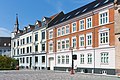 The northwestern section of Gabels Torv
 -
 One of the old restaurants (and wine cellars)
 -
 The eastern part of Korsgade
 -
 John F. Kennedy Square near the train station
 -
 A historical building in the town centre of Aalborg, namely Aalborg's Post and Telegraph (listed by the Heritage Agency of Denmark)
 -
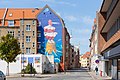 Holbergsgade 1 and Korsgade
 -
 The Courthouse in Aalborg and Aalborg University's Basis compus
 -
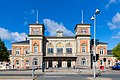 The train station in Aalborg
 -
 Østerågade 23 and 25
 -
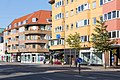 Vesterbro in Aalborg's town centre
 -
 A historical kiosk in Aalborg's town centre
 -
 Aalborg's town centre, on the way towards the central campus of Aalborg University
 -
 Aalborg's town centre, towards the Limfjords bridge linking the town with its satellite smaller town Nørresundby
 -
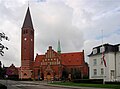 Vor Frelser Kirke in Aalborg's town centre
 -
 Aerial view of part of Aalborg, showcasing the area in the proximity of Vor Frelser Kirke
 -
 The train station in Aalborg (view towards the railways)


.jpg)


.JPG)


Notes
[edit]- ^ Aalborg University (AAU) attracts several thousands new students on an annual basis in the town of Aalborg which temporarily increases its population.
- ^ The white building at Boulevarden 38 pertains to the International Accommodation Office of Aalborg University (AAU) and is inhabited predominantly by MSc international students on an annual basis.
References
[edit]Notes
- ^ "ELSA Aalborg". studyvisits.elsa.org. Archived from the original on 25 September 2022. Retrieved 27 February 2020.
- ^ a b "Statistikbanken". Archived from the original on 3 November 2021. Retrieved 28 August 2022.
- ^ Statistik Banken(in Danish) Archived 12 November 2020 at the Wayback Machine
- ^ Statistik Banken(in Danish) Archived 1 September 2022 at the Wayback Machine
- ^ "Befolkningstal". Archived from the original on 14 August 2022. Retrieved 28 August 2022.
- ^ a b "Data services - Eurostat". ec.europa.eu. Archived from the original on 11 December 2022. Retrieved 11 December 2022.
- ^ a b Dijkstra, Lewis; Poelman, Hugo; Veneri, Paolo (11 December 2019). "The EU-OECD definition of a functional urban area". OECD Regional Development Working Papers. doi:10.1787/d58cb34d-en. S2CID 197468189. Archived from the original on 28 August 2022. Retrieved 28 August 2022.
- ^ "Folketal den 1. I kvartalet efter område, køn, alder og civilstand - Statistikbanken - data og tal". Archived from the original on 27 August 2022. Retrieved 28 August 2022.
- ^ Jones, Daniel (2011). Roach, Peter; Setter, Jane; Esling, John (eds.). "Aalborg". Cambridge English Pronouncing Dictionary (18th ed.). Cambridge University Press. p. 1. ISBN 978-0-521-15255-6.
- ^ Upton, Clive; Kretzschmar, William A. Jr. (2017). "Aalborg". The Routledge Dictionary of Pronunciation for Current English (2nd ed.). Routledge. ISBN 978-1-138-12566-7.
- ^ a b "Statistikbanken". www.statistikbanken.dk. Archived from the original on 3 November 2021. Retrieved 28 August 2022.
- ^ "Folketal den 1. i kvartalet efter område, køn, alder og civilstand - Statistikbanken - data og tal". www.statistikbanken.dk. Archived from the original on 27 August 2022. Retrieved 28 August 2022.
- ^ "Befolkningstal". www.dst.dk (in Danish). Archived from the original on 14 August 2022. Retrieved 28 August 2022.
- ^ "Nøgletal for Aalborg Universitet". Aalborg Universitet. Archived from the original on 11 December 2022. Retrieved 11 December 2022.
- ^ a b "NordDanmarks EU-kontor Aalborg er EU's mest tilfredse by". Archived from the original on 8 March 2014. Retrieved 7 March 2014.
- ^ a b c Søren Olsen; Kasper Monty (2000). Danmarks købstæder: 144 købstæder og andre gamle byer. Politiken. pp. 50–54. ISBN 978-87-567-6203-8.
- ^ Translated from an original document of the transactions of the city council on 7 June 1948 obtained from the Aalborg City Archive on the 12. of January, 2023. I will get a link later.
- ^ Roepstorff, Line (15 April 1984). "Cirkulære om anvendelse i statstjenesten af Å-å/Aa-aa i danske stednavne". Retsinformation (in Danish). Archived from the original on 12 January 2023. Retrieved 12 January 2023.
- ^ Sandersen, Vibeke (5 October 2010). "Nyt fra sprognævnet" (PDF). Archived from the original (PDF) on 5 October 2010. Retrieved 12 January 2023.
- ^ "Aalborg". DSN (in Danish). Archived from the original on 12 January 2023. Retrieved 12 January 2023.
- ^ "Ålborg". DSN (in Danish). Archived from the original on 12 January 2023. Retrieved 12 January 2023.
- ^ "§ 3. Å og dobbelt-a – DSN". DSN (in Danish). 2012. Archived from the original on 12 January 2023. Retrieved 12 January 2023.
- ^ Niarn (1 January 2004), Dobbelt A (in Danish), archived from the original on 12 January 2023, retrieved 12 January 2023
- ^ Jørgensen, Mogens (16 August 2018). "Møllgaard vender tilbage til "Nordens Paris"". TV2 Nord (in Danish). Archived from the original on 12 January 2023. Retrieved 12 January 2023.
- ^ a b c d e f "The History of Aalborg". Aalborg University. Archived from the original on 1 February 2014. Retrieved 20 August 2013.
- ^ a b c d e f g h Hans Lyngby Jepsen (1986). Nordjylland. Gyldendal. p. 158. ISBN 978-87-00-80962-8.
- ^ "Port of Aalborg". Springeren Maritimt Oplevelescenter. Retrieved 3 July 2025.
- ^ "Alaburs historie" (in Danish). Alabur.dk. Archived from the original on 3 September 2011. Retrieved 24 August 2013.
- ^ a b c d e f g h "The History of Aalborg". Aalborg University School of Engineering and Science. Archived from the original on 1 February 2014. Retrieved 5 September 2013.
- ^ Christensen & Mikkelsen 2008, p. 58.
- ^ Stig Bergmann Møller; Bente Springborg. "Aalborg kort fortalt: Fra 700-tallet til 1600-tallet" (PDF) (in Danish). Aalborg Kommune. Archived from the original (PDF) on 1 February 2014. Retrieved 22 August 2013.
- ^ Niels Clemmensen. "Budolfi kirke, Aalborg domkirke: Historie" (in Danish). Alborg Stift. Archived from the original on 2 February 2014. Retrieved 23 August 2013.
- ^ "Historien om Ellen Marsvins hus" Archived 3 February 2014 at the Wayback Machine, Rikki Tikki Company. (in Danish) Retrieved 18 September 2013.
- ^ a b c d "Danmarks Købstæder: Aalborg" (in Danish). Dansk Center for Byhistorie. Archived from the original on 25 November 2016. Retrieved 21 August 2013.
- ^ a b Peter Dragsbo. "Henning Bender: Aalborgs industrielle udvikling fra 1735 til 1940, Aalborgs Historie, bd. 4, udg. af Aalborg Kommune 1987, 520 s" (in Danish). Historisk Tidsskrift, Bind 15. række, 3 (1988) 2. Archived from the original on 25 March 2016. Retrieved 21 August 2013.
- ^ a b "Aalborg Lufthavns historie" (in Danish). Aalborg Lufthavn. Archived from the original on 21 October 2013. Retrieved 21 August 2013.
- ^ Sevaldsen, Bjørke & Bjørn 2003, p. 316.
- ^ Søren C. Flensted. "13 August 1940 attack on Aalborg West". Flensted. Archived from the original on 3 February 2014. Retrieved 17 August 2013.
- ^ Thomas 1996, p. 35.
- ^ "Aalborg Portland". State of Green. Archived from the original on 22 February 2014. Retrieved 31 August 2013.
- ^ a b c "Aalborg". Den Store Danske (in Danish). Archived from the original on 15 October 2013. Retrieved 21 August 2013.
- ^ "Charter of European Cities & Towns Towards Sustainability" (PDF). Europa.eu. Archived from the original (PDF) on 13 June 2013. Retrieved 17 August 2013.
- ^ "Sustainable Development" Archived 2013-09-02 at the Wayback Machine, Aalborg Kommune. Retrieved 8 September 2013.
- ^ "European Severe Weather Database". Archived from the original on 1 May 2023.
- ^ "Skypumpe skader huse i Aalborg - TV 2". 10 August 2009.
- ^ "Ramt af skypumpe: - Hele huset rystede". 10 August 2009.
- ^ a b c Bain, Booth & Parnell 2008, p. 294.
- ^ a b c d e f g "Aalborg" (Map). Google Maps. Retrieved 31 August 2013.
- ^ a b "Aalborg - Nørresundby: Bakker" Archived 20 December 2019 at the Wayback Machine, Danmarks største bakker. (in Danish) Retrieved 4 September 2013.
- ^ Albert Steen-Hansen. "Nibe Bredning" (in Danish). Natur-vesthimmerland.dk. Archived from the original on 21 September 2013. Retrieved 5 September 2013.
- ^ "Branths Plantage". All Trails. Retrieved 3 July 2025.
- ^ Nagel Travel Guide Series: Scandinavia. McGraw-Hill. 1964. p. 90.
- ^ a b c d "Aalborg – a city of taste". Official Website of Denmark. Archived from the original on 24 August 2018. Retrieved 2 September 2013.
- ^ "StatBank Denmark - table BEF4". Statistics Denmark. 14 April 2023. Archived from the original on 6 June 2023. Retrieved 30 July 2023.
- ^ a b c d "Egholm - øen i Limfjorden" (in Danish). Aalborg Kommune. Archived from the original on 14 November 2013. Retrieved 31 August 2013.
- ^ Henrik Juul Rasmussen, "Fruensholm" Archived 11 June 2015 at the Wayback Machine, Kajaksnakken (Rasmussen's blog). (in Danish) Retrieved 8 September 2013.
- ^ "Kalk". Den Store Danske (in Danish). Archived from the original on 27 October 2023. Retrieved 22 August 2013.
- ^ Erik Stenestad. "Fluviokarst in the top of the Maastrichtian chalk at Rørdal, Northern Jutland, Denmark" (PDF). Bulletin of the Geological Society of Denmark Vol. 53. pp. 93–110. Archived (PDF) from the original on 22 September 2013. Retrieved 22 August 2013.
- ^ a b c "Østre Anlæg" (in Danish). Aalborg Kommune. Archived from the original on 27 May 2013. Retrieved 21 August 2013.
- ^ "E/F Teglvænget 1-19 og Vangs Alle 6-10 (30-284)". teglvaenget.probo.dk. Archived from the original on 2 February 2022. Retrieved 2 February 2022.
- ^ a b c d e "Lindholm Fjordpark" (in Danish). Aalborg Kommune. Archived from the original on 3 August 2013. Retrieved 21 August 2013.
- ^ "Parks and Green Areas in Aalborg". VisitAalborg. Archived from the original on 11 August 2014. Retrieved 21 August 2013.
- ^ a b Bain, Booth & Parnell 2008, p. 297.
- ^ "About the Zoo". Aalborg Zoo. Archived from the original on 22 September 2013. Retrieved 25 August 2013.
- ^ "Karolinelund". Aalborg Kommune. Archived from the original on 13 September 2012. Retrieved 20 August 2013.
- ^ Topholm, Jens; Højbjerg, Klaus (1 October 2017). "Platform 4" (in Danish). Lex Danmarks National Leksikon. Retrieved 3 July 2025.
{{cite web}}: CS1 maint: multiple names: authors list (link) - ^ "Danish Climatological Normals 1971–2000 for selected stations" (PDF). Danish Meteorological Institute. Archived from the original (PDF) on 15 March 2018. Retrieved 11 July 2025.
- ^ "[EKYT] Aalborg [1940-] Monthly Summaries". The Iowa Environmental Mesonet. Retrieved 11 July 2025.
- ^ "Climate information for Aalborg". Climate Zone. Archived from the original on 4 November 2013. Retrieved 27 August 2013.
- ^ a b c "Weather Information for Aalborg" (in Danish). Danmarks Meteorologiske Institut. Archived from the original on 16 July 2011. Retrieved 12 May 2009.
- ^ "Henning G. Jensen, Borgmester, Socialdemokratiet" (in Danish). Aalborg Municipality. Archived from the original on 9 January 2014. Retrieved 21 August 2013.
- ^ "Henning G. Jensen". denstoredanske.dk (in Danish). Den Store Danske Encyklopædi. Archived from the original on 23 September 2015. Retrieved 26 August 2015.
- ^ "Thomas Kastrup-Larsen" (in Danish). Aalborg Municipality. Archived from the original on 22 December 2015. Retrieved 26 August 2015.
- ^ "Lasse Frimand Jensen" (in Danish). Aalborg Municipality. Archived from the original on 3 January 2024. Retrieved 3 January 2024.
- ^ "The 7 Civic Departments". Aalborg Kommune. Archived from the original on 5 October 2013. Retrieved 20 August 2013.
- ^ "Mayor's Department". Aalborg Kommune. Archived from the original on 9 April 2012. Retrieved 20 August 2013.
- ^ "Technical and Environmental Department". Aalborg Kommune. Archived from the original on 9 April 2012. Retrieved 20 August 2013.
- ^ "Department of Family and Employment". Aalborg Kommune. Archived from the original on 9 April 2012. Retrieved 20 August 2013.
- ^ "Department of Care for Elderly and Disabled Citizens". Aalborg Kommune. Archived from the original on 9 April 2012. Retrieved 20 August 2013.
- ^ "Department of Education and Cultural Affairs". Aalborg Kommune. Archived from the original on 9 April 2012. Retrieved 20 August 2013.
- ^ "Health and Sustainable Development Department". Aalborg Kommune. Archived from the original on 9 April 2012. Retrieved 20 August 2013.
- ^ "Public Utilities". Aalborg Kommune. Archived from the original on 16 January 2013. Retrieved 20 August 2013.
- ^ "City Council Members". Aalborg Kommune. Archived from the original on 4 January 2014. Retrieved 21 August 2013.
- ^ "Aalborg City Council Rules of Procedure". Aalborg Kommune. Archived from the original on 21 August 2013. Retrieved 21 August 2013.
- ^ "Statistikbanken Tabel BEF4A". Danmarks Statistik (in Danish). Archived from the original on 14 April 2021. Retrieved 26 October 2022.
- ^ a b c d "Befolkningstal". Dansk Center for Byhistorie. Archived from the original on 21 September 2013. Retrieved 5 September 2013. and Danmarks Statistik Archived 14 April 2021 at the Wayback Machine, Retrieved on 5 September 2013.
- ^ "Aalborgs Indbyggertal Gennem Tiderne" (in Danish). Bogogleg. 2021. Retrieved 3 July 2025.
- ^ a b Dijkman, p. 157.
- ^ "BY3: Population 1. January by urban areas, area and population density". Danmarks Statistik. Archived from the original on 25 October 2019. Retrieved 21 January 2020.
- ^ "Hypergenic WebNize Virtual Signpost - Hele Kommunen - 1 års aldersklasser" (in Danish). Aalborgkommune.dk. Archived from the original on 15 April 2012. Retrieved 11 June 2012.
- ^ "BY1: Population 1. January by urban areas, age and sex". statbank.dk. Statistics Denmark. 1 January 2016. Archived from the original on 25 February 2021. Retrieved 21 April 2016.
- ^ "Aalborg, Denmark". ICLEI. Archived from the original on 21 July 2013. Retrieved 21 August 2013.
- ^ "Aalborg is a hotspot for connectivity business". Investment in Aalborg. Retrieved 9 September 2025.
- ^ "The world's first reusable wind turbine blades are produced in Aalborg". Port of Aalborg. 30 September 2025. Retrieved 9 September 2025.
- ^ "Den globale erhvervsby: Erhvervsplan 2010 – 2014" (in Danish). Aalborg Kommune. Archived from the original on 22 September 2013. Retrieved 21 August 2013.
- ^ "We Love Business" (PDF) (in Danish). Aalborg Kommune. Archived from the original (PDF) on 26 September 2013. Retrieved 25 August 2013.
- ^ "Telenor fyrer 63 ansatte i Aalborg" Archived 22 September 2013 at the Wayback Machine, Nordjyske, 14 March 2013. Retrieved 25 August 2013.
- ^ "Siemens to expand Aalborg plant: Germany: Siemens Wind Power is expanding its factory in Aalborg, Denmark following its €2.8 billion order from Dong for 300 6MW offshore wind turbines" Archived 22 September 2013 at the Wayback Machine, WindPower, 31 July 2012.
- ^ "Siemens Opens World’s Largest R&D Test Center For Wind Turbine Technology" Archived 17 August 2013 at the Wayback Machine, CleanTechnica, 17 March 2013. (From material provided by Siemens.)
- ^ "Aalborg port ships record number of wind turbine blades in 2012" Archived 22 September 2013 at the Wayback Machine, Renewables, 12 December 2012.
- ^ "Arcus-Gruppen acquires Aalborg and other Nordic spirits brands" Archived 2013-08-23 at archive.today, Ratos. Retrieved 23 August 2013.
- ^ "Aalborg, Denmark" Archived 23 March 2014 at the Wayback Machine, The Avid Cruiser. Retrieved 3 September 2013.
- ^ "Alfa Laval Aalborg Aalborg, Denmark". ShipServ. Archived from the original on 21 September 2013. Retrieved 3 September 2013.
- ^ "Aalborg Industries" Archived 27 October 2023 at the Wayback Machine, LinkedIn. Retrieved 25 August 2013.
- ^ The Global Cement Report. Tradeship Publications Ltd. 28 February 2005. p. 112. GGKEY:BAYTPPXP1TX.
- ^ "Øget afsætning af hvid cement" Archived 21 September 2013 at the Wayback Machine, Berlinske, 11 May 2012. (in Danish) Retrieved 3 September 2013.
- ^ "Aalborg Storcenter" Archived 2013-09-23 at the Wayback Machine, VisitAalborg. (in Danish) Retrieved 24 August 2013.
- ^ a b c d Olesen 2011, p. 31.
- ^ Bain, Booth & Parnell 2008, p. 299.
- ^ "Gastronomical experiences" Archived 27 June 2013 at the Wayback Machine, Visit Aalborg. Retrieved 24 August 2013.
- ^ "Hotels in Aalborg" Archived 7 December 2013 at the Wayback Machine, Visit Aalborg. Retrieved 24 August 2013.
- ^ a b c d Porter, Prince & Norum 2011, p. 197.
- ^ "Restaurants". Radisson. Archived from the original on 28 October 2013. Retrieved 31 August 2013.
- ^ Bain, Booth & Parnell 2008, p. 295.
- ^ "Aalborg, Denmark" Archived 27 September 2013 at the Wayback Machine, Danishnet. Retrieved 26 August 2013.
- ^ "Jens Bangs Stenhus", dansk arkitektur guide. (in Danish) Retrieved 21 August 2013.
- ^ "Jørgen Olufsens House" Archived 27 October 2023 at the Wayback Machine, VisitAalborg. Retrieved 22 August 2013.
- ^ "Historien om Ellen Marsvins hus" Archived 3 February 2014 at the Wayback Machine, Rikki Tikki Company. (in Danish) Retrieved 22 August 2013.
- ^ "Aalborghus Castle" Archived 2013-10-26 at the Wayback Machine, Slotte & Kultur-Ejendomme. Retrieved 22 August 2013.
- ^ "Aalborg Rådhus" (in Danish). VisitAalborg. Archived from the original on 5 February 2013. Retrieved 25 August 2013.
- ^ "Sag: Ålborg gamle Rådhus". Kulturstyrelsen. Archived from the original on 10 June 2015. Retrieved 25 August 2013.
- ^ "Købmandsgårdens historie" Archived 7 June 2013 at the Wayback Machine, Haandværkerhuset - Aalborg. (in Danish) Retrieved 22 August 2013.
- ^ "Danish Distillers" Archived 22 March 2012 at the Wayback Machine, Kulturarv. (in Danish) Retrieved 23 August 2013.
- ^ "Jomfru Ane Gade" Archived 1 February 2022 at the Wayback Machine, VisitAalborg. (in Danish) Retrieved 21 August 2013.
- ^ "Nytorv Square". Cityseeker.com. Retrieved 25 April 2025.
- ^ "John F. Kennedy Square, Denmark". Darcawards.com. Retrieved 25 April 2025.
- ^ "Aalborgtårnet" Archived 11 June 2015 at the Wayback Machine, Den Stone Danske. (in Danish) Retrieved 25 August 2013.
- ^ "Aalborgtårnet" Archived 30 September 2012 at the Wayback Machine, Berlingske, 16 June 2008. (in Danish) Retrieved 25 August 2013.
- ^ "Utzon Center" [permanent dead link], Kim Utzon Arkitekter. Retrieved 25 August 2013.
- ^ "Tak til Kong Karneval" (in Danish). Aalborg Carnival. Archived from the original on 15 March 2012. Retrieved 17 August 2013.
- ^ "The Children's Carnival". Aalborg Carnival. Archived from the original on 10 June 2013. Retrieved 22 August 2013.
- ^ "Battle of the Carnival Bands". Aalborg Carnival. Archived from the original on 10 June 2013. Retrieved 22 August 2013.
- ^ "The Tall Ships races 2022". sailtraininginternational.org. Retrieved 25 April 2025.
- ^ "Aalborg-hallen, Aalborg Kongres- og Kulturcenter" (in Danish). Archived from the original on 10 June 2015. Retrieved 24 August 2013.
- ^ "Aalborg Kongres og Kultur Center" (in Danish). VisitDenmark. Archived from the original on 21 September 2013. Retrieved 24 August 2013.
- ^ "Teatrets historie" (in Danish). Aalborg Teater. Archived from the original on 27 September 2013. Retrieved 24 August 2013.
- ^ "Aalborg Teater". Den Store Danske (in Danish). Archived from the original on 27 September 2013. Retrieved 24 August 2013.
- ^ "Kunsthal Nord" (in Danish). Kunsthal Nord. Archived from the original on 4 February 2014. Retrieved 25 August 2013.
- ^ "Kunsthal Nord" (in Danish). VisitAalborg. Archived from the original on 27 October 2023. Retrieved 25 August 2013.
- ^ "Opførelsen af Musikkens Hus er et af de mest ambitiøse og imponerende byggeprojekter i Aalborg i mange år" (in Danish). VisitAalborg. Archived from the original on 24 August 2013. Retrieved 24 August 2013.
- ^ "Artists and galleries in Aalborg". VisitAalborg. Archived from the original on 11 February 2014. Retrieved 25 August 2013.
- ^ "Aalborg Historiske Museum" (in Danish). Dansk Architektur Guide. Retrieved 23 August 2013. [permanent dead link]
- ^ "Aalborg Historiske Museum". Nordjyllands Historiske Museum. Archived from the original on 21 September 2013. Retrieved 23 August 2013.
- ^ Elisabeth Barfod Carlsen (July 2012). "Fortidsmindet Lindholm Høje er en del af Kulturarvsstyrelsens project 'Danmarks Oldtid i Landskabet" (in Danish). DitBlad. Archived from the original on 16 December 2013. Retrieved 24 August 2013.
- ^ "The Underground Greyfriar Monestery [sic] Museum". KML. Archived from the original on 21 September 2013. Retrieved 24 August 2013.
- ^ "Om museet" (in Danish). Nordjyllands Historiske Museum. Archived from the original on 21 September 2013. Retrieved 26 August 2013.
- ^ "Om os" (in Danish). Springeren - Maritimt Oplevelsescenter. Archived from the original on 21 September 2013. Retrieved 26 August 2013.
- ^ "Springeren - Marine Experience Center". Visit Aalborg. Archived from the original on 8 August 2013. Retrieved 26 August 2013.
- ^ "Aarlborg Forsvars- og Garnisonsmuseum". Aarlborg Forsvars- og Garnisonsmuseum. Archived from the original on 27 November 2020. Retrieved 19 August 2013.
- ^ Simon Ostenfeld Pedersen. "Museum as a Light Machine". Danish Heritage. Archived from the original on 21 September 2013. Retrieved 7 October 2011.
- ^ "KUNSTEN: Collections". Kunsten.dk. Archived from the original on 21 September 2013. Retrieved 2 September 2013.
- ^ "Aalborg Symphony Orchestra". Dacapo Records. Archived from the original on 22 September 2013. Retrieved 25 August 2013.
- ^ "Aalborg Opera Festival". VisitDenmark. Archived from the original on 22 September 2013. Retrieved 25 August 2013.
- ^ "Den Blå Festival" (in Danish). VisitAalborg. Archived from the original on 22 September 2013. Retrieved 25 August 2013.
- ^ "Velkommen til Egholm Festival 2013!". Egholm Festival. Archived from the original on 28 August 2013. Retrieved 31 August 2013.
- ^ a b "Kirkens Historie" Aalborg Domkirke@www.aalborgdomkirke.dk
- ^ "Abbey of Our Lady". Vorfruekirke. Archived from the original on 9 December 2013. Retrieved 19 August 2013.
- ^ Niels Clemmensen. "Alborg Domkirke - Budolfi Kirke" (in Danish). Aalborg Domkirke. Archived from the original on 10 June 2015. Retrieved 23 August 2013.
- ^ "Vor Frue Kirke - Church of Our Lady". VisitAalborg. Archived from the original on 28 September 2013. Retrieved 23 August 2013.
- ^ "Om kirken" (in Danish). Ansgars Kirken. Archived from the original on 25 August 2013. Retrieved 25 August 2013.
- ^ "Om kirken" (in Danish). Sankt Markus Aalborg. Archived from the original on 4 March 2016. Retrieved 25 August 2013.
- ^ "Lidt kirkehistorie" (in Danish). Margrethekirken Aalborg. Archived from the original on 10 June 2015. Retrieved 25 August 2013.
- ^ "Almen Kirkegård" (PDF) (in Danish). Aalborg Kommune. Retrieved 2 September 2013. [permanent dead link]
- ^ a b c "Scandinavia Special Interest Group (SIG) Aalborg". Jewishgen.org. Archived from the original on 22 September 2013. Retrieved 5 September 2013.
- ^ "Germans Set Danish Synagogue Afire, Destroy Centuries-old Torahs". Sydvenska Dagbladet, via The Global Jewish News Source. 10 April 1945. Archived from the original on 26 September 2013. Retrieved 5 September 2013.
- ^ a b Roth 2001, p. 70.
- ^ a b OECD (1 June 2005). Reviews of National Policies for Education Reviews of National Policies for Education: University Education in Denmark 2005. OECD Publishing. p. 22. ISBN 978-92-64-00973-8.
- ^ "Antal årsværk for medarbejdere på AAU" (in Danish). Aalborg Universitet. Archived from the original on 27 January 2012. Retrieved 25 August 2013.
- ^ a b Jamison 2013, p. 73.
- ^ "Aalborg Business College". Aalborg Handelsskole. Archived from the original on 9 October 2013. Retrieved 23 September 2013.
- ^ "Welcome to Skipper Clement International School in Aalborg, Denmark". Skipper Clement International School. Archived from the original on 22 September 2013. Retrieved 23 September 2013.
- ^ "Sådan er det gået AaB i Superligaen". ligeher.nu (in Danish). 5 December 2022. Retrieved 25 April 2025.
- ^ "FC Nordjylland ude af 1. division" (in Danish). Politiken.dk. 28 July 2004. Retrieved 25 April 2025.
- ^ "Historie" (in Danish). Gigantium. Archived from the original on 31 August 2013. Retrieved 19 August 2013.
- ^ "Aalborg Cricket Club". Aalborg Cricket Club. Archived from the original on 14 May 2021. Retrieved 22 August 2013.
- ^ "Team Batting Statistics". Aalborg Cricket Club. Archived from the original on 6 May 2013. Retrieved 22 August 2013.
- ^ "Team Bowling Statistics". Aalborg Cricket Club. Archived from the original on 6 May 2013. Retrieved 22 August 2013.
- ^ "En moderne og traditionsrig golf klub i Nordjylland". Aalborg Golf Klub. Archived from the original on 22 September 2013. Retrieved 5 September 2013.
- ^ a b c "Aalborg Golf Klub". Top100golfcourses.co.uk. Archived from the original on 11 September 2013. Retrieved 5 September 2013.
- ^ "Velkommen til Ørnehøj Golfklub" (in Danish). Ørnehoj Golfklub. Archived from the original on 8 September 2013. Retrieved 5 September 2013.
- ^ "Aalborg Trotting Track". Speedwaylife.com. Retrieved 25 April 2025.
- ^ "Jernbanebroen over Limfjorden - er det nye navn!" (in Danish). Banedanmark. Archived from the original on 22 September 2013. Retrieved 31 August 2013.
- ^ "Limfjordstunnelen" Archived 24 September 2015 at the Wayback Machine, Den Store Danske. Retrieved 21 August 2013.
- ^ "Limfjord Tunnel (Limfjordstunnelen) - Aalborg". Danishnet.com. Archived from the original on 22 September 2013. Retrieved 31 August 2013.
- ^ "Report of the Working Party on Road Transport on its 111th session" (PDF). UN Economic and Social Council. p. 11. Archived (PDF) from the original on 26 November 2016. Retrieved 25 August 2018.
- ^ "Great Dane Airlines to launch Dublin and Edinburgh routes". Business Traveller. Archived from the original on 4 September 2019. Retrieved 4 September 2019.
- ^ "Passenger statistics 2000-2012" Archived 2013-04-24 at the Wayback Machine, Aalborg Airport. Retrieved 26 August 2013.
- ^ "Airbase Aalborg History" (PDF). Danish Air Show. Archived from the original (PDF) on 1 February 2014. Retrieved 11 October 2012.
- ^ "Velkommen til Aalborg Havn" (in Danish). Aalborghavn.dk. Archived from the original on 2 March 2012. Retrieved 17 August 2013.
- ^ "The Port of Aalborg". Maersk Broker. Archived from the original on 29 September 2013. Retrieved 1 September 2013.
- ^ "Aalborg station" (in Danish). Nordjyllands jernbaner. Archived from the original on 1 October 2013. Retrieved 2 September 2013.
- ^ "Aalborg Station" (in Danish). DSB. Archived from the original on 15 July 2019. Retrieved 3 May 2021.
- ^ "Standsningssteder på Skagensbanen" (in Danish). Nordjyske Jernbaner. Archived from the original on 4 May 2021. Retrieved 4 May 2021.
- ^ "Nordjyllands Trafik Selskab" (in Danish). Archived from the original on 28 August 2013. Retrieved 2 September 2013.
- ^ "Aalborg cykelby: Planlægning" Archived 2013-09-05 at archive.today, Aalborg Kommune. (in Danish) Retrieved 5 September 2013.
- ^ "Take a ride on a city bike" Archived 2013-05-01 at the Wayback Machine, Aalborg bycyklen. Retrieved 5 September 2013.
- ^ "Bycyklerne i Aalborg er fortid" (in Danish). Nordjyske. 11 June 2015. Archived from the original on 1 March 2022. Retrieved 1 March 2022.
- ^ Mick Knive Anderson (29 September 2015). "Aalborg Letbane slettet af finansloven" (in Danish). TV2 Nord. Retrieved 1 March 2022.[permanent dead link]
- ^ Ulrik Andersen (10 February 2017). "762 mio. kr til hurtigbusser i Aalborg, billigere tog på Sjælland og mere letbane i Aarhus" (in Danish). Ingeniøren. Archived from the original on 7 February 2020. Retrieved 1 March 2022.
- ^ "Om Plusbus" (in Danish). Plusbus. Archived from the original on 27 February 2022. Retrieved 1 March 2022.
- ^ "Efter fire års vejarbejde: I dag åbnede PlusBus officielt med stor fest". 23 September 2023. Archived from the original on 27 October 2023. Retrieved 24 September 2023.
- ^ "Om Aalborg Universitetshospital" (in Danish). Aalborg Universitetshospital. Archived from the original on 26 August 2013. Retrieved 24 August 2013.
- ^ "Aalborg Universitetshospital". Den Store Danske (in Danish). Archived from the original on 24 September 2015. Retrieved 24 October 2013.
- ^ Alison Furuto (11 July 2012). "New Aalborg University Hospital / schmidt hammer lassen architects". Arch daily. Archived from the original on 22 September 2013. Retrieved 24 August 2013.
- ^ "Aalborg Barracks". Traenregimentet. Archived from the original on 13 January 2016. Retrieved 21 August 2013.
- ^ "Nordjyske Stiftstidende" Archived 12 August 2014 at the Wayback Machine, Den Store Danske. (in Danish) Retrieved 2 September 2013.
- ^ NordjyskeMedier Archived 2013-11-13 at the Wayback Machine. (in Danish) Retrieved 2 September 2013.
- ^ "Om kendte personer begravet på Almen Kirkegård" [permanent dead link], Aalborg Kommune. (in Danish) Retrieved 5 September 2013.
- ^ "Preben Kaas" Archived 10 June 2015 at the Wayback Machine, Dansk Biografisk Leksikon. (in Danish) Retrieved 5 September 2013.
- ^ "Peter Gade Archived 4 September 2012 at the Wayback Machine", Badminton Europe. Retrieved 5 September 2013.
- ^ "Utzon and Aalborg" Archived 2012-07-17 at the Wayback Machine, Utzon Center. Retrieved 5 September 2013.
Bibliography
- Bain, Carolyn; Booth, Michael; Parnell, Fran (2008). Denmark. Lonely Planet. ISBN 978-1-74104-669-4.
- Bender, Henning (1987). Aalborgs industrielle udvikling fra 1735 til 1940 (in Danish). Aalborg kommune. ISBN 978-87-982530-1-3.
- Christensen, Søren Bitsch; Mikkelsen, Jørgen (2008). Danish Towns During Absolutism: Urbanisation and Urban Life 1660-1848. Isd. ISBN 978-87-7934-152-4.
- Dijkman, M. Europe Real Estate Yearbook 2010. Real Estate Publishers BV. ISBN 978-90-77997-48-2.
- Jamison, Andrew (1 March 2013). The Making of Green Engineers: Sustainable Development and the Hybrid Imagination. Morgan & Claypool Publishers. ISBN 978-1-62705-159-0.
- Laursen, Ib Skovfoged (1998). Aalborg i festlige og farlige tider: nordjysk lokalhistorie fra 1945 - 1990 (in Danish). Eget forlag. ISBN 978-87-985718-4-1.
- Mortensen, Leif (1997). Glimt af en by's historie (in Danish). Den Bette. ISBN 978-87-90635-00-8.
- Olesen, Elizabet (15 April 2011). Denmark Travel Adventures. Hunter Publishing, Inc. ISBN 978-1-58843-707-5.
- Porter, Darwin; Prince, Danforth; Norum, Roger (15 June 2011). Frommer's Scandinavia. John Wiley & Sons. ISBN 978-1-118-09023-7.
- Roth, Stephen (1 March 2001). Anti-Semitism Worldwide, 1999/2000. University of Nebraska Press. ISBN 978-0-8032-5943-0.
- Sevaldsen, Jørgen; Bjørke, Bo; Bjørn, Claus (January 2003). Britain and Denmark: Political, Economic and Cultural Relations in the 19th and 20th Centuries. Museum Tusculanum Press. ISBN 978-87-7289-750-9.
- Thomas, Andrew (1996). "Over All Things Everywhere: The story of 82 Squadron, Royal Air Force". Air Enthusiast. Vol. 66. Stamford, UK: Key Publishing. ISSN 0143-5450.
External links
[edit]

- Satellite image from Google Maps
- About Aalborg from Nordjyske Medier (local media group)
- Aalborg Kommune (Aalborg Municipality's official website)
- VisitAalborg (Aalborg Tourist Office)
- Aalborg University
- Aalborg University (in Danish)
- Aalborg Cricket Club Archived 14 May 2021 at the Wayback Machine
- Public Transport in Aalborg and surroundings (in Danish)
- Aalborg Akvavit
- Ålborgtårnet (in Danish)
- Instagram Photos of Aalborg (in Danish)
- Aalborg Carnival Information
 Texts on Wikisource:
- . Encyclopædia Britannica. Vol. I (9th ed.). 1878. p. 2.
- "Aalborg". The American Cyclopædia. 1879.
- "Aalborg". The Nuttall Encyclopædia. 1907.
- "Aalborg". Encyclopædia Britannica. Vol. I (11th ed.). 1911. p. 2.
- "Aalborg". Collier's New Encyclopedia. 1921.

| Neighborhoods and administration | |
|---|---|
| Landmarks |
|
| Culture | |
| Museums | |
| Education | |
| Sports | |
| Companies and retail | |
| Transport | |

| ||||||||||||||||||||||||||||||||||||||||||||||||||||||||||||||||||||||||||||||||||||||||||||||||


| International | |
|---|---|
| National | |
| Geographic | |
| Other | |

Aalborg
View on GrokipediaEtymology
Origins and Evolution of the Name
The name Aalborg originates from Old Norse Álaborg, a compound of ál ("eel") and borg ("fortified settlement" or "castle"), alluding to the prolific eel fisheries in the Limfjord that supported early inhabitants around the year 1000 AD.[6] This interpretation aligns with the region's historical reliance on eel trapping and trade, as evidenced by archaeological finds of fishing weirs and tools from Viking-era sites near the fjord.[6] Alternative derivations proposing all ("stream" or "current") for a "fort by the stream" lack direct ties to local ecology and appear less substantiated by primary linguistic evidence from Norse place-name patterns.[7] The earliest known reference appears on silver coins minted during the reign of King Hardicanute (r. 1035–1042), inscribed as Alabu, indicating a fortified trading post at the Limfjord's narrowest crossing.[6] By the 12th century, Danish records show variations such as Aleburch or Alaborg, reflecting phonetic shifts in North Jutland dialects where vowel sounds elongated under regional influences.[7] Medieval Latin documents, including ecclesiastical charters, rendered it as Alburgum or similar forms, adapting the name for scholarly use while preserving the core elements.[8] Spelling stabilized in Danish orthography by the 17th century as Aalborg, but post-1800 linguistic reforms, culminating in the 1948 introduction of å to replace aa in many place names, met local resistance; Aalborg's city council voted to retain the traditional aa spelling, preserving its distinct Jutlandic identity amid national standardization efforts.[9] This decision underscores dialectal persistence in North Jutland, where aa pronunciation diverged from Copenhagen norms, influencing modern usage without altering the name's etymological roots.[10]History
Early Settlement and Viking Age
Archaeological investigations in the vicinity of modern Aalborg reveal evidence of human settlement dating to the Migration Period around 400 AD, with the Lindholm Høje site demonstrating continuous habitation through the late Iron Age. This major burial ground, located north of the city, contains nearly 700 graves spanning approximately 500 years from the 5th to the 11th century, including cremation burials under mounds and distinctive stone ship settings indicative of elite Viking funerary customs.[11][12] The presence of these features underscores the site's role as both a settlement and cemetery, supported by artifacts suggesting local crafting and exchange activities prior to the height of the Viking Age.[13] The strategic positioning along the Limfjord, a vital waterway crossing Jutland and linking the [North Sea](/page/North Sea) to the Baltic, positioned early settlements for participation in regional trade and maritime expeditions from as early as the 5th century AD. This corridor facilitated the transport of commodities like amber, furs, and iron, while enabling raids westward into the British Isles and Francia, as evidenced by the evolution of Limfjord ports into centers of Danish economic and political influence by the 8th century.[14] During the Viking Age proper (c. 793–1066 AD), Aalborg's precursor communities likely contributed to these networks, with the fjord's sheltered access supporting shipbuilding and seasonal gatherings, though direct documentary references to the site remain scarce until later medieval records.[15] By the late 10th century, the Christianization of Denmark under King Harald Bluetooth, who declared the realm Christian around 965 AD via the Jelling Stone inscription, extended to northern Jutland, influencing local practices at sites like Lindholm Høje. Pagan cremation burials declined after approximately 1050 AD, coinciding with the introduction of Christian grave markers and the foundation of early wooden churches in the region, signaling a shift from Norse paganism to Christianity without abrupt disruption.[16][17] This transition is archaeologically attested by the absence of post-11th-century pagan monuments at Lindholm Høje, reflecting broader Scandinavian adoption of Christian burial norms.[18]Medieval Development and Trade
During the medieval period, Aalborg's development as a trade center was driven by its strategic location at the narrowest point of the Limfjord, enabling control over maritime routes connecting the North Sea to inland Jutland. This position facilitated the town's emergence as a key harbor for regional commerce from the 12th century onward, with early evidence of organized fishing and shipping activities supporting urban expansion.[19] In 1342, King Valdemar IV granted Aalborg its initial market privileges, establishing formal trading rights that elevated its status and spurred economic growth through regulated markets and tolls. These privileges, received as part of the king's dowry from his marriage to Helvig of Schleswig, encouraged exports of local products, particularly salted herring from the prolific Limfjord fisheries, which became a cornerstone of the town's prosperity. Herring catches were processed and shipped to markets in Germany and beyond, integrating Aalborg into broader North Sea trade networks with indirect ties to Hanseatic merchants via routes to Lübeck.[20][19][21] Cattle exports to Germany further bolstered the economy, drawing on Jutland's pastoral resources and leveraging the fjord for transport, though herring dominated medieval volumes. By the late 14th century, accumulated wealth from these trades manifested in architectural investments, including the construction of the Gothic stone structure of Sankt Budolfi Church around 1400, replacing earlier wooden edifices and symbolizing civic affluence. In 1430, King Erik of Pomerania reinforced this trajectory by granting Aalborg exclusive trading rights over Limfjord herring, solidifying its role as a monopolistic hub until the period's end circa 1500.[22][23][24]Early Modern Period (1500–1800)
The Reformation profoundly impacted Aalborg in 1536, as part of Denmark's national transition to Lutheranism during the Count's Feud (1534–1536). Local Franciscan monasteries, including Aalborg's, were forcibly closed by mobs, contributing to the shutdown of 28 such institutions across Denmark, with church properties confiscated by the crown to bolster royal revenues, which increased by approximately 300% nationwide. In Aalborg, the prominent monastery was repurposed as a diocesan hospital, marking a shift from ecclesiastical to secular and crown-influenced governance, while new Lutheran bishops from the burgher class assumed limited political roles.[25][24][26] Aalborg's economy, previously buoyed by Limfjord herring trade, stagnated after the mid-16th-century collapse of major herring stocks, particularly evident in the rapid decline of Bohuslän catches by 1589, which curtailed regional exports and shipping volumes. Fiscal and shipping records from the period reveal a contraction in international commerce, with Aalborg's maritime dependency shifting toward localized regional trade rather than sustained diversification; timber exports, once viable, dwindled due to deforestation by the 16th century, while oxen and other agrarian goods assumed greater but limited prominence. Guild charters and urban tax data underscore small-scale adaptations in crafts like shipbuilding, yet overall growth lagged behind national trends, positioning Aalborg as a secondary regional hub amid broader Danish mercantilist policies.[27][28][28] Catastrophic events exacerbated this stagnation, with recurrent fires and plagues disrupting urban development; shipping and population records indicate setbacks from such disasters, including a 1663 conflagration that razed the tower of Budolfi Church, symbolizing the vulnerability of wooden structures in a port city prone to outbreaks amid Europe's second plague pandemic. These factors, combined with political upheavals like the loss of preferential trade status post-Reformation, fostered resilience through localized economic networks but precluded significant expansion until later centuries.[29]Industrial Revolution and 19th Century Growth
The introduction of steam-powered manufacturing marked Aalborg's transition from trade-dependent economy to proto-industrial hub in the late 18th and early 19th centuries, beginning with the establishment of C.W. Obel's tobacco factory in 1787, which leveraged local labor for processing imported leaves into products like cigars and snuff. This was followed in the 1830s by additional factories, including a prominent tobacco works and a distillery founded in 1846, which produced Aalborg Akvavit and employed hundreds in mechanized operations.[30] These ventures capitalized on Aalborg's port access to raw materials, with tobacco output contributing to export growth amid Denmark's gradual adoption of steam technology post-1800.[22] Cement production emerged as a cornerstone by the late 19th century, with Aalborg Portland founded in 1889 by Hans Holm, exploiting abundant local chalk deposits for Portland cement patented in 1824; the factory's initial capacity reached 60,000 tons annually by 1900, fueling construction booms in Denmark and exports.[31] This sector, alongside distilleries and machine shops, drove demographic expansion, as census data record Aalborg's population rising from 5,579 in 1801 to 31,457 by 1901, reflecting influxes of rural migrants seeking factory wages averaging 1-2 kroner daily for unskilled labor.[32][33] Infrastructure advancements facilitated this growth, notably the 1865 pontoon bridge across Limfjorden providing the first fixed link to Nørresundby, followed by the railway's arrival in 1869 via a dedicated span on the Aalborg-Randers line, which reduced transport costs by 50% for goods and enabled inland raw material sourcing.[34][35] These connections spurred suburban expansion but strained urban resources, with municipal reports noting overcrowded tenements and sanitation deficits by the 1890s, as worker influxes outpaced housing construction limited to ad-hoc wooden barracks.[36]20th Century Expansion and Challenges
During the German occupation of Denmark from April 9, 1940, to May 5, 1945, Aalborg experienced relatively limited physical destruction compared to other European cities, owing to Denmark's policy of cooperation with the occupiers, which preserved much of the urban infrastructure. [37] The city's strategic airfield, one of Europe's largest, was requisitioned by Luftwaffe forces for operations including the invasion of Norway, leading to industrial requisitions such as shipyard facilities diverted to German repair work, though sabotage by local groups like the Churchill Club disrupted some efforts. [38] Economic strains included rationing and shortages, but the absence of major bombing campaigns meant Aalborg's factories emerged largely intact, facilitating a swift post-liberation recovery. [37] In the immediate post-war decades, Aalborg's economy surged with a shipbuilding boom at Aalborg Værft, which by the 1950s expanded to supply international markets with boilers and vessels, peaking at over 3,000 direct employees in the sector amid Denmark's broader industrial reconstruction. [39] This growth, supported by Marshall Plan aid and domestic demand for merchant shipping, contributed to population influx and urban expansion, with the yard producing nearly 230 ships before its later decline. [39] Concurrently, the cement industry, led by Aalborg Portland established in the late 19th century, scaled production to dominate exports, accounting for significant GDP shares through high-volume output of Portland cement for reconstruction projects across Europe. [40] Heavy reliance on these sectors brought environmental challenges, as 1970s measurements documented elevated particulate matter and sulfur dioxide emissions from cement kilns and shipyard operations, exacerbating local air quality degradation in North Jutland. [41] Aalborg Portland's clinker production, involving limestone calcination at 1,500°C, released substantial CO2—estimated at over 0.8 tons per ton of cement—while dust fallout affected nearby agriculture and health, prompting early regulatory scrutiny amid Denmark's emerging pollution-industrial tensions. [42] These emissions, unmitigated until later frameworks, underscored the causal trade-offs of industrial primacy for short-term prosperity. By the 1980s, global competition signaled deindustrialization, with Aalborg Værft facing layoffs as orders shifted to lower-cost Asian yards, contributing to localized unemployment spikes exceeding national averages and skill mismatches in the workforce. [43] The yard's contraction, culminating in partial closures, displaced thousands in a region dependent on manufacturing, amplifying economic vulnerabilities without immediate diversification, as evidenced by elevated job-to-job mobility rates among affected workers. [43] This period highlighted the fragility of Aalborg's expansion model, where wartime survival and post-war peaks yielded to structural shifts, leaving a legacy of pollution remediation needs and labor reallocation challenges. [41]Post-2000 Developments and Urban Renewal
In the early 2000s, Aalborg initiated comprehensive waterfront regeneration projects as part of relocating port activities northward to newer facilities, such as the North Harbour (planned 2012–2021), to repurpose central port lands for urban uses.[44] The Stigsborg Harbourfront project, starting post-2016 with Phase 1 in 2018, encompasses 54 hectares overall (33 hectares in the initial phase), transforming former industrial port areas into mixed residential and commercial zones.[44] This has enabled the development of approximately 4,000 new flats accommodating up to 7,500 residents, contributing to densification along the waterfront.[44] Similarly, the Eastern Harbour regeneration (2007–ongoing) includes residential expansions like Lindholm Brygge, with capacity for 400 dwellings integrated with business functions.[44] These initiatives have driven measurable population increases, with the Aalborg/Nørresundby urban area recording annual growth of 1,600–1,900 residents since 2010, the highest rates in North Jutland.[44] Complementary projects, such as the Central Harbourfront (2000–2011) and House of Music area (2000–2014), added recreational, cultural, and youth housing elements, enhancing urban connectivity and livability without relying solely on port-derived land.[44] Suburban retrofits, including ecological upgrades in areas like Aalborg East, have emphasized resident co-creation for quality-of-life improvements, aligning with a shift from heavy industry to sustainable density.[45] Economic diversification post-2000 has focused on knowledge-based sectors, particularly IT and healthcare innovation, bolstered by Aalborg University's collaborations with nascent industries in North Denmark.[46] Aalborg University Hospital's innovations, such as the 2008 idéaclinic for health tech development, have supported this transition, contributing to regional growth in digital health solutions. While city-specific GDP data is limited, Aalborg's per capita GDP reached approximately 66,919 GBP with a 3.6% real growth rate in recent assessments, reflecting broader economic adaptation amid Denmark's stable national expansion.[47] Persistent challenges include aging infrastructure vulnerable to climate-induced flood risks, particularly in western neighborhoods near the Limfjord and streams, where heavy rainfall and high water levels threaten low-lying areas.[48] Studies project heightened flood hazards from land-use changes and sea-level rise, necessitating adaptive measures like improved surface water modeling, though implementation faces departmental silos.[49][50] These risks underscore the need for policy-driven retrofits to balance renewal gains with resilience.[51]Geography
Location and Physical Features
Aalborg is situated at geographic coordinates 57°03′N 09°55′E in the northern part of Jutland, Denmark, positioned along the Limfjord, a 180-kilometer-long strait that traverses the peninsula from the North Sea to the Kattegat.[52][53] The city lies on both sides of the fjord, with its urban core spanning low-lying terrain shaped by glacial deposits and underlying Maastrichtian chalk formations exposed in local quarries such as Rørdal, which contribute to the region's subtle elevation variations and resource extraction influences on the landscape.[54] The Aalborg Municipality encompasses an area of approximately 1,144 square kilometers, including a mix of coastal lowlands, agricultural plains, and forested zones, with the fjord's irregular bays and islands defining much of the western boundary.[55] Egholm, a 6.05-square-kilometer island in the Limfjord immediately adjacent to Aalborg, serves as a natural green buffer, featuring predominantly farmland and wildlife habitats accessible via a short ferry from the city center.[56] The Limfjord's physical characteristics include dynamic tidal flows and water exchange with the North Sea, resulting in a tidal range of up to 0.5 meters that, combined with storm surges, has historically molded flood-prone lowlands around Aalborg through sediment deposition and erosion patterns.[57][58] These features create a shallow, brackish environment prone to rapid water level fluctuations driven by wind and tidal forces, influencing the flat, marshy terrains south and west of the city.[59]Climate and Environmental Conditions
Aalborg features a temperate oceanic climate (Köppen Cfb), marked by mild temperatures without extreme seasonal variations and consistent precipitation influenced by its North Sea proximity. The annual mean temperature is 8.8°C, with January averages around 0.5°C (highs of 2.9°C and lows of -1.5°C) and July peaks at 17.0°C (highs of 20.4°C and lows of 13.0°C), reflecting short, cool winters and moderate summers rarely exceeding 30°C.[60] [61] Annual precipitation totals approximately 594 mm, distributed fairly evenly with February and April as the driest months (around 30 mm each) and October the wettest (up to 70 mm), often falling as light rain or drizzle rather than heavy downpours.[62] Denmark's national meteorological records, including data from stations near Aalborg, indicate a slight warming trend of about 1.2°C since 1900, with accelerated increases in recent decades (e.g., 0.5–1.0°C from 1990–2020 relative to mid-20th century baselines). This aligns with broader Northern European patterns, though precise local attribution remains uncertain, as factors like urban heat islands from Aalborg's expansion may contribute alongside regional atmospheric changes. Winter minima have risen modestly, reducing frost days from historical averages of 80–100 per year to around 60–70 in recent periods.[63] [64] Historically, Aalborg's industrial activities—centered on cement production, shipping, and manufacturing—elevated air and water pollution in the mid-20th century, particularly during the 1970s when SO₂ emissions from coal-fired plants and shipping exceeded early European thresholds by factors of 3–5 times in urban monitoring sites across Denmark. National abatement efforts, including flue-gas desulfurization scrubbers mandated from the 1980s and fuel switching, reduced SO₂ levels by over 90% by the 1990s, with current annual averages below 5 µg/m³ in Aalborg's monitoring stations. Water quality in the Limfjord, adjacent to the city, suffered from industrial effluents and agricultural runoff, leading to eutrophication peaks in the 1970s–1980s, but phosphorus controls and wastewater treatment upgrades have since lowered nutrient loads.[65] [66] Legacy effects persist in localized soil contamination from heavy metals (e.g., lead, cadmium) at former industrial sites, prompting remediation under Denmark's contaminated soil action plans, with over 600 groundwater wells nationwide closed due to anthropogenic pollutants since 1987, including some in North Jutland near Aalborg. Groundwater vulnerability to nitrates remains elevated in agricultural fringes, with monitoring detecting exceedances of EU drinking water limits (50 mg/L) in isolated aquifers, though urban core supplies are treated. These conditions have influenced public health metrics, correlating with historical respiratory issues tied to pre-1990s air quality, but current levels meet WHO guidelines.[67] [68]Urban Layout and Green Spaces
Aalborg's urban layout centers on the historic Centrum district, characterized by a 19th-century grid pattern of streets radiating from key pedestrian axes like Jomfru Ane Gade, which facilitates compact commercial and residential density. This core has expanded outward via post-war suburban developments, including districts such as Vesterbro to the southwest and Øster Uttrup to the east, incorporating functionalist principles and garden city influences to accommodate population growth while preserving connectivity across the Limfjord. Municipal planning documents direct urban intensification along a designated 'growth axis' (vækstaksen), prioritizing infill over sprawl to maintain spatial coherence and limit peripheral encroachment on agricultural lands.[69] Green spaces constitute a key element of Aalborg's spatial organization, with hedonic pricing analyses identifying eight categorized types—including forests, parks, and buffer zones—that integrate with density patterns to enhance urban livability and separate residential areas from industrial sites. These buffers, often leveraging GIS-mapped data, mitigate the aesthetic and environmental externalities of heavy industry, such as the Portland cement facilities, by providing transitional vegetated corridors that reduce perceived negative impacts on adjacent properties. Notable examples include Vestre Fjord Park, spanning 8 hectares along the fjord edge as a linear green linkage, and Østre Anlæg, a 6.5-hectare historic park serving as an early urban oasis.[70][71][72] Reclaimed industrial sites further bolster green coverage, exemplified by chalk pits in the Rørdal area, where post-extraction rehabilitation has transformed quarries into biodiversity hotspots with lakes supporting rare flora and fauna, as documented in environmental assessments. These features, exceeding 100 hectares in aggregate for larger pit complexes, align with local plans to repurpose legacy extraction zones into stable ecological buffers rather than expanding built-up areas. Access metrics indicate over 55% of residents reside within 300 meters of such greenspaces, underscoring their role in planned density gradients without relying on expansive suburban forests.[73][74][75]Demographics
Population Trends and Statistics
As of 1 January 2025, Aalborg Municipality had a population of 224,612.[76] The urban area of Aalborg, encompassing the city proper and adjacent built-up zones including Nørresundby, numbered approximately 143,598 residents as of 1 July 2022.[32] The town proper recorded 119,862 inhabitants as of 1 July 2022.[77] The municipality experienced steady growth in recent decades, with an estimated annual increase of about 1.1% in the city proper from 2024 to 2025, reflecting a rise from 113,417 in 2024 to 123,693 projected for 2025.[2] Over the preceding decade, the urban area saw a cumulative expansion of roughly 11.5%, driven by net migration and natural increase.[78] Historically, Aalborg's population doubled or more during the late 19th century amid industrialization, expanding from approximately 11,953 in 1870 to around 30,000 by 1900, fueled by manufacturing and port activities. [22] Earlier, the city had grown slowly to 5,579 by 1801.[33] Demographic aging is pronounced, with about 18.7% of the municipal population aged 65 and over in recent estimates, mirroring national trends where this group reached 20.6% in 2023.[79] [80] Low fertility contributes to this shift, with a municipal birth rate of 9.9 per 1,000 inhabitants and a total fertility rate aligning with Denmark's 1.55 children per woman in 2022.[81]Ethnic Composition and Immigration Patterns
As of late 2024, Aalborg's population of approximately 220,000 includes around 26,000 residents with immigrant backgrounds or as descendants of immigrants, comprising roughly 12% of the total, which remains below the national average of 16%.[82] Among these, non-Western origins predominate, with an estimated 17,500 individuals tracing roots to regions such as the Middle East, including peaks in arrivals from Syria following the 2015 migrant crisis that boosted asylum grants across Denmark.[82] This composition reflects a historically low immigrant density of 7-8% in earlier decades, with gradual increases driven by family reunification and refugee inflows rather than broad economic migration.[83] Immigration patterns in Aalborg show concentration in eastern suburbs, forming localized enclaves where non-Western groups cluster, though overall urban density remains modest compared to Copenhagen or Aarhus.[84] These areas exhibit correlations with elevated crime rates in police statistics, consistent with national trends where non-Western immigrants are over-represented in violent and property offenses relative to their population share. Integration metrics reveal persistent gaps, particularly in employment: non-Western immigrants and descendants aged 25-64 in Aalborg face a participation rate roughly 17 percentage points below that of Danish-origin individuals, mirroring national disparities of 50-60% versus 80% for natives.[85] [86] Such employment shortfalls contribute to welfare strains, with non-Western immigrants nationally imposing a net fiscal cost estimated at tens of billions of DKK annually due to higher benefit usage and lower tax contributions over lifetimes.[87] In Aalborg, this manifests in elevated social assistance reliance among immigrant subgroups, exacerbating local budget pressures despite the city's below-average immigrant proportion.[88] Social cohesion data indicate limited mixing, with ethnic Danes reporting fewer close ties to immigrants than vice versa, underscoring challenges in causal integration beyond mere presence.[89]Government and Politics
Municipal Administration
Aalborg Kommune was established on 1 January 2007 through the merger of the former Aalborg, Hals, Nibe, and Sejlflod municipalities, as mandated by Denmark's structural reform of local government to enhance administrative efficiency and service delivery.[90] The municipal council (Byråd) consists of 31 members elected every four years via proportional representation, responsible for policy-making and oversight of local services including education, social welfare, and infrastructure.[91] The council elects the mayor and deputy mayors, who lead the executive functions. The mayor, currently Lasse Frimand Jensen of the Social Democrats—a party that has traditionally dominated the position—oversees an administration with approximately 6,000 employees organized into departments such as By og Land (urban and rural development), Børn og Unge (children and youth), and Job og Velfærd (employment and welfare).[92][93] The 2025 operating budget totals 20 billion DKK, funding core municipal operations under frameworks like the Danish Local Government Act.[94] Local governance incorporates decentralized elements, particularly in service delivery and planning; for instance, technical services are divided into five districts each led by a district manager to address area-specific needs, while urban planning adheres to local plans tailored to districts pursuant to the Planning Act.[95] This structure supports efficient resource allocation across the municipality's 1,144 km² area.Political Landscape and Key Policies
In the 2021 municipal elections held on November 16, Aalborg voters shifted toward right-leaning parties, with the Conservatives experiencing notable gains nationwide that echoed locally, alongside sustained support for the Danish People's Party (DF), which advocates strict immigration controls and welfare prioritization for native citizens. This reflected broader concerns over long-term fiscal sustainability of Denmark's generous welfare model amid demographic pressures from immigration and aging populations, as DF's platform emphasizes reducing public spending on non-contributors to preserve benefits for Danes.[96][97] Local policies in Aalborg have aligned with national post-2010s reforms tightening immigrant integration, mandating active participation in language training, job activation, and civic education programs to foster self-sufficiency, with non-compliance risking benefit reductions or deportation. These measures, implemented via municipal integration contracts, correlate with a sharp empirical decline in national asylum approvals, from 21,316 residence permits granted in 2015 to fewer than 2,500 annually by 2022–2023, driven by heightened evidentiary thresholds and repatriation incentives that prioritize low-welfare-cost outcomes over expansive humanitarianism.[98][99] Fiscal conservatism has gained traction in Aalborg's political discourse, with debates focusing on curbing municipal debt accumulation—held below 10% of GDP locally through 2023—and favoring local tax autonomy over reliance on EU structural funds, which some council members critique as entailing sovereignty trade-offs for conditional aid. National surveys indicate around 60% of Danish voters, including in Jutland regions like Aalborg's, prioritize retaining control over fiscal and border policies to safeguard welfare exclusivity, influencing local resistance to EU-driven spending mandates that could strain taxpayer resources without proportional returns.[100][97]Economy
Industrial Base and Key Sectors
Aalborg's industrial base has historically centered on manufacturing, with cement production emerging as a cornerstone since the late 19th century, leveraging local limestone resources and proximity to the Limfjorden for export.[40] The sector's legacy reflects a transition from heavy industry dominance in the mid-20th century, when shipbuilding and cement accounted for significant employment, to a more diversified profile amid global shifts, though manufacturing retains a foundational role in the local economy.[39][31] Cement manufacturing remains a key pillar, with Aalborg Portland operating Denmark's primary facility, boasting an annual capacity of approximately 3 million tons, including 2.1 million tons of grey cement produced from local raw materials.[101] This output supports both domestic construction and international exports, underscoring the industry's enduring scale despite environmental pressures on energy-intensive processes.[102] The maritime sector, rooted in shipbuilding traditions dating back over 550 years, has declined in traditional yards but sustains logistics through the Port of Aalborg on the Limfjorden, handling around 2.5 million tons of cargo annually as of 2024, including bulk goods like cement and grain.[39][103] This throughput facilitates trade connectivity across rail, road, and sea, positioning Aalborg as Denmark's largest inland port with intermodal capabilities.[104] Energy-related industries have gained prominence, particularly in wind technology, building on manufacturing expertise to support component production and logistics for offshore installations, with the port increasingly serving as a hub for turbine exports amid Denmark's renewable push.[105] This evolution traces causal continuity from legacy heavy industry to specialized engineering, though shipbuilding's contraction highlights vulnerabilities to international competition.[39]Major Employers and Companies
Aalborg University employs over 3,700 salaried staff, making it one of the largest employers in the region and a key driver of research and innovation in engineering, health sciences, and social sciences.[106] The institution supports local economic activity through collaborations with industry, including technology transfer and skilled workforce development.[107] Siemens Gamesa Renewable Energy operates a major blade manufacturing facility in Aalborg, employing more than 1,000 people as of recent data, contributing significantly to the city's manufacturing sector focused on wind energy components.[108] The plant, established for onshore and offshore wind turbine blades, has been operational since 2002 and supports global exports in renewable technology.[109] Aalborg Portland, a leading cement producer, maintains its primary operations in the city with approximately 335 employees in Denmark as of 2019, specializing in white and gray cement for construction and export markets. The company, part of the F.L. Smidth group, generates substantial revenue from Nordic and international sales, bolstering Aalborg's industrial base in materials production.[110] Other notable employers include Det Nordjyske Mediehus, a regional media conglomerate with over 1,000 employees, handling publishing, broadcasting, and digital content distribution.[108] Smaller but specialized firms, such as Samsung Denmark Research Center with around 50 staff developing Bluetooth technologies, add to the tech ecosystem without dominating employment figures.[111]Economic Challenges and Growth Drivers
Aalborg's economy exhibits persistent productivity challenges, with GDP per capita in the North Jutland Region, where the city is located, reaching 323,000 DKK in 2017 compared to 418,000 DKK in Copenhagen City, representing approximately a 23% lag that persists due to structural shifts from manufacturing to services.[112][113] This disparity stems causally from deindustrialization during the 1980s–2000s, when offshoring of production to lower-cost locations eroded high-value industrial employment, reducing overall regional output per worker as Aalborg transitioned to lower-productivity sectors like retail and administration without commensurate skill upgrading.[114] Non-Western immigration imposes a significant fiscal drag, with empirical analyses indicating that such immigrants generate net public costs averaging substantial annual deficits per person in Denmark's generous welfare system, where benefits and integration expenses exceed tax contributions, thereby offsetting fiscal surpluses from native Danes.[115][87] These costs, documented in forecast models projecting lifetime net drains equivalent to 1% of national GDP from non-Western inflows, strain municipal budgets in areas like Aalborg with higher immigrant concentrations, diverting resources from infrastructure and growth initiatives.[87] Counterbalancing these hurdles, port regeneration efforts at the Port of Aalborg drive job creation through expansions in green logistics and offshore wind support, sustaining thousands of direct and indirect positions while enhancing export connectivity.[116] Concurrently, R&D investments anchored by Aalborg University foster innovation spillovers, attracting foreign direct investment and bolstering high-tech sectors that contribute to regional GDP growth via enhanced productivity in engineering and renewables.[117][118]Culture and Heritage
Historical Landmarks and Architecture
Aalborghus Castle, constructed between 1539 and 1555 under the orders of King Christian III, represents a key example of Danish Renaissance-era fortifications. Built as a half-timbered structure initially serving defensive purposes along the Limfjord, it transitioned into a royal residence and administrative hub, underscoring Aalborg's strategic importance in northern Jutland during the Reformation period.[119] [120] Today, the castle retains its historical footprint while functioning for regional governance.[121] Jens Bang's House, completed in 1624 by the prosperous salt merchant Jens Bang, exemplifies Dutch Renaissance influence in Scandinavian urban architecture. This stone mansion on Nytorv square features elaborate gables, sculptures, and a prominent tower, constructed during a time of commercial expansion in Aalborg.[122] [123] It housed the city's oldest pharmacy for over three centuries, highlighting the integration of residential and commercial functions in preserved merchant dwellings.[124] Aalborg maintains a collection of pre-1600 half-timbered houses, including seven on their original locations, which illustrate traditional Jutland framing techniques with infilled panels and central hearths.[125] These structures, part of districts rebuilt after earlier urban conflagrations, contribute to the city's medieval and early modern built heritage. Industrial landmarks, such as surviving cement silos from 19th- and 20th-century factories like those associated with fiber cement production, have been heritage-protected to commemorate Aalborg's manufacturing legacy.[126]Museums and Cultural Venues
Aalborg's museums preserve and exhibit regional history and modern art through extensive collections. The Nordjyllands Historiske Museum, incorporating the Aalborg Historical Museum founded in 1863, maintains over 100,000 artifacts spanning from the Stone Age to the industrial era, with notable holdings on Viking settlements at sites like Lindholm Høje and local industrial development.[127][128] Kunsten Museum of Modern Art Aalborg, established in 1879 with its iconic building completed in 1972 by architects Alvar Aalto, Elissa Aalto, and Jean-Jacques Baruël, houses more than 4,000 works of modern and contemporary art from 1900 onward, including pieces by Fluxus artists such as John Cage.[129][130][131] The House of Music, opened in March 2014 and designed by Coop Himmelb(l)au, serves as a cultural venue emphasizing acoustic innovation, featuring a 1,300-seat concert hall with advanced engineering for optimal sound distribution alongside practice facilities.[132][133]Arts, Music, and Festivals
Aalborg's music scene features a mix of established venues hosting rock, pop, jazz, blues, and alternative genres, with Skråen and 1000Fryd serving as key hubs for live performances by local and touring bands.[134] [135] Musikkens Hus provides a larger-scale platform for diverse concerts, including classical, opera, and contemporary acts, contributing to the city's annual event calendar.[136] While the rock and metal subscene remains relatively small, with limited major international tours, grassroots initiatives sustain underground bookings at smaller spots like Studenterhuset and Stubhuset.[137] [138] Theater in Aalborg centers on Aalborg Teater, established in 1878 as the region's primary dramatic venue, which draws approximately 70,000 visitors yearly across three stages with productions ranging from classical plays to musicals.[139] [140] Complementing this, Teater Nordkraft offers experimental and genre-crossing performances aimed at broader demographics, emphasizing innovative dramatic art.[141] Aalborg's festivals highlight public participation, notably the Aalborg Carnival, Northern Europe's largest, held annually in May with a Grand Parade involving up to 60,000 participants and attracting over 100,000 spectators.[142] [143] Additional events include the Aalborg Metal Festival, focusing on heavy music lineups, and emerging gatherings like the Shelter From The Storm festival planned for 2026 at Skråen.[138] [144]Religion
Lutheran Dominance and Churches
The Church of Denmark, Denmark's Evangelical Lutheran state church, holds a dominant position in Aalborg, with national membership statistics indicating 72.1% of the population affiliated in 2023, a figure consistent with patterns in urban areas like Aalborg where secularization has not drastically deviated from the average.[145] [146] This high formal affiliation rate underscores the church's enduring cultural and institutional role, sustained in part by automatic infant baptism and a church tax system tied to membership.[147] Budolfi Cathedral, rebuilt in the late 14th century atop an earlier structure dating to around 1000 AD, functions as the seat of the Bishop of Aalborg Diocese, symbolizing the Lutheran ecclesiastical authority in the region.[148] [149] The cathedral's Gothic brick architecture and historical expansions reflect Aalborg's medieval growth as a trading hub under Lutheran oversight following the Reformation.[150] Aalborg's Lutheran infrastructure comprises over 20 parishes within the municipality, each maintaining churches for services, baptisms, and lifecycle events, though active weekly attendance has fallen below 5% of members according to surveys tracking Denmark's broader secular trends. This decline aligns with national data showing ritual participation far outpacing regular worship, with only about 3% attending services weekly as of recent estimates. Prior to the 20th century, Lutheran parishes in Denmark, including those in Aalborg, administered key welfare functions such as poor relief, orphanages, and basic education, embodying Lutheran principles of communal responsibility and state-church partnership that laid groundwork for later secular welfare systems.[151] These roles persisted through the 19th century, with churches collecting tithes and alms to support the indigent until municipal reforms shifted responsibilities around 1900.[152]Minority Faiths and Communities
The Jewish community in Aalborg dates to the early 19th century, with records indicating 119 individuals in 1834 and growth to 123 by 1854, reflecting early settlement patterns among Denmark's Jewish population.[153] A synagogue existed during this period but was destroyed by German forces in 1945 amid World War II events, after which no organized Jewish congregation has reformed locally.[154] Current Jewish presence in Aalborg remains negligible, with Denmark's approximately 6,000-8,000 Jews overwhelmingly concentrated in Copenhagen and lacking documented institutional activity in northern Jutland cities like Aalborg.[155] Catholicism maintains a foothold through Sankt Mariæ Kirke, a parish established to serve immigrant populations, consistent with national trends where about one-third of Denmark's roughly 35,000 Catholics are foreign-born and often worship in culturally specific services.[156] This immigrant-led character aligns with broader patterns of non-Lutheran Christian minorities in Denmark, where communities from Poland, the Philippines, and other regions sustain small parishes amid low native Danish Catholic adherence.[157] The largest minority faith in Aalborg is Islam, with mosques established since the late 20th century to accommodate immigration from Muslim-majority countries, mirroring Denmark's overall Muslim population of approximately 250,000 (4.4% nationally) concentrated in urban centers.[155] Aalborg hosts multiple prayer facilities, though exact congregation sizes are not officially tracked due to Denmark's lack of religious census data beyond Evangelical Lutheran Church membership; community estimates suggest several thousand adherents locally, driven by post-1970s labor and refugee inflows.[158] Interfaith engagement remains limited at the municipal level, with religious communities operating largely in parallel and minimal documented joint initiatives, as reflected in national reports emphasizing separate institutional maintenance over collaborative activities.[159] Other minorities, such as Eastern Orthodox or Buddhists, exist in trace numbers without dedicated Aalborg institutions, comprising under 1% nationally and even less regionally.[157]Education and Research
Higher Education Institutions
Aalborg University (AAU), founded in 1974 as Denmark's fifth university, serves as the region's flagship institution for higher education and research, with its main campus in Aalborg accommodating the majority of its operations.[160] As of 2024, AAU enrolls 17,934 full-time students, including 2,408 international students, alongside 3,237 part-time students and 795 PhD candidates, totaling over 22,000 individuals in its academic community.[160] The university pioneered a problem-based learning (PBL) model, where students engage in semester-long projects addressing real-world problems in interdisciplinary teams, fostering skills in engineering, IT, health sciences, and social sciences.[4] AAU's research strengths lie in engineering and applied sciences, producing outputs such as patents in electronics, energy systems, and biomedical technologies, with departments registering hundreds of such innovations through platforms like VBN.[161] This focus supports Denmark's innovation ecosystem, where university R&D expenditures contribute to national gross domestic expenditure on research and development at approximately 2.9% of GDP in 2022, though localized impacts in Aalborg emphasize technology transfer to industry clusters in manufacturing and renewables.[162] The University College of Northern Denmark (UCN), operating a campus in Aalborg among others in Hjørring and Thisted, complements AAU by offering professional bachelor's degrees in applied fields including business, engineering technology, health, and pedagogy.[163] UCN emphasizes practice-oriented education with integrated internships and research-development-innovation activities tailored to regional labor needs, enrolling thousands of students annually across North Jutland.[163] Its programs prioritize vocational competencies, bridging academia and workforce demands in sectors like healthcare and sustainable technology.Primary and Secondary Education
In Aalborg Municipality, compulsory education, known as folkeskole, encompasses grades 0 through 9 (with an optional 10th grade), serving students aged 6 to 16 and provided free of charge through 42 public schools across 47 locations, alongside 11 private schools and 4 special schools.[164] This structure aligns with Denmark's national framework, emphasizing core subjects like Danish, mathematics, and sciences, with local adaptations to support regional needs such as integration programs for non-Danish speakers. Completion rates for the compulsory folkeskole exceed 95% nationally, reflecting mandatory attendance and supportive measures like individualized plans, though Aalborg-specific data mirrors this high adherence due to municipal oversight and low dropout incidence below upper secondary levels.[165] Performance outcomes in Aalborg's compulsory schools contribute to Denmark's above-OECD-average results in international assessments, with 15-year-olds scoring 489 points in mathematics (versus the OECD average of 472) and comparable strengths in science during the 2022 PISA evaluation, indicating robust foundational skills in STEM areas despite a post-pandemic dip.[166] These scores stem from curriculum emphases on practical problem-solving and teacher-led instruction, though regional variations in Aalborg may reflect industrial influences like engineering-focused electives. Following folkeskole, upper secondary education includes vocational tracks (erhvervsuddannelser, or EUD) that integrate apprenticeships with classroom learning, often lasting 2–5 years and tailored to local sectors; for instance, maritime-related programs at institutions like Aalborg Business College combine on-the-job training in shipping and logistics with theoretical modules, addressing Aalborg's port economy and yielding employment rates over 80% upon completion.[167] Persistent challenges include performance disparities for students of immigrant background, who exhibit gaps of approximately 20–30 percentage points in standardized test outcomes and completion rates compared to native peers, attributed to language barriers, socioeconomic factors, and segregation effects as documented in national studies.[168] [169] Municipal initiatives, such as targeted language support and bridging classes, aim to mitigate these, but OECD analyses highlight that immigrant-origin students in Denmark face comparatively larger achievement divides than in peer nations, necessitating ongoing reforms for equity without diluting standards.[168]Transportation
Road and Rail Networks
The European route E45 serves as the principal highway traversing Aalborg, connecting the city northward to Frederikshavn and southward toward Aarhus and beyond, while crossing Limfjorden via the Limfjordsbroen bridge and associated tunnel infrastructure. This route bisects the urban core, facilitating both local and long-distance freight and passenger traffic, with annual average daily volumes ranging from 40,000 to 80,000 vehicles along much of its Danish segments through the region.[170] Recent developments include plans for a new four-lane motorway linking Aalborg to the nearby island of Egholm, aimed at enhancing connectivity and reducing reliance on ferry services, with construction valued at approximately €1.2 billion as of 2024.[171] Aalborg's municipal road network extends over 1,900 kilometers, encompassing primary arterials like Hadsundvej and Hobrovej, which support commuter flows from surrounding suburbs and contribute to peak-hour congestion amid ongoing urban expansion.[172] Traffic management systems, including intelligent transport solutions on the E45 through the Limfjorden crossing and city sections, monitor and mitigate bottlenecks, though suburban sprawl has intensified demand pressures on these corridors.[173] Rail connectivity centers on Aalborg Central Station, a major interchange hub integrating intercity, regional, and local services operated primarily by Danish State Railways (DSB). The Randers–Aalborg line, a double-tracked 80.7-kilometer standard-gauge route, links the city to southern Jutland networks, enabling direct InterCityLyn express trains to Copenhagen with journey times of about 4 hours and 7 minutes for the 223-kilometer distance. Regional lines under Nordjyske Jernbaner extend northward to Hjørring and Frederikshavn, supporting frequencies up to half-hourly during daytime hours and bolstering freight transfer to road networks at intermodal facilities.[174]Port and Maritime Facilities
The Port of Aalborg maintains a maritime heritage exceeding 550 years, tracing back to the establishment of the city's first shipyards and its role as a trading hub along the Limfjord. Over time, operations evolved from historical shipbuilding and general trade to modern bulk and specialized cargo handling, with significant adaptations including the relocation of industrial facilities like cement production eastward, enabling the port to repurpose western areas for aggregates and emerging sectors.[39][175] In 2023, the port handled approximately 6 million tons of cargo, with subsequent growth in 2024 exceeding 20% driven by heightened exports of wind energy components and related materials for the green transition. This throughput reflects specialization in bulk goods such as aggregates from local quarries and oversized elements for offshore wind projects, including substation topsides and turbine foundations, positioning Aalborg as a key European hub for renewable energy logistics. Infrastructure upgrades, including progressive deepening of the Limfjord approach channel since the 1870s to current depths of up to 10.3 meters, accommodate larger vessels and support increased vessel calls, rising from 808 in 2023 to 901 in 2024.[176][177][178] The port's activities generate direct employment in roles spanning crane operations, engineering, and logistics, while indirectly sustaining multiplier effects in ancillary industries; official port operations encompass a diverse workforce including technical specialists and project managers, contributing to regional economic resilience through multimodal connections focused on waterborne trade. Ongoing projects, such as site preparations for transformer stations and CO2 infrastructure, further enhance capacity for heavy-lift and specialized maritime traffic without reliance on container dominance.[116][179]Air and Public Transit
Aalborg Airport, situated approximately 6 kilometers northwest of the city center, functions as the main aerial hub for northern Denmark, facilitating domestic connections primarily to Copenhagen via airlines such as SAS and Norwegian, alongside seasonal charter flights to Mediterranean destinations like Spain and Greece. In 2023, the airport recorded 1,423,024 passengers, reflecting a 4.8% rise from 2022 and aligning closely with pre-COVID levels of around 1.2 million annually in 2019.[180] Infrastructure expansions, including a new terminal extension completed in the 2010s, have supported steady growth in both scheduled and charter traffic.[181] Public transit within Aalborg is coordinated by Nordjyllands Trafikselskab (NT), which operates an extensive bus network integrated with regional trains under Denmark's national Rejsekort ticketing system, enabling seamless travel via a single chip card or mobile app for real-time schedules and payments. Bicycles and scooters are permitted on buses and trains around the clock without restrictions, promoting multimodal trips in a city known for its cycling-friendly policies.[182] [183] A key feature is the Plusbus, Denmark's first bus rapid transit line, launched in 2023 along a dedicated 12-kilometer corridor with 22 stops linking suburbs to the city center using electric double-articulated buses for high-capacity, low-emission service.[184] Aalborg hosts northern Europe's largest electric bus depot, operational since 2023, which supports a growing fleet of fully electric vehicles across suburban and urban routes, reducing reliance on fossil fuels in line with regional sustainability targets.[185] Cycling infrastructure complements these services, with free city bike sharing stations available since 2013 and policies encouraging bike-public transport combinations to enhance intra-urban mobility efficiency.[186]Healthcare and Social Services
Medical Facilities and Providers
Aalborg University Hospital serves as the primary regional healthcare hub for the North Denmark Region, encompassing northern Jutland and handling specialized care across multiple disciplines including cardiology, oncology, and emergency services.[187] It employs approximately 7,000 staff and manages around 564,000 outpatient visits annually, functioning as the largest employer and facility in the area.[188] The hospital maintains roughly 800 inpatient beds, supporting a population of about 582,000 residents with referral services for complex cases.[189] Private providers complement public facilities, with Aleris Aalborg offering expedited specialist consultations and treatments in areas such as cardiology, dermatology, and orthopedics.[190] These clinics prioritize rapid diagnostics, including imaging and surgical options, often bypassing longer public queues for patients opting to pay out-of-pocket or via supplemental insurance.[191] Other specialized practices in Aalborg focus on cardiology, providing services like echocardiograms and stress testing through independent cardiologists affiliated with broader networks.[192] Non-emergency procedures in Denmark, including those accessed via Aalborg facilities, typically involve median wait times of 30 to 60 days, based on national data for elective surgeries and specialist referrals as of 2023–2025.[193] Recent reforms have reduced some surgical delays to around 43 days in comparable regions, though variations persist due to demand and resource allocation tracked by official registries.[194] These metrics reflect systemic pressures on public healthcare, where guarantees aim to cap waits but enforcement relies on regional capacity.[195]Social Welfare and Integration Programs
Aalborg Municipality administers social assistance benefits, known as kontanthjælp, for residents unable to meet basic needs through employment or other means, with eligibility tied to active participation in job activation measures. As of recent municipal reports, Aalborg has approximately 2,260 activity-eligible citizens over age 30 receiving such benefits, reflecting targeted efforts to transition recipients toward employment amid Denmark's national decline in overall kontanthjælp recipients to 91,300 by end-2023—the lowest since 2007.[196][197] These programs emphasize preventive services to foster self-reliance, aligning with municipal mandates to offer activities reducing long-term dependency.[198] Integration programs for immigrants, particularly non-Western arrivals, mandate participation in Danish language courses and vocational activation as a condition for benefits, with municipal job centers coordinating placements. National data indicate that additional language training boosts refugee employment margins by 1.1-2.8 percentage points per 100 hours, though completion rates remain challenged, contributing to persistent gaps in Aalborg's context where early outreach to unemployed immigrants has improved transition rates to work.[199][200] However, non-Western immigrants in Denmark, including North Jutland, exhibit employment rates substantially below natives—around 53% for working-age non-Western immigrants versus higher native figures—highlighting limited net uplift from these interventions despite record-high overall immigrant employment in 2025.[201][202] Post-2010s reforms have prioritized self-reliance through stricter activation requirements and benefit reductions for non-compliant recipients, yielding measurable dependency reductions in Aalborg via enhanced municipal monitoring and exemptions for high self-efficacy cases.[203][204] Critics, drawing from empirical outcomes, point to high local fiscal burdens—embedded in Aalborg's broader social expenditures—and suboptimal employment gains for non-Western groups, attributing persistence to factors like skill mismatches and cultural barriers rather than program design alone, as evidenced by sustained gaps despite intensified efforts.[205][206] These dynamics underscore causal trade-offs in welfare generosity versus integration efficacy, with municipal data showing improved outflows from benefits to jobs but ongoing challenges in achieving parity.Sports and Recreation
Major Sports Clubs and Events
Aalborg Boldspilklub (AaB), founded in 1885, is the city's premier professional football club and the largest in northern Jutland, with four Danish Superliga titles, including victories in 1999, 2008, 2011, and 2014.[207] After relegation from the Superliga following the 2022–23 season, AaB now competes in the 1st Division, where home matches at Energi Nord Arena typically draw crowds reflecting its historical average attendance of 7,932 during the 2021–22 Superliga campaign.[208] Handball holds significant prominence in Aalborg, led by Aalborg Håndbold, a professional club formed in 2002 that has captured four Danish championships and reached the EHF Champions League final in recent years, regularly hosting high-profile European matches. The team plays at Gigantium, a multi-purpose arena opened in 1999 with a capacity exceeding 8,000 for handball, which also accommodates ice hockey and other events.[209] Ice hockey's Aalborg Pirates, based at the same venue's ice rink added in 2007, clinched the Metal Ligaen national title in 2022, marking their second championship.[210][211] Key annual events include the Aalborg Marathon, held since the early 2000s, which offers full marathon, half-marathon, 10 km, and shorter distances starting and finishing at Skansen Sports Center, drawing participants across fitness levels in a flat urban course along the Limfjord.[212] Handball fixtures, such as EHF Champions League group stage games at Gigantium, attract thousands of spectators, exemplified by Aalborg Håndbold's competitive 2025–26 season matches against teams like HBC Nantes and Veszprém HC. These organized competitions underscore Aalborg's emphasis on team-based athletic achievements, supported by facilities like Gigantium that host both domestic leagues and international contests.[207]Parks and Outdoor Activities
Aalborg's urban parks and green spaces emphasize recreational use, integrating natural features for walking, picnicking, and relaxation. Stigsborg Nature Park, the city's largest urban green area, spans diverse terrains modeled on local geology, including meadows, wetlands, and forested zones, with dedicated car-free paths for pedestrian and cycling activities.[213] Østre Anlæg, covering 6.5 hectares, features a central lake, flower gardens, playgrounds, and sports fields, serving as a local oasis for daily leisure.[214] Vestre Fjordpark along the Limfjord includes harbor baths and waterfront promenades, facilitating swimming and casual strolls amid regenerated coastal environments.[3] Hiking and biking trails extend from city parks into surrounding natural areas, promoting informal exercise. Local networks connect to Rebild National Park, approximately 30 km north, where forested hills and heaths support marked paths for both activities, drawing locals for weekend outings.[215] AllTrails catalogs 17 dedicated hiking routes and 15 walking paths in the Aalborg vicinity, varying in difficulty from flat urban loops to moderate woodland treks.[216] These green corridors contribute to physical health by encouraging sustained movement, with empirical studies linking such access to reduced urban heat stress and improved mobility.[217] The Limfjord enables water-based recreation, including kayaking, sailing, and angling from Aalborg Harbor, where anglers target seasonal species such as cod, mackerel, and flatfish.[218] [219] Recreational fishing has seen rising participation amid broader trends in nature tourism, though commercial yields remain regulated for sustainability.[220] Skanse Park in Nørresundby, landscaped since the 1600s, offers additional seaside trails blending historical elements with fjord views.[221] Accessibility features in Aalborg's parks accommodate an aging population, with smooth gravel paths, benches, and lighting enhancing usability for those with mobility limitations.[222] Danish policies on universal design extend to these spaces, prioritizing inclusive paths over steep gradients and incorporating elements like pram-friendly routes that also benefit the elderly.[223] Such provisions align with national efforts to support active aging, evidenced by features in sites like Aalborg Zoo's grounds, which include ramps and disabled parking adjacent to green areas.[224]Media
Local Print and Digital Outlets
Nordjyske, published by Nordjyske Medier in Aalborg, serves as the principal daily regional newspaper covering North Jutland, with a focus on local economy, politics, and community affairs. Established in 1767 as part of the Stiftstidende tradition, it maintains a print edition alongside its digital platform, attracting approximately 50,000 readers through content emphasizing verifiable regional developments. [225] [226] Print circulation for Danish regional newspapers, including those in Aalborg, experienced a decline of roughly 20-30% between 2010 and 2020, driven by digital migration and reduced advertising revenue, as total national daily circulation fell from about 1.5 million copies in 2010 to under 1 million by 2020. [227] Nordjyske adapted by expanding nordjyske.dk, which delivers real-time local news and supplements print with multimedia, though print remains central for older demographics. [226] Local digital outlets are dominated by Nordjyske's online operations, with supplementary portals like myaalborg.com providing event-driven content but lacking the depth of investigative reporting. [228] Mainstream outlets like Nordjyske exhibit alignment with center-liberal perspectives common in Danish regional media, offering limited alternatives to right-leaning viewpoints amid a broader ecosystem where institutional biases toward progressive narratives prevail without robust counterbalance. [225] This structure prioritizes empirical local coverage but reflects the scarcity of ideologically diverse print-digital hybrids in Aalborg.Broadcasting and Community Media
TV2 Nord, a regional public service television station within the TV2 network, covers North Jutland including Aalborg with daily news bulletins, current affairs programs, and local reportage transmitted via its dedicated channel TV2 Nord Salto.[229] Founded on April 1, 1988, the station maintains studios primarily in Aabybro but extends its programming to urban centers like Aalborg, emphasizing regional events and issues such as infrastructure developments and community impacts from Limfjorden activities.[230] The Danish public broadcaster Danmarks Radio (DR) operates a regional studio in Aalborg, contributing to DR P4 Nordjylland, which delivers localized radio content including news, music, and talk shows tailored to northern Jutland audiences.[231] This station focuses on popular hits and regional storytelling, forming part of DR's broader network that prioritizes public service obligations over commercial metrics. Local commercial radio stations supplement these with niche formats; ANR (Aalborg Nærradio) broadcasts on 87.6 FM, targeting youth and young adults with chart-topping hits and recent decade classics in Danish.[232] Other outlets include Radio Nord on 95.1 FM, offering pop and entertainment, and myROCK, which specializes in rock for listeners aged 25-54 within the Jammerbugt area encompassing parts of Aalborg's reach.[233][234] These stations maintain modest footprints compared to national DR channels, reflecting the fragmented local market where audience shares prioritize regional relevance over mass appeal. Community-oriented media in Aalborg features grassroots radio efforts like Folkets Radio, providing folk and adult contemporary programming for localized engagement.[235] Such outlets, often volunteer-driven, aim to foster civic participation but exhibit limited broadcast penetration, serving as alternatives to mainstream channels amid Denmark's regulated spectrum allocation favoring established broadcasters. Post-2020 digital transitions have boosted podcasting regionally, mirroring national trends where weekly podcast reach rose to 33% by 2023 from 17% in 2018.[236] In Aalborg, examples include the #AalUP podcast by Kickstart Aalborg, which discusses startups, entrepreneurship, and technology scalability, indicating a shift toward on-demand audio for professional and innovative communities.[237] This growth aligns with broader audio consumption patterns, driven by smartphone accessibility and remote listening habits accelerated by the COVID-19 pandemic.Notable People
Historical Figures
Prince Johan of Denmark (1 February 1455 – 20 February 1513) was born in Aalborg as the son of King Christian I and Dorothea of Brandenburg.[8] He was granted ducal titles over Holstein and Stormarn but resided primarily in Aalborg, where he died and was initially buried before reinterment in Odense.[8] His presence underscored Aalborg's role as a royal residence in the late medieval period, with Aalborghus Castle serving as a key site during his lifetime.[8] Clement Andersen, known as Skipper Clement (c. 1482 – 9 December 1536), was born on a farm near Aalborg in North Jutland.[238] Originally a farmer's son, he became a merchant and ship captain in Aalborg before turning to privateering during the early 16th century. In 1534, amid the Count's War (Grevefejden), he led a peasant rebellion supporting the Catholic bishop against Lutheran forces, capturing and briefly controlling Aalborg, where his forces burned the city and defeated royal troops at the Battle of Svendborg.[238] His uprising highlighted social tensions in the region but ended with his execution in 1536 after surrender at Naestved. Clement's actions demonstrated the strategic importance of Aalborg's port in regional conflicts.[239]Contemporary Notables
Mette Frederiksen, born on November 19, 1977, in Aalborg, serves as Prime Minister of Denmark since June 27, 2019, leading the Social Democrats. She earned a bachelor's degree in administration and social science from Aalborg University in 2000, entering politics as a member of the Folketing in 2001.[240] Peter Gade, born December 14, 1976, in Aalborg, is a retired professional badminton player who reached world number one in 1999 and won the All England Open three times between 1999 and 2001. He secured a bronze medal at the 2004 Athens Olympics and multiple European Championships, retiring in 2012 after 22 Superseries titles.[241] Kasper Hjulmand, born April 9, 1972, in Aalborg, is a football manager currently heading Bayer Leverkusen since September 2025; he previously coached the Denmark national team from 2020 to 2023, guiding them to the semi-finals of UEFA Euro 2020 following Christian Eriksen's on-pitch collapse. His career includes managerial roles at FC Nordsjælland and FC Midtjylland, emphasizing tactical discipline and player development.[242][243] Frede Blaabjerg, professor of power electronics at Aalborg University since 1998, has advanced renewable energy technologies through research on wind turbines, photovoltaics, and grid integration, amassing over 241,000 scholarly citations as of 2025. His work, initiated with a PhD from the university in 1995, focuses on reliability and efficiency in power converters, contributing to Denmark's leadership in offshore wind.[244][245]References
- https://en.wiktionary.org/wiki/Aalborg