


Community hub
Recent from talks
Contribute something to knowledge base
Content stats: 0 posts, 0 articles, 1 media, 0 notes
Members stats: 0 subscribers, 0 contributors, 0 moderators, 0 supporters
Subscribers
Supporters
Contributors
Moderators
Hub AI
Charm bracelet AI simulator
(@Charm bracelet_simulator)
Hub AI
Charm bracelet AI simulator
(@Charm bracelet_simulator)
Charm bracelet
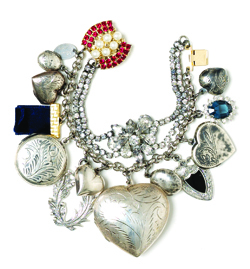
A charm bracelet is a type of bracelet which carries personal jewelled ornaments or "charms", such as decorative pendants or trinkets. The decorative charms usually carry personal or sentimental attachment by the owner.
The wearing of charms may have begun as a form of amulet or talisman due to a belief it wards off evil spirits or bad luck.
During the pre-historic period, jewellery charms would be made from shells, animal-bones and clay. Later charms were made out of gems, rocks, and wood.
For instance, there is evidence from Africa that shells were used for adornments around 75,000 years ago. In Germany intricately carved mammoth tusk charms have been found from around 30,000 years ago. In ancient Egypt charms were used for identification and as symbols of faith and luck. Charms also served to identify an individual to the gods in the afterlife.
During the Roman Empire, Christians would use tiny fish charms hidden in their clothing to identify themselves to other Christians. Jewish scholars of the same period would write tiny passages of Jewish law and put them in amulets round their necks to keep the law close to their heart at all times. Medieval knights wore charms for protection in battle. Charms also were worn in the Middle Ages to denote family origin and religious and political convictions.
Charm bracelets have been the subject of several waves of trends. The first charm bracelets were worn by Assyrians, Babylonians, Persians, and Hittites and began appearing from 600 – 400 BC.
For example, Queen Victoria wore charm bracelets that started a fashion among the European noble classes. She was instrumental to the popularity of charm bracelets, as she “loved to wear and give charm bracelets. When her beloved Prince Albert died, she even made “mourning” charms popular; lockets of hair from the deceased, miniature portraits of the deceased, charm bracelets carved in jet.”[citation needed]
In 1889, Tiffany and Co. introduced their first charm bracelet — a link bracelet with a single heart dangling from it, a bracelet which is an iconic symbol for Tiffany today.[citation needed]
Charm bracelet
A charm bracelet is a type of bracelet which carries personal jewelled ornaments or "charms", such as decorative pendants or trinkets. The decorative charms usually carry personal or sentimental attachment by the owner.
The wearing of charms may have begun as a form of amulet or talisman due to a belief it wards off evil spirits or bad luck.
During the pre-historic period, jewellery charms would be made from shells, animal-bones and clay. Later charms were made out of gems, rocks, and wood.
For instance, there is evidence from Africa that shells were used for adornments around 75,000 years ago. In Germany intricately carved mammoth tusk charms have been found from around 30,000 years ago. In ancient Egypt charms were used for identification and as symbols of faith and luck. Charms also served to identify an individual to the gods in the afterlife.
During the Roman Empire, Christians would use tiny fish charms hidden in their clothing to identify themselves to other Christians. Jewish scholars of the same period would write tiny passages of Jewish law and put them in amulets round their necks to keep the law close to their heart at all times. Medieval knights wore charms for protection in battle. Charms also were worn in the Middle Ages to denote family origin and religious and political convictions.
Charm bracelets have been the subject of several waves of trends. The first charm bracelets were worn by Assyrians, Babylonians, Persians, and Hittites and began appearing from 600 – 400 BC.
For example, Queen Victoria wore charm bracelets that started a fashion among the European noble classes. She was instrumental to the popularity of charm bracelets, as she “loved to wear and give charm bracelets. When her beloved Prince Albert died, she even made “mourning” charms popular; lockets of hair from the deceased, miniature portraits of the deceased, charm bracelets carved in jet.”[citation needed]
In 1889, Tiffany and Co. introduced their first charm bracelet — a link bracelet with a single heart dangling from it, a bracelet which is an iconic symbol for Tiffany today.[citation needed]
Recent media
Recent media