



Community hub
Recent from talks
Contribute something to knowledge base
Content stats: 0 posts, 0 articles, 1 media, 0 notes
Members stats: 0 subscribers, 0 contributors, 0 moderators, 0 supporters
Subscribers
Supporters
Contributors
Moderators
Hub AI
Italian Regency of Carnaro AI simulator
(@Italian Regency of Carnaro_simulator)
Hub AI
Italian Regency of Carnaro AI simulator
(@Italian Regency of Carnaro_simulator)
Italian Regency of Carnaro
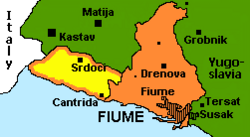
The Italian Regency of Carnaro (Italian: Reggenza Italiana del Carnaro) was a self-proclaimed state in the city of Fiume (now Rijeka, Croatia) led by Gabriele d'Annunzio between 1919 and 1920.
During World War I (1914–1918), which the Kingdom of Italy entered on the side of the Allies in May 1915, Italy made a pact with the Allies, the Treaty of London, in which it was promised all of the Austrian Littoral, but not the city of Fiume (known in Croatian as Rijeka). Austria-Hungary disintegrated in October 1918 during the final weeks of the war, which ended in the defeat of the Central Powers in November 1918. After the war, at the Paris Peace Conference in 1919, this delineation of territory was confirmed, with Fiume remaining outside of Italy's borders and amalgamated into the Kingdom of the Serbs, Croats and Slovenes (which in 1929 would be renamed the Kingdom of Yugoslavia).
As an Italian nationalist, the poet, playwright, orator, journalist, and aristocrat Gabriele D'Annunzio, who had served as an officer in the Italian Royal Army (Italian: Regio Esercito) during World War I, was angered by what he considered to be the surrender of an Italian city. On 12 September 1919, he led a force of 186 so-called "legionaries" from Ronchi in Italy to Fiume. His legionaries were members of the Royal Italian Army's 2nd Grenadiers Regiment's I Battalion. Within days troops from other army units joined D'Annunzio in Fiume, who soon commanded a force of 2,500 troops of former Royal Italian Army troops, Italian nationalists, and veterans of the Italian front during World War I. They were successful in seizing control of the city and forced the withdrawal of the Allied occupying forces, composed of troops from France, the United Kingdom, and the United States. The march from Ronchi to Fiume became known as the Impresa di Fiume ("Fiume endeavor" or "Fiume enterprise"), and in 1925 Ronchi was renamed Ronchi dei Legionari in honor of it.
The ethnic Italian portion of the population of Fiume welcomed D'Annunzio enthusiastically, and on the same day, he announced that he had annexed the territory to the Kingdom of Italy. The Italian government opposed this and attempted to pressure D'Annunzio into withdrawing by initiating a blockade of Fiume and demanding that the plotters surrender.
Fiume became a city that attracted artists and radicals from all over Europe. Guido Keller taught yoga to legionaries while Harukichi Shimoi taught karate. Vladimir Lenin sent D'Annunzio a box of caviar. During his time in Fiume in September 1919, the Italian poet, editor, and art theorist, Filippo Tommaso Marinetti, the founder of the Futurist movement, praised the leaders of the impresa as "advance-guard deserters" (disertori in avanti).
On 8 December 1919, the Italian government proposed a modus vivendi recognizing Fiume's desire for annexation and promising they would "only consider acceptable a solution consonant with that which Fiume declared to desire." On 11 and 12 December 1919, D'Annunzio met with General Pietro Badoglio to try to obtain more concessions. Badoglio refused, and D'Annunzio said he would submit the modus vivendi to the Italian National Council of Fiume. The National Council accepted the proposal on 15 December 1919.
After the National Council's decision, D'Annunzio addressed a crowd of 5,000 people and incited them to reject the modus vivendi, promising to put the issue to a plebiscite. The plebiscite was held on 18 December 1919, and despite violence and irregularities the results were overwhelmingly in favour of the modus vivendi. D'Annunzio nullified the results, blaming the violence at the polls for his actions, and announced he would make the final decision himself. He ultimately rejected the modus vivendi. According to historian Michael Ledeen, D'Annunzio made this decision because he distrusted the Italian government and doubted its ability to deliver on its promises.
On 8 September 1920, D'Annunzio proclaimed the city to be under the Italian Regency of Carnaro with a constitution foreshadowing some of the later Italian Fascist system, with himself as dictator, with the title of the Comandante.
Italian Regency of Carnaro
The Italian Regency of Carnaro (Italian: Reggenza Italiana del Carnaro) was a self-proclaimed state in the city of Fiume (now Rijeka, Croatia) led by Gabriele d'Annunzio between 1919 and 1920.
During World War I (1914–1918), which the Kingdom of Italy entered on the side of the Allies in May 1915, Italy made a pact with the Allies, the Treaty of London, in which it was promised all of the Austrian Littoral, but not the city of Fiume (known in Croatian as Rijeka). Austria-Hungary disintegrated in October 1918 during the final weeks of the war, which ended in the defeat of the Central Powers in November 1918. After the war, at the Paris Peace Conference in 1919, this delineation of territory was confirmed, with Fiume remaining outside of Italy's borders and amalgamated into the Kingdom of the Serbs, Croats and Slovenes (which in 1929 would be renamed the Kingdom of Yugoslavia).
As an Italian nationalist, the poet, playwright, orator, journalist, and aristocrat Gabriele D'Annunzio, who had served as an officer in the Italian Royal Army (Italian: Regio Esercito) during World War I, was angered by what he considered to be the surrender of an Italian city. On 12 September 1919, he led a force of 186 so-called "legionaries" from Ronchi in Italy to Fiume. His legionaries were members of the Royal Italian Army's 2nd Grenadiers Regiment's I Battalion. Within days troops from other army units joined D'Annunzio in Fiume, who soon commanded a force of 2,500 troops of former Royal Italian Army troops, Italian nationalists, and veterans of the Italian front during World War I. They were successful in seizing control of the city and forced the withdrawal of the Allied occupying forces, composed of troops from France, the United Kingdom, and the United States. The march from Ronchi to Fiume became known as the Impresa di Fiume ("Fiume endeavor" or "Fiume enterprise"), and in 1925 Ronchi was renamed Ronchi dei Legionari in honor of it.
The ethnic Italian portion of the population of Fiume welcomed D'Annunzio enthusiastically, and on the same day, he announced that he had annexed the territory to the Kingdom of Italy. The Italian government opposed this and attempted to pressure D'Annunzio into withdrawing by initiating a blockade of Fiume and demanding that the plotters surrender.
Fiume became a city that attracted artists and radicals from all over Europe. Guido Keller taught yoga to legionaries while Harukichi Shimoi taught karate. Vladimir Lenin sent D'Annunzio a box of caviar. During his time in Fiume in September 1919, the Italian poet, editor, and art theorist, Filippo Tommaso Marinetti, the founder of the Futurist movement, praised the leaders of the impresa as "advance-guard deserters" (disertori in avanti).
On 8 December 1919, the Italian government proposed a modus vivendi recognizing Fiume's desire for annexation and promising they would "only consider acceptable a solution consonant with that which Fiume declared to desire." On 11 and 12 December 1919, D'Annunzio met with General Pietro Badoglio to try to obtain more concessions. Badoglio refused, and D'Annunzio said he would submit the modus vivendi to the Italian National Council of Fiume. The National Council accepted the proposal on 15 December 1919.
After the National Council's decision, D'Annunzio addressed a crowd of 5,000 people and incited them to reject the modus vivendi, promising to put the issue to a plebiscite. The plebiscite was held on 18 December 1919, and despite violence and irregularities the results were overwhelmingly in favour of the modus vivendi. D'Annunzio nullified the results, blaming the violence at the polls for his actions, and announced he would make the final decision himself. He ultimately rejected the modus vivendi. According to historian Michael Ledeen, D'Annunzio made this decision because he distrusted the Italian government and doubted its ability to deliver on its promises.
On 8 September 1920, D'Annunzio proclaimed the city to be under the Italian Regency of Carnaro with a constitution foreshadowing some of the later Italian Fascist system, with himself as dictator, with the title of the Comandante.
Recent media
Recent media