Hubbry Logo
Croatian languageCroatian languageMain
Open search
Croatian language
Community hub
Croatian language
logo
8 pages, 0 posts
0 subscribers
Be the first to start a discussion here.
Croatian language
Croatian language
from Wikipedia

Croatian
hrvatski
Pronunciation[xř̩ʋaːtskiː]
Native toCroatia, Bosnia and Herzegovina, Hungary (Bácska), Montenegro (Bay of Kotor), Romania (Caraș-Severin County), Serbia (Vojvodina),[1] Kosovo (Janjevo)
RegionSoutheast Europe
EthnicityCroats
SpeakersL1: 5.1 million (including all dialects spoken by Croats) (2021)[1]
L2: 1.3 million (2012)[1]
Latin (Gaj's alphabet)
Yugoslav Braille
Glagolitic (historical)
Bosnian Cyrillic (historical)
Official status
Official language in
Recognised minority
language in
Regulated byInstitute of Croatian Language and Linguistics
Language codes
ISO 639-1hr
ISO 639-2hrv
ISO 639-3hrv
Glottologcroa1245
Linguaspherepart of 53-AAA-g
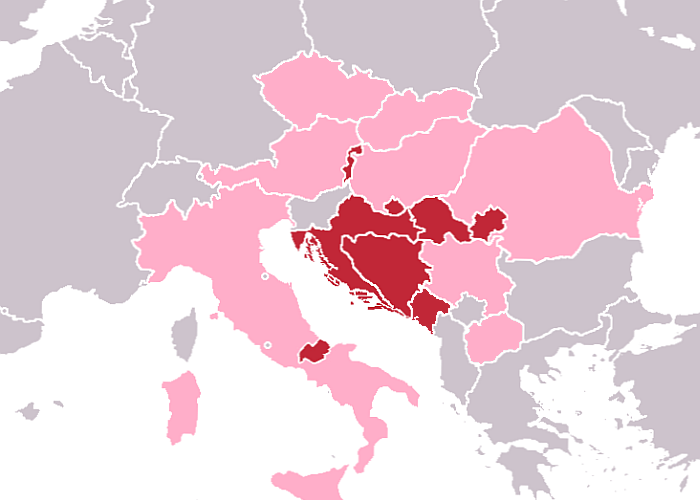
States and regions which recognize Croatian as (co-)official (dark red) or minority language (light red)
Croatian is not endangered according to the classification system of the UNESCO Atlas of the World's Languages in Danger
This article contains IPA phonetic symbols. Without proper rendering support, you may see question marks, boxes, or other symbols instead of Unicode characters. For an introductory guide on IPA symbols, see Help:IPA.

Croatian[a] is the standard variety of the Serbo-Croatian language mainly used by Croats.[8] It is the national official language and literary standard of Croatia, one of the official languages of Bosnia and Herzegovina, Montenegro, the Serbian province of Vojvodina, the European Union and a recognized minority language elsewhere in Serbia and other neighbouring countries.

In the mid-18th century, the first attempts to provide a Croatian literary standard began on the basis of the Neo-Shtokavian dialect that served as a supraregional lingua franca – pushing back regional Chakavian, Kajkavian, and Shtokavian vernaculars.[9] The decisive role was played by Croatian Vukovians, who cemented the usage of Ijekavian Neo-Shtokavian as the literary standard in the late 19th and the beginning of the 20th century, in addition to designing a phonological orthography.[10] Croatian is written in Gaj's Latin alphabet.[11]

Besides the Shtokavian dialect, on which Standard Croatian is based, there are two other main supradialects spoken in Croatia, Chakavian and Kajkavian. These supradialects, and the four national standards – Bosnian, Croatian, Montenegrin and Serbian – are usually subsumed under the term "Serbo-Croatian" in English; this term is controversial for native speakers,[12] and names such as "Bosnian-Croatian-Montenegrin-Serbian" (BCMS) are used by linguists and philologists in the 21st century.[13]

In 1997, the Croatian Parliament established the Days of the Croatian Language from March 11 to 17.[14] Since 2013, the Institute of Croatian language has been celebrating the Month of the Croatian Language, from February 21 (International Mother Language Day) to March 17 (the day of signing the Declaration on the Name and Status of the Croatian Literary Language).[14]

History

[edit]

Modern language and standardization

[edit]

In the late medieval period up to the 17th century, the majority of semi-autonomous Croatia was ruled by two domestic dynasties of princes (banovi), the Zrinski and the Frankopan, which were linked by inter-marriage.[15] Toward the 17th century, both of them attempted to unify Croatia both culturally and linguistically, writing in a mixture of all three principal dialects (Chakavian, Kajkavian and Shtokavian), and calling it "Croatian", "Dalmatian", or "Slavonian".[16] Historically, several other names were used as synonyms for Croatian, in addition to Dalmatian and Slavonian, and these were Illyrian (ilirski) and Slavic (slovinski).[17] It is still used now in parts of Istria, which became a crossroads of various mixtures of Chakavian with Ekavian, Ijekavian and Ikavian isoglosses.[18]

The most standardised form (Kajkavian–Ikavian) became the cultivated language of administration and intellectuals from the Istrian peninsula along the Croatian coast, across central Croatia up into the northern valleys of the Drava and the Mura. The cultural apex of this 17th century idiom is represented by the editions of "Adrianskoga mora sirena" ("The Siren of the Adriatic Sea") by Petar Zrinski and "Putni tovaruš" ("Traveling escort") by Katarina Zrinska.[19][20]

However, this first linguistic renaissance in Croatia was halted by the political execution of Petar Zrinski and Fran Krsto Frankopan by the Holy Roman Emperor Leopold I in Vienna in 1671.[21] Subsequently, the Croatian elite in the 18th century gradually abandoned this combined Croatian standard.[22]

Illyrian period

[edit]

The Illyrian movement was a 19th-century pan-South Slavic political and cultural movement in Croatia that had the goal to standardise the regionally differentiated and orthographically inconsistent literary languages in Croatia, and finally merge them into a common South Slavic literary language. Specifically, three major groups of dialects were spoken on Croatian territory, and there had been several literary languages over four centuries. The leader of the Illyrian movement Ljudevit Gaj standardized the Latin alphabet in 1830–1850 and worked to bring about a standardized orthography. Although based in Kajkavian-speaking Zagreb, Gaj supported using the more populous Neo-Shtokavian – a version of Shtokavian that eventually became the predominant dialectal basis of both Croatian and Serbian literary language from the 19th century on.[23][24] Supported by various South Slavic proponents, Neo-Shtokavian was adopted after an Austrian initiative at the Vienna Literary Agreement of 1850,[22] laying the foundation for the unified Serbo-Croatian literary language. The uniform Neo-Shtokavian then became common in the Croatian elite.[22]

In the 1860s, the Zagreb Philological School dominated the Croatian cultural life, drawing upon linguistic and ideological conceptions advocated by the members of the Illyrian movement.[25] While it was dominant over the rival Rijeka Philological School and Zadar Philological Schools, its influence waned with the rise of the Croatian Vukovians (at the end of the 19th century).[26]

Distinguishing features and differences between standards

[edit]

Croatian is commonly characterized by the ijekavian pronunciation (see an explanation of yat reflexes), the sole use of the Latin alphabet, and a number of lexical differences in common words that set it apart from standard Serbian.[27] Some differences are absolute, while some appear mainly in the frequency of use.[27] However, as professor John F. Bailyn states, "an examination of all the major 'levels' of language shows that BCS is clearly a single language with a single grammatical system."[28]

Sociopolitical standpoints

[edit]

Croatian, although technically a form of Serbo-Croatian, is sometimes considered a distinct language by itself.[12] This is at odds with purely linguistic classifications of languages based on mutual intelligibility (abstand and ausbau languages),[29] which do not allow varieties that are mutually intelligible to be considered separate languages. "There is no doubt of the near 100% mutual intelligibility of (standard) Croatian and (standard) Serbian, as is obvious from the ability of all groups to enjoy each others' films, TV and sports broadcasts, newspapers, rock lyrics etc.", writes Bailyn.[28] Differences between various standard forms of Serbo-Croatian are often exaggerated for political reasons.[30] Most Croatian linguists regard Croatian as a separate language that is considered key to national identity,[31] in the sense that the term Croatian language includes all language forms from the earliest times to the present, in all areas where Croats live, as realized in the speeches of Croatian dialects, in city speeches and jargons, and in the Croatian standard language.[32][33] The issue is sensitive in Croatia as the notion of a separate language being the most important characteristic of a nation is widely accepted, stemming from the 19th-century history of Europe.[34] The 1967 Declaration on the Status and Name of the Croatian Literary Language, in which a group of Croatian authors and linguists demanded greater autonomy for Croatian, is viewed in Croatia as a linguistic policy milestone that was also a general milestone in national politics.[35]

On the 50th anniversary of the Declaration, at the beginning of 2017, a two-day meeting of experts from Croatia, Bosnia-Herzegovina, Serbia and Montenegro was organized in Zagreb, at which the text of the Declaration on the Common Language of Croats, Bosniaks, Serbs and Montenegrins was drafted.[36] The new Declaration has received more than ten thousand signatures. It states that in Croatia, Serbia, Bosnia-Herzegovina and Montenegro a common polycentric standard language is used, consisting of several standard varieties, similar to the existing varieties of German, English or Spanish.[37] The aim of the new Declaration is to stimulate discussion on language without the nationalistic baggage[38] and to counter nationalistic divisions.[39]

The terms "Serbo-Croatian", "Serbo-Croat", or "Croato-Serbian", are still used as a cover term for all these forms by foreign scholars, even though the speakers themselves largely do not use it.[27] Within ex-Yugoslavia, the term has largely been replaced by the ethnopolitical terms Bosnian, Croatian, Montenegrin, and Serbian.[40]

The use of the name "Croatian" for a language has historically been attested to, though not always distinctively. The first printed Croatian literary work is a vernacular Chakavian poem written in 1501 by Marko Marulić, titled "The History of the Holy Widow Judith Composed in Croatian Verses".[41][42] The Croatian–Hungarian Agreement designated Croatian as one of its official languages.[43] Croatian became an official EU language upon accession of Croatia to the European Union on 1 July 2013.[44][45] In 2013, the EU started publishing a Croatian-language version of its official gazette.[46]

Official status

[edit]
Areas with an ethnic Croatian majority (as of 2006)

Standard Croatian is the official language of the Republic of Croatia[47] and, along with Standard Bosnian and Standard Serbian, one of three official languages of Bosnia and Herzegovina.[2] It is also official in the regions of Burgenland (Austria),[48] Molise (Italy)[49] and Vojvodina (Serbia).[50] Additionally, it has co-official status alongside Romanian in the communes of Carașova[51] and Lupac,[52][53] Romania. In these localities, Croats or Krashovani make up the majority of the population, and education, signage and access to public administration and the justice system are provided in Croatian, alongside Romanian.

Croatian is officially used and taught at all universities in Croatia and at the University of Mostar in Bosnia and Herzegovina. Studies of Croatian language are held in Hungary (Institute of Philosophy at the ELTE Faculty of Humanities in Budapest[54]), Slovakia (Faculty of Philosophy of the Comenius University in Bratislava[54]), Poland (University of Warsaw, Jagiellonian University, University of Silesia in Katowice, University of Wroclaw, Adam Mickiewicz University in Poznan),[55] Germany (University of Regensburg[56]), Australia (Center for Croatian Studies at the Macquarie University[57]), Northern Macedonia (Faculty of Philology in Skopje[58]) etc.

Croatian embassies hold courses for learning Croatian in Poland,[59] United Kingdom[60] and a few other countries. Extracurricular education of Croatian is held in Germany in Baden-Württemberg, Berlin, Hamburg and Saarland,[61] as well as in North Macedonia in Skopje, Bitola, Štip and Kumanovo.[58] Some Croatian Catholic Missions also hold Croatian language courses (e.g., CCM in Buenos Aires[62]).

There is no regulatory body that determines the proper usage of Croatian. However, in January 2023, the Croatian Parliament passed a law that prescribes the official use of the Croatian language, regulates the establishment of the Council for the Croatian language as a coordinating advisory body whose work will be focused on the protection and development of the Croatian language. State authorities, local and regional self-government entities are obliged to use the Croatian language.[63]

The current standard language is generally laid out in the grammar books and dictionaries used in education, such as the school curriculum prescribed by the Ministry of Education and the university programmes of the Faculty of Philosophy at the four main universities.[citation needed][needs update] In 2013, a Hrvatski pravopis by the Institute of Croatian Language and Linguistics received an official sole seal of approval from the Ministry of Education.

The most prominent recent editions describing the Croatian standard language are:

Also notable are the recommendations of Matica hrvatska, the national publisher and promoter of Croatian heritage, and the Miroslav Krleža Institute of Lexicography, as well as the Croatian Academy of Sciences and Arts.

Numerous representative Croatian linguistic works were published since the independence of Croatia, among them three voluminous monolingual dictionaries of contemporary Croatian.

In 2021, Croatia introduced a new model of linguistic categorisation of the Bunjevac dialect (as part of New-Shtokavian Ikavian dialects of the Shtokavian dialect of the Croatian language) in three sub-branches: Dalmatian (also called Bosnian-Dalmatian), Danubian (also called Bunjevac), and Littoral-Lika.[64][65] Its speakers largely use the Latin alphabet and are living in parts of Bosnia and Herzegovina, different parts of Croatia, southern parts (inc. Budapest) of Hungary as well in the autonomous province Vojvodina of Serbia. The Institute of Croatian Language and Linguistics added the Bunjevac dialect to the List of Protected Intangible Cultural Heritage of the Republic of Croatia on 8 October 2021.[66][67]

Sample text

[edit]

Article 1 of the Universal Declaration of Human Rights in Croatian (2009 Croatian government official translation):

Sva ljudska bića rađaju se slobodna i jednaka u dostojanstvu i pravima. Ona su obdarena razumom i sviješću te trebaju jedna prema drugima postupati u duhu bratstva.[68]

Article 1 of the Universal Declaration of Human Rights in English:

All human beings are born free and equal in dignity and rights. They are endowed with reason and conscience and should act towards one another in a spirit of brotherhood.[69]

See also

[edit]

Notes

[edit]

References

[edit]

Sources

[edit]

Further reading

[edit]
[edit]
Revisions and contributorsEdit on WikipediaRead on Wikipedia
from Grokipedia
The Croatian language is a standardized variety of , classified as a South Slavic language within the Indo-European family, primarily spoken by around 5.5 million native speakers worldwide, with the largest concentrations in and among the in countries like and . It functions as the official language of , as enshrined in Article 12 of the national constitution, which mandates its use alongside the in official proceedings, though regional minority languages may also receive recognition in specific locales. Croatian employs a phonetic -based known as , developed in the , and exhibits a phonological inventory of five vowels (distinguished by length) and 25 consonants, fewer than many other Slavic tongues. Standard Croatian is based on the Štokavian dialect, which forms the core of the , rendering it mutually intelligible with Serbian, Bosnian, and Montenegrin despite political efforts since Croatia's 1991 independence to emphasize distinctions through lexical purism—favoring native Slavic roots over internationalisms—and minor syntactic preferences. This standardization, solidified in the amid national revival movements, draws from earlier traditions including inscriptions like the 11th-century Baška tablet, marking some of the oldest continuous Slavic literary records outside Church Slavonic influence. Grammatically, it features a highly inflected structure with three genders, seven cases, and in some forms, alongside three main dialect groups—Štokavian, Čakavian, and —that reflect regional phonological and lexical variations but do not impede the standard's dominance in education, media, and administration. The language's evolution underscores a tension between linguistic unity rooted in shared historical substrates and engineered divergences driven by ethnopolitical identity post-Yugoslav dissolution, where empirical persists amid assertions of separateness.

Linguistic Classification

Indo-European Ancestry and South Slavic Branch

The Croatian language belongs to the , specifically within the Balto-Slavic branch's Slavic subgroup, where it forms part of the West South Slavic group alongside languages such as Slovenian, Bosnian, Serbian, and Montenegrin. This classification traces Croatian's ancestry to Proto-Indo-European, the reconstructed common ancestor of spoken approximately 4500–2500 BCE in the region, which evolved through intermediate stages including Proto-Balto-Slavic (around the 2nd millennium BCE) and Proto-Slavic (emerging by the early centuries CE). Proto-Slavic, the direct progenitor of all , exhibited features such as a rich system of cases, aspects in verbs, and pitch accent, which persisted variably in descendants like Croatian. The divergence of Slavic into its three main branches—East, West, and South—occurred after the relative unity of Proto-Slavic, likely following Slavic expansions from their original homeland in Eastern Europe during the Migration Period. South Slavic specifically arose from Proto-Slavic varieties transported southward into the Balkans by Slavic tribes between the 6th and 7th centuries CE, amid the collapse of Roman authority and interactions with local Illyrian, Roman, and Gothic populations. This branch is characterized by shared innovations absent in East and West Slavic, including the development of a dialect continuum influenced by geography and substrate languages, with Western South Slavic (encompassing Croatian) distinguished from Eastern South Slavic (Macedonian and Bulgarian) by features such as retention of certain consonant clusters and vowel shifts. Croatian's core vocabulary and grammar thus reflect this South Slavic trajectory, with over 80% lexical similarity to neighboring South Slavic varieties stemming from their common Proto-Slavic roots. Historical linguistics identifies key Proto-Slavic-to-South Slavic transitions, such as the monophthongization of diphthongs and the evolution of the vowel (*), which in South Slavic often yielded distinct reflexes like ije or e, contributing to Croatian's phonological profile. Empirical reconstruction relies on comparative methods applied to attested Slavic texts from the onward, including Glagolitic inscriptions, confirming South Slavic's separation from other branches by around 800–1000 CE through areal developments in the . These changes were driven by geographic isolation and contact phenomena rather than abrupt splits, underscoring the gradual, evidence-based nature of linguistic phylogeny in this branch.

Relations to Serbo-Croatian Varieties and Neighboring Languages

The emerged as one of the four principal varieties of what was officially termed during the existence of from 1918 to 1991, encompassing Croatian, Serbian, Bosnian, and later Montenegrin standards, all based primarily on the . Linguistically, these varieties exhibit nearly identical grammatical structures, syntax, and core vocabulary, with Croatian and the others sharing over 95% lexical overlap in standard forms. Scholars in formal maintain that no substantive differences exist to classify Croatian and Serbian as distinct languages, viewing them instead as standardized registers of a single linguistic system. Mutual intelligibility among these standards is exceptionally high, approaching 100% in spoken and written forms for native speakers, facilitated by shared phonological inventories and morphological rules, though regional accents and idiolects may introduce minor comprehension challenges. Key divergences include —Croatian employs exclusively the Latin alphabet, while Serbian permits both Latin and Cyrillic— preferences, such as Croatian's consistent ijekavian reflex (e.g., mlijeko for "") versus Serbian's ekavian (mleko) in some standards, and lexical choices, where post- Croatian language policies emphasized by favoring Slavic-rooted neologisms over international loanwords or perceived "Serbianisms" adopted during Yugoslav unification. These efforts, initiated in the early , aimed to assert linguistic but have not altered the underlying structural unity, as evidenced by showing equivalent comprehension rates across variants. In relation to neighboring , Croatian maintains closer ties to Bosnian and Serbian due to the shared base, but exhibits greater divergence from Slovenian, which belongs to the South Slavic branch yet features distinct phonological traits like pitch accent and morphology not present in Croatian. with Slovenian is partial at best, estimated at 50-70% for standard forms, hindered by vocabulary differences and grammatical innovations in Slovenian influenced by West Slavic contacts; however, northern Croatian dialects show higher similarity to Slovenian border varieties, reflecting historical continuum effects. Further afield, Croatian shares fewer cognates and lower intelligibility with Macedonian and Bulgarian, which preserve older Slavic case systems but diverge in and analytic constructions. Non-Slavic neighbors like Italian and Hungarian contribute primarily through historical loanwords in Croatian, particularly in and coastal regions, without significant structural impact.

Historical Development

Proto-Slavic Origins and Early Slavic Settlement

The Croatian language traces its origins to Proto-Slavic, the reconstructed ancestor of all , which emerged from Proto-Balto-Slavic around 1500 BCE in the region of the middle , Pripet, and upper rivers in . Proto-Slavic remained relatively uniform as a without written attestation until approximately the CE, featuring characteristics such as a rich system of , nasal vowels, and a mobile pitch accent inherited from Indo-European roots. This proto-language's lexical and grammatical core, including innovations like the replacement of Indo-European laryngeals and the development of a distinct case system, forms the foundational substrate for South Slavic varieties, including those that evolved into Croatian. The divergence of South Slavic dialects from late Proto-Slavic occurred in tandem with the large-scale migrations of Slavic-speaking groups into the beginning in the CE, driven by population pressures and the collapse of centralized powers like the Hunnic and Avar khaganates. Genomic evidence from confirms that these migrations introduced substantial Eastern European ancestry—associated with Proto-Slavic speakers—into the as early as the 7th century, replacing or admixing with pre-existing Romanized Illyrian and Italic populations in regions like and . Linguistic markers of this early South Slavic phase include shared innovations such as the satemization of Indo-European stops and the preservation of certain dual forms, which persisted in the dialects spoken by in what became Croatian territory. In the areas of modern , Slavic settlement intensified in the early , with tribes identified in Byzantine sources as Croats establishing principalities in and upper , initially under Avar overlordship before achieving autonomy. Archaeological correlates, including Prague-Korchak type and settlement patterns, align with this influx, indicating a rapid linguistic shift where Proto-Slavic dialects supplanted Latin and Illyrian substrates, as evidenced by substrate loanwords in toponyms (e.g., river names ending in -ica) and hydronyms. These early settlers' speech, transitional from Proto-Slavic to proto-South Slavic, laid the groundwork for the , , and that characterizes Croatian, with minimal early divergence due to the recency of the migrations relative to other Slavic branches. The uniformity of Proto-Slavic at the time of settlement minimized initial dialectal fragmentation, allowing for subsequent regional influenced by and contact with Romance and Germanic speakers.

Medieval Croatian and Glagolitic Script

The Glagolitic script, developed in the 9th century by Saints Cyril and Methodius for translating liturgical texts into Old Church Slavonic, was adopted in medieval Croatia, evolving into a distinctive angular form known as Croatian Glagolitic. This script facilitated the expression of early Croatian linguistic features within the Church Slavonic recension, distinguishing it from other Slavic variants. In Croatia, Glagolitic coexisted with Latin script and was uniquely permitted for Catholic liturgy, reflecting the region's cultural and religious autonomy under papal indults. A pivotal development occurred with papal privileges granting Croatian clergy the right to conduct the in Slavic using Glagolitic. In 1248, authorized its use among Slavs in and , with a specific 1252 indult extended to Benedictine monks in Omišalj on Island for . This permission, unique in Western Christendom, spurred the production of Glagolitic liturgical books, including missals, breviaries, and psalters, which preserved and adapted Slavic textual traditions. The Baška tablet, dating to circa 1100 AD, exemplifies early medieval Croatian Glagolitic usage. Discovered in 1851 on Island, this inscription in 13 lines records a church dedication under Croatian King Zvonimir, invoking the and detailing property grants, thus attesting to the script's role in legal and religious documentation. Other inscriptions and manuscripts from the 11th to 12th centuries, primarily in rounded Glagolitic transitioning to angular forms, indicate widespread scribal activity in coastal and island communities. Medieval Croatian Glagolitic literature encompassed liturgical works alongside non-liturgical texts such as homilies, apocrypha, and hagiographies, often blending biblical translations with original compositions. Centers like those on Krk and in Istria produced codices that maintained the Cyrillo-Methodian heritage while incorporating local linguistic innovations, contributing to a vernacular-inflected Slavic written culture until the script's gradual supplantation by Cyrillic and Latin alphabets in later centuries.

Ottoman, Habsburg, and Venetian Influences

During the Ottoman Empire's expansion into Croatian territories from the early 16th century, particularly affecting regions like , , and parts of between 1526 and the late 17th century, Turkish loanwords entered the Croatian lexicon primarily through military, administrative, and daily life interactions. These borrowings, numbering among the most substantial foreign influxes, include terms for food (e.g., burek for a , ćevap for grilled ), clothing (čarapa for ), and architecture (), often adapted phonetically to fit Slavic patterns. Ottoman control, which peaked after the in 1526 and persisted until the Habsburg reconquests in the 1690s, facilitated this via direct rule in border areas and cultural exchange in contested zones, though Croatian speakers under Habsburg protection experienced indirect influence through refugee populations and trade. Under Habsburg rule, formalized after the Croatian parliament's election of Ferdinand I as king in 1527 and extending through the Austro-Hungarian Empire until 1918, German emerged as the dominant language of administration, education, and military in northern and inland Croatian lands, leading to extensive lexical borrowing. By the late 18th century, German had supplanted Latin in official functions across the empire, introducing over 2,000 words into Croatian related to governance (bürger influencing građanin for citizen), technology (maschine for machine), and urban life, particularly in Zagreb and surrounding areas where bilingualism was common among elites and officials. These terms often pertained to public spheres rather than rural peasant vocabulary, reflecting Habsburg centralization efforts like the Theresian reforms of the 1770s, which mandated German in schools and courts, though Croatian persisted in liturgy and local literature. Venetian dominance in Dalmatia, secured progressively from 1409 and consolidated by 1420 until the republic's fall in 1797, imposed Italian (specifically Venetian dialect) as a lingua franca in coastal cities like Zadar, Split, and Dubrovnik, profoundly shaping the Chakavian and transitional dialects of Croatian through maritime trade, governance, and cultural assimilation. Loanwords proliferated in nautical terminology (galeon for galley), commerce (bancon for bench or bank), and architecture (palazzo adapted as palata), with Venetian influence blending into local Romance substrates and accelerating the decline of the extinct Dalmatian language while enriching Croatian variants in urban centers. This period's multilingualism, evident in notarial records and literature from the 15th to 18th centuries, fostered hybrid forms like the Zaratin dialect in Zadar, where Venetian syntax subtly affected Croatian prosody and vocabulary, though Slavic identity was maintained via Glagolitic script in ecclesiastical contexts.

19th-Century Illyrian Movement and Initial Standardization

The , initiated in the early 1830s by Croatian intellectuals amid Habsburg rule over the Kingdom of Croatia-Slavonia, pursued cultural and linguistic unification among to counter Hungarian dominance and foster ethnic identity. Central to this effort was the promotion of a standardized , termed "Illyrian" or "Croato-Slavonic," drawn primarily from the widespread dialect to bridge regional variations and align with emerging Serbian literary norms. (1809–1872), a key proponent, argued for phonetic and dialectal convergence to enable broader Slavic solidarity, publishing foundational works that shifted Croatian writing from archaic Kajkavian-based forms toward Neo-Shtokavian, which reflected the vernacular of and regions. In 1830, Gaj issued Kratka osnova horvatsko-slavenskoga pravopisaňa, a 32-page printed in , which outlined principles for a reformed using diacritics such as hooks (e.g., č, , ) and accents to achieve one-to-one sound-letter correspondence, eliminating digraphs and etymological spellings prevalent in prior Croatian texts. This system, inspired partly by Czech orthographic models and Vuk Karadžić's Serbian reforms, initially incorporated elements but evolved to prioritize phonology, facilitating its use for both Croatian and Serbian variants under the Illyrian banner. The 's title explicitly referenced "Croatian or Serbian," underscoring the movement's initial vision of linguistic reciprocity rather than separation. Adoption accelerated with Gaj's launch of the newspaper Novine horvatske (later Ilirske novine), which mandated the new , reaching thousands of readers and embedding it in administrative and educational contexts within the . By the 1840s, the movement's linguistic innovations had supplanted inconsistent regional scripts, establishing Neo-Shtokavian as the basis for Croatian standard forms despite resistance from purists favoring or traditions. Standardization efforts included compiling grammars and dictionaries, such as Gaj's 1834 Rječnik horvatskoga ili ilirskoga jezika, which documented over 10,000 terms while preserving Croatian lexical distinctions. Hungarian authorities suppressed the pan-Illyrian label in 1843, prompting a pivot to explicit , yet the orthographic and dialectal foundations endured, forming the core of codified Croatian by century's end. This process, grounded in empirical dialect mapping rather than ideological imposition, resolved orthographic fragmentation but sowed seeds for later debates over shared Slavic heritage.

Interwar and Yugoslav Era Policies

In the Kingdom of Serbs, Croats, and (renamed in 1929), formed on December 1, 1918, language policy centered on unifying the South Slavic dialects into a single to promote national integration. The Constitution, adopted on June 28, 1921, declared Serb-Croat-Slovene as the of the state, with Article 5 specifying its use in , courts, and while allowing minority languages in designated areas. This framework drew on pre-war Serbo-Croatian standardization efforts but prioritized the Eastern Herzegovinian (Ijekavian) dialect—common in Croatian territories—as the basis, supplemented by Ekavian forms prevalent in ; however, implementation often favored Serbian lexical and orthographic preferences, including alongside Latin. Croatian linguists and cultural figures, such as those in the Matica hrvatska society, protested these asymmetries as eroding Croatian distinctiveness, particularly after King Alexander's January 6, 1929, dictatorship intensified centralization, banning regional parties and imposing uniform school curricula that emphasized shared "Yugoslav" identity over ethnic-linguistic differences. World War II disrupted these policies amid occupation and the Independent State of Croatia's (1941–1945) promotion of a purified Croatian variant, excluding Serbian influences. Postwar, the Federal People's Republic of Yugoslavia (later Socialist Federal Republic of Yugoslavia from 1963) under the 1946 constitution guaranteed equality for languages of the "peoples of Yugoslavia" (Serbs, Croats, Slovenes, Macedonians, Montenegrins, and others), mandating their use in federal bodies alongside . Federal policy, however, treated as a polycentric with four variants (Serbian, Croatian, Bosnian, Montenegrin), enforcing joint orthographies and grammars to suppress national divisions. The pivotal 1954 Novi Sad Agreement, endorsed by the Serbian, Croatian, and Montenegrin academies of sciences and arts on October 3–5, 1954, codified this by declaring Serbs, Croats, and Montenegrins speakers of one common language—named (in Croatia) or Croato-Serbian (in Serbia)—with equal validity for Ijekavian and Ekavian pronunciations, Latin and Cyrillic scripts, and no privileging of one ethnic variant. Tensions persisted as Croatian scholars argued the agreement facilitated "Serbization" through shared terminology and reduced emphasis on Croatian-specific lexicon. This culminated in the (Hrvatsko proljeće, 1967–1971), a reform movement led by intellectuals and Matica hrvatska, which demanded Croatian as the sole official language in Croatian institutions, rejection of the Novi Sad framework, and linguistic purification via neologisms and rejection of "Serbisms." In April 1971, Matica hrvatska published Hrvatski pravopis (Croatian Orthography), advocating stricter Ijekavian norms and etymological spellings divergent from the 1960 joint manual. The movement linked language to broader calls for economic and federal asymmetry favoring republics. Yugoslav authorities, viewing these demands as nationalist threats, cracked down in December 1971 under Josip Broz Tito's directive; Croatian Communist League leaders like Savka Dabčević-Kučar and Miko Tripalo were ousted, Matica hrvatska purged, and publications suppressed, including the 1971 orthography, a 1973 Croatian grammar, and school textbooks through 1987. Subsequent 1974 constitutional amendments devolved some language authority to republics, allowing de facto Croatian variants in local use, but federal oversight maintained Serbo-Croatian unity in military, diplomacy, and interstate communication until the federation's dissolution. This era entrenched resistance among Croatian linguists, setting precedents for post-1991 restandardization.

Post-1991 Independence and Linguistic Purification

Following Croatia's on 25 June 1991, Article 12 of the established Croatian as the and as mandatory in , judicial proceedings, and , explicitly rejecting the designation from the Yugoslav period. This legal affirmation aligned with broader efforts to codify Croatian's distinct ijekavian , , and , which had been suppressed under federal unitarism favoring ekavian Serbian influences. The transition involved immediate revisions to textbooks, signage, and official documents to prioritize Croatian-specific forms, driven by the need to assert national sovereignty during the ensuing war (1991–1995). Under President Franjo Tuđman's administration (1990–1999), top-down purification targeted lexical elements perceived as Serbian imports or non-native loans, promoting and revivals of archaic Slavic terms to "cleanse" the standard. Examples include coining "računalo" (from "računati," to calculate) for "computer" and compiling resources like the 1993 book Do We Speak Croatian Correctly?, which listed Croatian equivalents for contested vocabulary. State media and the Croatian Philological Society enforced these shifts, with academics such as Milan Moguš framing foreign influences as an "illness" requiring treatment to preserve linguistic purity. Such measures extended to professional terminology, as seen in the 1992 launch of contests by linguistic journals to foster native innovations over internationalisms. The 2005 establishment of the Council for the Standard Croatian Language Norm by the government provided an institutional framework for ongoing oversight, issuing non-binding recommendations on usage in science, media, and administration to sustain distinctiveness from neighboring varieties. While these initiatives built on 19th-century purist traditions amplified by , they elicited for rigid prescriptivism, which heightened educational insecurities and resisted natural borrowing, though public adherence grew, with 96% of respondents in the 2001 census identifying Croatian as their mother tongue. Post-2000 governments moderated extremes, yet purification persisted as a marker of post-Yugoslav identity consolidation.

Dialectology and Standardization

Principal Dialect Groups (Shtokavian, Kajkavian, Chakavian)

The principal dialect groups of the Croatian language are , , and , classified based on the interrogative pronoun for "what": ča in Čakavian, kaj in Kajkavian, and što or šta in Štokavian. These groups reflect historical South Slavic migrations and geographic isolation, with Štokavian serving as the foundation for standard Croatian, while Čakavian and Kajkavian retain more archaic features and limited contemporary use. Štokavian dominates spoken Croatian, comprising the majority of dialects in central and southern regions, whereas the other two are confined to northern and coastal areas, influencing regional identities but not the national standard. Čakavian dialects are spoken primarily along the northern Adriatic coast, including , the Kvarner islands, and parts of , with a relatively uniform structure allowing high among speakers. Phonologically, Čakavian features a pitch accent system distinct from the stress-based prosody of standard Croatian, and it preserves older Slavic vocalism, such as the reflex of the vowel as ě or e. Historically associated with use in medieval liturgy, Čakavian represents an early literary tradition but has declined in prestige since the , spoken today by approximately 10-15% of Croatians in isolated communities. Kajkavian dialects prevail in northern inland , encompassing Hrvatsko Zagorje, around , and extending into parts of , with speakers estimated at about 35% of the Croatian population. Linguistically, Kajkavian exhibits similarities to Slovenian, including long distinctions and a tendency to drop the , alongside unique innovations like the merger of certain consonants and retention of nasal vowels. It features periphrastic future tenses more akin to West Slavic patterns and has influenced Zagreb's urban speech, though it lacks formal and faces pressure from Štokavian in education and media. Štokavian dialects form the core of standard Croatian, based specifically on the Neo-Štokavian Ijekavian variety spoken in , , and , covering the bulk of Croatia's territory south of . Key features include the ijekavian reflex of yat (e.g., mlijeko for ), fixed stress patterns evolving into dynamic accentuation, and a rich system of subdialects differentiated by ekavian/ikavian reflexes in eastern areas. As the prestige dialect since the 19th-century , Štokavian enabled unification of Croatian linguistic norms post-independence in , with its supradialectal status facilitating across South Slavic variants while incorporating purified lexicon to distinguish from neighboring standards.

Evolution of the Standard Based on Neo-Shtokavian

The Neo-Shtokavian dialect, distinguished by phonetic shifts including the affrication of *č to ć and *dž to đ, emerged as a literary medium in the 17th and 18th centuries among South Slavic writers, laying groundwork for its later standardization. Initial efforts to unify Croatian literary expression on this basis occurred in the mid-18th century, marking the first steps toward a cohesive standard amid diverse regional varieties. A turning point came with the Vienna Literary Agreement of March 1850, where Croatian and Serbian intellectuals, including Đuro Daničić and Ivan Mažuranić, endorsed —specifically the Ijekavian Neo-Shtokavian variant prevalent in eastern —as the foundation for a shared , emphasizing phonetic spelling and . This accord facilitated the gradual supplanting of earlier Kajkavian-influenced norms promoted by figures like , as Neo-Shtokavian's widespread vernacular use and growing literary output proved more practical for broader South Slavic unity. By the late , Croatian adherents to Vuk Karadžić's phonological principles, known as Vukovians, solidified Ijekavian Neo-Shtokavian as the dominant standard through adaptations that preserved Croatian-specific pronunciations and , overcoming resistance from purists favoring autochthonous dialects. This consolidation aligned with the dialect's demographic dominance in Croatian-speaking areas, enabling its entrenchment in , administration, and print media by the early 20th century. During the Kingdom of Serbs, Croats, and Slovenes (1918–1929) and subsequent Yugoslav periods, the standard operated within the framework, yet retained Neo-Shtokavian Ijekavian traits as the western variant. The Agreement of 1954, signed by linguists from , , and Bosnia, reaffirmed this polycentric model, stipulating Ijekavian Neo-Shtokavian in for Croatian usage while promoting lexical equivalence. Post-World War II institutionalization further embedded these features in official orthographies and grammars, such as the 1967 Croatian Orthographic Manual. The persistence of Neo-Shtokavian post-1991 Croatian independence reflects its entrenched role, with reforms focusing on lexical purification rather than dialectal overhaul, as evidenced by the 1998 Croatian Language Declaration prioritizing native etymologies without altering the phonological core. Ongoing debates among linguists center on refining orthographic consistency and resisting puristic excesses, ensuring the standard's adaptability while anchored in its Neo-Shtokavian origins.

Criteria for Standard Forms and Ongoing Reforms

The standard form of Croatian is codified through phonological, orthographic, grammatical, and lexical criteria centered on the Neo-Štokavian dialect with the Ijekavian reflex, as established in linguistic norms dating to the 19th-century standardization efforts and reaffirmed post-independence. Key phonological criteria mandate the ijekavian pronunciation (e.g., mlijeko for "milk," distinguishing it from the ekavian mleko prevalent in standard Serbian), fixed pitch accent patterns, and a vowel system of five qualities without reduction. Orthographically, it employs the Latin alphabet with diacritics (č, ć, đ, š, ž) and rejects digraphs or Cyrillic, enforcing phonetic spelling where one grapheme corresponds to one phoneme, as per rules updated in post-1991 manuals. Grammatical standards derive from Štokavian inflections, including seven cases, three genders, and dual number in some conservative usages, with syntactic preferences for subject-verb-object order but flexible word order for emphasis. Lexically, criteria prioritize native Slavic roots, coinages from existing morphemes, and avoidance of internationalisms or variants associated with Serbo-Croatian unification, such as preferring zrakoplov over avion for "airplane" to maintain etymological transparency. Post-1991 independence, reforms have emphasized differentiation from legacies through purist policies, including the replacement of over 100,000 lexical items influenced by Yugoslav-era standardization, with official bodies like the Council for Standard Croatian promoting native equivalents in media, education, and administration. The Law on the Croatian Language and subsequent 2023 amendments established systematic oversight, mandating expert review for public usage and prohibiting non-standard forms in official contexts, while funding terminological databases to codify reforms. Spelling conventions saw four manual revisions since 1994, diverging from 1960 Agreement norms by reinstating pre-Yugoslav rules, such as capitalizing nouns optionally in some styles and standardizing hyphenation for compounds. These changes, driven by assertion amid the 1991-1995 , reduced shared with Serbian by approximately 10-15% through deliberate , though critics argue excessive hampers post-EU accession in . Ongoing debates, informed by academic , balance purism with pragmatic borrowing, as evidenced in 2020s terminological projects adapting EU legal terms while preserving core Slavic lexicon.

Phonological and Orthographic Features

Vowel and Consonant Inventory

The standard Croatian language features a vowel system of five qualities, each distinguished by phonemic length into short and long variants, yielding ten vowel phonemes in total: short /a/, /e/, /i/, /o/, /u/ and long /aː/, /eː/, /iː/, /oː/, /uː/. Vowel length affects meaning, as in minimal pairs like pas /pâs/ ('dog') versus pâs /paːs/ ('belt'), where the stressed long vowel contrasts with the short one. These vowels are realized without significant diphthongization in standard pronunciation, and quality remains relatively stable across positions, though unstressed vowels may exhibit minor centralization. The consonant inventory consists of 25 phonemes, characterized by voicing contrasts in , palatal nasals and laterals, and a lack of labiodental or uvular fricatives beyond the standard set. Stops include bilabial /p b/, alveolar /t d/, and velar /k ɡ/; affricates feature alveolar /t͡s d͡z/ and postalveolar /t͡ʃ d͡ʒ/; fricatives encompass labiodental /f v/, alveolar /s z/, postalveolar /ʃ ʒ/, and velar /x/. Sonorants comprise bilabial nasal /m/, alveolar nasal /n/, palatal nasal /ɲ/, alveolar lateral /l/, palatal lateral /ʎ/, alveolar trill /r/, and palatal /j/. Voicing assimilation occurs across obstruent clusters, but the underlying phonemic distinctions persist.
Manner/PlaceBilabialLabiodentalAlveolarPostalveolarPalatalVelar
Stopsp bt dk ɡ
Affricatest͡s d͡zt͡ʃ d͡ʒ
Fricativesf vs zʃ ʒx
Nasalsmnɲ
Lateralslʎ
Trillsr
j
This table illustrates the distribution, with no phonemic aspiration or ejection in stops, and palatalization limited to /ɲ/ and /ʎ/ rather than a broader series.

Prosodic Elements and Intonation

The prosodic system of standard Croatian, derived from the Neo-Štokavian dialect, features a pitch-accent paradigm that combines culminative stress, tonal contours, and vowel quantity to distinguish lexical items. Four pitch accents are traditionally recognized: short falling (realized with an early low tone and slight fall), short rising (late peak with posttonic distinction), long falling (steeper fall on lengthened vowel), and long rising (similar to short rising but protracted). These accents are mobile across inflectional paradigms and marked diacritically in linguistic descriptions, though omitted in everyday orthography. Acoustic analysis of 89 speakers from diverse regions confirms their robustness, with approximately 40% employing the full four-accent inventory, while others exhibit transitional forms merging accents into two or three variants. Stress in Croatian is dynamic and unpredictable, applying to one per and influencing , which remains contrastive even in unaccented positions (e.g., rad 'work' vs. rȃd 'I'd do'). In the Zagreb variety, influencing urban standard speech, lexical tonal contrasts diminish, yielding pragmatic peak alignment: posttonic for broad focus, tonic for narrow, alongside retained stress. Tonal realizations vary regionally, with rising accents often manifesting as slight falls, and post-accentual lowering aiding differentiation. Intonation in Croatian overlays lexical accents with phrasal melodies, typically employing a low boundary tone (L-) for neutral declaratives, resulting in a falling contour on the rightmost prominent word to signal broad or narrow focus via pitch compression post-focus. Yes/no interrogatives feature a rise-fall (LHL) or end-rising pattern, with prominence on the focused constituent (often the in broad contexts) and heightened pitch floor for illocutionary force. Wh-questions align more closely with declarative falls (HL tune) but permit rise-fall in emphatic or multiple-wh constructions, interacting with to delimit focus domains (e.g., SVO allowing sentence-wide projection, OSV restricting to ). Emotive intonation expands pitch range on focused elements, enabling early accents while adhering to adjacency constraints between and arguments for projection.

Latin Alphabet Usage and Spelling Conventions

The Croatian language utilizes , formalized by linguist in during efforts to standardize South Slavic , comprising 30 letters that include modified consonants with diacritics and specific digraphs to achieve phonemic representation. This system excludes the letters Q, W, X, and Y from native vocabulary, reserving them solely for foreign loanwords, proper names, or abbreviations, which maintains orthographic purity while accommodating international terms.
UppercaseLowercaseNamePhonetic Value (IPA)
Aaa/a/
Bbbe/b/
Ccce/ts/ (before e,i) or /k/ (elsewhere, but rare in native words)
Ččče/tʃ/
Ććće/tɕ/
Ddde/d/
dže/dʒ/
Đđđe/dʑ/
Eee/e/ (or /ɛ/)
Ffef/f/
Ggge/ɡ/
Hhha/x/
Iii/i/
Jjje/j/
Kkka/k/
Llel/l/
Ljljlj/ʎ/
Mmem/m/
Nnen/n/
Njnjnje/ɲ/
Ooo/o/
Pppe/p/
Rrer/r/ (trilled)
Sses/s/
Ššše/ʃ/
Ttte/t/
Uuu/u/
Vvve/ʋ/
Zzze/z/
Žžže/ʒ/
The adheres to a strictly phonemic principle, where each corresponds to one without silent letters or variable spellings in native words, facilitating straightforward reading and writing; diacritics appear only on consonants (acute accents on and , carons on and , and a on Đ), while vowels remain undiacriticized to reflect their consistent . Digraphs , Lj, and Nj function as indivisible units, sorted and alphabetized as single letters in dictionaries and indices—for example, words beginning with "lj" precede those with "l" followed by a vowel—and are capitalized holistically (e.g., LJubav for ""). Spelling conventions, codified in official manuals such as the Hrvatski pravopis (most recently revised in post-independence editions emphasizing Ijekavian forms), prohibit arbitrary variations and mandate etymological transparency; compound words are typically joined without hyphens (e.g., književnost for "literature"), and foreign elements are adapted phonetically unless proper nouns demand retention (e.g., Washington remains unaltered). Capitalization is restrained compared to many Indo-European languages: it applies to sentence initials, proper nouns (including geographic and personal names), and honorific titles only when preceding the name (e.g., predsjednik Miloš, but predsjednik zemlje), but not to common nouns, days, months, or adjectives derived from proper names unless proper-noun status is retained. Punctuation follows standard Latin conventions with adaptations: the en dash (–), called "crtica", is used with spaces on both sides to indicate stronger pauses, parenthetical insertions, interruptions, dialogue, or ranges (e.g., 2020 – 2025), while the em dash (—), or "duga crtica", is not used; the shorter hyphen (-), or "spojnica", is employed without spaces for compound words. Other adaptations include the decimal comma and guillemets for quotes in formal texts, ensuring alignment with phonetic and morphological structures. These rules, rooted in 19th-century standardization and refined through 20th-century linguistic councils, prioritize auditory fidelity over historical orthographic relics, distinguishing Croatian from Ekavian Serbian variants while supporting post-1991 purification efforts against non-native influences.__6.pdf)

Grammatical Structure

Nominal Declension and Cases

Croatian nouns decline according to seven grammatical cases—nominative, genitive, dative, accusative, vocative, locative, and —and two numbers, singular and plural, with forms largely predictable by (masculine, feminine, neuter) and, for masculines, . This system reflects Proto-Slavic inheritance, where case endings encode syntactic roles such as subject, object, possession, and location, often obviating prepositional phrases. is inherent and determines paradigm choice: masculines typically end in s in the nominative singular, feminines in -a or a consonant, and neuters in -o or -e. distinctions affect accusative forms in masculines, aligning them with genitive for animates but nominative for inanimates. Declension classes are grouped by stem type and , with regular patterns but irregularities in stems ending in palatal or sibilant consonants. Feminine nouns in -a (e.g., kuća "house") follow a standard paradigm where genitive singular adds -e, dative/locative -i, accusative -u, vocative -o, and -om. Consonant-stem feminines (i-stems, e.g., kost "") use -i across genitive, dative, locative, and singular. Masculine paradigms split by : animates (e.g., konj "") have accusative singular identical to genitive (-a), while inanimates (e.g., grad "") match nominative. Neuters (e.g., nebo "") show , with accusative identical to nominative across numbers and genitive plural in -a. Plural forms generally unify across genders, with nominative/accusative/ vocative in -i (masculine) or -e (feminine/neuter), and other cases following singular-like endings adjusted for number. The following tables illustrate core paradigms for singular and plural forms, using representative examples. These reflect standard neo-Štokavian norms codified in Croatian grammar references since the 19th century. Feminine -a paradigm (e.g., kuća "house"):
CaseSingularPlural
Nominativekućakuće
Genitivekućekuća
Dativekućikućama
Accusativekućukuće
Vocativekućokuće
Locativekućikućama
Instrumentalkućomkućama
Masculine animate paradigm (e.g., konj ""):
CaseSingularPlural
Nominativekonjkonji
Genitivekonjakonja
Dativekonjukonjima
Accusativekonjakonje
Vocativekonjukonji
Locativekonjukonjima
Instrumentalkonjemkonjima
Neuter paradigm (e.g., nebo "sky"):
CaseSingularPlural
Nominativenebonebesa
Genitivenebaneba
Dativenebunebima
Accusativenebonebesa
Vocativenebonebesa
Locativenebunebima
Instrumentalnebomnebima
Adjectives and pronouns agree in case, number, and gender, amplifying the system's expressiveness, while post-1991 purist reforms have emphasized native Slavic forms over borrowings in declensional contexts. Irregularities occur in foreign loanwords, often adapted to nearest native paradigms (e.g., masculines ending in -um decline as -a in genitive), but core nouns maintain high transparency due to phonological consistency.

Verbal Conjugation, Aspects, and Tenses

Croatian verbs inflect for (first, second, third), number (singular, ), (in and conditional forms), tense, mood, and aspect, with conjugation patterns determined by the infinitive stem and . Verbs are classified into three primary conjugation types based on infinitive endings: first conjugation (-ati verbs, e.g., raditi "to work"), second conjugation (-e-ti or -a-ti verbs with present stems in -im/-eš, e.g., jeseti "to carry"), and third conjugation (-i-ti verbs, e.g., spavati "," though classifications vary slightly by stem alternations and markers). This system reflects inherited Proto-Slavic patterns, with over 90% of verbs fitting these classes, though irregular verbs like biti ("to be") and htjeti ("to want") deviate. Aspect is a grammatical category inherent to the verb stem, distinguishing imperfective (nesavršeni) verbs, which denote ongoing, habitual, repeated, or incomplete actions without emphasis on completion, from perfective (savršeni) verbs, which denote bounded, completed, or single telic events. Most verbs exist in aspectual pairs, with perfective forms derived from imperfective bases via prefixation (e.g., imperfective čitati "to read" yields perfective pročitati "to read [completely]"), suffixation, or suppletion; biaspectual verbs, which lack strict pairing, often undergo prefixation for perfectivization in specific contexts. Aspect interacts with tense: imperfective verbs freely form present, past, and future tenses for durative or iterative senses, while perfective verbs cannot form true present tenses for actual ongoing actions (instead using present forms for imminent future or generic truths) and rely on past or future for completion. This binary system, shared with other Slavic languages, prioritizes viewpoint over duration alone, enabling nuanced expression of causality and boundedness without auxiliary constructions common in Romance languages. The indicative mood features three primary tenses in everyday use: present, past (perfective-dominant), and future. The present tense conjugates the stem with person endings (e.g., for pisati "to write," imperfective: pišem, pišeš, piše, pišemo, pišete, pišu), expressing current states or habits only for imperfectives; archaic aorist and imperfect tenses, synthetic formations for punctual or durative past, persist in literary or dialectal registers but are obsolete in standard speech. The past tense (perfekt) employs the l-participle (active past participle, e.g., pisao masculine singular, pisala feminine singular, agreeing with subject gender/number) plus the present or past of auxiliary biti (e.g., ja sam pisao "I wrote/m have written"); a pluperfect variant uses the l-participle with imperfect biti for anterior past but is rare. Future tense I for imperfectives uses htjeti ("will," conjugated: ću, ćeš, će, ćemo, ćete, će) plus infinitive (e.g., pišat ću "I will write [ongoing]"); perfectives use their present tense for future completion (e.g., pročitat ću via prefixed form implying "I will have read"); future II, expressing posteriority, layers perfective participles over future auxiliaries but sees limited colloquial use. The , expressing hypothetical or polite intent, has present and past forms: present conditional uses the l-participle plus present biti (e.g., pisao bih "I would write," with enclitic bi from biti); past conditional adds past biti for counterfactuals (e.g., pisao bih bio "I would have written"). derives from present stems, with singular forms often identical to second-person present (e.g., piši! "write!") and plural via -te suffix; negative imperatives employ nemoj plus . Voice includes active (default) and passive, formed with biti plus (e.g., knjiga je pročitana "the book was read"). These elements combine aspectually: perfectives favor resultative passives and conditionals for completed hypotheticals, while imperfectives support progressive-like nuances in compounds.

Syntactic Patterns and Word Order Flexibility

Croatian exhibits a basic subject-verb-object (SVO) word order in declarative sentences, akin to many , as in the neutral construction "Ja čitam knjigu" (I read a ). This default order conveys straightforward propositional content without emphasis. The language's syntactic flexibility arises from its rich morphological case system, comprising seven cases (nominative, genitive, dative, accusative, vocative, locative, instrumental), which encode grammatical roles independently of linear position. This permits permutations such as subject-object-verb (SOV), object-subject-verb (OSV), or verb-initial structures (e.g., "Knjigu ja čitam" for object-fronting to emphasize the book), altering pragmatic focus rather than semantic interpretation. Fronting of constituents, including adverbial phrases or objects, signals topic prominence or new information placement toward the end, as in "Na stolu je pismo" (A letter is on the table, introducing new referent) versus "Pismo je na stolu" (The letter is on the table, presupposing familiarity). Enclitic pronouns, auxiliaries (e.g., forms of "biti"), reflexive "se", and particles like interrogative "li" adhere to second-position placement (Wackernagel's Law), attaching to the first stressed word or prosodic constituent, which constrains flexibility. Their internal order is templatic: "li" precedes auxiliaries, followed by dative pronouns, then accusative/genitive, "se", and finally "je" (e.g., "Dao sam ti ga" – I gave it to you). As a , subjects may be omitted when contextually recoverable, further enabling concise structures while preserving the enclitic rule. This interplay of free constituent order and rigid clitic positioning underscores Croatian's discourse-driven , where deviations from SVO enhance stylistic neutrality or focal contrast.

Lexicon and Semantic Evolution

Slavic Core and Etymological Layers

The core of the Croatian lexicon derives from Proto-Slavic, the reconstructed common ancestor of all spoken approximately from the 5th to 9th centuries AD, encompassing basic terms for , anatomy, numerals, and environment that constitute the inherited Slavic substrate. These elements, often traceable to Proto-Balto-Slavic and ultimately Proto-Indo-European roots, include words like bràtrъ (brother; Croatian brat), nòga (leg; noga), glava (head; glava), jèzero (lake; jezero), and zvězda (star; zvijezda), which exhibit South Slavic phonological shifts such as the yat reflex (ě > ij/ē) and consistent morphological patterns across the . This Proto-Slavic stock forms the bulk of everyday vocabulary, with derivations via prefixes and suffixes enabling expansion, as in do-jiti (to breast-feed) from dojiti. Etymological layers build upon this core through diachronic Slavic developments, including Common Slavic (late Proto-Slavic) innovations and post-Proto-Slavic dialectal retentions. In Croatian dialects, particularly Kajkavian and Čakavian, archaic lexemes preserved from Proto-Slavic demonstrate ties to West Slavic, such as Kajkavian čara (line, from Proto-Slavic čara), smika (sledge part), and mrha (animal corpse), which lack Eastern Slavic cognates but align phonologically with Slovenian and Polish forms. Standard Shtokavian Croatian, the basis of the modern norm, integrates these layers via shared South Slavic evolutions, like the merger of nasal vowels and specific suffixations, while avoiding non-inherited strata in purist registers. A distinct literary layer emerged from Croatian recensions of Church Slavonic, beginning in the 9th century with the Glagolitic script introduced by Cyril and Methodius, and evolving into Croatian Church Slavonic by the 11th century through vernacular (primarily Čakavian) phonetic and lexical adaptations. This hybrid form, used in inscriptions like the 1102 Baška tablet, incorporated Proto-Slavic roots into ecclesiastical and legal terminology—e.g., reinforcing terms for abstract concepts like sud (judgment; sud)—while blending Old Church Slavonic morphology with local innovations, thus layering enriched Slavic vocabulary without foreign intrusion. These strata underscore Croatian's conservative retention of Slavic etymons, distinguishing it from heavier non-Slavic overlays in neighboring languages.

Foreign Influences and Regional Borrowings

The Croatian lexicon incorporates significant foreign borrowings primarily from periods of Roman, Ottoman, Habsburg, and Venetian domination, reflecting centuries of geopolitical contact rather than inherent linguistic affinity. Turkish loanwords, introduced during Ottoman rule from the 15th to 19th centuries, form one of the largest non-Slavic strata, with estimates exceeding several hundred integrated terms related to administration, daily life, and ; examples include kutija ("," from Turkish kutu), kesten ("," from kestane), and čaršija ("," from çarşı), often entering via direct mediation or Greek intermediaries. German borrowings, stemming from Habsburg administration in the 18th and 19th centuries, predominantly affect technical, administrative, and colloquial domains in northern varieties, such as fabrika ("," from Fabrik) and bager ("," from Bagger), with studies identifying persistent use in modern corpora despite standardization efforts. Italian and Venetian influences, concentrated from the 13th to 18th centuries under control, contribute architectural and maritime terms like balkon ("," from balcone) and cepin ("," from cippo), particularly assimilated through phonetic adaptation in coastal registers. Latin loans, dating to early around the 7th-9th centuries and reinforced via , appear in abstract and legal vocabulary, including zakon ("," derived from lex via intermediate forms). Regional borrowings vary by dialect clusters, mirroring localized historical dominions and trade routes. In Kajkavian dialects of northern Croatia (e.g., around Zagreb and Varaždin), exposed to Hungarian and Austro-German spheres until 1918, Hungarian traces are sparse but evident in agrarian terms, alongside denser German lexical overlays in tools and governance, such as dialectal variants of šnops ("schnapps," from Schnaps). Čakavian dialects along the Adriatic (Istria, Dalmatia, islands) exhibit pronounced Italian-Venetian integrations from prolonged maritime commerce and governance, with borrowings like kònoba ("tavern," from Venetian canaba) and jarbol ("mast," from arbòl) embedded in fishing, cuisine, and architecture, totaling hundreds in local idiolects per linguistic surveys of Dalmatian contact zones. Štokavian dialects, foundational to standard Croatian and prevalent in inland Slavonia and Herzegovina, retain more Turkish administrative and household items (e.g., ćuprija "bridge," from köprü) alongside northern German intrusions, though coastal Štokavian fringes blend Italian elements; these asymmetries arise from Ottoman incursions sparing western coasts but penetrating eastern interiors, as corroborated by etymological mappings of Balkan contact layers. Such dialect-specific integrations persist in spoken forms, influencing regional semantic fields despite 19th-century standardization favoring Štokavian with Slavic neologisms over unchecked adoption.

Purist Efforts Against Ekavian and Internationalisms

Croatian , a tradition dating to the 19th-century , has consistently prioritized native Slavic lexicon and derivations over foreign borrowings, including those from German, Italian, Hungarian, and later English, to preserve ethnic linguistic identity. This approach extended to rejecting phonetic and lexical elements perceived as non-Croatian, particularly after the dissolution of Yugoslavia in 1991, when purists targeted features shared with standard Serbian to reinforce distinctions. Efforts intensified in the 1990s under linguists like Stjepan Babić, who advocated systematic replacement of "Serbianisms"—terms common to both standards—with Croatian neologisms, framing as a defense against historical suppression during the Yugoslav era (1918–1991). Against Ekavian influences, purists have upheld the Ijekavian dialect as the sole basis for standard Croatian since the 19th-century on Štokavian-Ijekavian substrates, explicitly rejecting the Ekavian reflex (e.g., mleko for ) used in Serbian as a marker of divergence. The 1967 Declaration on the Status and Name of the , signed by over 150 Croatian intellectuals and linguists, asserted the polycentric but distinct nature of Croatian, implicitly endorsing Ijekavian norms and opposing unificationist policies like the 1954 Novi Sad Agreement that tolerated Ekavian in shared frameworks. Post-independence, educational curricula, media guidelines, and official documents enforced Ijekavian exclusivity, with state institutions like the Institute for the Croatian Language and Linguistics promoting its use to avoid phonetic convergence with Serbian. Parallel initiatives combated internationalisms—loanwords from global technical, scientific, and cultural domains—by coining descriptive Slavic compounds or reviving archaic terms, often through the Croatian Academy of Sciences and Arts. Examples include substituting zrakoplov (aircraft, from zrak "air" + plov "navigation") for French-derived avion, and računalo (computer, from računati "to calculate") for English-influenced kompjuter, with these neologisms entering official lexicons by the mid-1990s. Such replacements targeted not only direct foreign loans but also internationalized terms shared with Serbian (e.g., preferring zdravlje refinements over hybrid forms), aiming for lexical autonomy amid . Purists justified this as empirical preservation of Croatian's diachronic evolution, citing historical precedents like 17th–18th-century expulsions of Venetian and Latin elements, though implementation varied, with some neologisms gaining limited everyday traction. By 2000, purist dictionaries and language laws, such as Croatia's 2010 Language and Script Act, institutionalized these preferences, mandating native terms in while acknowledging dialectal flexibility.

Distribution, Speakers, and Status

Global Speaker Demographics and Diaspora

Approximately 5.6 million people speak Croatian as a globally, with the core population concentrated in and adjacent regions of the former . In , the 2021 census recorded a total population of 3.87 million, of which 95.6% identified Croatian as their native language, equating to roughly 3.7 million speakers. In , Croatian serves as the standard for the Croat ethnic minority, comprising about 15.4% of the 3.5 million population or approximately 540,000 individuals who use it natively. Smaller native-speaking communities exist in (around 40,000), (under 20,000), and (about 30,000), often tied to historical border regions and . These figures reflect self-reported native proficiency, though intergenerational transmission in mixed areas can vary due to assimilation pressures. The , estimated at 3.2 million ethnic Croats and descendants living abroad as of , sustains the through heritage maintenance, though fluency rates decline across generations outside primary speech communities. hosts the largest expatriate group, with over 400,000 Croatian-born residents and descendants from 1960s-1970s labor migrations, many of whom retain conversational proficiency. maintains around 100,000 Croatian speakers, largely from post-World War II waves, supported by community organizations and media. In the United States, self-identified Croatian ancestry numbers about 1.2 million, but active first-language speakers are fewer, estimated at 50,000-100,000, concentrated in states like and with cultural institutions promoting transmission. Other notable diaspora pockets include (around 100,000 speakers), (50,000-70,000 from early 20th-century economic migrations), and (about 80,000), where economic remittances and voting blocs underscore linguistic continuity despite host-language dominance.
Country/RegionEstimated Native SpeakersPrimary Migration Waves
Croatia3.7 millionN/A
Bosnia and Herzegovina~540,000Historical settlement
Germany~400,0001960s-1970s guest workers
Australia~100,000Post-WWII refugees
United States~50,000-100,00019th-20th century, post-WWII
Canada~100,000Post-WWII, recent
These estimates derive from self-reports and surveys, which may overstate full proficiency; empirical studies indicate higher attrition rates in second- and third-generation immigrants due to patterns and educational policies favoring majority languages. Overall, while native speaker numbers remain stable, vitality relies on institutional efforts like Saturday schools and , countering globalization's homogenizing effects.

Official Use in Croatia and Institutions

The Constitution of the Republic of Croatia, as amended and consolidated through January 15, 2014, designates the Croatian language and Latin script as the official means of communication throughout the country. Article 12 specifies that Croatian holds this status nationally, while allowing local units with significant minority populations to introduce another language and script—such as Cyrillic—alongside Croatian for official purposes. This provision balances national linguistic unity with regional accommodations, primarily affecting areas with Serbian, Italian, or Hungarian minorities. The Croatian Language Act, enacted on January 22, 2024, and published in the Official Gazette (NN 14/24), reinforces this framework by mandating the standard Croatian language and (gajica) for all official uses within . Article 8 explicitly states that these are in official use across the republic, extending to , judicial proceedings, and state documentation. The Act establishes the Council for the Croatian Language to oversee compliance, monitor linguistic standards, and advise on policy, aiming to preserve Croatian against non-standard influences while promoting its systematic development. It also protects native toponyms as , requiring their use in official contexts unless overridden by historical exceptions. In governmental institutions, Croatian serves as the sole of the Croatian Parliament (Sabor), where debates, legislation, and records are conducted exclusively in standard Croatian. Executive bodies, including the Office of the and ministries, operate in Croatian for internal and public communications, with the National Croatian Language Policy Plan—adopted post-Act—further standardizing its application to ensure unfettered linguistic evolution. Judicial institutions, from municipal courts to the , require proceedings, judgments, and filings in Croatian, upholding the language's primacy in legal enforcement and dispute resolution. Education across all levels mandates Croatian as the primary language of instruction in public and most private institutions. Article 12 of the Language Act stipulates that , examinations, and administrative functions in schools, universities, and vocational programs occur in standard Croatian using , with exceptions only for minority-language in designated regions. This policy, aligned with pre-existing frameworks like the 2002 Constitutional Act on Minority Rights, ensures Croatian's role in forming while accommodating bilingual models where minorities exceed specified thresholds (e.g., 15% in units). Compliance is monitored through national curricula set by the Ministry of Science and , emphasizing proficiency in Croatian , , and .

Recognition in Multilingual Contexts and EU Frameworks

Croatian became an of the on 1 July 2013, upon Croatia's accession as the 28th member state, thereby joining the existing 23 official languages and expanding the Union's linguistic framework to 24. This status mandates that EU institutions provide Croatian translations of all , , and key documents, as well as interpretation services in parliamentary sessions, deliberations, and Court of Justice proceedings, in line with Article 290 of the on the Functioning of the , which upholds as a core principle. In practice, the EU's multilingual policy ensures procedural equality for Croatian, including its use in communications and the European Commission's maintenance of a Croatian database for consistent translation.) However, resource constraints limit full implementation across all contexts; while formal outputs like the Official Journal are available in Croatian, internal working languages remain dominated by English, French, and German, reflecting efficiency priorities over absolute parity. This arrangement has prompted Croatian authorities to advocate for enhanced digital tools and parallel corpora to support and terminological alignment within EU systems. Beyond the , Croatian receives recognition in select multilingual regional frameworks, such as , where it holds co-official status at the state level alongside Bosnian and Serbian under the 1995 , enabling its use in federal institutions and education in Croatian-majority areas. In international organizations like the and , Croatian is employed by Croatian delegations for submissions and speeches but lacks enumerated official status, relying instead on ad hoc translation from the six UN working languages or English in Council proceedings. This positions Croatian as functionally recognized in diplomatic multilingualism without the binding obligations afforded in EU structures.

Sociolinguistic and Political Dynamics

Nationalism, Identity, and Language Separation Debates

The debates over the Croatian language's distinctiveness from other South Slavic varieties, particularly Serbian, have been central to and identity formation, especially after independence in 1991. Proponents of separation argue that recognizing Croatian as a unique language is essential for preserving national sovereignty and cultural autonomy, viewing the prior designation as under as an imposition that diluted Croatian identity. This perspective gained momentum during the , with linguistic policies emphasizing Ijekavian pronunciation, exclusivity, and lexical purism to differentiate from Ekavian Serbian norms. Linguistic purism in post-Yugoslavia involved systematic efforts to replace words of perceived Serbian origin or common internationalisms with neologisms or archaic Slavic terms, framed as a reclamation of authentic Croatian heritage suppressed during communist-era standardization. For instance, terms like "tenis" were proposed to be replaced by "loptaš" in purist campaigns, though not all succeeded in widespread adoption. These initiatives, supported by institutions like the Croatian Academy of Sciences and Arts, served as a "barometer of Croat nationalist sentiments," linking language reform directly to ethnic differentiation amid the . Critics, including linguist Snježana Kordić, contend that such separations are ideologically driven rather than empirically grounded, pointing to near-complete between standard Croatian and Serbian—estimated at over 95% lexical overlap—and shared grammatical structures as evidence of a single . Kordić's analysis highlights how nationalist language ideologies in post-Yugoslav states construct artificial boundaries to mirror ethnic divisions, potentially exacerbating regional tensions rather than reflecting linguistic reality. A pivotal flashpoint occurred in with the Declaration on the Common Language, signed by over 200 intellectuals from , , Bosnia, and , asserting that Bosnian, Croatian, Montenegrin, and Serbian constitute variants of one based on mutual comprehensibility and historical continuity. This document provoked backlash in , where it was decried as undermining hard-won , leading to legal challenges and public debates that underscored the politicization of . Despite such controversies, empirical sociolinguistic studies affirm high cross-variety understanding in spoken and written forms, suggesting that identity-based separations prioritize symbolic over communicative functionality.

Yugoslav Suppression and Post-War Revival

In the , policies promoting as a unified often marginalized distinct Croatian linguistic features, particularly through the 1954 Novi Sad Agreement, which standardized and in ways perceived by Croatian linguists as favoring the Ekavian prevalent in over the Ijekavian form central to Croatian. This agreement, signed by philologists from , , and , asserted a single with two variants but was criticized by figures like Ljudevit Jonke for imposing Serbian influences on Croatian usage in and media. Tensions escalated with the 1967 Declaration on the Name and Status of the Croatian Literary Language, adopted on by over 100 Croatian scholars and published in the Telegram, which demanded recognition of Croatian as an equal standard, rejection of the Novi Sad compromises, and exclusive use of Croatian variants in Croatian institutions. The declaration argued that unification diluted Croatian identity, but Yugoslav authorities condemned it as nationalist agitation, leading to punishments for most signatories, including dismissals from academic posts. These efforts fueled the (1967–1971), a broader reform movement led by intellectuals and the cultural institution Matica hrvatska, which advocated "de-Serbianization" of the language through publications excluding shared elements and public discussions on linguistic purity. In December 1971, ordered the suppression of the movement, purging leaders like Savka Dabčević-Kučar and Miko Tripalo, dissolving Matica hrvatska's leadership, and imposing a period of enforced "Croatian silence" that stifled open linguistic debates until the late 1980s. Following Croatia's on June 25, 1991, and the ensuing (1991–1995), the Croatian language underwent deliberate revival as a marker of national sovereignty, with the 1992 Croatian Language Corpus and Dictionary projects initiating systematic purist reforms to excise perceived "Serbianisms" and revive archaic or coined Slavic terms. Post-independence policies, including the 1998 Orthography Law, emphasized Ijekavian exclusivity and native neologisms for modern concepts, reversing Yugoslav-era s and fostering differentiation from Serbian. By 2013, the establishment of the Institute of the Croatian Language and formalized ongoing , prioritizing empirical dialectal data over prior unified norms. These measures, while enhancing cultural distinctiveness, drew criticism for politicizing lexicon changes amid wartime identity assertions.

Criticisms of Purism vs. Mutual Intelligibility Claims

Critics of Croatian contend that it artificially inflates differences between Croatian and other variants, such as Serbian, by prioritizing ideological separation over empirical linguistic evidence of . Studies on comprehension, including tasks involving native speakers, have shown near-complete mutual understanding between standard Croatian and Serbian, with shared grammatical systems and lexical overlap exceeding 95% in core vocabulary, enabling unhindered communication without or adaptation. This high intelligibility, documented in controlled tests where participants from both groups accurately rendered texts across variants, undermines purist assertions of fundamental linguistic divergence, suggesting instead that observed differences—such as Ijekavian vs. Ekavian pronunciations or select neologisms—represent dialectal variation within a polycentric standard rather than discrete languages. Snježana Kordić, a linguist specializing in Balkan languages, has argued that constitutes an undemocratic intervention in evolution, driven by rather than descriptive , as it enforces prescriptivist bans on "non-Croatian" elements like Ekavian-derived terms or international loanwords despite their comprehension by Croatian speakers. In her analysis, such policies foster a false binary of "pure" Croatian versus foreign intrusions, ignoring how facilitates cross-variant exchange and how purist neologisms often fail to gain widespread adoption, remaining confined to official or academic contexts. Kordić further critiques for promoting linguistic censorship, exemplified by post-1991 efforts to excise shared lexicon, which she views as lacking empirical justification given the unbroken continuity of usage patterns among speakers. Other linguists, including Vladimir Anić and Dubravko Škiljan, have echoed these concerns, highlighting how purist doctrines prioritize etymological obsessions and historical revivalism over functional criteria like intelligibility, potentially hindering pragmatic communication in multilingual Balkan settings. Empirical assessments of spoken interaction reveal that Croatian-Serbian asymmetry in comprehension is minimal, with any barriers arising more from sociopolitical reluctance than structural opacity, as evidenced by seamless across borders pre- and post-Yugoslav dissolution. Proponents of mutual intelligibility claims thus posit that purism's emphasis on orthographic or lexical "purification" distorts causal linguistic realities, where shared substrate ensures unity, and advocate for recognizing variants as equal standards within a common pluricentric system to align policy with verifiable speaker behavior.

Cultural and Modern Applications

Role in Literature, Media, and Education

The Croatian language has served as the primary medium for literary expression since the medieval period, with early works such as the 11th-century Baška tablet inscription marking foundational texts in Glagolitic script. Marko Marulić (1450–1524), often regarded as the father of Croatian literature, composed epic poetry like Judita (1501), blending Renaissance humanism with Christian themes in the Štokavian dialect. In the 20th century, Miroslav Krleža (1893–1981) emerged as a dominant figure, authoring novels such as The Return of Philip Latinowicz (1932) that critiqued social structures and influenced subsequent generations through his encyclopedic output and cultural advocacy. Croatian literature expanded in the interwar and postwar eras with contributions from authors like Marija Jurić Zagorka, whose historical novels serialized in newspapers from 1902 onward depicted women's roles and national history, reaching wide audiences via print media. Post-independence, contemporary writers continue this tradition, though translation into major languages remains limited, constraining global reach. In media, Croatian dominates national outlets, with approximately six daily newspapers circulating in the language, including Večernji list and , which together accounted for a significant share of the roughly 33 million sold copies reported for dailies in 2022. Television broadcasting, led by channels like Nova TV and , delivers news and entertainment primarily in Croatian, with Nova TV's digital platform Dnevnik.hr attracting 39% of online news users as of 2017 surveys. Radio remains a key medium for local content, with over 50% of citizens engaging local stations for information, underscoring the language's role in sustaining community discourse amid digital shifts. Educationally, Croatian is the compulsory core subject in primary and secondary schools, comprising , , and communication domains as per national curricula reforms, with integrated into language classes to foster critical analysis of content. Croatia operates around 940 primary schools where Croatian instruction begins at age six, emphasizing native proficiency alongside dialect awareness. At higher levels, the University of Zagreb's School of Croatian Language and Culture offers specialized programs, including 120-hour courses since 2025 for foreign learners, combining , practical usage, and cultural immersion to support and international students.

Digital Adaptation and Technological Challenges

The Croatian language, utilizing the Latin alphabet with diacritics such as č, ć, đ, š, and ž, encountered encoding limitations in early digital systems reliant on ASCII, which lacked support for these extended characters, necessitating or omission in texts. Adoption of in the late 1990s resolved these issues by incorporating Croatian-specific glyphs in the block, enabling full representation in modern software and web standards. Despite this, legacy data and informal digital communication often feature texts without diacritics, prompting development of automated restoration models; for instance, transformer-based approaches like ByT5 have achieved high accuracy in correcting both typos and missing accents in Croatian. Input methods for Croatian have standardized around QWERTZ layouts in operating systems such as Windows and , where diacritics are accessed via dead keys or AltGr combinations, with variants like hr-US providing bilingual support. Mobile devices pose ergonomic challenges, as Croatian keyboards reduce key sizes for special characters, leading users to default to English and omit diacritics in casual texting. This practice persists, with surveys indicating widespread avoidance in digital correspondence despite available input tools. In (NLP), Croatian's status as a low-resource language limits training data for models, resulting in suboptimal performance for tasks like , , and disinformation detection compared to high-resource languages such as English. Large language models (LLMs) struggle with Croatian variants and dialects due to insufficient multilingual pretraining, exacerbating errors in cross-lingual transfer; extensions like C-XNLI datasets aim to mitigate this by augmenting resources for inference tasks. systems, including those trained on parliamentary audio, achieve viable accuracy for transcription but falter with accents or noisy environments, while translation tools like exhibit inaccuracies in idiomatic expressions and generation. Ongoing efforts, such as specialized ASR APIs and typo-correction models, indicate adaptation, yet resource scarcity hinders parity with major languages.

Sample Texts and Illustrative Phrases

The , known in Croatian as Oče naš, serves as a standard liturgical text in the Roman Catholic tradition predominant in , showcasing subject-verb-object syntax, vocative forms, and imperative moods typical of contemporary Croatian .
Oče naš, koji jesi na nebesima!
Sveti se ime tvoje.
Dođi kraljevstvo tvoje.
Budi volja tvoja,
kako na nebu, tako i na zemlji.
Kruh naš svagdanji daj nam danas.
I otpusti nam naše dugove,
kao i mi otpuštamo dužnicima našim.
I ne uvedi nas u napast,
nego nas izbavi od zla.
An English rendering is: "Our Father, who art , hallowed be thy name. Thy kingdom come, thy will be done, on earth as it is . Give us our daily , and forgive us our trespasses, as we forgive those who trespass against us. And lead us not into temptation, but deliver us from evil." The opening of Croatia's , Lijepa naša domovino ("Our Beautiful Homeland"), written by Antun Mihanović in 1835 and officially adopted in 1991, illustrates patriotic verse with and rhyme schemes common in 19th-century .
Lijepa naša domovino,
Oj junačka i slavnija,
Tebe želimo, tebe želimo,
Dok mu živo srce bije
Translation: "Our beautiful homeland, oh so fearless and gracious, our fathers' ancient glory, this we desire, this we desire, while hearts still beat." Dobriša Cesarić's 1921 poem Voćka poslije kiše ("Little Fruit Tree After Rain") exemplifies modernist imagery and rhythmic simplicity in early 20th-century Croatian poetry, using diminutives and sensory description to evoke transience.
Gle malu voćku poslije kiše:
Puna je kapi pa ih njiše.
I bliješti suncem obasjana,
Čudesna raskoš njenih grana.
Al' nek se sunce malo skrije,
Nestane sve te raskoši...
: "Look at the little after the rain: full of drops, it shakes them. And shines, sunlit, wonderful luxury of its branches. But let the sun hide a little, all that luxury disappears..." Illustrative phrases reveal everyday usage, idiomatic expressions, and proverbs rooted in agrarian and communal heritage:
  • Bok! ("Hello!" informal greeting, derived from Italian buon but nativized).
  • Hvala. ("Thank you," a staple of politeness in transactions and social interactions).
  • Kako se zovete? ("What is your name?" using reflexive verb for formal inquiry).
  • Bez muke nema nauke. ("Without hardship there is no knowledge," proverb emphasizing resilience through effort).
  • Tko prvi, njegova djevojka. ("Whoever is first gets the girl," idiomatic for priority in opportunities).
These examples highlight Croatian's Latin alphabet, pitch accent (e.g., lijepa vs. slavnija), and case system, as in genitive domovino or accusative kapi.

References

Add your contribution
Related Hubs
User Avatar
No comments yet.