Hubbry Logo
Chebyshev functionChebyshev functionMain
Open search
Chebyshev function
Community hub
Chebyshev function
logo
8 pages, 0 posts
0 subscribers
Be the first to start a discussion here.
Contribute something
Chebyshev function
Chebyshev function
from Wikipedia
The Chebyshev function , with x < 50
The function , for x < 104
The function , for x < 107

In mathematics, the Chebyshev function is either a scalarising function (Tchebycheff function) or one of two related functions. The first Chebyshev function ϑ  (x) or θ (x) is given by
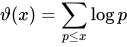
where denotes the natural logarithm, with the sum extending over all prime numbers p that are less than or equal to x.

The second Chebyshev function ψ (x) is defined similarly, with the sum extending over all prime powers not exceeding x

where Λ is the von Mangoldt function. The Chebyshev functions, especially the second one ψ (x), are often used in proofs related to prime numbers, because it is typically simpler to work with them than with the prime-counting function, π (x) (see the exact formula below.) Both Chebyshev functions are asymptotic to x, a statement equivalent to the prime number theorem.

Tchebycheff function, Chebyshev utility function, or weighted Tchebycheff scalarizing function is used when one has several functions to be minimized and one wants to "scalarize" them to a single function:

[1]

By minimizing this function for different values of , one obtains every point on a Pareto front, even in the nonconvex parts.[1] Often the functions to be minimized are not but for some scalars . Then [2]

All three functions are named in honour of Pafnuty Chebyshev.

Relationships

[edit]

The second Chebyshev function can be seen to be related to the first by writing it as
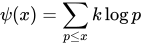
where k is the unique integer such that pkx and x < pk + 1. The values of k are given in OEISA206722. A more direct relationship is given by
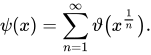
This last sum has only a finite number of non-vanishing terms, as

The second Chebyshev function is the logarithm of the least common multiple of the integers from 1 to n.

Values of lcm(1, 2, ..., n) for the integer variable n are given at OEISA003418.

Relationships between ψ(x)/x and ϑ(x)/x

[edit]

The following theorem relates the two quotients and .[3]

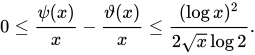
Theorem: For , we have

This inequality implies that
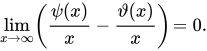
In other words, if one of the or tends to a limit then so does the other, and the two limits are equal.

Proof: Since , we find that
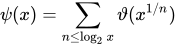
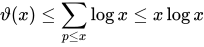
But from the definition of we have the trivial inequality

so
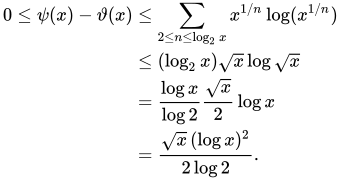
Lastly, divide by to obtain the inequality in the theorem.

Asymptotics and bounds

[edit]

The following bounds are known for the Chebyshev functions:[1][2] (in these formulas pk is the kth prime number; p1 = 2, p2 = 3, etc.)

Furthermore, under the Riemann hypothesis,
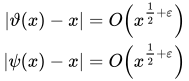
for any ε > 0.

Upper bounds exist for both ϑ  (x) and ψ (x) such that[4] [3]
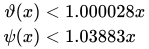
for any x > 0.

An explanation of the constant 1.03883 is given at OEISA206431.

The exact formula

[edit]

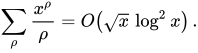
In 1895, Hans Carl Friedrich von Mangoldt proved[4] an explicit expression for ψ (x) as a sum over the nontrivial zeros of the Riemann zeta function:

(The numerical value of ζ(0)/ζ (0) is log(2π).) Here ρ runs over the nontrivial zeros of the zeta function, and ψ0 is the same as ψ, except that at its jump discontinuities (the prime powers) it takes the value halfway between the values to the left and the right:

From the Taylor series for the logarithm, the last term in the explicit formula can be understood as a summation of xω/ω over the trivial zeros of the zeta function, ω = −2, −4, −6, ..., i.e.
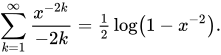
Similarly, the first term, x = x1/1, corresponds to the simple pole of the zeta function at 1. It being a pole rather than a zero accounts for the opposite sign of the term.

Properties

[edit]

A theorem due to Erhard Schmidt states that, for some explicit positive constant K, there are infinitely many natural numbers x such that

and infinitely many natural numbers x such that

[5][6]

In little-o notation, one may write the above as

Hardy and Littlewood[7] prove the stronger result, that

Relation to primorials

[edit]

The first Chebyshev function is the logarithm of the primorial of x, denoted x #:

This proves that the primorial x # is asymptotically equal to e(1  + o(1))x, where "o" is the little-o notation (see big O notation) and together with the prime number theorem establishes the asymptotic behavior of pn #.

Relation to the prime-counting function

[edit]

The Chebyshev function can be related to the prime-counting function as follows. Define
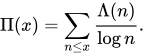
Then

The transition from Π to the prime-counting function, π, is made through the equation

Certainly π (x) ≤ x, so for the sake of approximation, this last relation can be recast in the form

The Riemann hypothesis

[edit]

The Riemann hypothesis states that all nontrivial zeros of the zeta function have real part 1/2. In this case, |xρ| = x, and it can be shown that

By the above, this implies

Smoothing function

[edit]
The difference of the smoothed Chebyshev function and x 2/2 for x < 106

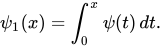
The smoothing function is defined as

Obviously

Notes

[edit]

References

[edit]
[edit]
Revisions and contributorsEdit on WikipediaRead on Wikipedia
from Grokipedia
In , the Chebyshev functions refer to two key summatory functions that aggregate logarithmic contributions from primes and their powers to study the distribution of prime numbers: the first Chebyshev function θ(x)=pxlogp\theta(x) = \sum_{p \leq x} \log p, where the sum is over all primes pp not exceeding xx, and the second Chebyshev function ψ(x)=nxΛ(n)\psi(x) = \sum_{n \leq x} \Lambda(n), where Λ(n)\Lambda(n) is the defined as logp\log p if n=pkn = p^k for some prime pp and positive integer k1k \geq 1, and $0$ otherwise. Named after the Russian mathematician , these functions were introduced in his seminal 1852 memoir Mémoire sur les nombres premiers, where he employed them to investigate the π(x)\pi(x). The Chebyshev functions are central to the (PNT), which asserts that the number of primes up to xx is asymptotically x/logxx / \log x; equivalently, the PNT holds if and only if ψ(x)x\psi(x) \sim x or θ(x)x\theta(x) \sim x as xx \to \infty. Using elementary methods, Chebyshev established explicit bounds such as 0.92129xlogx<π(x)<1.10555xlogx0.92129 \frac{x}{\log x} < \pi(x) < 1.10555 \frac{x}{\log x} for sufficiently large xx, derived via estimates on θ(x)\theta(x) and ψ(x)\psi(x) that showed their growth is sandwiched between constants times xx, providing the first rigorous evidence toward the PNT decades before its proof in 1896.

Definitions and Notation

First Chebyshev function

The first Chebyshev function, denoted θ(x)\theta(x), is defined as the sum of the natural logarithms of all prime numbers up to xx: θ(x)=pxlogp,\theta(x) = \sum_{p \leq x} \log p, where the sum runs over all primes pxp \leq x. This function provides a weighted measure of the primes below xx, with each prime contributing its logarithm to emphasize larger primes in the distribution. Introduced by Pafnuty Chebyshev in his 1852 memoir on prime numbers, θ(x)\theta(x) served as a key tool for investigating the distribution of primes and establishing bounds related to the prime-counting function π(x)\pi(x). Chebyshev employed θ(x)\theta(x) to derive inequalities that supported Bertrand's postulate and laid groundwork for understanding prime density, demonstrating that primes are sufficiently frequent without fully resolving the prime number theorem. Known specifically as the Chebyshev theta function in analytic number theory, it is distinct from other theta functions, such as those arising in elliptic functions or modular forms. For small values of xx, θ(x)\theta(x) can be computed directly from the list of primes. For instance, the primes less than or equal to 10 are 2, 3, 5, and 7, so θ(10)=log2+log3+log5+log70.693+1.099+1.609+1.946=5.347.\theta(10) = \log 2 + \log 3 + \log 5 + \log 7 \approx 0.693 + 1.099 + 1.609 + 1.946 = 5.347. This explicit summation highlights θ(x)\theta(x) as a cumulative logarithmic weight of primes. As a foundational construct, θ(x)\theta(x) establishes the weighted sum of logp\log p up to xx as a building block for assessing prime density, facilitating comparisons between the growth of primes and logarithmic scales in subsequent number-theoretic analyses.

Second Chebyshev function

The second Chebyshev function, denoted ψ(x)\psi(x), is defined for x0x \geq 0 as the sum ψ(x)=pkxlogp\psi(x) = \sum_{p^k \leq x} \log p, where the sum runs over all primes pp and positive integers k1k \geq 1 such that the prime power pkp^k does not exceed xx. Equivalently, ψ(x)\psi(x) can be written as the partial sum ψ(x)=nxΛ(n)\psi(x) = \sum_{n \leq x} \Lambda(n), with Λ(n)\Lambda(n) denoting the von Mangoldt function, which equals logp\log p if n=pkn = p^k for some prime pp and integer k1k \geq 1, and zero otherwise. This function generalizes the first Chebyshev function θ(x)\theta(x) by incorporating contributions from higher prime powers beyond just the primes themselves. Specifically, ψ(x)=n=1θ(x1/n),\psi(x) = \sum_{n=1}^{\infty} \theta\left(x^{1/n}\right), where the infinite series truncates after finitely many terms because θ(y)=0\theta(y) = 0 for y<2y < 2, so only terms with nlogx/log2n \leq \log x / \log 2 contribute. This relation highlights how ψ(x)\psi(x) aggregates the logarithmic weights across iterated roots of xx, providing a layered summation that captures the full structure of prime powers. Pafnuty Chebyshev introduced ψ(x)\psi(x) in his 1852 memoir Mémoire sur les nombres premiers, where he employed it to derive bounds on the distribution of primes and support on the existence of primes in short intervals. Subsequent refinements in the late 19th century, particularly in the works of and Charles-Jean de la Vallée Poussin, elevated ψ(x)\psi(x) to a central tool in by linking it to the non-vanishing of the on the line (s)=1\Re(s) = 1. For example, ψ(10)\psi(10) includes the terms for prime powers up to 10: log2\log 2 (from 2,4=22,8=232, 4=2^2, 8=2^3), log3\log 3 (from 3,9=323, 9=3^2), log5\log 5 (from 5), and log7\log 7 (from 7), yielding ψ(10)=3log2+2log3+log5+log7=log2520\psi(10) = 3\log 2 + 2\log 3 + \log 5 + \log 7 = \log 2520. The inclusion of higher prime powers in ψ(x)\psi(x) results in a smoother cumulative distribution compared to sums over primes alone, which facilitates its analysis through Dirichlet series, as the generating function n=1Λ(n)ns=ζ(s)/ζ(s)\sum_{n=1}^\infty \Lambda(n) n^{-s} = -\zeta'(s)/\zeta(s) connects ψ(x)\psi(x) directly to the logarithmic derivative of the Riemann zeta function. This property makes ψ(x)\psi(x) particularly valuable for broader applications in the study of arithmetic functions and prime distributions.

Basic Properties

Analytic properties

The first Chebyshev function θ(x)\theta(x) and the second Chebyshev function ψ(x)\psi(x) are both step functions that are piecewise constant on the positive real line, with discontinuities occurring exclusively at prime numbers for θ(x)\theta(x) and at prime powers for ψ(x)\psi(x). At each prime pp, θ(x)\theta(x) exhibits a jump discontinuity of size logp\log p, while ψ(x)\psi(x) jumps by logp\log p at every prime power pkp^k for k1k \geq 1. Since the jumps are positive (logp>0\log p > 0 for all primes pp), both θ(x)\theta(x) and ψ(x)\psi(x) are non-decreasing functions. Between discontinuity points, they remain constant, reflecting the absence of contributions in those intervals. This step-like structure uniquely encodes the locations and logarithmic weights of all s, allowing the functions to capture the arithmetic distribution of primes without redundancy—each jump corresponds precisely to a single contribution via the Λ(n)=logp\Lambda(n) = \log p if n=pkn = p^k and 0 otherwise, with ψ(x)=nxΛ(n)\psi(x) = \sum_{n \leq x} \Lambda(n). A fundamental integral representation for θ(x)\theta(x) is given by the Stieltjes integral form, but an explicit summation equivalent arises from changing the : 2xθ(t)tdt=pxlogplog(xp).\int_2^x \frac{\theta(t)}{t} \, dt = \sum_{p \leq x} \log p \cdot \log \left( \frac{x}{p} \right). This equality holds exactly and expresses the as a weighted sum over primes, where each term logplog(x/p)\log p \cdot \log(x/p) measures the contribution of prime pp scaled by the logarithmic of the interval from pp to xx; it relates directly to double-logarithmic growth patterns inherent in prime distributions, such as those appearing in , though without asymptotic evaluation here. In the , the Chebyshev functions connect to through the ζ(s)\zeta(s). For Re(s)>1\operatorname{Re}(s) > 1, the for the yields ζ(s)ζ(s)=n=1Λ(n)ns=pk=1logppks,-\frac{\zeta'(s)}{\zeta(s)} = \sum_{n=1}^\infty \frac{\Lambda(n)}{n^s} = \sum_p \sum_{k=1}^\infty \frac{\log p}{p^{ks}}, which encodes the prime power contributions logarithmically; this meromorphic continuation to the critical strip (with a simple pole at s=1s=1) provides the analytic foundation for studying ψ(x)\psi(x) and θ(x)\theta(x) via Perron's formula or explicit formulae, highlighting their role in the of primes.

Multiplicative properties

The Λ(n)\Lambda(n), which defines the second Chebyshev function via ψ(x)=nxΛ(n)\psi(x) = \sum_{n \leq x} \Lambda(n), exhibits arithmetic structure through its expression as a : logn=dnΛ(d)\log n = \sum_{d \mid n} \Lambda(d). By Möbius inversion, this yields Λ(n)=dnμ(d)log(n/d)\Lambda(n) = \sum_{d \mid n} \mu(d) \log(n/d), where μ\mu is the . For n=pkn = p^k a , the sum simplifies to logp\log p, confirming Λ(pk)=logp\Lambda(p^k) = \log p. This convolution relation underscores the role of multiplicativity in arithmetic functions, as both μ(n)\mu(n) and the constant function 1 are multiplicative, and the logarithm is completely additive, allowing decomposition of Λ(n)\Lambda(n) based on the prime of nn. Although Λ(n)\Lambda(n) itself is neither multiplicative nor additive, its Dirichlet series n=1Λ(n)ns=ζ(s)/ζ(s)\sum_{n=1}^\infty \Lambda(n) n^{-s} = -\zeta'(s)/\zeta(s) admits an Euler product p(1+k=1logppks)\prod_p \left( 1 + \sum_{k=1}^\infty \frac{\log p}{p^{ks}} \right), reflecting the multiplicative nature over primes inherent in the ζ(s)\zeta(s). This product form facilitates analysis of ψ(x)\psi(x) in terms of prime contributions and aids computations for composite arguments by leveraging sieve methods or recursive decompositions tied to the prime factors, such as expressing partial sums over contributions independently before aggregation. In the context of arithmetic progressions, the multiplicative properties extend to twisted variants ψ(x;χ)=nxΛ(n)χ(n)\psi(x; \chi) = \sum_{n \leq x} \Lambda(n) \chi(n), where χ\chi is a Dirichlet character modulo qq. The Dirichlet series for this twist is n=1Λ(n)χ(n)ns=L(s,χ)/L(s,χ)\sum_{n=1}^\infty \Lambda(n) \chi(n) n^{-s} = -L'(s, \chi)/L(s, \chi), with L(s,χ)=p(1χ(p)ps)1L(s, \chi) = \prod_p (1 - \chi(p) p^{-s})^{-1} possessing an Euler product that encodes the multiplicative action of χ\chi on primes. For example, when χ\chi is the principal character, ψ(x;χ)=ψ(x)\psi(x; \chi) = \psi(x); nontrivial characters allow decomposition of sums in residue classes via orthogonality: nx,na(modq)Λ(n)=1ϕ(q)χmodqχ(a)ψ(x;χ)\sum_{n \leq x, n \equiv a \pmod{q}} \Lambda(n) = \frac{1}{\phi(q)} \sum_{\chi \bmod q} \overline{\chi}(a) \psi(x; \chi), enabling multiplicative separation of the progression's behavior across characters. This structure is pivotal for studying prime distributions modulo qq without delving into individual residue details.

Interrelations

Relation between the two functions

The second Chebyshev function ψ(x)\psi(x) is expressed in terms of the first Chebyshev function θ(x)\theta(x) via the summation formula ψ(x)=k=1θ(x1/k),\psi(x) = \sum_{k=1}^\infty \theta\left(x^{1/k}\right), where the infinite series truncates naturally at klogx/log2k \approx \log x / \log 2, since θ(y)=0\theta(y) = 0 for y<2y < 2. This relation arises from the definitions: θ(x)\theta(x) sums logp\log p over primes pxp \leq x, while ψ(x)\psi(x) extends this to all prime powers pmxp^m \leq x with multiplicity mm, grouping terms by the exponent k=mk = m. The difference between the functions follows directly as ψ(x)θ(x)=k=2θ(x1/k),\psi(x) - \theta(x) = \sum_{k=2}^\infty \theta\left(x^{1/k}\right), with the tail bounded by ψ(x)θ(x)=O(xlogx)\psi(x) - \theta(x) = O(\sqrt{x} \log x)
Add your contribution
Related Hubs
Contribute something
User Avatar
No comments yet.