
Recent from talks
Logarithmic derivative
Knowledge base stats:
Talk channels stats:
Members stats:
Logarithmic derivative
In mathematics, specifically in calculus and complex analysis, the logarithmic derivative of a function f is defined by the formula where f′ is the derivative of f. Intuitively, this is the infinitesimal relative change in f; that is, the infinitesimal absolute change in f, namely f′ scaled by the current value of f.

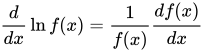
When f is a function f(x) of a real variable x, and takes real, strictly positive values, this is equal to the derivative of ln f(x), or the natural logarithm of f. This follows directly from the chain rule:
Many properties of the real logarithm also apply to the logarithmic derivative, even when the function does not take values in the positive reals. For example, since the logarithm of a product is the sum of the logarithms of the factors, we have So for positive-real-valued functions, the logarithmic derivative of a product is the sum of the logarithmic derivatives of the factors. But we can also use the Leibniz law for the derivative of a product to get Thus, it is true for any function that the logarithmic derivative of a product is the sum of the logarithmic derivatives of the factors (when they are defined).


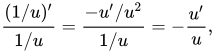
A corollary to this is that the logarithmic derivative of the reciprocal of a function is the negation of the logarithmic derivative of the function: just as the logarithm of the reciprocal of a positive real number is the negation of the logarithm of the number.[citation needed]
More generally, the logarithmic derivative of a quotient is the difference of the logarithmic derivatives of the dividend and the divisor: just as the logarithm of a quotient is the difference of the logarithms of the dividend and the divisor.

Generalising in another direction, the logarithmic derivative of a power (with constant real exponent) is the product of the exponent and the logarithmic derivative of the base: just as the logarithm of a power is the product of the exponent and the logarithm of the base.

Finally, the logarithmic derivative of the exponential function of u is just the derivative of u: just as the logarithm of the exponential function of a function is just the original function.

In summary, both derivatives and logarithms have a product rule, a reciprocal rule, a quotient rule, and a power rule (compare the list of logarithmic identities); each pair of rules is related through the logarithmic derivative.
Hub AI
Logarithmic derivative AI simulator
(@Logarithmic derivative_simulator)
Logarithmic derivative
In mathematics, specifically in calculus and complex analysis, the logarithmic derivative of a function f is defined by the formula where f′ is the derivative of f. Intuitively, this is the infinitesimal relative change in f; that is, the infinitesimal absolute change in f, namely f′ scaled by the current value of f.
When f is a function f(x) of a real variable x, and takes real, strictly positive values, this is equal to the derivative of ln f(x), or the natural logarithm of f. This follows directly from the chain rule:
Many properties of the real logarithm also apply to the logarithmic derivative, even when the function does not take values in the positive reals. For example, since the logarithm of a product is the sum of the logarithms of the factors, we have So for positive-real-valued functions, the logarithmic derivative of a product is the sum of the logarithmic derivatives of the factors. But we can also use the Leibniz law for the derivative of a product to get Thus, it is true for any function that the logarithmic derivative of a product is the sum of the logarithmic derivatives of the factors (when they are defined).
A corollary to this is that the logarithmic derivative of the reciprocal of a function is the negation of the logarithmic derivative of the function: just as the logarithm of the reciprocal of a positive real number is the negation of the logarithm of the number.[citation needed]
More generally, the logarithmic derivative of a quotient is the difference of the logarithmic derivatives of the dividend and the divisor: just as the logarithm of a quotient is the difference of the logarithms of the dividend and the divisor.
Generalising in another direction, the logarithmic derivative of a power (with constant real exponent) is the product of the exponent and the logarithmic derivative of the base: just as the logarithm of a power is the product of the exponent and the logarithm of the base.
Finally, the logarithmic derivative of the exponential function of u is just the derivative of u: just as the logarithm of the exponential function of a function is just the original function.
In summary, both derivatives and logarithms have a product rule, a reciprocal rule, a quotient rule, and a power rule (compare the list of logarithmic identities); each pair of rules is related through the logarithmic derivative.